Gaza’s Damaged Buildings Face Growing Risk of Collapse as Winter Approaches

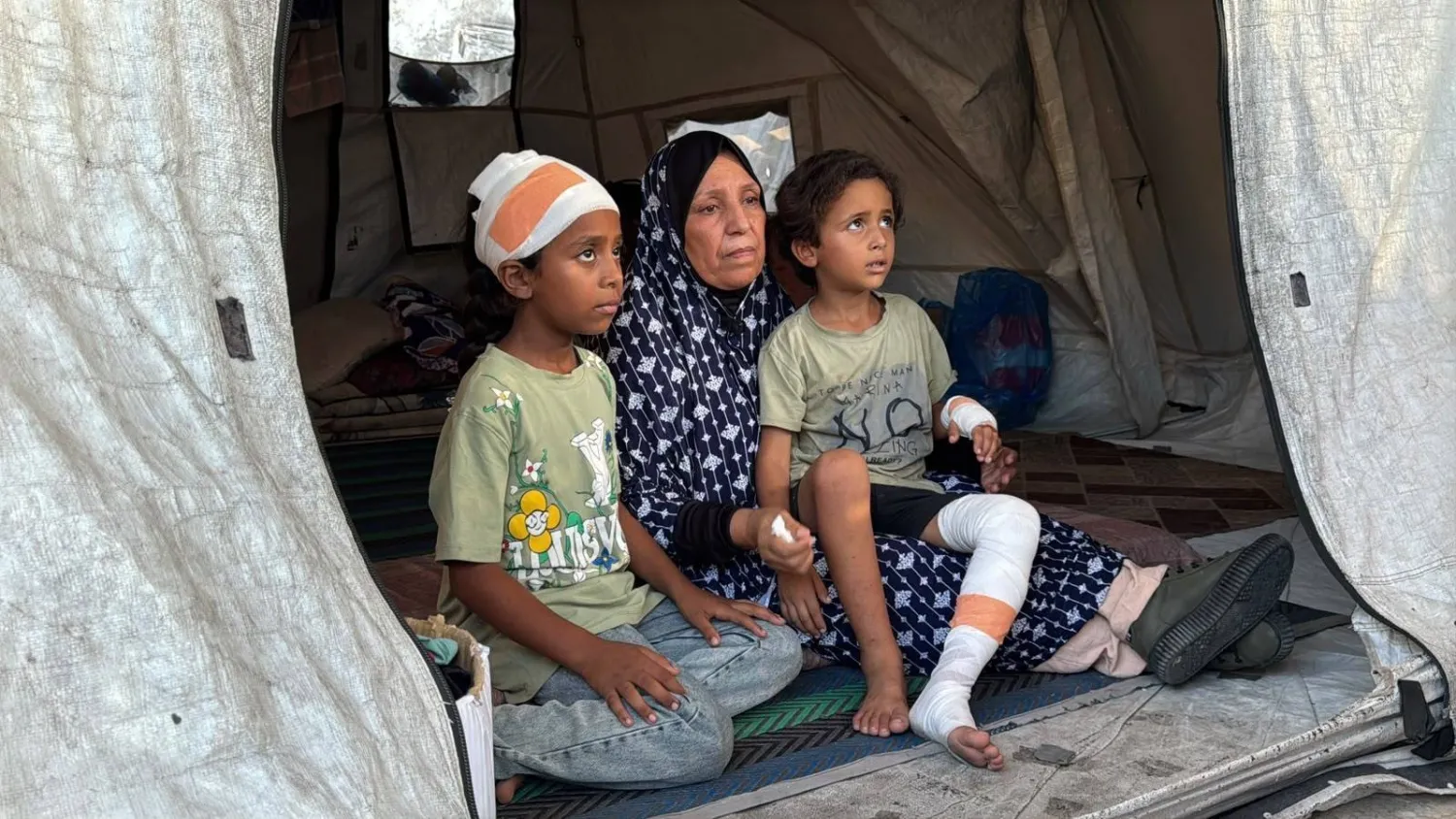
Palestinian Umm Iyad Azzam sits with her two grandchildren who survived the collapse of the Al-Saada building in Gaza (Asharq Al-Awsat) 
TT

Gaza’s Damaged Buildings Face Growing Risk of Collapse as Winter Approaches

Palestinian Umm Iyad Azzam sits with her two grandchildren who survived the collapse of the Al-Saada building in Gaza (Asharq Al-Awsat) 

When 69-year-old Umm Iyad Azzam heard that the Al-Saada building in the Al-Sinaa area of southwest Gaza City had collapsed, she rushed from the tent where she was staying, about 400 meters away, searching for her daughter-in-law and grandchildren.

There, she learned that her daughter-in-law, Islam, and grandson Rizq had been killed. Residents and Civil Defense crews managed to rescue two other grandchildren, along with dozens of people trapped beneath the rubble.

Reeling from her loss, Azzam then hurried to Al-Shifa Medical Complex, itself heavily damaged by the Israeli war, to bid farewell to those who had died and check on those who survived.

Her relatives were among dozens of casualties in the collapse of the six-story Al-Saada building about a week ago. The building had been damaged during the Israeli war after being struck in earlier raids and a series of heavy bombardments at the start of the conflict in October 2023.

Gaza officials estimate that around 2,000 inhabited buildings across the territory are at risk of collapse.

Recalling the first moments after the disaster, Azzam told Asharq Al-Awsat that her eldest son, Iyad, was away from his family when he received a call about the collapse. He immediately headed there without alarming her. A short time later, another daughter-in-law told Azzam that the building housing Iyad’s family had fallen on its occupants.

“There is no safety in Gaza. No one can feel secure about their life,” Azzam said. “Danger threatens everyone, wherever they are, in a tent, a house or a building at risk of collapse.”

“Every home is in mourning, and if it isn’t today, it will be tomorrow,” she added. “We’ve had enough suffering and massacres. We want a solution.”

Twenty-one Palestinians were killed in the Al-Saada building collapse, while 45 others were injured and rescued. About 35 escaped after leaving the building before it fell.

Dozens of tents housing displaced people surround the site, alongside another damaged residential building at risk of collapse, fueling fears that the disaster could be repeated.

Mahmoud Basal, spokesman for Gaza’s Civil Defense, warned that structurally unsafe buildings posed a major threat across the territory. More than 2,000 were at risk of collapse and all were inhabited by civilians, he told Asharq Al-Awsat. Even the least crowded building houses around 10 people, while some accommodate more than 100.

Nowhere else to go

Aref Fura, 57, a displaced resident of the same area who himself lives in a damaged building, explained that those sheltering in Al-Saada had lost their homes, property, savings and livelihoods during the war.

With nowhere else to go, they remained there until the last moment despite signs that the building might collapse.

Their response, Fura recalled, was always the same: “Where will we go? Where can we go? There is nowhere else.”

More than two million Palestinians were now crowded into around 70 square kilometers after Israel occupied about 70 percent of the Gaza Strip, Fura said, arguing that this had pushed residents into thousands of buildings at risk of collapse.

Displaced from Gaza City’s Shujaiya neighborhood, he witnessed the first moments of the Al-Saada disaster.

“We held our breath after the building buried its residents beneath the rubble, without being able to do anything,” he recalled.

Now the approaching winter is deepening fears among those living in Gaza’s damaged buildings, with rainfall expected to heighten the risk of further collapses.

“People have no real options for dealing with the current reality, especially with winter approaching and the genuine threat it poses to those in buildings at risk of collapse and even those living in tents,” Fura warned.

“I personally live in a dangerous building. All of Gaza is living under a similar threat, and even those in tents are living beside buildings at risk of collapse, so their lives are in danger too.”

He appealed to the world to find solutions for Gaza’s residents, who he said faced a genuine threat. “All they want is to live safely, nothing more.”

‘We are forced to sleep on chairs’

For Bassam Naseer, 48, displaced from Beit Hanoun, danger is part of daily life.

Naseer described living in humiliating and difficult conditions, fearing that the roof sheltering his family could collapse. He shares a small room and an empty, damaged storefront near the site of the Al-Saada rubble with his family of eight. His son-in-law and his six-member family live with them.

The structure could collapse at any moment, Naseer told Asharq Al-Awsat, but the only alternatives were a tent or the street.

“No one knows who will live and who will die, because every winter this place floods, and we are forced to sleep on chairs,” he said.

He noted that several airstrikes, as well as the collapse of Al-Saada about 150 meters away, had worsened cracks and structural damage in the roof of the storefront.

“We can’t live like this. There are no solutions or options, and no one tells us we can live with dignity, because dignity is gone,” Naseer said. “Things are extremely difficult for us. There are no tarpaulins, tents or caravans. We cover ourselves with scraps of worn fabric.”

For Naseer and hundreds of thousands of other displaced people, the hardship extends beyond winter and unsafe shelter.

Rodents force him to stay awake at night to keep them away from his children, while mosquitoes and other insects leave him and his wife struggling to sleep as they try to protect their family.

“This is not a life,” he said. “Let the officials come and see how we live.”

Winter brings greater danger

Gaza’s Civil Defense has warned of the risk of further collapses.

In the 24 hours from Saturday afternoon to Sunday afternoon following the Al-Saada disaster, crews responded to several incidents involving homes previously hit by Israeli strikes and classified as uninhabitable but occupied by displaced residents because no alternative housing was available.

Several families were rescued after partial collapses in buildings and homes across Gaza City, including in the Zeitoun and Sheikh Radwan neighborhoods.

Civil Defense prevention and safety teams also inspected several cracked homes and told residents of four to evacuate and move to safer accommodation.

Basal explained that Civil Defense repeatedly urges residents to leave unstable buildings, only to receive the same response: “What is the alternative?”

He argued that addressing the problem was the responsibility of the international community, calling for intervention to evacuate residents and provide safe alternatives.

“Tents are not fit to live in, either in summer or winter,” Basal warned. “We are already living through difficult conditions, and now winter is approaching. It has become the nightmare and the great danger facing Gaza’s residents — those living in buildings at risk of collapse, those in tents and those living anywhere in Gaza.”

“The lives of all Gaza’s residents are threatened by the coming winter,” he added, urging the international community and international organizations to intervene immediately to protect civilians and provide a safe environment.

Such intervention, he continued, would allow residents to move from dangerous areas to safer ones and “provide them with a dignified life instead of the danger that accompanies them all the time.”


Jordan, Iraq Stress Importance of Implementing Basra-Aqaba Oil Pipeline Project

A view of the Shuaiba oil refinery southwest of Basra, Iraq (Reuters)
TT

Jordan, Iraq Stress Importance of Implementing Basra-Aqaba Oil Pipeline Project

A view of the Shuaiba oil refinery southwest of Basra, Iraq (Reuters)

Jordan’s King Abdullah II and Iraqi President Nizar Amidi have stressed the need to proceed with implementation of the Basra-Aqaba oil pipeline project, in service of the two countries and their peoples.

The king received a phone call from Amidi on Monday, during which they discussed the deep-rooted ties between Jordan and Iraq, as well as ways to enhance cooperation across various sectors.

The pipeline project, which has been stalled for years, would allow oil to be transported from Basra, on the Arabian Gulf coast, to the port of Aqaba in southern Jordan, bypassing the export route through the Strait of Hormuz.

Iraqi Parliament Speaker Haibat al-Halbousi described the project during a visit to Amman on June 7 as a “strategic option” for Iraq amid restrictions on oil exports through the strait.

The two countries signed a framework agreement in April 2012 to build a 1,700-kilometer pipeline with a capacity to transport one million barrels of oil per day. However, the project, whose cost is estimated at around $18 billion, has yet to be implemented.

The pipeline is expected to provide Jordan with about 150,000 barrels of crude oil per day. The project also includes the construction of storage facilities with a capacity of seven million barrels, as well as an oil export terminal.

Iraq has lost around $60 billion during the Middle East war, Foreign Minister Fuad Hussein said last week.

Iraq was producing about four million barrels of oil per day before the conflict, exporting about 3.5 million bpd -- mostly shipped from the country's south via the strait.

Iraq's foreign currency reserves have shrunk by 20 billion dollars and consumer prices have risen sharply.


West Bank on Verge of ‘Explosion’, Says Senior Palestinian Official

Israeli soldiers take positions during an army raid in the Rafidia area of Nablus, West Bank, 19 October 2026. (EPA)
TT

West Bank on Verge of ‘Explosion’, Says Senior Palestinian Official

Israeli soldiers take positions during an army raid in the Rafidia area of Nablus, West Bank, 19 October 2026. (EPA)

Israeli settler attacks risk setting off an "explosion" in the occupied West Bank, a senior Palestinian leader told AFP, while urging that the response remain peaceful.

Jibril Rajoub, the secretary general of the central committee of the Palestinian Authority's ruling Fatah faction, said he called for "peaceful confrontation" as he took part in meetings in Cairo with other Palestinian movements including Gaza-based rival Hamas, which led the October 7, 2023 attacks against Israel.

"The terrorism carried out by the army and settlers, under the supervision of the Israeli government... is a prelude to a coming reaction and explosion," Rajoub told AFP in Cairo.

But he said that a "peaceful, nonviolent struggle is a necessity and a strategic choice for all Palestinians".

"Bloodshed is no longer an acceptable option," he said, calling for "peaceful confrontation with the occupation, despite the crimes it commits".

Settlers have carried out daily physical attacks, thefts and other attacks against Palestinians, with the violence intensifying in the run-up to October 27 elections, in which Prime Minister Benjamin Netanyahu, governing with the fiercely pro-settlement far-right, is seeking a new mandate.

Violence has picked up as extremist settlers seek to stop the Palestinian olive harvest, an annual season with cultural resonance for the community.

More than 500,000 Israelis live in West Bank settlements, which are considered illegal under international law, surrounded by around three million Palestinians.

The talks in Cairo came after Palestinian leader Mahmoud Abbas, who has ruled since 2005, delayed elections slated to start next month until September 2027.

Rajoub said the talks called for "unified political representation" with the principle of a "single authority" and "only one legitimate armed force".

Hamas took over Gaza in 2007, dividing the two Palestinian territories. Israel has vowed to obliterate Hamas after the October 7, 2023 attack, the deadliest day in Israel's history. The Hamas attack resulted in 1,221 deaths.

At least 1,125 Palestinians have died in the West Bank since October 2023, mostly by the Israeli military, according to an AFP tally based on Palestinian health ministry figures.

Settler attacks have killed 23 Palestinians in that timeframe, according to the United Nations.

Palestinian attacks have killed at least 49 Israelis in the same period, according to Israeli figures.

In Gaza, the Israeli offensive has killed 74,459 Palestinians since October 2023, according to figures under the health ministry run under Hamas. The United Nations generally considers the figures reliable.


Israel to Resume Commercial Shipments to Gaza After Hamas Fee Dispute

Tents are pictured by the rubble of collapsed buildings in the Jabalia camp for Palestinian refugees in the northern Gaza Strip on October 19, 2026. (AFP)
TT

Israel to Resume Commercial Shipments to Gaza After Hamas Fee Dispute

Tents are pictured by the rubble of collapsed buildings in the Jabalia camp for Palestinian refugees in the northern Gaza Strip on October 19, 2026. (AFP)

Israel said on ‌Monday it would resume allowing commercial goods shipments into Gaza after a days-long halt over a tax dispute involving Hamas and merchants, restoring a key route for food and other essentials to the aid-dependent enclave.

COGAT, the Israeli military agency overseeing humanitarian affairs in Gaza, said it made the decision after merchants reported that Hamas authorities had withdrawn demands for payments of 10,000 shekels ($3,225) per truck.

"The resumption of coordination is being carried ‌out in accordance ‌with Israel's commitment to the ‌humanitarian provisions ⁠of the ceasefire agreement," ⁠it said.

COGAT said the merchants' accounts had not been independently verified and shipments would resume gradually, with priority given to essential goods ahead of winter.

Oversight would be tightened to ensure payments are made and received only through documented bank transfers, with any merchant ⁠found to have paid Hamas facing ‌exclusion from the system.

Hamas said ‌the 10,000-shekel fee was a voluntary contribution by better-off Gazans ‌to a national fund supporting people in need in ‌the war-ravaged territory.

Most Gazans remain dependent on aid after three years of war, repeated displacement and severe restrictions on aid deliveries. While last year's US-brokered ceasefire halted the heaviest ‌fighting, it has not ended Israeli attacks.

Local health officials said on Monday ⁠that at ⁠least five Palestinians, including a 14-year-old boy, were killed in separate Israeli strikes in Gaza City and Khan Younis. The Israeli military did not immediately comment.

Israel says Hamas has continued to rearm and carry out attacks in violation of the ceasefire, while Hamas accuses Israel of undermining the agreement.

Gaza health officials say about 1,500 Palestinians have been killed by Israeli fire since the October 2025 ceasefire, while Israel says four of its soldiers have been killed by fighters in Gaza over the same period.