


Iran Airlines Cancel Flights as US Sanctions Hit

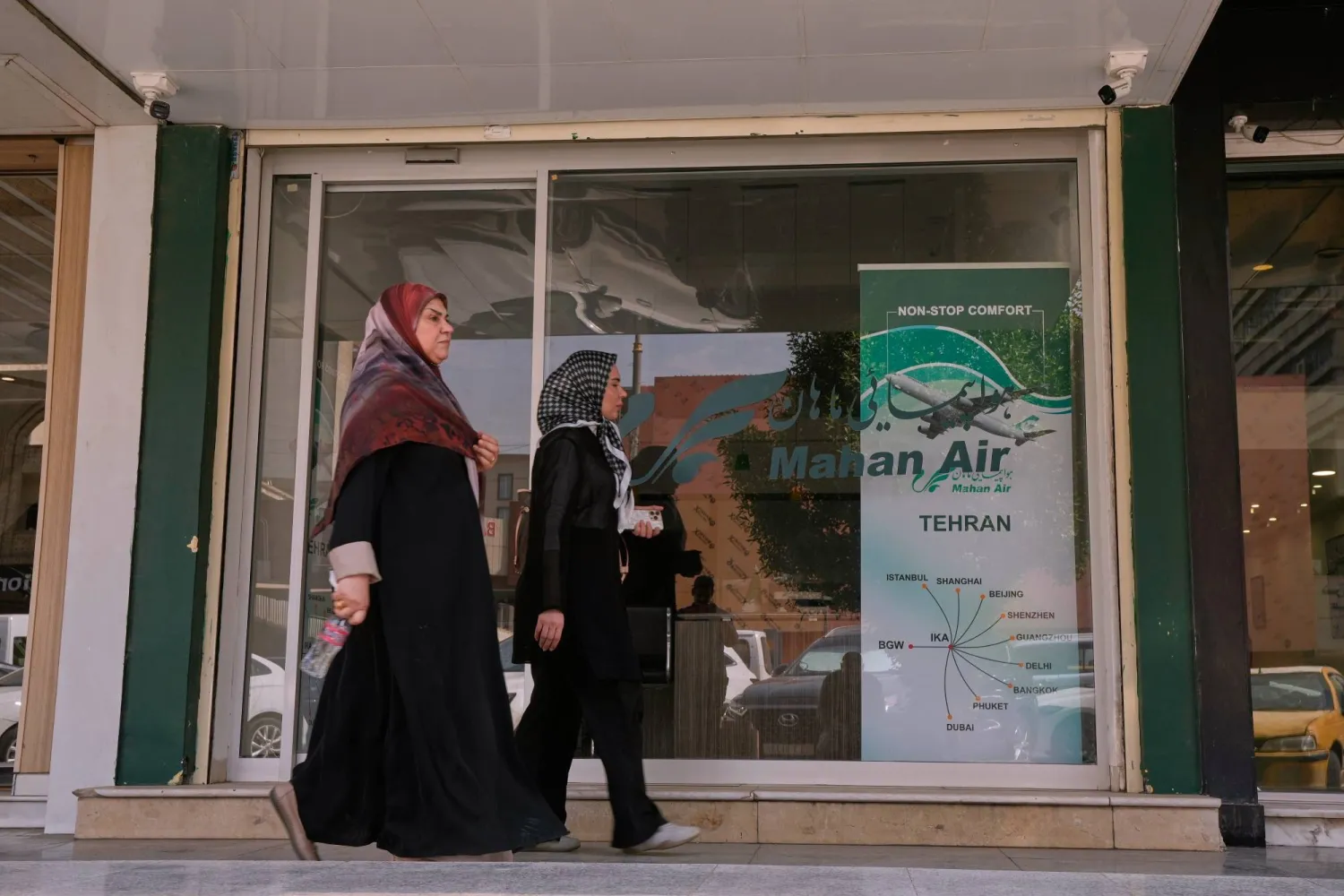
Pedestrians walk past an office of Iranian airline Mahan Air in Baghdad, Iraq, Wednesday, Sept. 23, 2026. (AP Photo/Hadi Mizban)
TT

Iran Airlines Cancel Flights as US Sanctions Hit

Pedestrians walk past an office of Iranian airline Mahan Air in Baghdad, Iraq, Wednesday, Sept. 23, 2026. (AP Photo/Hadi Mizban)

Iranian airlines were forced to cancel some international flights on Wednesday after the US tightened sanctions on Iran's aviation industry in a new effort to cripple its economy.

A travel agent in Tehran told AFP that flights to Baghdad, Muscat, Qatar, Georgia and Azerbaijan had all been suspended, but routes to multiple other destinations remained available, including China.

US Treasury Secretary Scott Bessent announced the new measures on Monday as part of an earlier threat to impose "economic D-Day" on Iran, an attempt to force it into submission following their nearly seven-month war.

But Iran's aviation sector has already been a target of sanctions for years, and it remains unclear what the full impact will be and whether other countries will comply.

Even after the new sanctions took effect on Wednesday, a flight from Tehran operated by Mahan Air, one of Iran's biggest carriers, landed in Guangzhou in China, according to tracking data from FlightRadar24.

China on Tuesday said it opposes the US sanctions and called them illegal. A flight to Shanghai was also due to depart on Wednesday, according to Tehran's international airport.

Some flights to Istanbul were also scheduled, though others had been cancelled, the travel agent in Tehran told AFP.

"The situation is unstable and we are no longer selling tickets for the time being for fear of cancellations," the the agent said, requesting anonymity.

A Mahan flight from Kabul was also expected to arrive in Tehran around midday. According to the website for Tehran's international airport, other connections to Türkiye and Armenia also remained possible using smaller Iranian airlines, including Varesh.

Flights to Najaf in Iraq and Dubai in the United Arab Emirates were also scheduled.

Bessent on Monday vowed to "shut down" Iranian carriers and punish anyone doing business with them.

"If they land, you cannot provide them with fuel, you cannot provide them with landing services, you cannot sell them tickets or you will be knocked out of the dollar system," he warned other countries.

The restrictions will further complicate the ability of Iranians to travel abroad or return to their country.

Iranian media also reported cancellations, with the Tasnim news agency on Tuesday citing a civil aviation spokesman as saying that Baghdad and Muscat airports "will no longer accept" Iranian flights.

"Other international flights, including Istanbul, will operate as scheduled and as usual, and at present there are no problems with these flights," Tasnim said.

According to Tasnim, Iran's aviation authorities are in talks to reroute Baghdad flights to Najaf, a major destination for Iranian pilgrims.

In Iraq, while the government has not publicly announced plans to enforce the ban, several sources including a senior government official told AFP that Baghdad would comply with the US measures.



Pope Leo Has Cancerous Growth Removed in Lung Operation

Pope Leo arrives at Gemelli Hospital ahead of the pontiff's surgery to remove a lung nodule, in Rome, Italy, October 13, 2026. (Vatican Media/­Simone Risoluti/Handout via Reuters)
TT

Pope Leo Has Cancerous Growth Removed in Lung Operation

Pope Leo arrives at Gemelli Hospital ahead of the pontiff's surgery to remove a lung nodule, in Rome, Italy, October 13, 2026. (Vatican Media/­Simone Risoluti/Handout via Reuters)

Pope Leo XIV had a cancerous growth removed from his right lung in a 90-minute operation on Tuesday and "woke up normally" after the procedure, the Vatican said.

A Vatican source said further tests were being carried out to determine if the cancer had spread.

"To ensure the procedure was radical, the lower lobe of the right lung was removed," the Vatican said in a statement.

The operation "confirmed the diagnosis of a pulmonary adenocarcinoma, as suspected from the pre-operative tests", it said.

The pope was in the operating room for a total of three hours and the operation lasted half that time.

"The surgery was successful and there were no complications," the Vatican said.

A Vatican source said he requested dinner after the procedure.

Leo had entered the hospital smiling and waving earlier on Tuesday hours before the surgery.

The Vatican has said it expects the pope to stay in his room on the 10th floor of Rome's Gemelli hospital to recover for several days.

His audiences have been cancelled until October 20 and the operation raises questions about whether the pope will go on a lengthy visit to Latin America next month.

- 'I will pray a lot' -

The surgery marks the 71-year-old Leo's first hospitalization since he became head of the Catholic Church on May 8, 2025.

In a surprise announcement following Angelus prayers on Sunday, Leo told crowds in St Peter's Square that doctors had discovered a nodule "at a very early stage" during medical checks.

"The doctors believe it would be right to intervene," he said.

The Vatican has historically been very secretive about the health of popes, but began to be more transparent during the illness of Leo's predecessor Francis, an Argentine who freely discussed his ailments.

Ahead of the operation, people outside the hospital expressed concern over the pope's condition.

Giorgia Fei, a 57-year-old Italian, said she had been worried.

"However, he is in very good hands here at the hospital because we have some outstanding doctors," she said.

"I will pray a lot for him."

Giuseppe Purpura, 72, said he too was concerned.

"He's still quite young and I really wasn't expecting this. I thought he was in better health," he said, noting that "thankfully it was caught in time."

The Vicar General for the Diocese of Rome, Cardinal Baldassare Reina, led a rosary prayer for the pope inside the hospital chapel which was broadcast by the Vatican. Dozens of people attended and Reina asked all the city's parishes to join in.

The Vatican secretary of state, Cardinal Pietro Parolin, told ANSA news agency that Leo had been "very calm" about his condition when they met on Monday.

The Vatican told AFP the nodule was found during routine health checks, and there were no symptoms that led to checking the pope's lungs.

Chicago-born Leo, the first US pope, is sporty and believed to generally be in good health.

He is scheduled to travel to South America from November 6-17 to visit Uruguay, Argentina and Peru.

It was not immediately clear what would happen if the pope was forced into a longer recovery.

Under Church law, a figure known as the Cardinal Camerlengo -- or chamberlain -- takes over administrative duties if the pope dies, but pontiffs do not have a deputy to replace them if they become incapacitated.


Trump Says Yemen's Houthis are 'Behaving Very Badly'

President Donald Trump talks to reporters before boarding Marine One on the South Lawn of the White House, Tuesday, Oct. 13, 2026, in Washington. (AP Photo/Manuel Balce Ceneta)
TT

Trump Says Yemen's Houthis are 'Behaving Very Badly'

President Donald Trump talks to reporters before boarding Marine One on the South Lawn of the White House, Tuesday, Oct. 13, 2026, in Washington. (AP Photo/Manuel Balce Ceneta)

US President Donald Trump on Tuesday said that the Houthi militants were "behaving very badly."

This came as the group has recently escalated attacks on commercial shipping in the Red Sea and the vital Bab al-Mandab Strait.

The Houthis also launched attacks on Riyadh's King Khalid International Airport in recent days, killing 13 people, wounding more than 300.

Trump told reporters that he "might" ask Turkish President Tayyip Erdogan to intervene and support Saudi interests.

"President Erdogan, I think, would do as I ask," Trump said.

Meanwhile, in a development reflecting the widening scope of military strikes against resources relied upon by the Houthi group, the Coalition to Support Legitimacy in Yemen carried out several airstrikes Tuesday on the Al-Sabaha Central Fuel Storage Station, west of the Yemeni capital, Sanaa, in an effort to disrupt a key Houthi fuel supply line that supports the group's military operations.


MI5 Chief Says Iran is Targeting Military Sites and Suspected Plot at RAF Fairford is 'Not Unique’

Director General of MI5 Ken McCallum speaks at Thames House, the headquarters of the UK's Security Service in London, Tuesday Oct. 13, 2026. (Jonathan Brady/PA via AP, Pool)
TT

MI5 Chief Says Iran is Targeting Military Sites and Suspected Plot at RAF Fairford is 'Not Unique’

Director General of MI5 Ken McCallum speaks at Thames House, the headquarters of the UK's Security Service in London, Tuesday Oct. 13, 2026. (Jonathan Brady/PA via AP, Pool)

Iran is trying to hit military sites in the UK and the suspected plot to attack a US-run military air base in September is “not unique," the head of Britain's MI5 spy agency said Tuesday.

Ken McCallum, who leads the UK’s domestic security service, said Tehran is seeking to intensify its attacks in Britain beyond the traditional targets of Iranians opposed to the country's Islamic authorities.

That has included arson and sabotage attacks on Jewish sites that Britain says were carried out by Iranian proxies.

McCallum said another “major shift this year has been Iranian ambitions to come at harder targets, like military sites.”

The incident at RAF Fairford “is not unique. There have been other examples, not just in the UK but around the world,” McCallum said.

McCallum delivered a speech outlining major threats to the UK as detectives investigate a suspected terror plot against the US-run base in western England, which has been used to bomb Iran during this year’s war.

Scores of residents were evacuated from their homes near the base on Sept. 27 as armed police officers and army bomb-disposal experts swarmed the rural area. Police later said they had found a quantity of an accelerant — gasoline — in three vans at the site, but no explosives, The AP news reported.

British authorities have linked Tehran to the incident, which led the US to pull its bombers from RAF Fairford. Prime Minister Andy Burnham said Monday that the apparent plot was “almost certainly” directed by Iran’s Revolutionary Guard.

Seven men in their 20s have been arrested and released on bail under investigation.

Iran has denied involvement, although it has previously said that it considers any base used to attack its territory a legitimate target.

MI5 says AI could bring bioweapon risk In a stark speech, McCallum argued that the UK faces a “new era of national security” and is at a turning point equivalent to the 9/11 attacks a quarter century ago.

He said his agency’s work countering state threats – chiefly from Russia, Iran and China – has quadrupled in the past decade, and claimed that both Russia and Iran are expanding their hybrid warfare campaigns against the UK.

Meanwhile, technology is racing ahead, with artificial intelligence “supercharging” the cybersecurity battle between attackers and defenders, he said.

McCallum said terror plotters have used artificial intelligence for reconnaissance and attacks, including AI-enabled drones. Even more concerning, he said, is “AI’s potential to change the stakes on existing or even new bioweapons.”

He said terror groups “would dearly love” to have chemical, biological or radiological weapons, but these are hard to obtain.

“One risk is that AI could enable dangerous knowledge to get into the hands of people we would all rather didn’t have that knowledge,” he said. “A second and different risk ... is the possibility that AI could generate novel pathogens not previously seen.”

McCallum said MI5 has set up a new AI Threat Assessment Center to try to keep ahead of the risks.

“Human history has given us no experience of facing an actor which is smarter than we are. It is capable of outthinking us. This is genuinely novel, and deserves the serious attention it is getting, including in MI5,” he said.