


Centuries-old Japanese Art of Ikebana Draws Those Seeking Calm

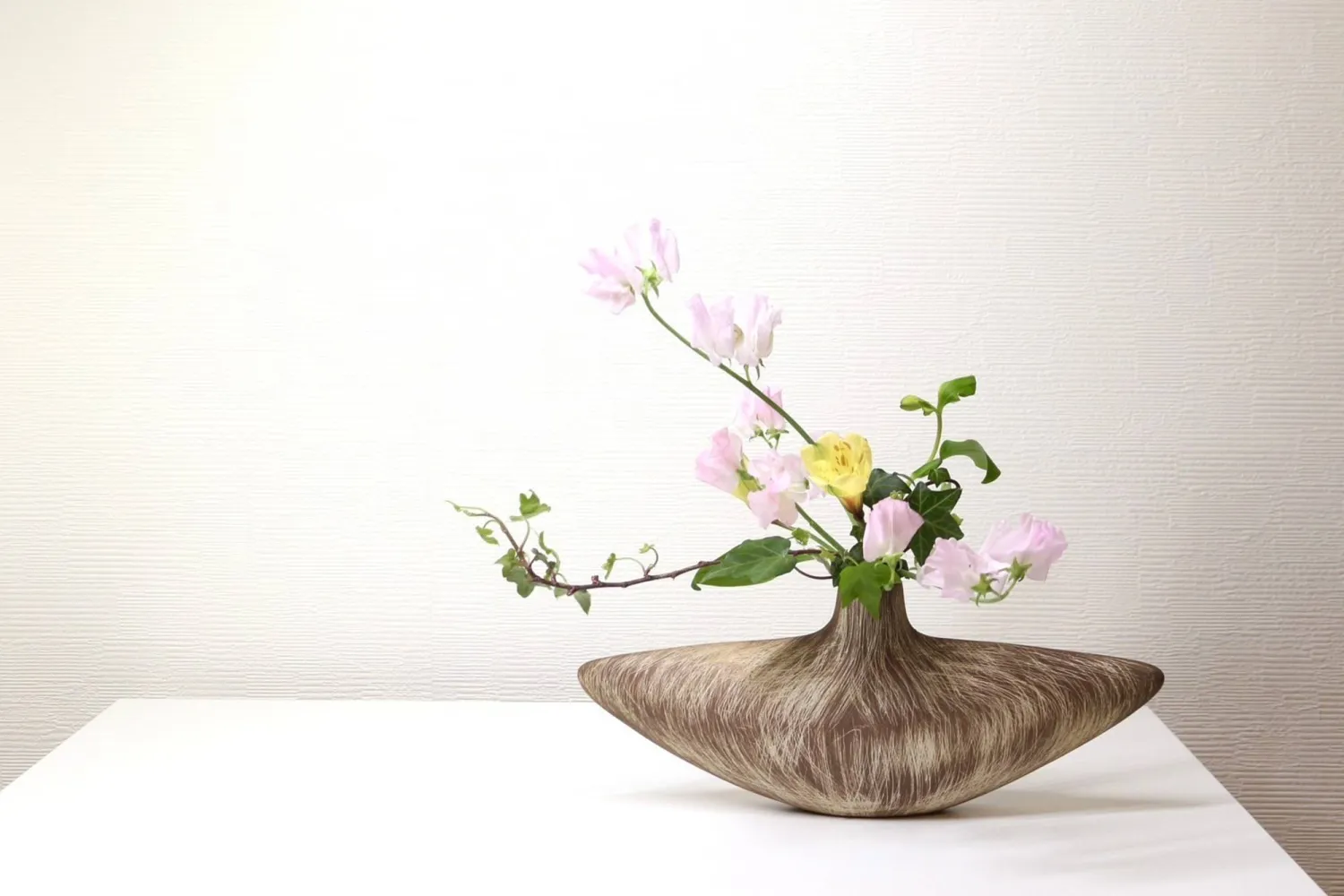
This photo released by Hiroyuki Okada shows a free-style Ikenobo ikebana arrangement in Tokyo on March 11, 2026. (Hiroyuki Okada via AP)
TT

Centuries-old Japanese Art of Ikebana Draws Those Seeking Calm

This photo released by Hiroyuki Okada shows a free-style Ikenobo ikebana arrangement in Tokyo on March 11, 2026. (Hiroyuki Okada via AP)

Ikebana, the Japanese art of arranging flowers, is a form of expression that dates back more than 500 years. It continues to blossom, quietly, not only with traditionalists but also with newcomers who find its blend of creativity and mindfulness to be restorative.

Ikebana can be a bit like solving a puzzle, except there’s no fixed answer. Because each flower, and human individual, is different, there are multiple solutions.

“There’s a ‘detox’ purifying factor, and a healing,” says Hiroyuki Okada, 40, who began taking lessons in ikebana about seven years ago. He now teaches Ikenobo, the oldest of three major ikebana schools, The Associated Press reported.
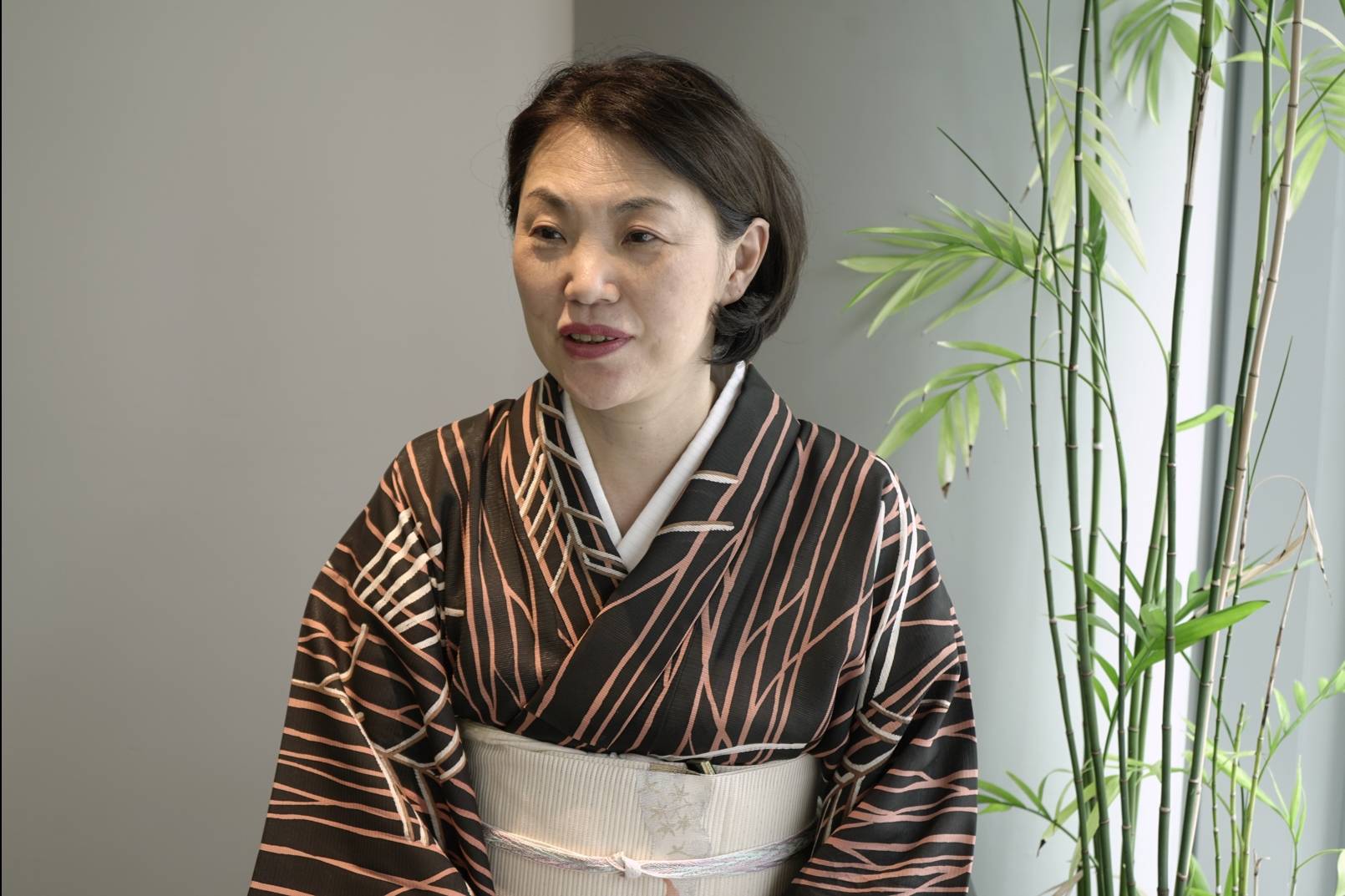
Ikenobo headmaster designate Senko Ikenobo speaks during an interview in Tokyo, on July 17, 2026. (AP Photo/Mayuko Ono)

Okada, who also teaches backflips to anyone who wants to learn, usually wears silver chains and jeans, but he wears a nice kimono when he formally demonstrates his arrangements. He considers himself typical of those drawn to ikebana today, people looking for joy, purpose, or solace from the daily grind or pain of modern life.

“In arranging (flowers), you are dealing with the life that is there, the beauty, of course, but you find what’s in your heart,” said Okada. “You come face to face with yourself.”

The Kyoto-based Ikenobo school, which is rooted in Buddhism, now has chapters around the world.

Okada's previous job at a nonprofit involved talking to people from around the world, and he realized how different — and alike — people were. When he switched to his current job, at a flower shop, he decided to take up a pursuit that was Japanese, so he could explore that aspect of himself, and one that could be done for a long time, alone.
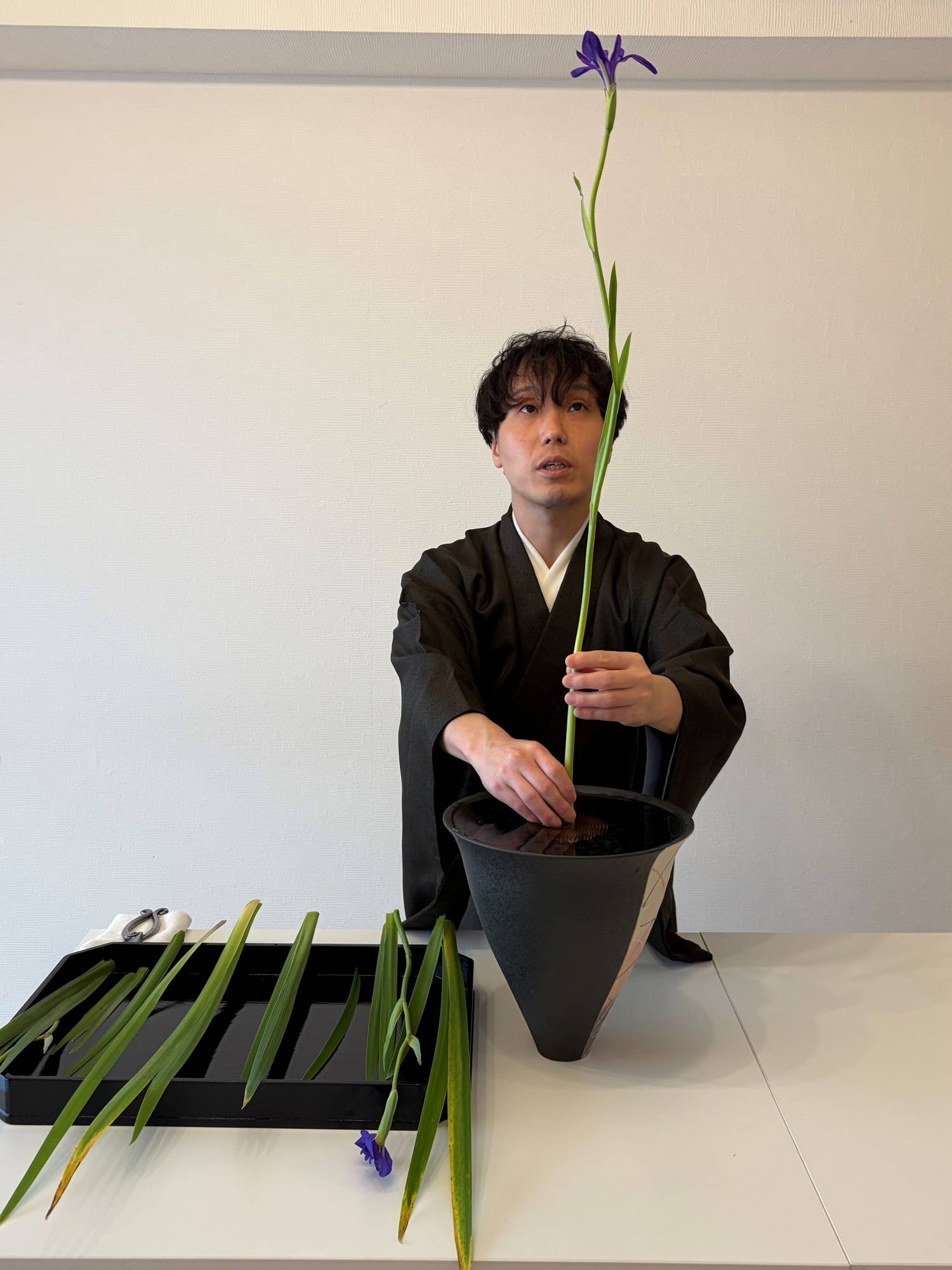
Ikenobo ikebana instructor Hiroyuki Okada demonstrates a basic flower arrangement style called “Shoka Shofutai” at a studio in Tokyo on Aug. 11, 2026. (AP Photo/Yuri Kageyama)

Observing how flowers and plants grow is part of the art Ikebana involves interacting with nature, although on a small scale — usually in a little vase.

“It is about the relationship of the creator with the flowers,” said Senko Ikenobo, headmaster-designate of the Ikenobo school.

Her family dates back generations to the originators of the art. Her father is the current headmaster.

Jeannette Haviland-Jones, professor of social psychology at Rutgers University, says studies have shown “that flowers and even flower scents promote happiness in people. We suggested a coevolutionary theory for this in which flowers became the ‘pets’ of the plant world.”

Besides a flower's beauty and fragrance, the feel of its petals and leaves to the touch is crucial, like petting a kitten or a puppy, according to Okada.

There are toddlers who do Ikenobo, copying their moms, and there are devoted centenarians. The headmaster-designate says she has seen ikebana help women who are juggling work and motherhood, or taking care of aging parents.

Ikebana has a healing effect similar to that of yoga, meditation or play, says Mayu Shimizu, who works for an online educational service and has been taking lessons from Okada for about three years.

“I like this moment of nothingness when you are concentrating on the flowers before you,” she says. “My mind feels clearer. I feel more at peace, and gentle.”
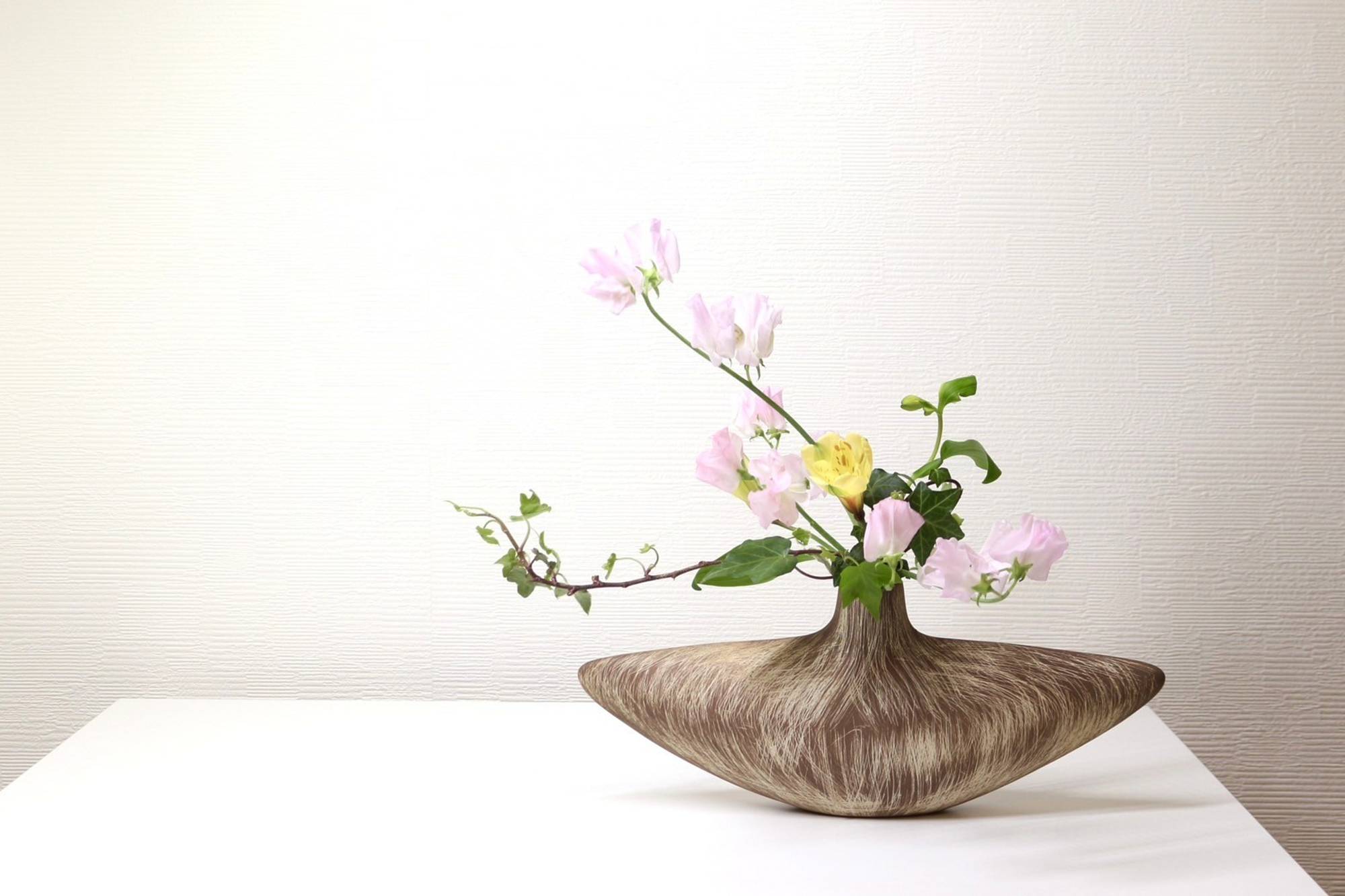
This photo released by Hiroyuki Okada shows a free-style Ikenobo ikebana arrangement in Tokyo on March 11, 2026. (Hiroyuki Okada via AP)

One traditional Ikenobo arrangement is shoka shofutai, which attempts to arrange the flowers, leaves and branches as they might look in nature, reaching toward sunlight or bending in the wind. The vase, sometimes crafted from wood or pottery, also becomes part of the arrangement's vision.

Yet the overall look is pure and simple, expressing the life cycle of flowers — from blossoming through withering — through three main elements:

— Shin, the tallest element, is arranged first, representing one's core, reaching up toward the sky.

— Soe, which is trimmed to about two-thirds the height of the shin and is placed at the side, expresses the flower’s individuality. The leaves might be slightly faded, representing the later stages of life.

— Tai, the third element, is the future. Choose a blossom or fresh small leaves — things that are being born.

There are also freer, spinoff styles that look more like casual, Western-style bouquets than the stoic, textbook-oriented shoka shofutai. That may feel easier, and more fun, for beginners.

Just as ikebana connects a person with flowers, those who practice the art say it’s also about the passing of the art over generations, connecting people.



In First, French Presidential Candidate Gives Birth During Campaign

Marine Tondelier, National Secretary of Les Ecologistes (the Ecologists - EELV - French Green Party) party arrives for a meeting with French President Emmanuel Macron about the situation in the Middle East and Ukraine and their consequences for France's security and energy supplies, at the Elysee Palace in Paris, France, September 18, 2026. REUTERS/Sarah Meyssonnier
TT

In First, French Presidential Candidate Gives Birth During Campaign

Marine Tondelier, National Secretary of Les Ecologistes (the Ecologists - EELV - French Green Party) party arrives for a meeting with French President Emmanuel Macron about the situation in the Middle East and Ukraine and their consequences for France's security and energy supplies, at the Elysee Palace in Paris, France, September 18, 2026. REUTERS/Sarah Meyssonnier

French Greens leader and candidate in the 2027 presidential election Marine Tondelier said Wednesday she had given birth to a son, emphasizing that she would press on campaigning while prioritizing the health of her child.

Tondelier, 40, was the first candidate in French politics to campaign while pregnant and, while acknowledging the challenges, she had expressed hope it would push issues including infertility and motherhood up the agenda.

Her boy Leon was born in Lens in northern France on September 18, Tondelier told AFP, saying the family had kept the news private for a few days.

He was born hours after Tondelier as Greens chief had attended a rare meeting at the Elysee Palace where President Emmanuel Macron had warned France's political leaders over the risk of Russian hybrid attacks.

She told AFP that the birth had gone "very well," adding that she would be "working differently" for a while and "trying to figure out how to balance a presidential campaign with a newborn, whose health and well-being come first."

Already the mother of a 7-year-old boy, Tondelier was confirmed as the candidate for the Greens on Monday. In December, the party will decide whether to maintain her candidacy or withdraw and throw the party's weight behind another left-wing figure.

Polls currently show Tondelier, who has the slogan "another Marine is possible!" in reference to far-right frontrunner Marine Le Pen, lagging well under five percent in the first round of voting.


Voting Opens in Alaska's Annual Fat Bear Week

A brown bear eats his catch while fishing for salmon in Brooks Falls, Alaska on August 12, 2023. (Photo by JOHN MOORE / GETTY IMAGES NORTH AMERICA / AFP)
TT

Voting Opens in Alaska's Annual Fat Bear Week

A brown bear eats his catch while fishing for salmon in Brooks Falls, Alaska on August 12, 2023. (Photo by JOHN MOORE / GETTY IMAGES NORTH AMERICA / AFP)

Polls opened Tuesday in the only American election that really matters: Fat Bear Week.

While the United States might be gearing up for midterm ballots that will decide who runs Washington, hundreds of thousands of people were readying to vote on animals gorging themselves in rural Alaska.

In a contest that has rapidly become one of the internet's favorite moments, the brown bears of Katmai National Park unwittingly compete in a series of head-to-head contests to see which one of them has most impressively piled on the pounds ahead of hibernation.

Viewers can watch a livestream of the enormous animals as they scoop salmon from the Brooks River, or browse biographies of some of the top contenders, including before-and-after pictures showing how much weight the bears have gained over a summer of feasting.

"For each match-up, vote for the bear you believe best exemplifies fatness and success in brown bears," said organizers, according to AFP.

"The bear with the most votes advances to the next round. Only one will be crowned Fat Bear Week champion."

Last year's winner, Chunk, beat out a stiff challenge from two-time winner Grazer.

Summer and early autumn are key fueling periods for the brown bears, which will not eat for five months of hibernation, relying on their store of fat to survive the punishing Alaskan winter.

The online contest began in 2014 with just a few thousand people voting, but has now turned into an eagerly awaited exercise in tongue-in-cheek democracy with more than a million people voting every year.

The aim is to raise awareness of brown bears and their habitat in Alaska, and the risks they face from human activity.


Another Beluga Whale Dies at Chicago Aquarium after Rescue Mission from Canada Park

This photo provided by Shedd Aquarium shows a beluga whale named Osiris at Shedd Aquarium in Chicago, Aug. 20, 2026. (Rachel Mittelstaedt/Shedd Aquarium via AP)
TT

Another Beluga Whale Dies at Chicago Aquarium after Rescue Mission from Canada Park

This photo provided by Shedd Aquarium shows a beluga whale named Osiris at Shedd Aquarium in Chicago, Aug. 20, 2026. (Rachel Mittelstaedt/Shedd Aquarium via AP)

A third beluga has died at a Chicago aquarium after being rescued this summer from a shuttered Canadian marine park in a complex international operation that moved 30 whales to aquariums in the US and Spain.

Osiris, a 26-year-old female whale, died on Monday, Chicago's Shedd Aquarium said in a statement. The death comes less than a week after a fourth beluga, named Jelly Bean, died since it was rehomed at Oceanogràfic de València in Spain.

The deaths were sudden and unexpected as their health wavered amid the challenges of adjusting to a new home, according to statements from the aquariums.

Beluga whales are particularly vulnerable to changes in their environment, like climate change, pollution and other sources of stress, according to the National Oceanic and Atmospheric Association. Beluga whales native to the Cook Inlet on Alaska's coast are classified as an endangered species, and their population rapidly declined by nearly 80% from 1979 to 2018.

“When Shedd was asked to help with this rescue, we understood that these animals arrived with significant vulnerabilities and that the outcome for every individual could not be guaranteed,” The Associated Press quoted the Shedd Aquarium as saying in a statement.

The Shedd Aquarium took in 10 of the 30 belugas and four dolphins stranded at Marineland, an Ontario park that closed years ago and could no longer care for them. The Canadian government signed off on a last-minute agreement to move its last captive whales out of the country earlier this year, saving them from euthanasia.

The belugas came from the Marineland park and zoo in Niagara Falls, Ontario, which announced in early 2023 that it was for sale and closed to the public in late summer 2024.

Twenty whales — 19 belugas and one killer whale — had died at Marineland since 2019, according to provincial government data obtained through freedom of information laws and official statements.

The rescued belugas were moved in custom-made slings and temperature-controlled containers, Shedd staff told The Associated Press. Aquarium personnel traveled to Marineland to examine their health records in preparation for the move. They have monitored their health minute-by-minute since they arrived, the aquarium staff said.

Peekachu and Rain died at the Shedd in late August and early September after arriving from Canada. Another beluga that had lived at the aquarium for decades died around the same time.

Osiris was a “whale of clinical concern” since she arrived, according to the aquarium. The whale did not eat as consistently as her fellow animals, which complicated the efforts to keep her well-fed and hydrated, according to the statement.

“Osiris experienced periods of meaningful progress, both nutritionally and socially, but her overall condition remained closely monitored,” the aquarium stated.

Osiris' caretakers noticed sudden changes in her behavior and breathing patterns the morning of her death, according to the aquarium. She was moved to the medical habitat, but “her condition declined rapidly,” and she “passed away despite lifesaving efforts.”

A beluga sent to Spain died suddenly Jelly Bean, the whale that died at Oceanogràfic de València, also died “suddenly and unexpectedly,” according to José Rafael Serra, a spokesperson for the facility. The whale “experienced feeding difficulties, prompting the veterinary team to intensify her monitoring,” despite periods of improvement, Serra said in an email.

The Spanish aquarium took in two of Marineland's beluga whales, including Jelly Bean. The Georgia Aquarium and SeaWorld locations in San Diego and San Antonio have also accepted whales from the Canadian park.

The two rescued whales at the Georgia Aquarium showed decreased appetites and were examined, but no issues were found, the aquarium said in a social media post Friday. The whales at SeaWorld are in “stable health,” according to AnneMarie Iturrizaga, a spokesperson for the company that owns the parks.

The Shedd Aquarium notified the NOAA of Osiris’ death Monday, according to John Chu, a spokesperson for NOAA Fisheries. Within 30 days of the whales’ deaths, the aquarium must formally submit their names and causes of death, and on request, provide copies of necropsy reports, Chu said in an email earlier this month.

The Shedd Aquarium said it will conduct necropsies into the whales and will share the results when they are confirmed.

Andrew Trites, the director of the University of British Columbia’s Marine Mammal Research Unit, said it was concerning that the four belugas had died “so shortly after arriving in their new homes."

The belugas were in small, confined spaces on the flights out of Marineland, but that's not out of the ordinary for them, Trites said. The whales often swim in narrow spaces between sheets of ice, and “should be reasonably well adapted to that sort of condition,” he said.

“Four animals have died so shortly after arriving in the new homes, and that’s what stands out to me as being surprising," Trites said.