

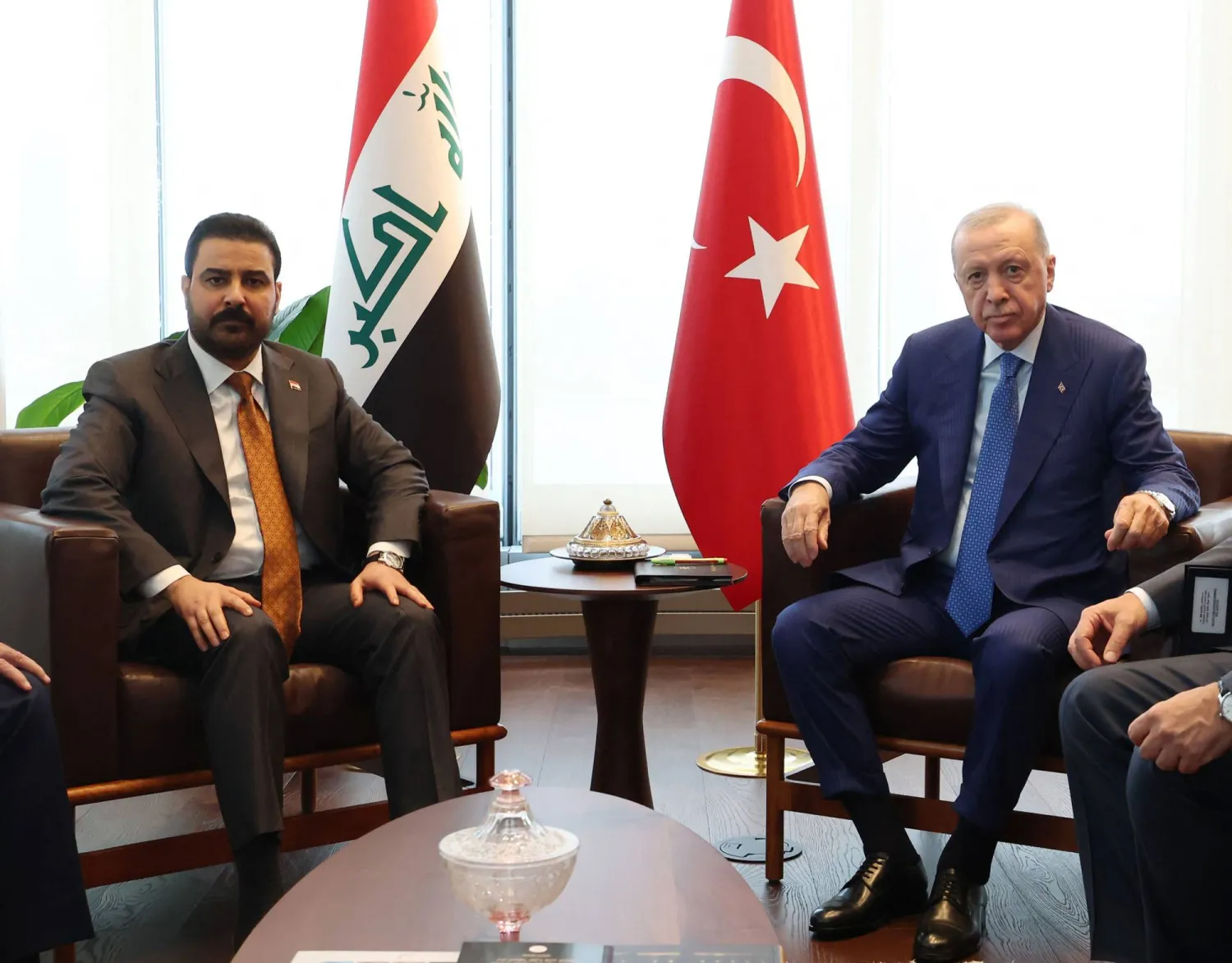

Türkiye to Hand Over Military Base to Iraq

This handout photograph taken and released by Turkish Presidency Press Office on September 23, 2026, shows Turkish President Recep Tayyip Erdogan (R) meeting with Prime Minister of Iraq Ali al-Zaidi on the sidelines of the 81st United Nations General Assembly in New York. (Photo by Handout / Turkish Presidential Press Service / AFP)
TT

Türkiye to Hand Over Military Base to Iraq

This handout photograph taken and released by Turkish Presidency Press Office on September 23, 2026, shows Turkish President Recep Tayyip Erdogan (R) meeting with Prime Minister of Iraq Ali al-Zaidi on the sidelines of the 81st United Nations General Assembly in New York. (Photo by Handout / Turkish Presidential Press Service / AFP)

Türkiye will hand over control of its base in Bashiqa in northern Iraq to Baghdad, the Turkish presidency announced Wednesday in a joint statement with its neighbor.

"In light of progress achieved by these security measures implemented by Iraq, Turkish forces will gradually hand over the Bashiqa-Zilkan base to the Federal Government of Iraq in accordance with the agreed mechanism and timetable," a joint statement said.

The announcement followed a meeting Wednesday between Turkish President Recep Tayyip Erdogan and Iraqi Prime Minister Ali al-Zaidi on the sidelines of the United Nations General Assembly in New York.

The handover's timetable was not specified.

The US ambassador to Türkiye and special envoy for Syria and Iraq, Tom Barrack, hailed the agreement.

"History rarely announces its turning points; it stitches them quietly. Ankara returning Zilkan to Baghdad by agreed mechanism and timeline is one such thread: Iraqi sovereignty and Turkish security, both served," he posted on X.

With the agreement of the autonomous region of Iraqi Kurdistan, Türkiye established a military base in Bashiqa in December 2015.

According to the Turkish press, Ankara deployed up to 600 soldiers there. This sparked tensions with Baghdad, which accused Ankara of violating its sovereignty.

Ankara and Baghdad also agreed on Wednesday to "fully restore state authority in Sinjar and eliminate the presence of illegal foreign armed elements".

Türkiye has in the past conducted military operations in the Sinjar region against fighters from the Kurdistan Workers' Party (PKK).

As part of a peace process conducted with Ankara, the PKK announced its dissolution in May 2025, before holding a highly symbolic disarmament ceremony in July 2025 in northern Iraq, where only some fighters remain, according to Turkish authorities.

Baghdad announced in early September that Sinjar would be placed under the full authority of the federal government and its security and administrative institutions, following an agreement reached with Yazidi armed groups for them to hand over their weapons to the state.



Morocco Votes for a New Parliament

A woman casts her vote at a polling station in Rabat, Morocco, 23 September 2026. (EPA)
TT

Morocco Votes for a New Parliament

A woman casts her vote at a polling station in Rabat, Morocco, 23 September 2026. (EPA)

Moroccans voted for a new parliament Wednesday in an election shaped by mounting frustration among young people, high unemployment despite a thriving economy and demands for better schools, hospitals and housing.

Voter turnout in the election for the 395-seat House of Representatives was 38%.

The vote was the first since youth-led protests nearly a year ago and a mass attempt by migrants to cross Morocco’s northern border into the Spanish territory of Ceuta that left dozens dead. It will determine the next prime minister and the makeup of the government, which will serve alongside a powerful monarchy that retains broad authority over strategic affairs.

Results are expected Thursday.

The next government will oversee billions of dollars in investment as Morocco prepares to co-host the 2030 FIFA World Cup, prompting some to describe it as the “World Cup government.” The new political leadership will also face pressure to address everyday concerns, including jobs, wages and the cost of living.

Othmane Mouden, a Casablanca businessman in his late 30s, believes elections are the only way Moroccans can make their voices heard.

“Protesting like the Gen Z youth will not bring any change,” he said on his way to the polling station. “You can only claim your rights through the polls.”

Voters chose among 7,288 candidates from 27 political parties. Since no single party is expected to obtain an absolute majority, the winner will need to negotiate with others to form a governing coalition.

The Moroccan Constitution requires the king to appoint the head of government from the party that wins the most seats in legislative elections.

One possibility for prime minister is Faouzi Lakjaa, president of Morocco’s soccer federation, who recently joined the PAM party and has been buoyed by Morocco’s recent soccer achievements.

Another is Fatima-Zahra Mansouri, 50, mayor of Marrakech and minister of urban planning, who would be Morocco’s first female prime minister.

As ballot stations opened in Casablanca and Rabat, voters of various ages formed small but continuous lines to cast their ballots.

Jamal Aamar, a 63-year-old retired banker, came to vote for the Federation of the Democratic Left, a left-wing coalition. Aamar said participating in the election allows his voice to be heard.

“If you boycott, you will leave others an empty seat,” he said.

Caterer Bader Eabram, 24, said Morocco's strong performance in recent World Cups and other soccer championships is driving some voters' choices, and providing hope.

“We’re all really eager to host the World Cup. It’s a great country,'' he said. ‘’We can do anything.''


Son of Israel’s Ambassador to US Critically Injured in Ramming Attack in the Occupied West Bank

23 September 2026, Beit Horon: Israeli security forces inspect the scene, where a Palestinian man was shot and killed after ramming his car into Maccabim checkpoint and seriously wounding an officer, near the West Bank Jewish settlement of Beit Horon. (dpa)
TT

Son of Israel’s Ambassador to US Critically Injured in Ramming Attack in the Occupied West Bank

23 September 2026, Beit Horon: Israeli security forces inspect the scene, where a Palestinian man was shot and killed after ramming his car into Maccabim checkpoint and seriously wounding an officer, near the West Bank Jewish settlement of Beit Horon. (dpa)

The son of Israel's ambassador to the United States was gravely injured in a ramming attack in the occupied West Bank on Wednesday.

Neria Leiter, a reservist in Israel's military, “needs a miracle," Ambassador Yechiel Leiter said in a social media post. Leiter's older son, Moshe Yedidya Leiter, who also served in Israel's military, was killed in Gaza just days after the Hamas-led Oct. 7, 2023 attack, which triggered the war in Gaza.

According to the military and law enforcement, a Palestinian man rammed his car into a security checkpoint Wednesday afternoon near the settlement of Beit Horon, seriously wounding the officer.

Israeli forces at the scene then “opened fire at the terrorist as he attempted to flee” and killed him. More military forces were deployed in the aftermath in the area, which is crossed by a major highway connecting Jerusalem to Tel Aviv.

A paramedic with the Magen David Adom emergency service said the injured officer was unconscious when crews arrived at the scene and was evacuated to a hospital in Jerusalem.

The suspect was identified as Mahmoud Suleiman, according to the Palestinian Health Ministry.

Israel's Prime Minister Benjamin Netanyahu and President Isaac Herzog both sent wishes for Leiter's recovery. A social media post by Herzog described Leiter as “fighting for his life."

Netanyahu visited Leiter's family at the hospital Wednesday night before departing for the UN General Assembly in New York. The Iran war, which Israel launched together with the United States on Feb. 28, is a major focus of the gathering of world leaders.

Earlier this week, an Israeli man was killed in a shooting attack in the West Bank, which has experienced a surge in deadly violence since the war in Gaza began. Recent months have seen marked increases in attacks by settlers on Palestinians, evictions from Palestinian towns, Israeli military operations, as well as several Palestinian attacks on Israelis.

The latest violence is happening in the middle of the Jewish High Holy Days, just after Yom Kippur, the Day of Atonement, which is widely considered the holiest day in the Jewish calendar.

In mid-April, Ambassador Leiter was a central figure in the first direct diplomatic talks in decades between Israel and Lebanon in Washington. In late June, Leiter, Lebanon’s ambassador to the US, and Secretary of State Marco Rubio announced a framework agreement between Israel and Lebanon that was described as a first step toward peace following months of renewed conflict between Israel and the Lebanon-based, Iran-backed Hezbollah group.


Board of Peace Proposes $2.45 Billion Blueprint to Begin Gaza Reconstruction

Palestinian firefighters extinguish a fire on a vehicle hit by an Israeli airstrike in Khan Younis, in the southern Gaza Strip, September 23, 2026. REUTERS/Ramadan Abed
TT

Board of Peace Proposes $2.45 Billion Blueprint to Begin Gaza Reconstruction

Palestinian firefighters extinguish a fire on a vehicle hit by an Israeli airstrike in Khan Younis, in the southern Gaza Strip, September 23, 2026. REUTERS/Ramadan Abed

The US-backed Board of Peace is proposing a six-month, $2.45 billion plan to begin reconstruction and governance in Gaza as President Donald Trump’s ceasefire plan struggles to stay afloat.

At a meeting of the group’s board in New York on the sidelines of the UN General Assembly on Wednesday, the governors unveiled a 66-project blueprint to get things started while acknowledging enormous hurdles that must still be overcome.

The projects include ambitious infrastructure, education and health initiatives that are designed to support Trump’s 20-point plan to end the Israel-Hamas war, The Associated Press reported.

“The need is immense,” the board said, noting that full reconstruction from the physical damage across Gaza will cost roughly $35.2 billion over the medium term and another $71.4 billion in the next 10 years.

The proposal is largely aimed at potential donors who will be asked to foot the bill for reconstruction of the war-devastated territory.

The ceasefire, which took effect on Oct. 10, was meant to clear the way for a broader process to rebuild Gaza under the guidance of the Board of Peace.

The plan included additional Israeli military withdrawals from Gaza, the disarmament of Hamas, the arrival of an international peacekeeping force and a new apolitical Palestinian government to administer the territory’s day-to-day affairs. It also envisioned an ambitious program for rebuilding war-ravaged Gaza.

But the US-backed plan has largely stalled. While the ceasefire halted the heaviest fighting and humanitarian conditions have improved, the Israeli military has expanded its control of Gaza and now occupies some 60% of the territory.

Hamas has not given up its weapons. The international military force and new government still have not entered Gaza, and reconstruction has not begun.

The vast majority of Palestinians continue to live in tent camps or ruins of their former homes.

The board’s high representative, Nikolay Mladenov, has said progress hinges largely on Hamas disarming — a step the group has refused to take. But he also has pressed Israel to scale back its military operation.

“I want to be very clear that we are not bound by a calendar,” he said. “We want to make sure that this works.”

Key questions that the board faces are not only laying out plans for reconstruction but also a timeline for the deployment of the international force meant to provide security in the territory and a new government, plans to disarm Hamas, and bringing in badly needed building materials.

US Gen. Jasper Jeffers, commander of the international stabilization force planned for Gaza, outlined a five-step approach to dealing with the thorny issue of demilitarizing Hamas. It begins with the first wave of the multinational unit being deployed with troops from Kosovo and Morocco, to be followed by additional personnel from Albania and Kazakhstan.

Their task will be to demilitarize the territory and decommission all of Hamas’ military infrastructure.

The goal, he said, is to gradually turn security control over to the interim government, after which Israel will be expected to withdraw its forces.