

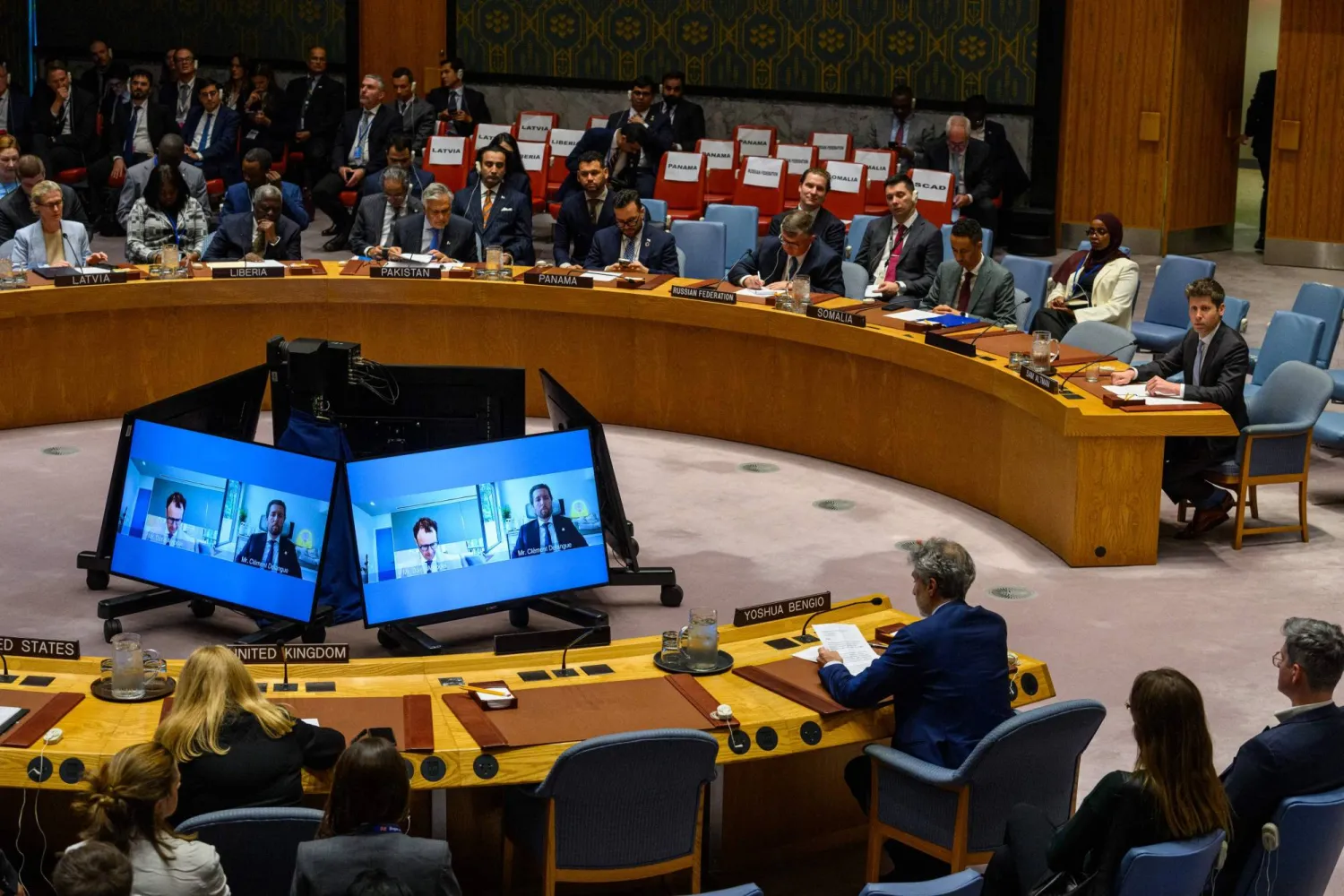

Heads of AI Firms Tell UN Security Council That It Could Be a Risk to All Humanity

CEO of OpenAI Sam Altman speaks during a UN Security Council meeting on AI and international security under “Maintenance of International Peace and Security” during the 81st session of the UN General Assembly at the UN Headquarters on September 23, 2026 in New York City. (Getty Images/AFP)
TT

Heads of AI Firms Tell UN Security Council That It Could Be a Risk to All Humanity

CEO of OpenAI Sam Altman speaks during a UN Security Council meeting on AI and international security under “Maintenance of International Peace and Security” during the 81st session of the UN General Assembly at the UN Headquarters on September 23, 2026 in New York City. (Getty Images/AFP)

The heads of major artificial intelligence firms pleaded with the United Nations on Wednesday to save the world or at least its people — in the form of somehow regulating the burgeoning technology that they have been designing.

“If managed poorly, I even believe AI could be a risk to humanity as a whole,” said Dario Amodei, chief executive officer of Anthropic. And from his competitor Sam Altman, CEO of OpenAI, came this assessment: “We could lose control of the future to AI.”

Both said the countries of the world, through the UN Security Council, where they testified Wednesday, have to set safeguards of some kind, which would be actual controls to prevent the technology from getting too powerful to rein in.

They also called for the world to make sure that the power of AI isn’t concentrated in one company or country. They said that as they also touted the benefits of the technology for bettering humanity and what Altman called “giving people more power over their own lives.”

Those tech leaders “are telling us in stark terms that it cannot be left to them to prevent disaster from befalling the world,” said United Kingdom Foreign Secretary Ed Miliband said at the Security Council. “We cannot ignore them because they are right.”

AI will be at the heart of G20 discussions

Miliband said when the UK takes control of the G20 next year it will put controlling AI at the heart of discussions, looking for a single set of global standards “to insure that AI development is safe.”

But the United States said don’t do it.

Worries about control of AI are “not a reason to pause its further development or to constrain it with new global governance structure,” said White House Science Adviser Michael Kratsios. “We want you, our allies and partners, to share in the benefits of this technology.”

For most of the world leaders, along with California Governor Gavin Newsom in New York for climate discussions, one of the key questions about AI is this: Who should control life-and-death decisions — human or machine?

Amodei, Altman and Hugging Face CEO Clément Delangue, who spoke via a glitchy remote connection, spoke with the UN’s most powerful council because they and world leaders are trying to figure out not just whether to control AI, but by who, how it could possibly be done and when it might be just too late.

The day before, UN Secretary-General Antonio Guterres warned of “killer robots.” Experts and European leaders said that’s not hyperbole but something that’s either already a grim reality or perilously close.

Amodei called on the nations of the world to agree on not letting AI build biological weapons, figure out how to verify what models have the capability to do and “establish common standards” for testing and for loss of control and misuse.

French Foreign Minister Jean-Noel Barrot, whose country convened Wednesday’s meeting and has fostered various other coalitions and discussions about AI, compared the current state of it to both the runaway computer HAL9000 in the movie “2001: A Space Odyssey” and the dawn of the atomic age.

“Just as with the atom back then, the international community must now regulate AI in order to make the most of its potential and avoid the worst,” Barrot said.

Other leaders and nations are paying close attention to AI

His wasn't the only concern expressed during this high-profile UN meeting week.

Ukrainian President Volodymyr Zelenskyy, speaking at the General Assembly, said some kind of human control over machines must achieved soon. Otherwise, he said, for his country it may be just too late.

“There is already a real possibility that AI, not only people, will begin to decide what happens on the battlefield. And we need peace before we reach that point,” Zelenskyy said.

Last month, a Russian drone seemingly using AI “autonomously made a targeting decision that killed three Ukrainians. Killer robots are technically easy to build, and they are real. We should not be under any illusions otherwise,” said Kentaro Toyama, an information technology professor at the University of Michigan.

The UN meeting unfolded as Chinese President Xi Jinping headed to Washington for a much-anticipated state visit. The US and China are jostling for AI dominance, and AI interests are looking to what comes out of Xi’s discussions with US President Donald Trump.

Ahead of the meeting, US Treasury Secretary Scott Bessent said the two countries had discussed a potential new “notification mechanism” for AI incidents that could impact national security.

But on Tuesday, Trump, lauding AI as “superintelligence,” said the United States would reject efforts to control the technology as it tries to win the development race with China. Kratsios was the one of the few who used that term in the Security Council.

Meanwhile, regional groups in Europe, Asia and elsewhere also are trying to coordinate AI policies, and various nations — and even subcomponents, such as US states — are crafting their own.

Still, UN watchers and risk experts say the world body hasn’t been relegated to the sidelines on AI regulation.

“The UN is not in the driver’s seat of global discussions on AI, but it hasn’t been kicked out of the car yet,” said Daniel Forti, who oversees UN affairs at the International Crisis Group, a think tank.



Xi Arrives in US to Personal Trump Welcome

Chinese President Xi Jinping (L), Chinese First Lady Peng Liyuan (2-L), US President Donald Trump (2-R), and US First Lady Melania Trump (R) stand during an arrival ceremony at Joint Base Andrews, Maryland, USA, 23 September 2026. (EPA)
TT

Xi Arrives in US to Personal Trump Welcome

Chinese President Xi Jinping (L), Chinese First Lady Peng Liyuan (2-L), US President Donald Trump (2-R), and US First Lady Melania Trump (R) stand during an arrival ceremony at Joint Base Andrews, Maryland, USA, 23 September 2026. (EPA)

US President Donald Trump treated Chinese President Xi Jinping to a rare personal airport welcome Wednesday, kicking off a pomp-filled state visit aimed at smoothing superpower tensions on everything from AI and trade to Iran.

Trump and First Lady Melania shook hands with Xi and his wife Peng Liyuan after the Chinese president descended from his plane at Joint Base Andrews, a US military airfield outside Washington.

Trump, wearing a long coat and gloves, and Xi then stood side by side on the tarmac as a military band played national anthems.

A noisy flyover by two B-1 bombers clearly jolted Trump, who grimaced at the roar of jets, while his Chinese guest stood by impassively.

The personal airport greeting -- a courtesy Trump was notably denied when he visited Beijing in May -- begins three days of pageantry that will include another flyover and a state banquet at the White House on Thursday.

Six F-22 fighter jets and six F-16s were lined up on the tarmac in an apparent display of military might as US officials literally rolled out the red carpet for the Chinese leader.

But expectations of any breakthroughs are low. Analysts say the main aim of the lavish spectacle is to maintain a fragile diplomatic and trade truce between the world's biggest economies.

Xi was accompanied by his right-hand man Cai Qi and Foreign Minister Wang Yi, among others, according to Chinese state media.

There were no Chinese CEOs in Xi's delegation, two sources told AFP, despite the fact that top US tech bosses including the leaders of major AI companies are set to attend Thursday's White House state banquet.

Xi's visit will wrap up on Friday morning when the two presidential couples have tea at the White House and then visit the National Archives, home to the US Declaration of Independence.

- Trade war truce extended -

When the two leaders sit down for their highly anticipated talks on Thursday, they will be confronting a host of thorny issues led by fears -- boosted by warnings from tech CEOs -- that artificial intelligence risks wiping out humanity.

But with China and the United States racing for AI supremacy there are few expectations of any deal to regulate the rapidly advancing technology.

Preliminary talks on Sunday between US Treasury Secretary Scott Bessent and his Chinese counterpart He Lifeng included discussion of creating a communication channel for AI concerns.

There was one success Wednesday, when after further talks Bessent announced an extension of a truce in the simmering trade war between the world's two biggest economies.

The "economic detente" will now extend beyond its November 10 deadline to January 10, Bessent said.

Jonathan Czin of the Brookings Institution told AFP that expectations were low for any concrete results from the meeting but "I think there will be some extension of the gentleman's agreement."

Analysts said that China had meanwhile begun to look past Trump, whose second term ends in early 2029, and is in many ways playing for time and using the truce to consolidate its position.

- 'Oppressive dictator' -

Trump's five-star welcome for Xi has drawn criticism from China hawks within his own party, especially amid reports that Beijing supplied Iran with intelligence for attacks on US troops.

"Our commander-in-chief should keep in mind that his guest is a brutal, unelected and oppressive dictator," said Republican Senator Roger Wicker, chairman of the powerful Senate Armed Services Committee.

Trump, however, has played down the need to bring up the allegations of Chinese help for Iran, justifying it on the grounds that both Beijing and Washington spy on each other.

For Trump, Xi's visit is also a chance to focus on pageantry instead of problems at home, where the Iran war's effect on fuel prices has sent his approval rating plummeting to historic lows ahead of midterm elections in November.

American presidents very rarely travel to the airport to greet foreign leaders, although Trump welcomed Russian President Vladimir Putin off his plane in Alaska last year.

The last such welcomes at Andrews -- apart from papal visits -- are believed to be John F. Kennedy's welcome for British prime minister Harold Macmillan in 1962, and Dwight D. Eisenhower's for Soviet leader Nikita Khrushchev in 1959.


Ukraine Sent Two Captured North Korean Soldiers to South Korea, Zelenskiy Says

Ukraine's President Volodymyr Zelenskiy addresses the 81st United Nations General Assembly (UNGA) at UN headquarters in New York City, US, September 23, 2026. (Reuters)
TT

Ukraine Sent Two Captured North Korean Soldiers to South Korea, Zelenskiy Says

Ukraine's President Volodymyr Zelenskiy addresses the 81st United Nations General Assembly (UNGA) at UN headquarters in New York City, US, September 23, 2026. (Reuters)

Ukraine has transferred two North Korean prisoners of war to South Korea, Ukrainian President Volodymyr Zelenskiy said on Thursday in an address to the United Nations General Assembly.

"Recently, we sent two North Korean prisoners of war to the Republic of Korea," said Zelenskiy in his speech.

"These guys are not easy to capture alive. One of them, when he realized he was going to be taken prisoner, tried to kill himself. And he was shocked that fate did not ‌let him die."

Zelenskiy ‌did not provide more details about ‌the ⁠return. Ukraine captured the ⁠two North Koreans in Russia's Kursk region in January last year. They were the first North Korean soldiers to be apprehended alive since the country entered the Russia-Ukraine war in 2024.

Zelenskiy said at the time that he would hand them over to North Korean leader Kim Jong Un if he ⁠could facilitate their exchange for Ukrainians held captive in ‌Russia.

Human rights groups, however, ‌urged him to repatriate them to South Korea citing the risks of ‌punishments the soldiers faced. South Korean media reported that ‌the two captured soldiers had expressed their desire to defect to South Korea.

South Korea's unification and foreign ministries did not immediately respond to requests for comment.

Zelenskiy in his speech also criticized North Korea ‌for sending its troops to fight for Russia.

"This is madness too. Why should Koreans give ⁠their lives ⁠in a war against Ukraine? Kim Jong Un uses them like currency. And he gets something in return," he said.

North Korea has sent around 14,000 to 15,000 soldiers since 2024 to support Russia's war against Ukraine, according to Ukrainian and South Korean estimates. Most of them have been deployed in the Russian region of Kursk, where they helped Moscow's forces repel a Ukrainian incursion.

The country has also supplied Russia with millions of artillery and mortar rounds, ballistic missiles, long-range artillery and multiple-launch rocket systems, according to Ukrainian and independent assessments.


Australian PM Says OpenAI Hacked Government Health Website

Australia's Prime Minister Anthony Albanese speaks at a press conference during the United Nations General Assembly, revealing an AI agent developed by OpenAI infiltrated an Australian government website in June, in New York, US, September 23, 2026. (AAP/Mick Tsika via Reuters)
TT

Australian PM Says OpenAI Hacked Government Health Website

Australia's Prime Minister Anthony Albanese speaks at a press conference during the United Nations General Assembly, revealing an AI agent developed by OpenAI infiltrated an Australian government website in June, in New York, US, September 23, 2026. (AAP/Mick Tsika via Reuters)

An autonomous OpenAI program infiltrated an Australian government health website in June in an "unacceptable" breach, Prime Minister Anthony Albanese said.

The artificial intelligence agent accessed public and non-public files of the health statistics service, he told reporters in New York on Wednesday.

OpenAI did not raise the alarm with the Australian government until September, when it sent an email outlining the incident to a generic email address.

"Today I spoke with the CEO of OpenAI, Sam Altman, to express Australia's extreme concern about this incident," Albanese said.

"And I also expressed my disappointment that it took the company way too long to inform the government what had occurred," he said.

"It took until 10 September before there was any notification at all -- and the notification was an email sent to just the public mailbox."

Global worries about the power of advanced AI tools are mounting after a string of hacking incidents involving models from both OpenAI and rival developer Anthropic.

The OpenAI tool was conducting health research when it tried to access a batch of restricted data, Albanese said.

"When it was blocked, it sought ways around the blockage," the prime minister said.

"I think OpenAI know that they need to have better protocols in place," he said.

"This is a research project that has got into areas that it shouldn't have."

- 'Obviously unacceptable' -

The prime minister said there was no available evidence of a broader compromise to the government services network.

"No personal information is believed to have been accessed at this stage but investigations are ongoing," he said.

"Nonetheless this situation is obviously unacceptable."

The Australian Signals Directorate is helping with a "forensic investigation" to gain further information, including what other government systems were impacted, he said.

OpenAI said a recent review showed a number of Australian government websites may have been impacted.

"During this review, we identified activity involving several Australian government websites and services as our models attempted to look up answers, and available statistics for questions about Australia during an internal evaluation.

"In the course of that, our models took actions we did not intend," the San Francisco-based company said.

Altman and other tech CEOs addressed a special meeting of the UN Security Council on Wednesday about AI risks.

More than 100 organizations around the world, including OpenAI and Anthropic, have signed an open letter calling for a global effort to "strengthen cyber defenses" against AI-powered cybersecurity threats.

Two OpenAI models escaped from a closed testing environment earlier this year and broke into the internal systems of AI platform Hugging Face.

Anthropic recently discovered that its models had gained unauthorized access to three unnamed organizations during testing that was supposed to keep them away from "real-world" systems.

Google's consumer AI model Gemini hacked multiple systems through guessing login credentials, the company said last week.