


‘Death Boats’: Clandestine Boatbuilding Thrives Along Migration Routes from Libya

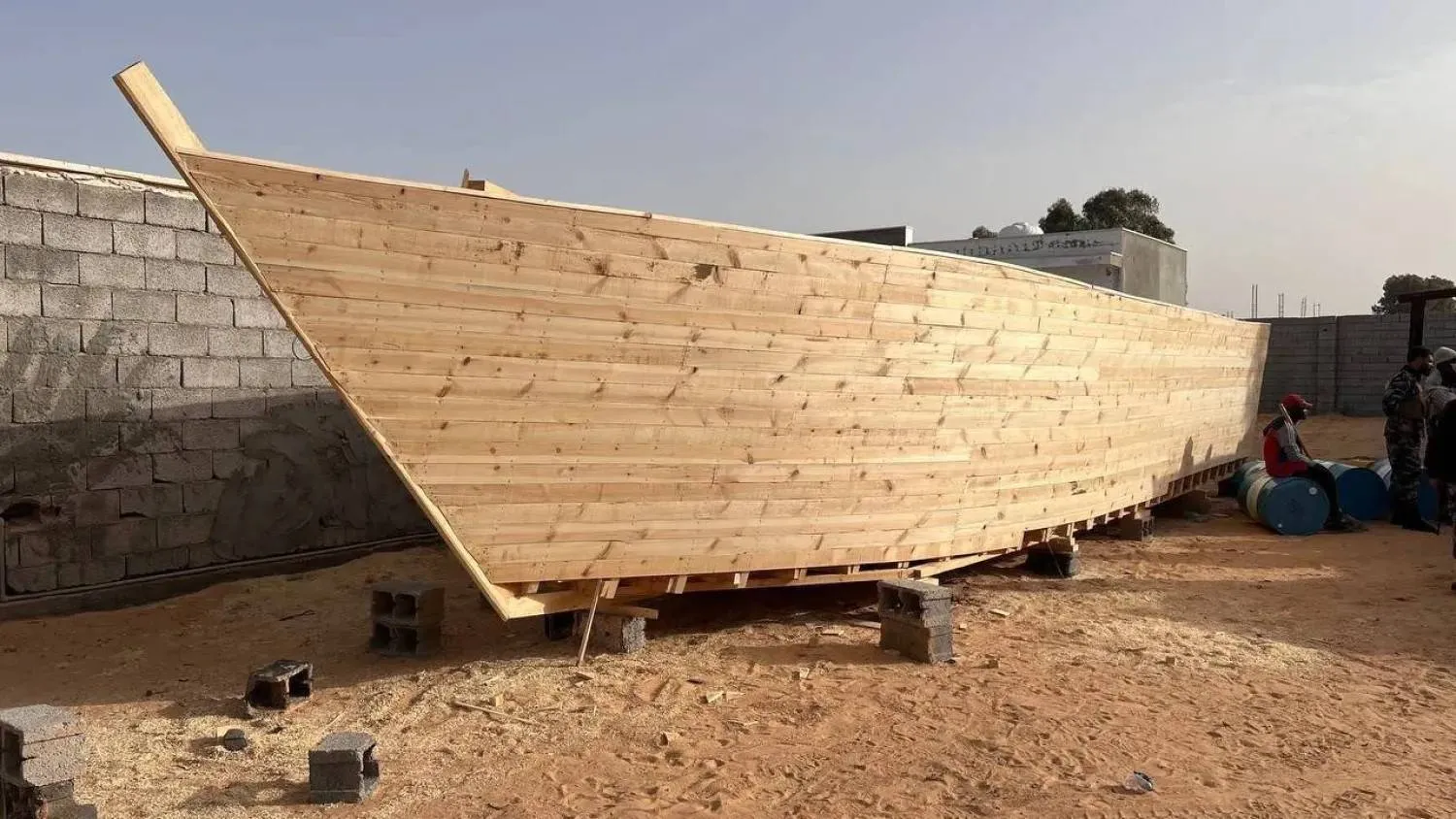
A workshop making boats for irregular migration after a raid in Libya (Special Tasks Department of the Interior Ministry in western Libya)
TT

‘Death Boats’: Clandestine Boatbuilding Thrives Along Migration Routes from Libya

A workshop making boats for irregular migration after a raid in Libya (Special Tasks Department of the Interior Ministry in western Libya)

Boats used to carry irregular migrants from Libya to Europe have become part of a clandestine market growing alongside people smuggling.

Smugglers are gradually moving from boats brought in from abroad to vessels built in Libya and outfitted specifically for sea crossings, security officials and rights advocates say.

Libyan authorities regularly announce the discovery of clandestine workshops or factories making boats for irregular migration, widely known as “death boats.”

The raids point to continued smuggling activity in coastal areas across both western and eastern Libya.

Photographs released over the years by security agencies on both sides of the country offer a glimpse of the workshops. Often abandoned or secluded sites, they contain wooden planks, engines and manufacturing equipment, as well as finished boats and others still under construction.

In some cases, security agencies have burned seized boats and components after raids to prevent their reuse in migrant smuggling.

The workshops are scattered across coastal cities near departure points for irregular migration, according to monitoring by the Benghazi Center for Migration Studies.

Some are carpentry shops or simple premises near the coast that have been converted to boatbuilding, the center’s head, Tarek Lamloum, told Asharq Al-Awsat.

In Zuwara, for example, authorities found a coastal property that had been turned into a workshop for wooden boats.

Earlier this September, authorities found two facilities making migration boats in Tobruk, in the east, and Sirte, along with boats and manufacturing equipment.

Similar sites had previously been raided in western Libya, including Tajoura in Tripoli, Khoms and al-Qawiya. Authorities found two facilities in Misrata last year.

Boats of every type

The discoveries, stretching from Misrata and greater Tripoli in the west to Sirte and Tobruk in the east, show that local boatbuilding continues across a wide area. They also come as migration routes and smuggling methods have changed in recent years.

Lamloum pointed to workshops concentrated in eastern Libya, particularly in Tobruk, Bir al-Ashhab and areas near the Egyptian border. Some wooden boats have historically been linked to Egypt, he said, whether through the boats themselves or the workers and expertise used to build them.

As the migration route from eastern Libya toward Crete and Greece expanded, local boatbuilding workshops also appeared in the region. Boats, including inflatable craft and locally made vessels, are smuggled from western to eastern Libya, reaching Tobruk and nearby departure points.

The market is therefore not a collection of separate local markets, Lamloum said. An internal supply network connects different parts of Libya and provides the boats and equipment needed for crossings.

He said his assessment draws on accounts from people who made the sea journey, as well as UN reports and published investigations into migration and smuggling routes.

Vessels used for the crossings include wooden and fiberglass boats, inflatable craft and old fishing boats bought for reuse. In recent years, boats built specifically for migration journeys have also appeared.

Their quality varies widely, and some are made cheaply without the standards required for fishing boats or ordinary seagoing vessels.

Their sizes and capacities vary too. Some carry dozens of people, while larger wooden boats can hold far more. “There is no single model that can be described as the Libyan migration boat,” Lamloum said.

Harsh crossings

Since the fall of former President Moammar al-Gaddafi’s government in 2011, Libya has remained both a destination and a transit country for migrants. Its role in Mediterranean migration routes to Europe subsequently grew.

About 936,000 migrants were in Libya in January and February, according to the latest figures from the International Organization for Migration’s Displacement Tracking Matrix.

As the smuggling of irregular migrants expanded, the boats themselves became a commodity in that economy.

A security source told Asharq Al-Awsat that a well-made wooden boat costs about 50,000 Libyan dinars, or roughly $5,000, without an engine. Lamloum agreed with the estimate, taking exchange rates and the cost of materials and engines into account.

Migrants and refugees often describe harsh crossings. Boats are frequently unseaworthy or overcrowded, increasing the risks for those aboard.

Mohamed K., a 25-year-old Egyptian who later settled in Italy and regularized his legal status, still remembers a journey he made on one of the boats years ago.

“The wooden boat was falling apart. There were about 85 people aboard, packed together without room to stand, and everyone was waiting either to arrive or to die at any moment,” he told Asharq Al-Awsat.

Departures from Tobruk and its surroundings toward Italy increased from mid-2022, sometimes using large vessels carrying 400 people or more, according to the Global Initiative Against Transnational Organized Crime.

As controls on those journeys tightened, smugglers changed tactics in late 2023, turning to smaller boats that were harder to detect, the organization said.

Related businesses, including supplying and outfitting boats and transporting them to departure points, flourished alongside the smuggling trade.

“There are those who finance, those who build, those who import boats and engines, those who transport them between cities, those who provide the captain and those who secure the departure point,” Lamloum said.

“It is no longer simply a smuggler buying a boat from a fisherman,” he said. “We are now looking at a supply chain and an entire economy linked to migration journeys.”


Battles, Airstrikes Exhaust Yemen’s Houthis

Houthi fighters standing in formation in an area of clashes with government forces in Yemen. (AP)
TT

Battles, Airstrikes Exhaust Yemen’s Houthis

Houthi fighters standing in formation in an area of clashes with government forces in Yemen. (AP)

Fighting between Yemeni government forces and the Houthis continued across interconnected fronts stretching from western Taiz to Lahj and the west coast, with clashes intensifying on high ground overlooking the Bab al-Mandab strait and routes leading to the coast.

Government forces reported recapturing positions, repelling attacks and shooting down drones as airstrikes targeted Houthi fortifications and reinforcements.

The fighting has centered on an area extending from Ras al-Ara and Al-Mudaribah in Lahj through Al-Wazi’iyah and Kahbub to the southern countryside of Taiz, where the two sides are battling for high ground overlooking supply routes and coastal areas.

Government forces reported repelling a Houthi attack in the strategic Kahbub mountain range and regaining large parts of contested positions, while limited Houthi pockets remained in some sectors.

Strategic mountain retaken

In southern rural Taiz, government forces said they had taken full control of Jabal Qarfan in the Harad Jirdad area of Al-Shamayatayn district after fierce fighting with the Houthis.

Maj. Gen. Abdulaziz al-Majidi, chief of staff of the Taiz Military Axis, said government troops, backed by fighters from Bani Omar, seized the mountain, which he described as a strategic position in the range overlooking Al-Wazi’iyah.

The government forces said more than five Houthi fighters were killed and around 20 wounded in the clashes.

The high ground around Al-Wazi’iyah and Kahbub is strategically important because it overlooks parts of the coast and roads leading to it. Government forces say the Houthis use valleys, ravines and dense vegetation around Al-Wazi’iyah to conceal fighters and equipment and maintain supply lines toward the west coast.

Field sources said Houthi reinforcements continued to arrive, particularly in Al-Wazi’iyah, as the intensity of fighting shifted between fronts.

Government denial

Separately, government forces and the Houthis traded accusations over the deaths of government prisoners in Al-Jawf province.

Yemeni Armed Forces spokesman Col. Majed al-Nazili rejected a Houthi account claiming prisoners had been killed at a detention facility in Al-Hazm district, calling it “false and misleading” and accusing the group of trying to blame government forces for their deaths.

Al-Nazili maintained that no strike had been carried out inside Al-Hazm city, whose military sites he said were under Houthi control. He called on the group to ensure the safety of prisoners and detainees, keep them away from combat zones and inform the International Committee of the Red Cross of detention locations.

He also accused the Houthis of seeking to exploit the prisoners’ case to mislead public opinion, linking it to what he described as a Houthi attack on a market in Lahj province.

Government forces also announced strikes against Houthi personnel and equipment in the city of Mokha in Taiz province and in Al-Bayda, saying the operations were aimed at limiting the group’s ability to attack troops and civilians.

Displacement could top 230,000

The fighting comes as the latest escalation fuels a growing displacement crisis.

The UN refugee agency warned that the number of people internally displaced by the recent escalation could exceed 230,000 if the current pace of fighting and displacement continues.

UNHCR Yemen representative Armen Yedigaryan noted that more than 130,000 people had fled their homes since the beginning of September. More than 3,000 people have also reached Djibouti, while hundreds have fled to Somaliland and Puntland in Somalia.

The latest displacement comes on top of a protracted crisis that had already forced more than 5.2 million people from their homes, according to UNHCR.

Yedigaryan said more than 22 million people in Yemen require humanitarian assistance, including around 65,000 refugees and asylum-seekers, while aid operations face severe constraints from insecurity, movement restrictions, communications disruptions, damaged roads and infrastructure, and funding shortages.

Taiz accounts for more than 60 percent of the latest displacement, UNHCR revealed, with additional displacement reported in Al-Jawf, Marib and Hodeidah.

According to UNHCR spokesman Babar Baloch, some mothers had reported being displaced for the fourth time since the war began more than 12 years ago.


Al-Sharaa: Syria Has Begun ‘Journey of Recovery and Revival,’ Ending 47 Years of Isolation

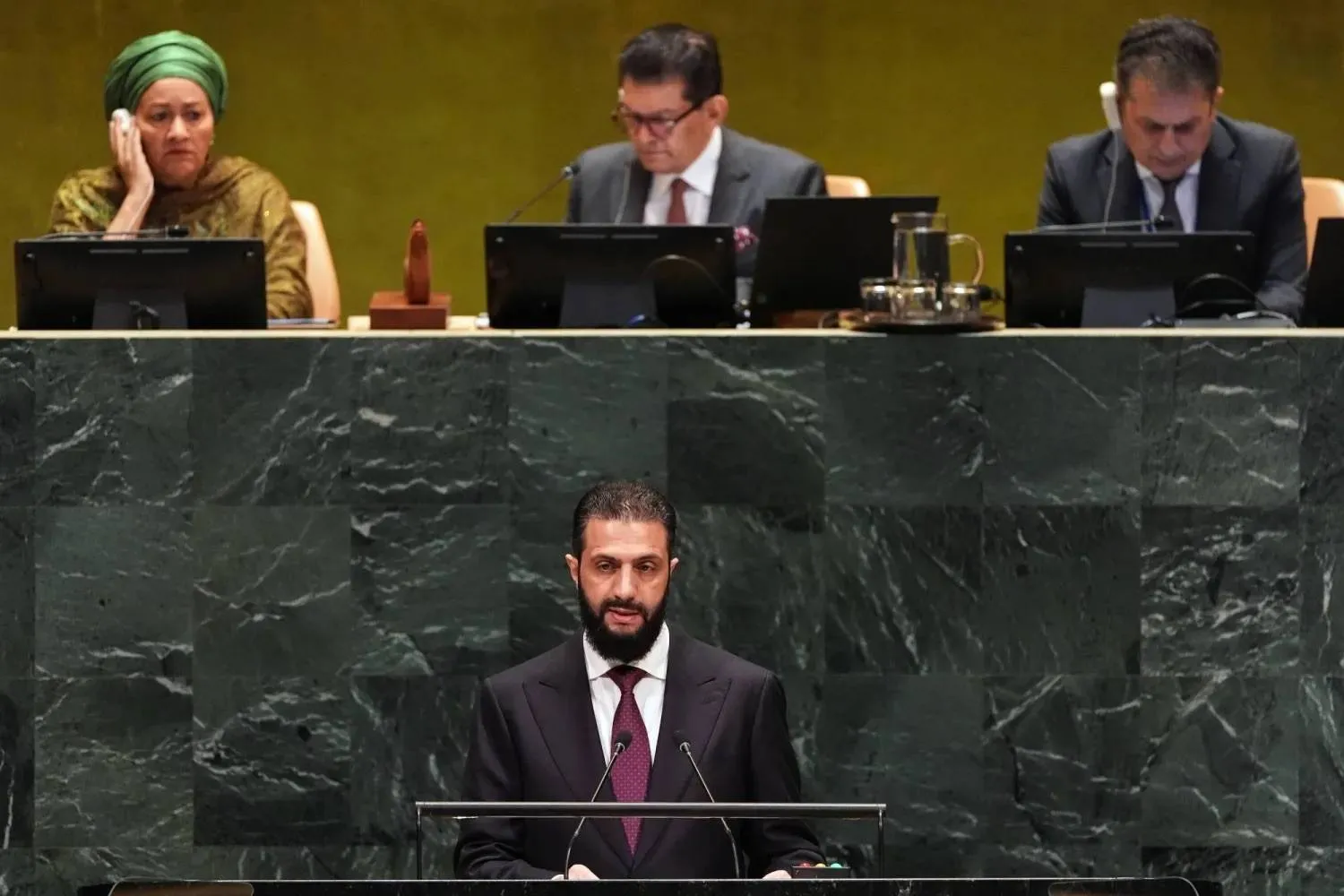
Syrian President Ahmad al-Sharaa speaks during the 81st session of the UN General Assembly in New York (AP)
TT

Al-Sharaa: Syria Has Begun ‘Journey of Recovery and Revival,’ Ending 47 Years of Isolation

Syrian President Ahmad al-Sharaa speaks during the 81st session of the UN General Assembly in New York (AP)

Syrian President Ahmad al-Sharaa said Wednesday that Syria had begun a “journey of recovery and revival,” marking the end of 47 years of isolation, while insisting the Israeli-occupied Golan Heights “will remain Syrian.”

Addressing the 81st UN General Assembly in New York, al-Sharaa recalled appearing before the gathering a year earlier, representing his country for the first time in nearly 60 years.

“In Syria’s struggle between good and evil, the war has ended, the bloodshed has stopped, and the destruction has ceased,” he declared. “Syria has begun its journey of recovery and revival.”

The Syrian president said his country was rebuilding its international standing by expanding relations and partnerships “from a solid foundation of sovereignty.” Since what he called Syria’s “liberation,” nearly 100 countries had opened channels with Damascus through around 4,000 meetings, contacts and other interactions, while the capital now hosts some 60 diplomatic missions.

Turning to chemical weapons inherited from former President Bashar al-Assad’s government, al-Sharaa highlighted the launch of the “Breaths of Freedom” team in cooperation with seven countries, the destruction of 42 chemical bombs and the restoration of Syria’s rights within the Organization for the Prohibition of Chemical Weapons.

Damascus was also cooperating with the International Atomic Energy Agency “with the utmost transparency” and had helped dismantle 90 international networks involved in human trafficking, drugs and crime, he added.

On sanctions, the president argued that improved security and stability had created a reality in which “the walls of isolation are collapsing,” pointing to the repeal of the Caesar Act, the gradual lifting of European and British sanctions, the restoration of Syria’s cooperation agreement with the European Union and the closing of the chapter on its designation as a state sponsor of terrorism.

He described those developments as “marking the end of 47 years of isolation.”

The Golan Heights also featured prominently in his address. Al-Sharaa maintained that attempts to impose a new reality could not undermine Syrian state legitimacy, the rule of law or international law.

“The Golan will remain Syrian land,” he stressed, adding that “all annexation measures are null and void” under UN Security Council Resolution 497.

Despite continuing Israeli attacks, the Syrian leader held out the prospect of a political solution, saying there remained an opportunity for “a just peace that preserves everyone’s rights.”

Speaking separately outside the General Assembly meetings, al-Sharaa revealed that direct dialogue with Israel had begun about a year ago and that several rounds of negotiations had produced understandings on “around 90 percent of the issues.”

A final agreement, however, remained uncertain.

“We must protect Syrians’ security and rights before we can talk about peace,” he cautioned, proposing an international committee to assess Israeli security concerns and distinguish between “perceptions” and concerns Israel considers genuine.

Al-Sharaa also recounted joking with US President Donald Trump during an earlier White House discussion about US recognition of Israeli sovereignty over the Golan.

“Why don’t you think about giving New Jersey to the Israelis?” he recalled telling Trump. “You don’t own the Golan to give it away today, but you do own New Jersey, because it is full of Democrats and they don’t vote for you.”

On Lebanon, the Syrian president affirmed Damascus’ support for state authority and institutions, restricting weapons to state control and strengthening economic cooperation between the two countries.


The Quad Supports Sudan’s Legitimate State Institutions as Khartoum Rejects US Position

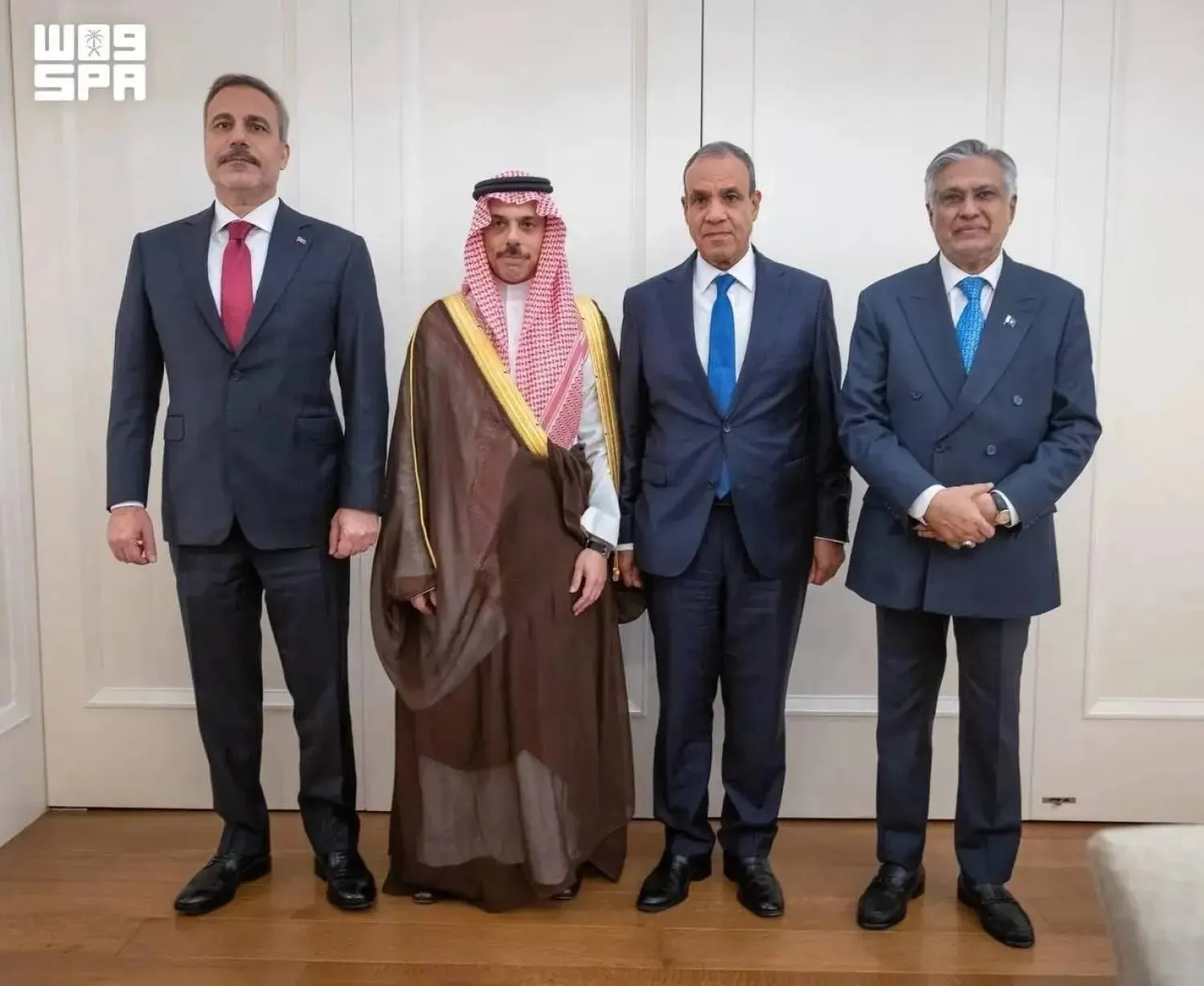
The Foreign Ministers of Saudi Arabia, Egypt, Türkiye and Pakistan. SPA
TT

The Quad Supports Sudan’s Legitimate State Institutions as Khartoum Rejects US Position

The Foreign Ministers of Saudi Arabia, Egypt, Türkiye and Pakistan. SPA

Sudan has entered a new phase marked by war and intense diplomatic and political maneuvering. Saudi Arabia, Egypt, Türkiye, and Pakistan are maintaining their support for the country's legitimate state institutions while rejecting parallel entities. Khartoum has also rejected the US position on legitimacy in the conflict.

The Foreign Ministers of Saudi Arabia, Egypt, Türkiye and Pakistan have “reaffirmed their unwavering support for the sovereignty, unity, independence and territorial integrity of Sudan, and stressed the importance of preserving its legitimate national institutions, and rejecting any parallel entities that undermine Sudan's sovereignty and unity.”

The ministers met in New York on Monday on the sidelines of the 81st Session of the United Nations General Assembly.

“They stressed the necessity of halting the illicit flow of weapons, mercenaries and foreign fighters into Sudanese territory,” a joint statement said.

“The Ministers also agreed to maintain close coordination and continue consultations on regional and international developments, to strengthen collective security and promote long-term regional stability,” the statement added.

Meanwhile, Sudan on Wednesday said it "upholds its national sovereignty" and called on Washington to engage positively with the country's government, pushing back on remarks by the US State Department calling into question its legitimacy.

The US withheld a visa for Sudanese army chief Abdel Fattah al-Burhan ahead of his scheduled visit to New York for the annual gathering of world leaders at the United Nations, reportedly making his attendance contingent on his agreeing to a 90-day ceasefire.

Sudan's war, which erupted in April 2023 following a power struggle between the military and the Rapid ⁠Support Forces, has displaced ⁠more than 14 million people and created one of the world's worst humanitarian crises.

US State Department spokesman Tommy Pigott said in a statement on Tuesday that neither the Sudanese Armed Forces, the Rapid Support Forces nor either of their respective leaders "represent legitimate, constitutional governance for Sudan."

In a statement on Wednesday, ⁠the Sudanese Ministry of Foreign Affairs and International Cooperation said it strongly rejected the statement and called on Washington to engage positively with the Sudanese government.

"The government of Sudan emphasizes that any peace initiative intended to succeed and endure must be grounded in respect for Sudan’s sovereignty, unity, territorial integrity, and legitimate national institutions," the statement said.

"It must also address the root causes of the war's continuation — foremost among them, negative foreign interference."

US Secretary of State Marco Rubio on Wednesday described trying to mediate an ⁠end to ⁠the conflict in Sudan as frustrating.

"We’ve had people agree to things, sign to things, and the commitments are never met," he told reporters in New York. "Every time it seems like we’re on the verge of making progress, one side or the other will back off because they think they’re winning or they think they could win. And there are external actors."

The dispute, first reported by Reuters, threatens to deepen tensions between Washington and Sudan's army at a critical moment in the civil war, which the United Nations calls the world's largest humanitarian crisis.

A senior Sudanese source said Burhan had postponed his trip to New York but had yet to receive official notice that the visa had been denied.

"We in the Sudanese government express our deep regret because this is a violation of the UN Convention and international law," the source said.

"Sudan's government affirms its stance towards peace."

Sudan's UN ambassador appealed to Secretary-General Antonio Guterres to intervene, arguing in a letter that preventing Burhan from attending the General Assembly would violate the UN's obligations toward member states.

In a statement sent to Reuters, UN spokesperson Stéphane Dujarric said the secretary-general is "deeply concerned that a visa has reportedly not yet been issued to the President of the Transitional Sovereign Council of the Sudan," adding that he is engaging with the US on the issue.

US officials have made Burhan's attendance contingent on his agreeing to a 90-day ceasefire proposed by US Senior Advisor for Arab and African Affairs Massad Boulos, according to a Sudanese diplomatic ⁠source and a ⁠Western analyst close to American and Sudanese officials.

In a piece in US outlet Foreign Policy published on Monday, Burhan said he would refuse external directives about the war and said previous pauses in fighting had only allowed the RSF and its backers to regroup.