Ex-Google Safety Chief Warns AI Could Harm Children More than Social Media Did

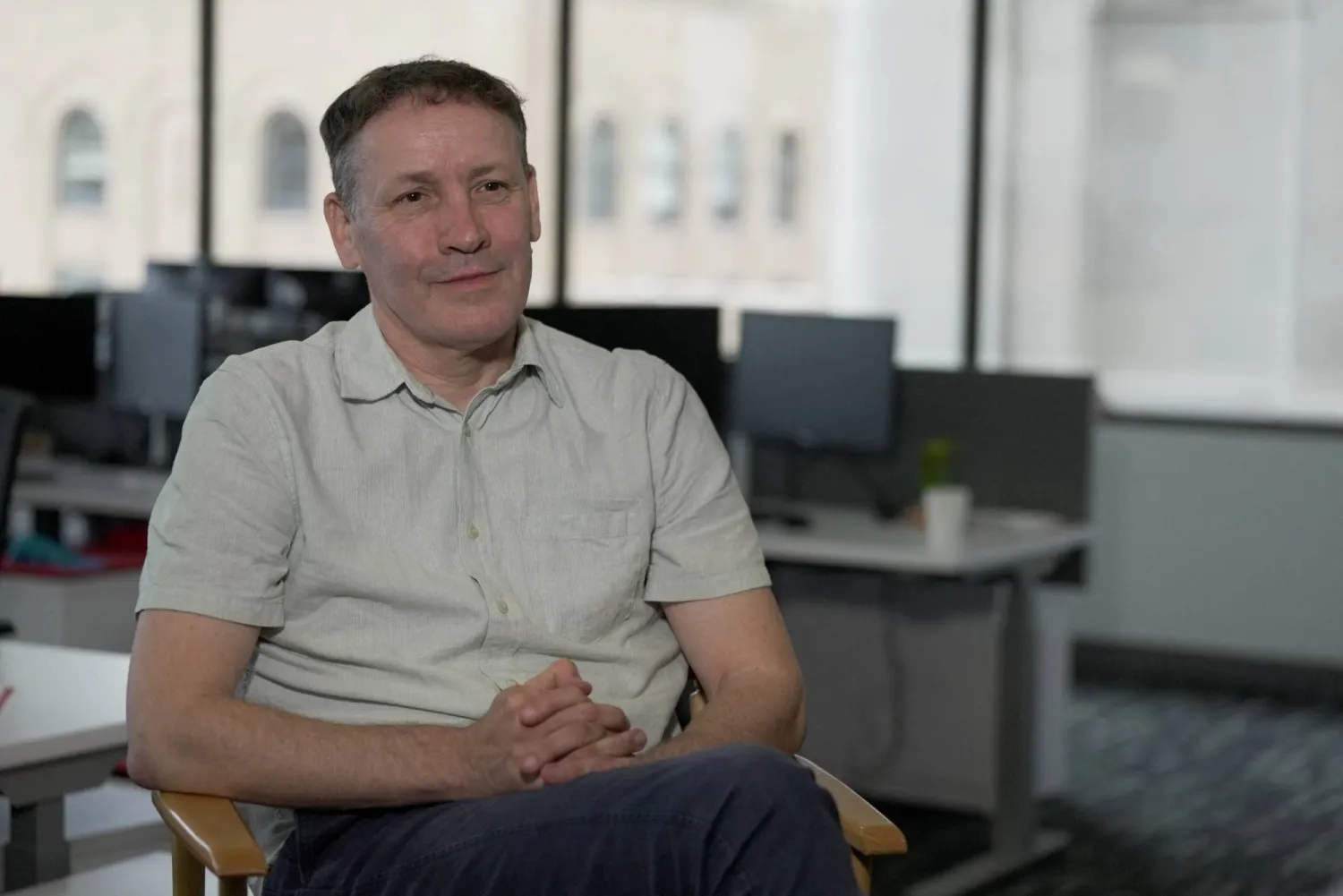
Tom Siegel, executive director of the Youth AI Safety Institute at Common Sense Media, and former vice president of trust and safety at Google, looks on during an interview in San Francisco, California, US, September 21, 2026. REUTERS/Nathan Frandino
TT

Ex-Google Safety Chief Warns AI Could Harm Children More than Social Media Did

Tom Siegel, executive director of the Youth AI Safety Institute at Common Sense Media, and former vice president of trust and safety at Google, looks on during an interview in San Francisco, California, US, September 21, 2026. REUTERS/Nathan Frandino

The founder of the trust and safety team at Alphabet’s Google this week called for a slowdown in AI development, warning that the tech industry was repeating the same mistakes from the social media era, potentially causing even greater harm to children.

Social media companies are paying huge sums and facing thousands of lawsuits over claims they harmed young users, while governments around the world are working to curb minors' access to their platforms.

Reuters last year exclusively reported on an internal Meta policy document that stated its chatbots could “engage a child in conversations that are romantic or sensual,” resulting in a congressional probe. Even so, regulation has yet to catch up with AI's breakneck pace of development.

“We find ourselves in a really terrible situation in terms of what AI is doing to kids,” Tom Siegel, the former vice president of trust and safety at Google, told Reuters. “The idea that the industry will figure ‌it out by ‌itself without outside help is unrealistic.”

Siegel's concerns mirror a growing fear among some tech insiders and ‌academic ⁠researchers that AI ⁠poses a deeper threat to children than social media did, at a time when the industry is racing to add increasingly advanced features to chatbots that millions of young people already use daily.

SIEGEL JOINS YOUTH AI SAFETY INSTITUTE

Siegel announced on Tuesday that he had joined Common Sense Media, a children’s online advocacy group. The non-profit, established in 2003, conducts research and reviews the suitability of various media for children. In May, it launched the Youth AI Safety Institute, a research organization to assess kids' AI use, for which Siegel will serve as the first executive director.

Anthropic and OpenAI Foundation, the nonprofit that controls OpenAI, are among the institute's backers.

Siegel said he planned to develop standards by which to hold AI firms ⁠accountable, and hoped to do so by working alongside those companies and third-party groups.

He previously worked ‌at Google from 2004 to 2019, but left after concluding that the tech industry ‌was “plateauing” in its ability to create safe online spaces for consumers. He then co-founded TrustLab, a startup that built tools to help companies detect safety threats, ‌before stepping aside as CEO earlier this month to take on his new position.

As it stands, major AI companies are ‌rolling out features to children without establishing sufficient guardrails, Siegel said.

RISKS RANGE FROM SUICIDE TO PSYCHOSIS

“I think we're looking at very, very severe scenarios of harm being done,” he said.

He suggested that the companies had immediate steps they could take to better protect young people, citing risks ranging from suicide and psychosis to cognitive offloading, a term used to describe decreased critical thinking caused by leaning on AI to answer questions.

Anthropic and OpenAI could enforce more robust ‌age verification measures to stop underage kids from accessing their chatbots, he said. His former employer Google could easily implement an option to turn off AI Overviews and AI Mode in its search ⁠engine, he added, in the ⁠same way that it already has a toggle that allows users to filter out sexually explicit content.

While these measures could affect usage or profits in the short term, AI companies that do not act will run the risk of lawsuits and regulation that could impact their business more heavily, Siegel added.

Asked to respond to Siegel's comments, a Google spokesman said parents have controls to turn off a child's access to the search engine entirely. "Our AI Search features are an incredibly useful way for kids and teens to learn, explore and make sense of information and the world," the spokesperson said.

After initial publication of this story, Google added in a statement that its AI tools undergo a "rigorous" testing and evaluation process focused on child safety issues.

An OpenAI spokesperson said the company uses “account and behavioral signals” in addition to self-reported age to identify underage users. “While no single age-assurance method is perfect, we continuously test and improve these systems, including against attempts to bypass safeguards.”

Anthropic did not immediately respond to a request for comment.

At Common Sense Media, Siegel said a top priority would be scaling up independent standards similar to car crash testing that would measure the risk of publicly available AI tools. The effectiveness will depend in part on the willingness of AI companies to collaborate, the likelihood of which Siegel said was not certain, but was high enough for him to take the job.



Popular Websites Subverted in Bid to Steal Crypto, Target iPhone Users

Apple's new iPhone 11 phones are displayed at the Apple Store in IFC, Central district, Hong Kong, China October 10, 2019. (Reuters)
TT

Popular Websites Subverted in Bid to Steal Crypto, Target iPhone Users

Apple's new iPhone 11 phones are displayed at the Apple Store in IFC, Central district, Hong Kong, China October 10, 2019. (Reuters)

Some of the world's most visited websites, including those belonging to Zoom, HSBC, Equifax, CNN, Salesforce and IKEA, were subverted in an effort to steal cryptocurrency and infect iPhones, a security researcher said on Monday.

Malicious JavaScript was aimed at visitors to the ‌websites of 178 ‌organizations across various sectors ‌through ⁠Optimizely, a website optimization ⁠platform, according to researcher Scott Helme.

The scripts attempted to replace cryptocurrency payment addresses with the attacker's wallet, skim card numbers as users entered credit card details, steal cookies and ⁠screenshots, and plant exploit code on ‌iOS devices.

Cybersecurity ‌firm HudsonRock also said it had found evidence ‌that the sites had served ‌malicious code to their visitors.

Reuters could not immediately ascertain whether the code was successfully used in each case, or the ‌extent of any resulting hacks.

Salesforce said it was investigating unauthorized Optimizely script ⁠changes, ⁠and had disabled them as a precaution.

Equifax also investigated the issue and ceased using Optimizely. The company said it did not find evidence of any compromise to its systems.

Optimizely, Apple, Zoom, HSBC, CNN and IKEA did not immediately respond to Reuters' requests for comment.


US Closes Loophole on China’s Access to AI Chips After Nvidia Scandal

Semiconductor chips are seen on a printed circuit board in this illustration picture taken February 17, 2023. (Reuters)
TT

US Closes Loophole on China’s Access to AI Chips After Nvidia Scandal

Semiconductor chips are seen on a printed circuit board in this illustration picture taken February 17, 2023. (Reuters)

The US Commerce Department on Monday issued a rule aimed at stopping Chinese companies from using advanced American AI chips housed in data centers in other countries.

The move comes days after a spy scandal forced Jensen Huang to step down as head of Nvidia, amid widening suspicions that he may have helped Chinese companies gain access to his company's most powerful AI chips in violation of US rules.

The Commerce Department, led by Howard Lutnick, has been accused by other voices inside the Trump White House of failing to properly enforce export controls that bar sales of Nvidia's most powerful AI chips to China.

One loophole allowed Chinese firms to rent AI computing power from data centers in Southeast Asia and elsewhere that run on US hardware not available for export to China.

Scrutiny of that loophole grew after Huang resigned last week over his relationship with Alice Huang, a former executive at Singapore-based Megaspeed.

US investigators suspect the Nvidia customer of illegally channeling the company's technology to China.

She is also suspected by some in US government to be an asset for Chinese secret services, according to The New York Times.

Megaspeed is under US investigation for possible export control violations and has denied wrongdoing. Alice Huang, who is not related to Jensen Huang, has not been charged, and Beijing has rejected the espionage allegations.

Treasury Secretary Scott Bessent on Friday blamed the Commerce Department for failing to blacklist Megaspeed over the alleged violations.

Under the new rule, data centers anywhere in the world will need a US license to provide large volumes of computing power from advanced chips to companies headquartered in China, Macau or other countries under US arms embargoes.

The rule also requires licenses to ship advanced chips to Singapore, Malaysia, Thailand, Indonesia and Brazil, which it says present a "higher-than-normal risk of diversion."

The rule "is designed to ensure that existing restrictions on access to sensitive American technology cannot be circumvented through remote computing arrangements involving data centers in third countries," the department's Bureau of Industry and Security (BIS) said in a statement.

BIS said the rule was "written by and at the direction of" the Treasury Department and the National Security Council.

The rule also formally rescinds the AI Diffusion Rule issued under former president Joe Biden. That rule set up a global licensing system for AI chips, and the Trump administration said in May 2025 that it would scrap it.


Tesla Invites Select Customers to Buy Cybercab for Personal Use

A passenger waves from a Tesla Cybercab driverless taxi as it travels through downtown Austin, Texas, US, October 27, 2026. (Reuters)
TT

Tesla Invites Select Customers to Buy Cybercab for Personal Use

A passenger waves from a Tesla Cybercab driverless taxi as it travels through downtown Austin, Texas, US, October 27, 2026. (Reuters)

Tesla said on Friday it was inviting select customers to buy the Cybercab for personal use, marking a push towards delivering fully designed autonomous vehicles to customers.

Tesla posted the announcement on X ‌with an ‌image of the golden butterfly door ‌two-seater, ⁠priced at $29,990 with ⁠an “Autonomy Subscription” of $299 a month.

Chief Executive Elon Musk said in a post on X that the offering would be available nationwide as Tesla receives regulatory approval.

"The monthly fee is too ⁠high," Musk said, adding that ‌it should match the ‌cost of Tesla Full Self Driving and connectivity ‌for other models, which is about $115 ‌per month.

The EV maker aims to start selling its Cybercab robotaxis to the public by the end of this year, ‌Lars Moravy, Tesla's vice president of vehicle engineering, said last month.

The ⁠Cybercab will work unsupervised in all the same geo locations as the robotaxi, Tesla’s head of artificial intelligence, Ashok Elluswamy, said in a separate X post.

Tesla launched its unsupervised robotaxi service in Austin, Texas, in June 2025, expanded the offering to Dallas and Houston in April 2026 and rolled it out in Miami in July 2026.