Iraqi Prime Minister Ali al-Zaidi is seeking to restore normal relations with neighboring and regional countries through a series of meetings in New York, where he is attending the UN General Assembly.
Al-Zaidi met US President Donald Trump on Wednesday to discuss strengthening bilateral cooperation and regional developments. The prime minister’s media office said the talks covered economic and investment partnerships between Baghdad and Washington, as well as joint efforts to bolster regional and international security and stability.
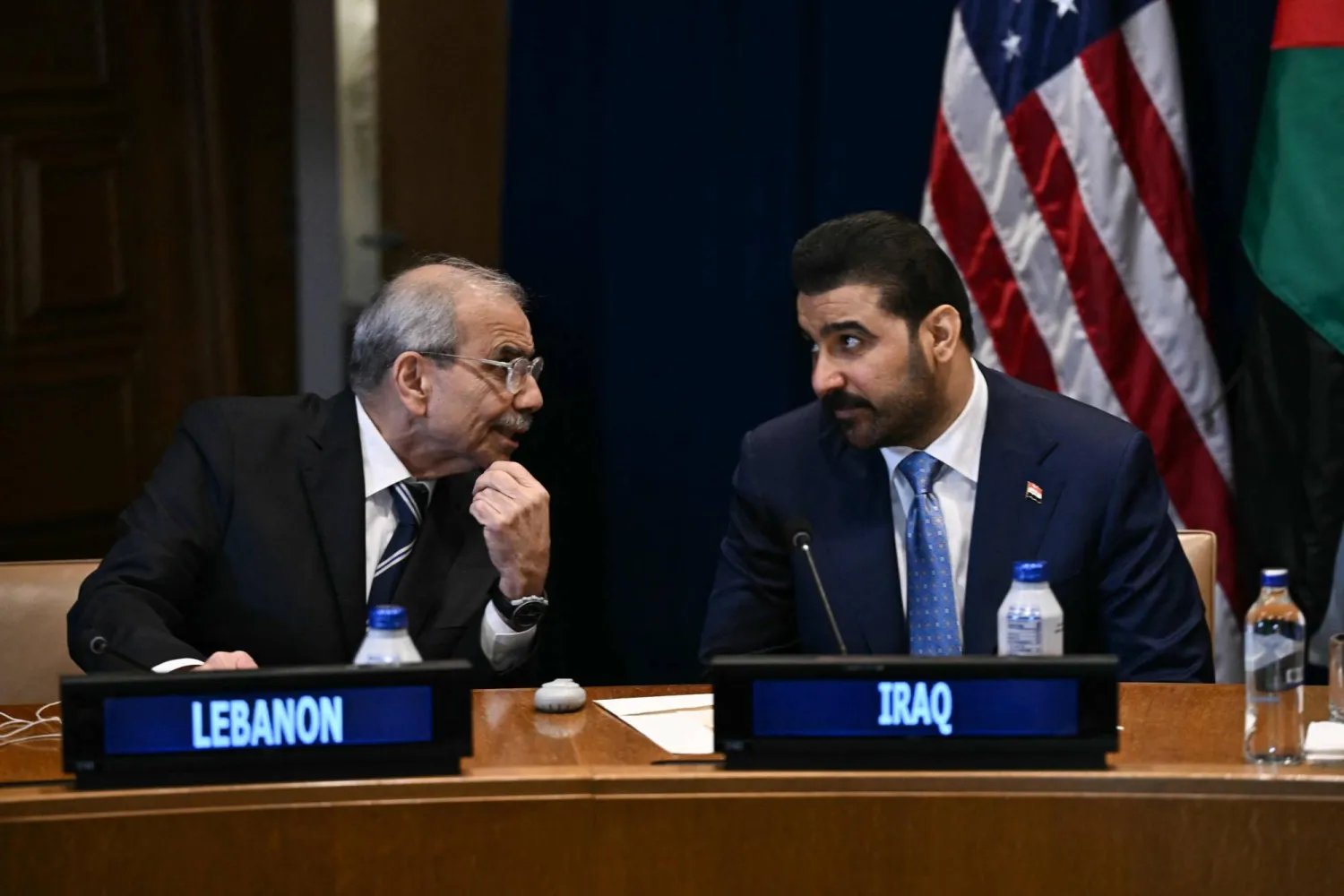
Al-Zaidi’s talks in New York have drawn particular attention, including his participation in a multilateral meeting with Trump to discuss postwar regional arrangements and his meeting with Syrian President Ahmad al-Sharaa.
Baghdad says it has been hurt by the closure of the Strait of Hormuz because of the war, but faces sharp contradictions at home because parties in the ruling Coordination Framework and armed factions are allied with Iran, one of the parties to the conflict with the United States.
Government spokesman Haider al-Aboudi said Iraq was pursuing an important program to coordinate positions and create opportunities for cooperation, noting that al-Zaidi had held several meetings in New York to coordinate policies and safeguard shared interests.
“Iraq has listened to the proposals of world leaders, but it has its own vision for producing solutions to secure energy supplies and stabilize the region,” al-Aboudi told reporters.
He explained that Iraq was guided by legal and constitutional principles of good-neighborly relations and non-interference in internal affairs while pursuing greater cooperation and integration to promote stability.
Al-Zaidi and Al-Sharaa
Al-Aboudi’s remarks followed a series of meetings al-Zaidi held with world leaders, most notably Syrian President Ahmad al-Sharaa.
Before a multilateral meeting convened by Trump on the sidelines of the UN General Assembly, journalists captured al-Sharaa and al-Zaidi shaking hands for the first time since the Iraqi premier took office.
Al-Zaidi’s office later confirmed that the two leaders met on the sidelines of the 81st UN General Assembly.
According to the statement, the talks covered regional and international developments, bilateral relations and ways to strengthen them in line with mutual interests, as well as efforts to promote de-escalation and ease regional tensions.
Al-Sharaa, for his part, told reporters that Damascus was working to provide a safe corridor for Iraqi oil exports through Syrian ports. He pointed to a strategic project to build an oil pipeline from Iraqi fields to Syrian ports, bypassing the Strait of Hormuz.
The Syrian president described Damascus’ relations with Iraq’s Kurdistan region as “very good,” citing shared interests in several areas. He also highlighted Kurdistan Democratic Party leader Masoud Barzani’s role in stabilizing Syria and integrating the Syrian Democratic Forces (SDF) into the state.
Postwar arrangements
Al-Zaidi also joined a multilateral meeting attended by Trump following what was described as a “productive” meeting between US and Iranian officials on Tuesday evening.
Al-Zaidi’s office reported that the meeting addressed security and stability, protecting global trade, securing supply chains and preserving development levels in regional economies.
Participants also discussed proposed strategies and arrangements for the postwar period and ways to advance peace and stability by prioritizing dialogue and diplomatic solutions.
The meeting included delegation heads from Saudi Arabia, Bahrain, Kuwait, the United Arab Emirates, Qatar, Oman, Jordan, Lebanon, Syria, Egypt and Türkiye, as well as the United States.
Baghdad political science professor Talib Mohammed Karim described al-Zaidi’s meetings as “an opportunity to give Baghdad greater room to build a more balanced foreign policy.”
The Iraqi government, he told Asharq Al-Awsat, was seeking security and economic cooperation and ways to protect shared interests at a complex geopolitical moment, without allowing regional relationships to become extensions of Iraq’s internal conflicts.