


US to Hand Over Center at Baghdad Airport, Says Iraqi FM

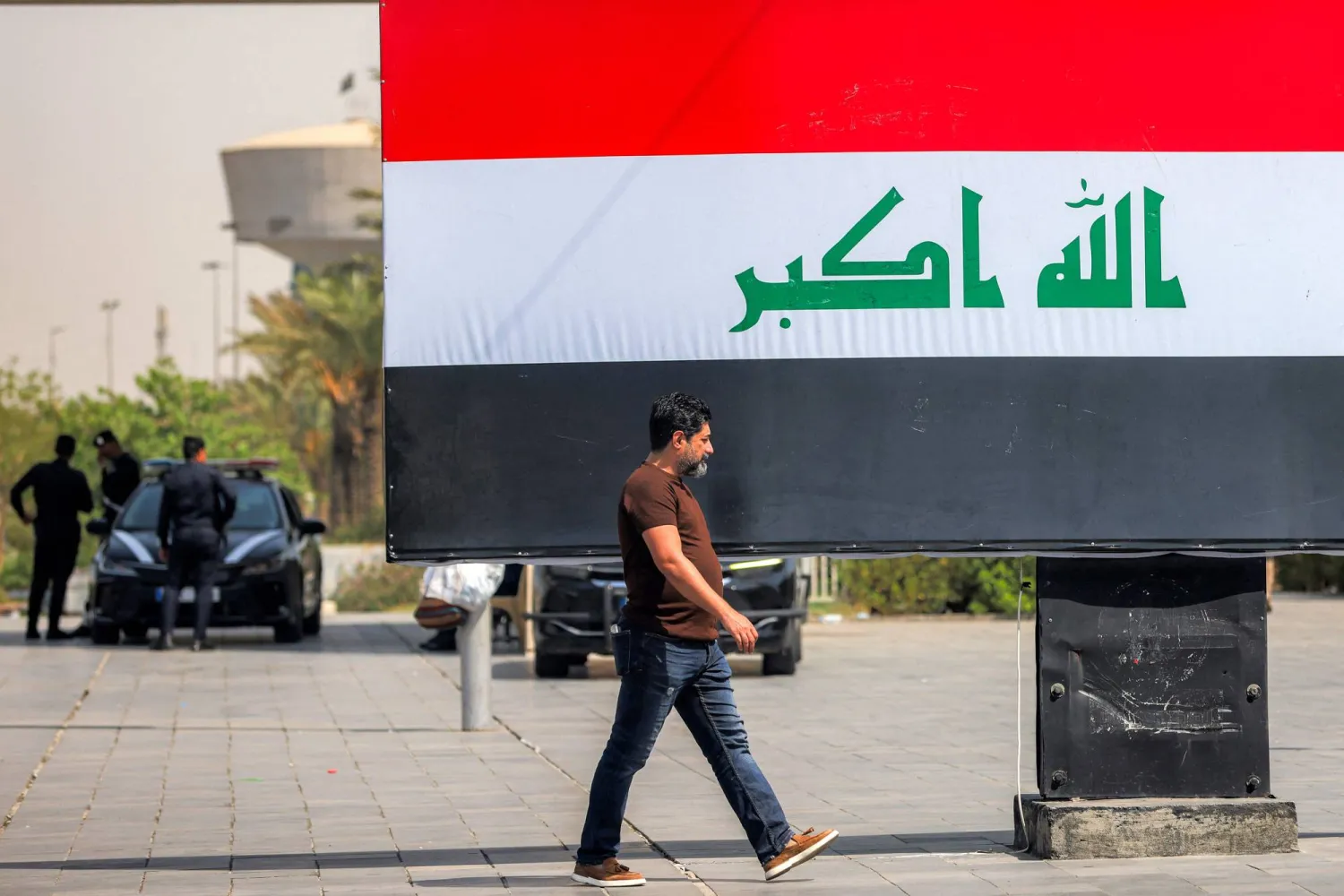
A man walks past a billboard displaying the Iraqi flag in Baghdad's central Tahrir Square on September 22, 2026. (AFP)
TT

US to Hand Over Center at Baghdad Airport, Says Iraqi FM

A man walks past a billboard displaying the Iraqi flag in Baghdad's central Tahrir Square on September 22, 2026. (AFP)

The United States will transfer to Iraq a diplomatic and logistics hub at Baghdad airport that was repeatedly targeted by Iran-backed groups during the Middle East war, the foreign ministry said Thursday.

It said an agreement was signed with the US charge d'affaires Steven Fagin "to hand over the diplomatic support center affiliated with the US embassy at Baghdad International Airport to the Iraqi government".

The move, it added, was part of efforts to end the US-led coalition's military presence in Iraq, with the remaining troops set to complete their exit by September 30.

For years, Iran-backed armed groups that have long called for the withdrawal of foreign troops have targeted US facilities and coalition forces in Iraq.

During the Middle East war, those groups targeted US sites more than 600 times, including the Baghdad airport facility.

An Iraqi security official and a diplomatic source told AFP earlier this month that US troops have already evacuated the site.

Baghdad and Washington agreed in 2024 to end the coalition's mission against the ISIS group in Iraq.

Coalition forces are now only present at Erbil airport after having withdrawn from other bases.

The coalition's presence, especially after the defeat of ISIS, has been a persistent point of friction between Iraqi authorities and Tehran-backed factions in the country.

Since taking office this year, Prime Minister Ali al-Zaidi has pledged to reinforce the state's monopoly on arms and ensure that armed factions hand over their arms to the state.

Authorities say that ending the coalition's mission removes a key justification used by those groups to keep their weapons.



Meeting between al-Zaidi, Trump Raises Questions in Baghdad

Iraqi Prime Minister Ali al-Zaidi meets with US President Donald Trump in New York on September 23, 2026. (Iraqi government)
TT

Meeting between al-Zaidi, Trump Raises Questions in Baghdad

Iraqi Prime Minister Ali al-Zaidi meets with US President Donald Trump in New York on September 23, 2026. (Iraqi government)

A meeting between US President Donald Trump and Iraqi Prime Minister Ali al-Zaidi in New York has raised questions due to the complete absence of the Iraqi delegation, coming just one day after Baghdad’s announcement that it would complete the plan to impose state monopoly over arms in June 2027.

The plan was supposed to be complete by the end of September, but it was postponed to next year.

A photograph released by the Iraqi government's media office on Wednesday showed al-Zaidi alone during the meeting, which was attended by Trump alongside senior US administration officials, including US Secretary of State Marco Rubio and Treasury Secretary Scott Bessent.

Al-Zaidi's office said that he discussed with Trump efforts by Iraq and the US to boost regional and international security and stability.

The government offered no explanation about the absence of the Iraqi delegation, which included the ministers of foreign affairs, finance, and electricity, and other officials.

Iraqi observers said al-Zaidi attended the meeting alone due to American suspicions that the discussions may be leaked to other delegation members, who are members of the Iran-aligned Coordination Framework coalition.

An Iraqi politician close to the State Administration coalition said the way the meeting was held “reflects American unease, especially by Trump, over the stalled process to impose state monopoly over weapons.”

According to official statements, September 30 will not mark the completion of the arms control process, but it will instead serve as the launching point for a new phase extending until June 2027.

Iraqi Prime Minister Ali al-Zaidi meets with US Secretary of State Marco Rubio in New York. (Iraqi government)

Al-Zaidi has evidently managed to convince the Americans to grant an additional grace period for the arms control plan, particularly after the new deadline was backed by US envoy to Iraq Tom Barrack.

Independent Iraqi politician Salah al-Arbawi said it remains to be seen whether the timetable that will be announced at the end of the month will tip the balance in favor of any political parties in the dispute over the factions’ weapons.

In remarks to Asharq Al-Awsat, he said the political parties must handle the factions’ weapons “rationally and calmly.”

He noted that al-Zaidi has managed to restore his control over the plan after it encountered obstacles in recent weeks.

Experts believe that recent discussions on the amendment of the arms control plan could turn into an opportunity to improve Iraqi-American relations.

Researcher Abbas Abboud said that the Iraqi-American relationship is being “restructured” by Barrack.

Baghdad’s relations with Washington’s allies in the region hinge on “decoupling Iraq from Iran”, he told Asharq Al-Awsat.

US Secretary of State Marco Rubio had issued a direct warning to Baghdad to "disarm the militias to avoid the balkanization of Iraq."

Rubio underlined US support for al-Zaidi's government in its efforts to consolidate state authority, urging the need to dismantle armed factions.


Lebanon PM Tells Iran President Country Cannot Be Arena for Regional Wars

Lebanese Prime Minister Nawaf Salam and Iranian President Masoud Pezeshkian meet on the sidelines of the UN General Assembly in New York. (NNA)
TT

Lebanon PM Tells Iran President Country Cannot Be Arena for Regional Wars

Lebanese Prime Minister Nawaf Salam and Iranian President Masoud Pezeshkian meet on the sidelines of the UN General Assembly in New York. (NNA)

Lebanese Prime Minister Nawaf Salam told Iranian President Masoud Pezeshkian on Thursday that his country did not want to be an arena for regional wars, after Tehran-backed Hezbollah drew it into the Middle East conflict.

Lebanon has repeatedly accused Iran of interfering in its affairs, especially since the start of the latest war, saying that Tehran was using it as a "bargaining chip" in talks with the United States.

Salam's office said in a statement that he met with Pezeshkian on the sidelines of the United Nations General Assembly in New York.

Salam "stressed that Lebanon has paid a heavy price in terms of its security, stability and economy, and that it does not want to become an arena for regional conflicts or a venue for the exchange of messages between others", it said.

Hezbollah dragged Lebanon into the broader Middle East war, which began with Israeli-US strikes on Iran, by attacking Israel in support of Tehran on March 2.

Israel responded with major airstrikes and a ground invasion that killed more than 4,300 people.

The war followed a 2023-2024 conflict between Hezbollah and Israel, which started when the group attacked Israel in support of its ally Hamas in the Gaza Strip.

Violence declined following a June framework agreement between Lebanon and Israel and a wider US-Iran deal, but Israel has continued to carry out attacks on its northern neighbor.

Salam said his country looked forward "to turning a new page" in its ties with Iran.

He called for "building a sound state-to-state relationship based on mutual respect for each country's sovereignty and independence, non-interference in each other's affairs and shared interests".

Salam said the priority was for "Israel to fully withdraw from Lebanese territory and cease its attacks, and for Lebanon to move forward with extending the authority of the Lebanese state over all of its territory".

He said Lebanon needed to ensure "that weapons are held exclusively by the state", in a jab at Hezbollah, which has so far refused to lay down its arms.

In an interview with AFP last week, Lebanese President Joseph Aoun said bilateral relations "must be based on mutual respect and non-interference".


Ground Fighting Eases in Sudan as Drone Warfare Intensifies

Sudanese army chief Abdel Fattah al-Burhan inside the presidential palace on March 26, 2025. (Reuters)
TT

Ground Fighting Eases in Sudan as Drone Warfare Intensifies

Sudanese army chief Abdel Fattah al-Burhan inside the presidential palace on March 26, 2025. (Reuters)

Ground fighting has eased on Sudan’s main fronts after army advances and a retreat by the Rapid Support Forces (RSF) in North Kordofan in recent days. Drone attacks have increased, while limited skirmishes continue on several fronts.

Witnesses and field sources said the lull followed heavy fighting that significantly changed the areas held by each side in North Kordofan.

The army captured several towns, strengthened its hold on Bara and the surrounding area, and secured the export road. It also opened a supply route from Omdurman through White Nile and North Kordofan states to El Obeid.

The RSF withdrew to the north and northwest.

The sources said the army’s advance west of El Obeid stopped abruptly when its forces reached Umm Sumaymah. A counterattack forced them back toward the outskirts of El Obeid. No further major attempt to advance has been reported on that front.

Activists said the army also pulled back from around Sodari and Mazrub after extending its defensive lines through several nearby towns. The RSF returned to the strategic town of Mazrub, which it had left during the army’s wider offensive.

In Blue Nile state, the army held its positions. Pro-army sources said its forces repelled RSF attacks and inflicted casualties and equipment losses, preventing the RSF from making further gains. The RSF and its allies still control Kurmuk and Geissan.

Direct ground fighting there has also eased in recent days, though both sides have continued attacks with drones and artillery.

Drone warfare

The army said on Thursday that its air defenses had shot down a long-range FH-95 drone it described as hostile. The announcement came days after intensive drone attacks on military sites in El Obeid.

North Kordofan residents said the RSF had stepped up drone attacks on government-held cities in the state, disrupting daily life and deepening their sense of insecurity.

Reuters recorded footage of the aftermath of major attacks this month on two cities along the front line. Residents described them as part of a new wave of strikes, following weeks in which the RSF appeared to have reduced its drone use under international pressure.

Drone use has increased sharply during Sudan’s three-and-a-half-year war. Both the army and the RSF use technology that has become central to other conflicts, including the war in Ukraine.

The United Nations says drone attacks by both sides killed more than 1,000 civilians in the first half of this year. The toll highlights the growing cost to civilians as such attacks spread beyond traditional front lines.

On September 8, a drone struck a crowded courtroom in the government-held city of Umm Rawaba. The city is in North Kordofan, a central Sudanese state that has become one of the war’s main fronts.

Emergency Lawyers, which describes itself as an independent volunteer professional group defending rights, said about 10 people were killed and dozens wounded. The courthouse was extensively damaged, with columns from its facade and debris from one of the city’s prominent buildings strewn around the site.

A day later, a drone struck the College of Development and Technological Sciences in El Obeid, the capital of North Kordofan. The strike destroyed its roof and extensively damaged its buildings.

Standing amid the wreckage as workers cleared debris, the college’s dean, Abdelaziz al-Sheikh, said a security guard had been killed and eight lecture halls badly damaged.

“We lost the college guard. Eight halls were targeted and completely destroyed,” he said. Other parts of the college had also sustained extensive damage, he added.

Omnia Abulgasim, a student who had taken an exam at the college the day before the attack, stood beside the rubble. “The whole college was destroyed. We feel our dreams and our future have been destroyed,” she said.

At a hospital in Umm Rawaba, Salah Bakhit said his arm had been crushed and his body struck by shrapnel in the courthouse attack. He had fled El Obeid for safety after months of drone attacks on the city earlier this year, as the RSF sought to increase pressure on it.

As ground fighting eases on several fronts, drones are playing a growing role in attacks on military positions, as well as on cities and civilian facilities relatively far from the fighting. Residents and vital infrastructure are bearing an increasing share of the war’s cost.