Mongolian Herders Enlist New Tech Against Harsher, Drier Climate

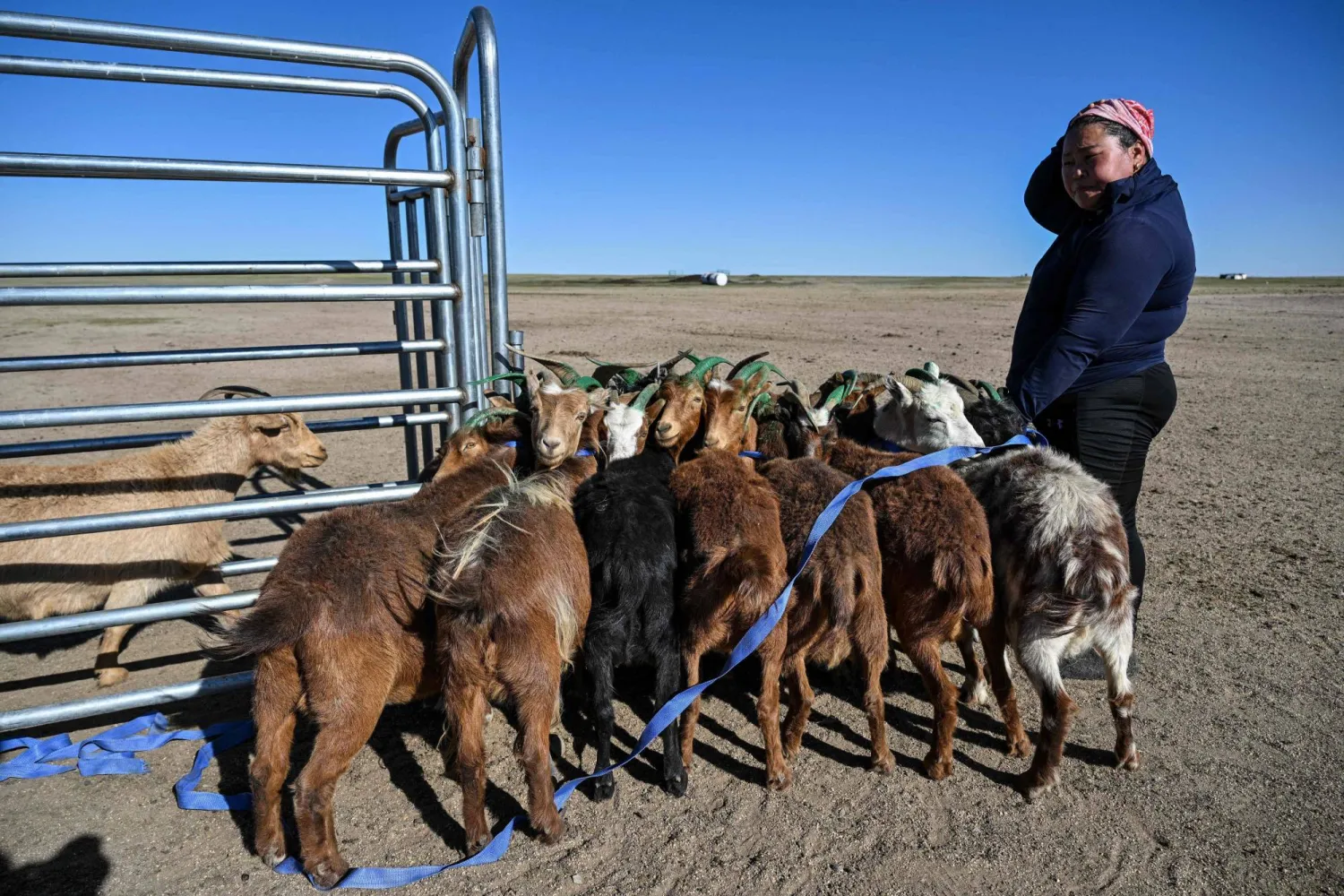
In this photo taken on August 25, 2026 sheep herder Ganchimeg stands with goats she rounded up in Bayantal, Mongolia's Govisumber province.  (Photo by Hector RETAMAL / AFP)
In this photo taken on August 25, 2026 sheep herder Ganchimeg stands with goats she rounded up in Bayantal, Mongolia's Govisumber province. (Photo by Hector RETAMAL / AFP)
TT

Mongolian Herders Enlist New Tech Against Harsher, Drier Climate

In this photo taken on August 25, 2026 sheep herder Ganchimeg stands with goats she rounded up in Bayantal, Mongolia's Govisumber province.  (Photo by Hector RETAMAL / AFP)
In this photo taken on August 25, 2026 sheep herder Ganchimeg stands with goats she rounded up in Bayantal, Mongolia's Govisumber province. (Photo by Hector RETAMAL / AFP)

When Mongolian herder Ganchimeg's sheep strayed dangerously near a salty lake this summer, driven by hunger as nearby vegetation was poor, she was in a "total panic".

"If they drank or stepped into it, the whole flock would be destroyed," she told AFP outside her traditional ger, the tent's shape silhouetted on the vast horizon of the Gobi Desert.

But thanks to an app helping herders navigate the risks that climate change is bringing to Mongolia, her husband was able to reach the sheep before they drank the brackish water.

"He immediately rushed over at top speed and intercepted them," said Ganchimeg, a mother of four who, like many Mongolians, goes by just one name.

"If we hadn't used that GPS tracker, we might have lost our entire flock."

Herders are on the frontline of both climate change and desertification impacts -- climate change is bringing extreme weather, including deadly cold snaps and droughts, which compound desertification caused by overgrazing.

Huge and sparsely populated, Mongolia is disproportionately affected by human-driven climate change, threatening the country's nomadic population and livestock.

Bilgudei Gankhulug, the 26-year-old founder of the Hunu app used by Ganchimeg, told AFP he was inspired to help herders after a 2024 "dzud" -- an extreme weather event that brought temperatures as low as minus 45C.

"Over eight million livestock died. I saw a lot of herders losing their income, losing their livelihoods in just the span of a few months," said Bilgudei.

Meaning "strong nomad", the name Hunu "embodies our mission of empowering nomadic herders with the help of technology," he said.

The app allows nomads to track their livestock with a solar-charging GPS device attached to one animal per group -- sufficient for herds that tend to stick together on the spacious steppe.

It has an artificial intelligence-powered weather feature with updates on the deadly dust storms and blizzards made more common in recent years by climate change, which scientists say is intensifying globally.

The app also compiles useful information on maps showing snow depth, wind direction, soil moisture and drought, assisting nomads in crucial decisions on where to move next.

Mongolia hosted talks on a global desertification treaty, known as COP17, last month.

Countries agreed financing for land restoration and tackling drought resilience, but concerns remain over a massive funding shortfall to the growing problem.

Bilgudei told AFP he hopes to expand Hunu to central Asian countries, and met with pastoralists from Tanzania and Uruguay at COP17 interested too.

"Our problems are pretty similar," he said.

About 80 percent of Mongolia is rangelands, large tracts of unfarmed land covered by native grasses and shrubs, according to Chimeddorj Buyanaa, Mongolia conservation director at the World Wildlife Fund.

"Rangelands are critically important for the local communities and also for the livelihoods of all of the Mongolian people," he told AFP.

Compounding the issue of climate change is rampant overgrazing that also endangers the region's wildlife, including snow leopards and saiga antelope, Chimeddorj said.

Around one in four Mongolians are nomadic herders.

Nearly 82 percent of the country's territory is affected by desertification and land degradation, authorities said in August.

Many herder families have simply decided to pack up and seek new lives in the city.

"Dundgovi Province's population has been declining continuously in recent years," the southern region's governor, Munkhchuluun Samdannyam, told AFP at COP17.

The worsening climate is a major problem for the province -- three-fifths of its economy depends on livestock husbandry, Munkhchuluun said -- but consequences are felt further afield.

"Dust storms can begin here and travel south to China, Korea, Japan and even as far as the United States," Munkhchuluun said.

"(It) is not only Mongolia's problem.

"It is also a global problem."

Speaking to AFP before heading to milk several camels tethered nearby, 49-year-old herder Bolormaa Erdenee said she was skeptical of forums like COP17.

"I often question whether the true voice of our herders is actually reaching decision-makers or not," she said.

Bolormaa and her husband raise about 400 livestock.

In their usual summer grazing area, she said roads for heavy mining trucks now criss-cross the steppe, kicking up dust and disrupting her animals.

Several nomadic households nearby have already relocated nearly 200 kilometers (125 miles) away in search of greener pastures.

Hunu app founder Bilgudei -- whose ancestors were nomadic herders -- said traditional migration itself is a form of environmental protection.

Bilgudei told AFP it's important to "learn from the traditions... and combine it with the science and technology".


Can't Cook or Shower: Indonesians Take Aim at Data Centers

Residents extend a supply hose to fill a barrel with clean water from a tanker truck in Kavling Bakau Serip, amid local water shortages linked to data center developments in Batam. ANDARU / AFP
TT

Can't Cook or Shower: Indonesians Take Aim at Data Centers

Residents extend a supply hose to fill a barrel with clean water from a tanker truck in Kavling Bakau Serip, amid local water shortages linked to data center developments in Batam. ANDARU / AFP

Cooking and bathing became difficult when taps ran dry in Batam, an Indonesian island where residents are protesting as data centers spring up to power the global artificial intelligence boom.

The area had suffered a "long drought" caused by low rainfall, the local water utility operator told AFP, as a strong El Nino cycle exacerbates dry weather.

But, as in other countries, anger has been directed at the data centers, warehouse-like facilities that keep apps and artificial intelligence tools running, with water often used to cool their humming servers.

Frustration is bubbling over in Indonesia and Malaysia -- especially in regions bordering Singapore that are seen as a prime location for new tech facilities.

At first the main reaction was, "thank God industry is coming" to Batam, 54-year-old tradesman Juniardi Adinda Sembiring Gurukinayan told AFP.

But severe recent outages hitting the municipal water service in some Batam communities meant "sometimes I skipped my shower".

"We cannot eat rice without water. We cannot cook vegetables without water," he said.

At the worst point, dozens of angry residents staged spontaneous protests outside Nongsa Digital Park -- a new cluster of data centers and other amenities, designated a special economic zone.

People in the district believe "that the water shortages... are related to the construction of data centers", Juniardi said.

The drought caused the nearby Nongsa Reservoir to run very low, and supply systems were further disrupted by an electrical fault, said Ginda Alamsyah, a spokesman for water utility operator Air Batam Hilir (ABH).

The tech park receives water from a different source, Duriangkang Reservoir, an industry source told AFP.

- 'Smelly, yellowish' -

Authorities in late September told developers they must build plants to desalinate seawater for cooling, to avoid straining local resources.

Companies behind operational or planned data centers at Nongsa Digital Park include the Singapore-headquartered BW Digital, DayOne, and Princeton Digital Group.

Another owner, Hong Kong-based Gaw Capital Partners, said it was "aware of the distress and frustration expressed by local residents in Nongsa and surrounding Batam communities" over water shortages.

To ensure sustainable operations, "our data center facilities must deploy a combination of advanced engineering, efficient architectural designs, and renewable energy sourcing," it said.

That includes using so-called "closed-loop" water systems that reuse resources and so require less fresh liquid.

As residents demanded a return to normal water supply at one protest last month, AFP saw a police officer filling up buckets they had brought to Nongsa Digital Park.

In nearby coastal village Mata Ikan, people had to use seawater to wash after defecating, said demonstrator Rahmat, 52, who like many Indonesians goes by one name.

"The water crisis has been going on for the past year, but it got worse in the last six months," 38-year-old Sulastri said at her home, where supply was out, so she poured water from a plastic bottle to wash dishes.

"Many of us here run small stalls. We used to make ice cubes, but we can't anymore."

The government has been distributing water from tanks driven around, but Sulastri said it was "smelly" and "yellowish".

AFP contacted the local government BP Batam, and Indonesia's ministry for economic affairs, which regulates Nongsa Digital Park, for comment. Neither responded.

Recent disruption to water distribution "was not caused by data centers or AI or investors entering that sector," Amsakar Achmad, Batam mayor and head of BP Batam said in October, according to local media.

The decline in water supply was instead "due to weather and climate factors", he said.

- Tech boom -

Data center capacity in Southeast Asia is projected to triple from 2025 levels by 2030, driven by a tenfold surge in AI use, according to a KPMG report.

This can put pressure on water supplies, but also electricity grids still heavily reliant on planet-warming fossil fuels.

The data center construction boom in Indonesia and Malaysia began when resource constraints led hyper-connected Singapore to halt new developments between 2019 and 2022.

It has since ramped up, boosting both countries' economies as governments and tech giants pour hundreds of billions of dollars into training and running AI.

Ginda said water provider ABH supports policies to encourage investment and development in Batam, south of Singapore and connected to it by undersea cables.

But he added that water demand must be managed properly, adding that ABH is trying to boost the capacity of Batam's six reservoirs by dredging them, with cloud seeding another option in dry periods.

- 'Inflection point' -

North of Singapore, Malaysia's Johor region has become "one of the largest emerging AI infrastructure clusters in the world", according to researcher James Chai of the ISEAS-Yusof Ishak Institute.

Just half a decade ago, Johor hosted 10 megawatts of data center capacity. That has ballooned by a factor of 200 to 2.1 gigawatts today, Chai said.

The environmental cost could be high.

By 2035, data centers are forecast to swallow up one-third of Malaysia's total energy consumption, the deputy prime minister told parliament in July.

The government said at that time it would only approve data center projects after ensuring sufficient energy and water supply capacity.

Johor residents have protested over dust pollution and flash floods linked to data center construction, as operators build closer to residential areas.

"Johor is at a critical inflection point," Mohd Fadhil Md Din of Malaysia's University of Technology told AFP.

"It has the potential to become Southeast Asia's leading sustainable data center hub," but only if it manages resources and spatial planning carefully, he said.

- 'We all feel it' -

Pushback sometimes works.

In Kota Damansara on the outskirts of Kuala Lumpur, a plot of land intended for a data center remains empty after local opposition.

The developer withdrew its planning permission application in August, after its neighbors spoke out online, lobbied their MP and gathered more than 9,000 petition signatures.

Jahaidi Harun, 72, had been concerned that the proposed data center could be noisy and pressure existing infrastructure.

Data centers "use a lot of water," the retiree told AFP, adding that, as in Batam, "if the rain doesn't come for one month, we all feel it".

Following the withdrawal, Malaysia's human resources minister Ramanan Ramakrishnan told local media he wasn't against "development or investment".

But "for large-scale projects that could affect the residents' lives, the people must have a say".


Electric Auto Rickshaws Reshape India’s Roads

This photograph taken on October 23, 2026 shows electric vehicles at the Mahindra Last Mile Mobility EV manufacturing facility at Zaheerabad in Sangareddy district of India's Telangana state. (AFP)
TT

Electric Auto Rickshaws Reshape India’s Roads

This photograph taken on October 23, 2026 shows electric vehicles at the Mahindra Last Mile Mobility EV manufacturing facility at Zaheerabad in Sangareddy district of India's Telangana state. (AFP)

Every 90 seconds, an electric three-wheeler rolls off the production line at an Indian factory, underscoring a transformation that has made the country the largest market for battery-powered auto rickshaws.

At a bustling plant run by Mahindra Last Mile Mobility, workers and robots fit cells into battery packs, attach body panels to metal frames and fix wheels into place, racing to meet demand for vehicles known for navigating the chaotic streets of the world's most populous country.

In September, more than one in two new three-wheelers sold in India was electric, compared with about 8.5 percent of cars and 11.6 percent of two-wheelers, reaffirming its position as the world's largest electric three-wheeler market.

"Our company has grown six times in its EV penetration in the last five years," said Mahindra LMM's chief executive Suman Mishra.

She said adoption accelerated over the past two years as government subsidies, improving vehicle quality and falling operating costs combined to make ownership more attractive.

E-rickshaws first appeared on New Delhi's streets more than a decade ago, often assembled in roadside workshops using Chinese-made batteries fitted to modified pedal-powered tricycles.

But the sector has since eaten into the market for sturdier fossil-fuel-powered three-wheelers, becoming a major industry as manufacturers such as Mahindra expand their share.

The shift has altered the look and sound of Indian cities.

Across northern India, e-rickshaws now queue outside railway stations and bustling markets, replacing the thumping noise of traditional "tuk-tuks".

- Fuel savings -

Mahindra is one of 15 finalists shortlisted for the environmental Earthshot Prize, to be awarded in Mumbai by Prince William on November 17.

For many drivers, however, earnings outweigh environmental benefits.

"Money is coming straight into my pocket," said Afroz Alam, a 31-year-old driver in Hyderabad who switched from a gas-powered model to an EV this year.

The cost of charging his vehicle saves him several hundred rupees a day, helping repay the loan he took out to buy the more expensive electric version.

"It may seem expensive, but then it levels out with the gas money you no longer have to pay," he told AFP.

Analysts agree economics is the key driver of adoption, with falling costs of batteries and rising fuel prices widening the advantage of e-vehicles.

Indian think-tank CEEW estimated in 2025 that petrol three-wheelers cost more than twice as much per kilometer to operate over their lifetime as EVs.

"Rickshaws, which operate continuously throughout the day, accumulate fuel savings rapidly," said Bidisha Bhattacharya of the Delhi-based Chintan Research Foundation.

The trend has also been welcomed by policymakers in India, which imports most of its oil and natural gas and has scrambled to manage energy costs, since conflict in the Middle East erupted in February.

Climate think-tank Ember said India consumes less transport fuel per capita than China did at a comparable income level in 2012, helped by the spread of cheap solar power and declining battery costs.

"In the race to curb oil imports, India is already far ahead," Ember said in a recent report.

Yet hurdles remain, with adoption uneven across the country.

- 'Battery will fail' -

E-rickshaws are common in cities such as Lucknow but far less visible in Mumbai, where limited parking and charging infrastructure complicate ownership.

"In Mumbai, there is no parking at all," Mishra said.

"So you can park on the side of the road for a (fuel-run) vehicle, but how do you do it for an EV when you have to charge it?"

Supply chains pose another challenge.

Last year, China restricted exports of rare-earth magnets, an essential component in electric motors, forcing several Indian automakers to cut or suspend production.

New Delhi has responded by promoting domestic manufacturing, including battery cells, most of which are still imported from China and South Korea.

"Two players are very close to commercialization of their cells in India. We have to be patient," Mishra said.

The bigger question is whether the success of e-rickshaws can be replicated in private cars and, eventually, trucks, which consume far more fuel.

Bhattacharya said commercial fleets could provide the next breakthrough.

When taxis transition to electric power, she said, they would help build the charging networks and consumer confidence.

For drivers already making the switch, the argument remains simple.

"They keep saying the battery will fail," said Mohammad Ali, 26, who bought an e-rickshaw this year.

"Do a trial, take the vehicle and do it for a day. They don't know yet how much money we are saving."


Saudi Healthcare Sector Wins 36 Awards at International Customer Experience Awards 2026 in London

File photo of the Saudi flag/AAWSAT
TT

Saudi Healthcare Sector Wins 36 Awards at International Customer Experience Awards 2026 in London

File photo of the Saudi flag/AAWSAT

The Saudi healthcare sector won 36 gold, silver, and bronze awards at the International Customer Experience Awards 2026 (ICXA) in London, including 29 awarded to Health Holding Company and its affiliated health clusters, in recognition of efforts to improve service quality and the beneficiary experience, the Saudi Press Agency reported Saturday.

Riyadh First Health Cluster led the participating healthcare entities with 11 awards, followed by Madinah Health Cluster and Eastern Health Cluster with six each. Al-Ahsa Health Cluster received five awards, while Najran Health Cluster won silver for Best Patient Experience in the category for organizations with more than 5,000 employees.

The Ministry of Health’s branch in Najran Region secured four awards: one gold and three bronzes. The Ministry of Interior’s Medical Services, represented by Security Forces Hospital in Dammam, won gold for Best Contact Center, silver for Best Patient Experience – Strategic Approach, and bronze for Customers at the Heart of Everything – Over 1,000 Employees.

In a separate achievement, Eastern Health Cluster earned “Best Practice” recognition in the Financial Resource Management category at the International Best Practice Competition 2026 (IBPC).

These achievements support the objectives of the Health Sector Transformation Program, one of the Saudi Vision 2030 realization programs, to improve access to healthcare, enhance service quality and efficiency, improve the beneficiary experience, and promote institutional excellence.