Bats Originated and Took First Flight in Europe 65 Million Years Ago

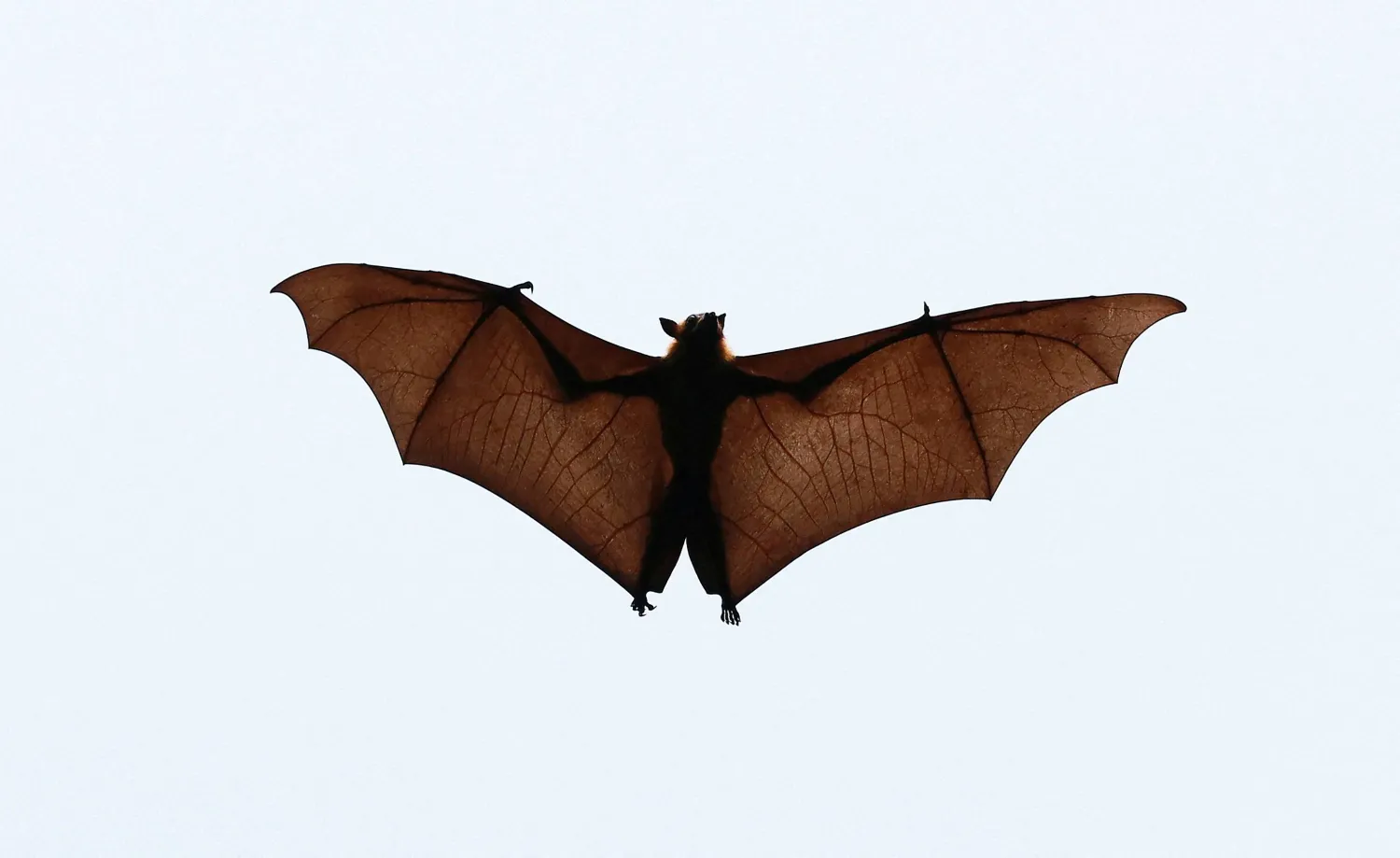
FILE PHOTO: An Indian flying fox or fruit bat flies over trees at Kodiyathur village in Kozhikode district in the southern state of Kerala, India, February 2, 2022.REUTERS/Sivaram V/File Photo
TT

Bats Originated and Took First Flight in Europe 65 Million Years Ago

FILE PHOTO: An Indian flying fox or fruit bat flies over trees at Kodiyathur village in Kozhikode district in the southern state of Kerala, India, February 2, 2022.REUTERS/Sivaram V/File Photo

Scientists have long struggled to establish where bats first originated, with previous hypotheses proposing Africa, Asia and North America.

A new research has rewritten the evolutionary history of bats, providing evidence the winged mammals most likely originated in Europe during the late Palaeocene, some 65-60 million years ago.

By combining genomic data from all living bat families with ancient fossil records, an international team of 137 researchers from 64 countries working as part of the Bat1K consortium, a global initiative dedicated to sequencing the genomes of all living bat species have reconstructed the evolutionary history of the world's only mammals capable of true powered flight.

The landmark study published in Nature magazine analyzed 103 bat genomes, including 42 newly generated chromosome-level assemblies, representing all 21 recognized bat families.

This was combined with evidence from 44 fossil bats. The results provide a clearer picture of where and how this remarkable lineage emerged.

The researchers found that bats most likely first evolved in Europe during the late Palaeocene. And from there, their descendants spread into Africa.

As bats diversified, different groups then expanded independently into the Americas, Asia and Australia, eventually giving rise to the major bat groups found around the world today.

“The approach we used to model the evolution of fossil and living species together can do what other methods cannot - identify the oldest group of fossil bats while taking the genomic data into account, and uncover when and where bats originated,” said senior author Professor Liliana M Davalos from Stony Brook University.

Computationally reconstructing the genome of the ancient ancestor from which all living bats descended, researchers are able to offer a glimpse into the genetic make-up of one of the earliest flying mammals.

This new genomic resource will allow scientists to investigate the genetic changes behind bats' extraordinary diversity and adaptations, including flight, echolocation, longevity and resistance to disease, as well as their remarkable resistance to disease and exceptionally long lives, for their size.

Bats are among the most extraordinary mammals on Earth. They are the only mammals capable of true powered flight. Most bats orient and hunt in complete darkness using sound alone, and they account for one fifth of all living mammals, playing a vital role in maintaining healthy ecosystems across the globe.

Many bat species show remarkable resistance to disease and live exceptionally long lives for their size.

Yet despite their unique biology and ecological importance, scientists have struggled for decades to answer some of the most fundamental questions about their evolution.

“It is extraordinary, after decades of research and conflicting findings, we finally have a robust phylogenetic tree that we can now use to properly understand how and where bats’ unique traits evolved,” said leading senior author and co-founding Director of Bat1K Professor Emma Teeling, from the UCD School of Biology and Environmental Science.

“We also have the genomes to uncover the molecular basis of these spectacular mammalian adaptations and know where the fossil bats fall in this tree.”

This new study represents the largest combined bat genome and fossil study ever undertaken, drawing on samples collected over decades from bats around the world, including some of the rarest and unusual species found only in the most remote locations.


India Stirs Up Its Gastronomy with French Cooking Schools

The boom in French cooking schools in India reflects a growing demand for high-end hospitality workers in the world's most populous country. Arun SANKAR / AFP
TT

India Stirs Up Its Gastronomy with French Cooking Schools

The boom in French cooking schools in India reflects a growing demand for high-end hospitality workers in the world's most populous country. Arun SANKAR / AFP

Fiercely proud of its culinary traditions, India is increasingly open to foreign influences, with French cooking schools attracting students eager to make their mark on the country's growing fine-dining sector.

"Ten or 15 years ago, there were far fewer young people dreaming of becoming chefs," said Aabhas Jain, director of bakery and pastry training at Ecole Ducasse, a French culinary school also operating in India.

"But with the rise of social media... today's students have greater ambitions in this profession," added Jain, 36, who is also part of the Indian School of Hospitality (ISH) in Gurugram, just outside New Delhi.

In the world's most populous country, the need for high-end hospitality workers is immense, fueled by economic growth and the rise of a middle class that travels more and increasingly eats at plush establishments.

"There are plenty of job opportunities," said Saurav Chhabra, head of French hotel school Vatel's Indian campus, which has been based in Gurugram since 2015 in partnership with Sushant University.

"Employers' expectations are very high, particularly in five-star hotel chains."

- 'Braising, blanching' -

Culinary and pastry courses, once relatively rare in India, have proliferated over the past decade, with foreign private schools helping drive its high-end hospitality sector.

Such is the enthusiasm that France is considering opening vocational schools, notably in Puducherry, the former French colonial port in India's southeast.

Ecole Ducasse has more than 600 students, most from affluent backgrounds.

Indian chefs who have worked at prestigious restaurants, including overseas, teach their respective specialties: Indian, European, Mediterranean and Asian cuisine, as well as bakery and pastry-making.

Siddhant Marwah, a final-year student, joined the school to acquire "French techniques that represent the quintessence of culinary expertise."

As he puts the finishing touches to a gratin dauphinois -- a dish of sliced potatoes baked in cream -- he explains that French and Indian cuisines share techniques such as "braising, blanching, and slow cooking in stews."

While France boasts its beef bourguignon, India is not to be outdone with goat nihari, a meat dish cooked for hours in a spicy broth.

Drawn by the opportunities for travel and meeting people that a career as a chef offers, Marwah already dreams of opening his own restaurant in India.

Nearby, Amitabh Sukhwal has just enrolled at Vatel, whose tuition fees are considerably lower than those at Ecole Ducasse.

The school has around 120 students, many from modest backgrounds.

Sukhwal, 18, who calls himself a "lover of the French language", plans to go to France in four years to pursue a master's degree, gain experience abroad and then draw on it to open his own hotel in India.

He learned French through interactions with guests at the small hotel run by his parents in Chittorgarh, Rajasthan and is now honing his skills at his new school, where French-language classes are compulsory.

- 'In vogue' -

A majority of the students interviewed by AFP at the two schools plan to remain in India.

After working for many years in India's luxury hotels, chef Shikha Gupta, who teaches bakery and pastry-making at Vatel, is pleased to see her classes have "as many men as women."

"Over the past 10 to 12 years, attitudes have changed and many women have chosen to enter the culinary profession," said Ecole Ducasse's Aabhas Jain.

"We now see near parity, or even a ratio of 60 percent women to 40 percent men."

Anusha Nagia, who joined Ecole Ducasse in 2024, hopes to open a restaurant in India and one day earn a Michelin star, perhaps by betting on fusion cuisine, which is "very much in vogue."

While chicken chasseur is one of her favorite French dishes, she fondly recalls a galantine -- a French preparation of stuffed meat -- in which she and her classmates incorporated the spicy flavors of chicken tikka.


No More Taking Out the Trash at Your Airbnb

A general view of apartment and office buildings in Hanoi, Vietnam, 21 October 2026. EPA/LUONG THAI LINH
TT

No More Taking Out the Trash at Your Airbnb

A general view of apartment and office buildings in Hanoi, Vietnam, 21 October 2026. EPA/LUONG THAI LINH

The days of having to take out the trash or wash the dishes before leaving an Airbnb are numbered as the short-term rental platform is tightening rules on what conditions hosts may impose on guests.

"Our rules regarding accommodations allow travelers to receive guidelines from hosts; however, our community has let us know that they can be confusing, restrictive, and difficult to manage," Airbnb said Thursday to AFP.

New rules published this week that will apply to reservations made from November 20 will seek to reduce that confusion.

In particular the new rules will generally prohibit hosts from asking guests "to complete tasks that require significant effort or time, or would typically be performed by a cleaner, including stripping the bed, taking trash offsite, or washing and putting away dishes."

Hosts can still ask guests to put dirty dishes in the sink or separate trash and recyclables.

Hosts will also no longer be able to impose fines or penalties on guests, who instead must seek compensation for any damage from insurance provided through Airbnb.


Champion-chip: Best Fries Contest Heats Up Belgium

Fries are a national passion in Belgium. Nicolas TUCAT / AFP
TT

Champion-chip: Best Fries Contest Heats Up Belgium

Fries are a national passion in Belgium. Nicolas TUCAT / AFP

Thick or thin, greasy or crispy, with samurai sauce or a more traditional mayo dip? A TV show has been on a quest to find the best fries in potato-mad Belgium.

For four years running "La meilleure friterie" (the best chip shop), a lighthearted culinary competition aired by broadcaster RTL-TVI, has been seeking out perfection among fry peddlers in the country's French-speaking region.

Watching it is a "sacred Thursday night ritual", said David Antoine, the host.

Crowning a winner among a dozen contestants is no picnic.

"There's sometimes friction among the judges, but we always find that famous Belgian compromise" over a portion of fries, Antoine told AFP in a joking reference to the country's penchant for lengthy political negotiations.

Fried potatoes are a national dish and symbol of pride in Belgium, home to about 4,600 diners specializing in the dish known as "friteries" in French or "frituren" in Flemish.

That number "has remained stable for many years," said Bernard Lefevre of the National Chip Shop Union, an industry group, noting the "market is doing well".

Each has its own flair.

To Lefevre, a good chip is preferably cut from a Belgian potato of the Bintje variety and double fried in beef fat. And size is paramount.

"Anything under nine millimeters is too thin and anything over fourteen is too thick," he explained.

- Hand-peeled 'gold' -

At Hill's Burger, a diner in Brussels, chef Massimo Sefa has gone for a "size twelve" -- that is "a two-millimeter crust and ten millimeters of creamy flesh", he said.

The 23-year-old smiled nervously when the TV show's judges entered his joint and the cameras started rolling.

But the stress is worth it, he explained. The broadcast will shine a spotlight on his friterie and a win would likely send sales skyrocketing.

Sefa opened up shop with his two younger brothers, Lorenzo and Marco. For them chips are a family matter: their grandfather ran about 10 chip shops in Brussels.

"Wow, delicious, crispy, and peeled by hand," Fabienne De Corte, one of the judges, raved upon tasting the goods.

"Fries in Belgium are our gold," added her husband Patrick De Corte, who is also on the judging panel.

"Every little detail makes a difference."

The show has a devout following, including some who tag along for filming sometimes dressed as fry cones and chanting "We've got the fries, we've got the potatoes!".

It has also had its share of controversies, particularly on the hot topic of sauces.

A technical glitch caused trouble during public voting in the first season and some grumbled the winner had bamboozled jurors with dazzling sauces, while the fries were not to everyone's taste.

Still the show has established itself in the French-speaking Belgian media landscape at a time where fries are sometimes changing along with Belgian society.

"There are halal, vegetarian, and vegan fry shops -- that's perfectly normal; society is evolving. We're not a museum of bygone folklore," Lefevre insists.