


Heavy Fighting, Internet Disruption as Ethiopia Conflict Rages

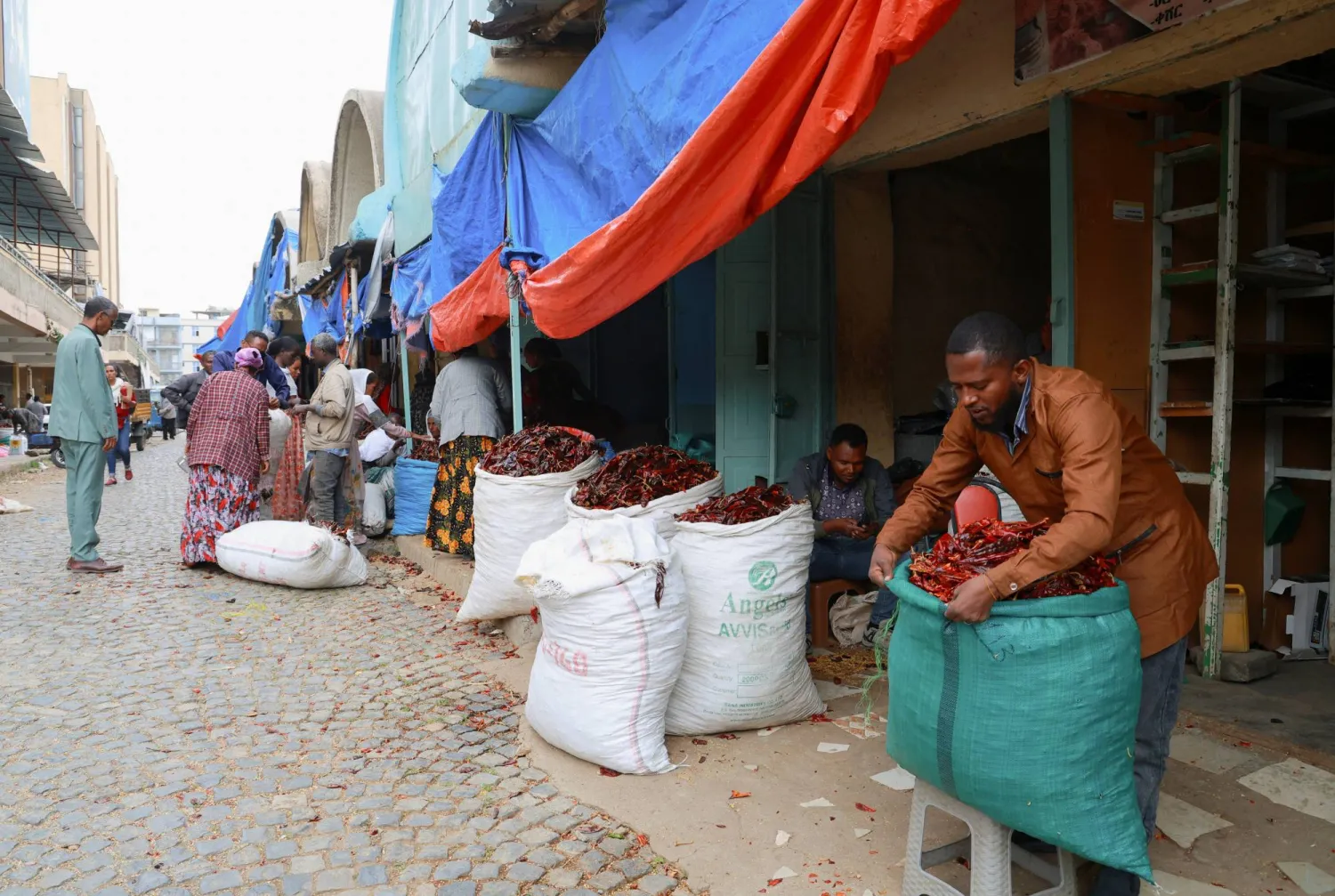
A man holds a sack of dried pepper at a local market, as tensions intensify after the forces launched a major offensive against the federal government in multiple locations, in Mekelle, Tigray Region, Ethiopia, September 24, 2026. Obtained by REUTERS
TT

Heavy Fighting, Internet Disruption as Ethiopia Conflict Rages

A man holds a sack of dried pepper at a local market, as tensions intensify after the forces launched a major offensive against the federal government in multiple locations, in Mekelle, Tigray Region, Ethiopia, September 24, 2026. Obtained by REUTERS

Ethiopian forces battled overnight to repel an assault by Tigray rebels in the Afar region, a humanitarian source said Friday, with reports of an internet blackout in the north of the country.

Rebels in the northern Tigray region seized local airports and launched attacks into the neighboring states of Afar and Amhara this week, saying they were once again in a "full-blown war" with the federal government.

Locals fear a repeat of the telecoms blackout and supplies blockade imposed on Tigray during the last civil war in 2020-2022 that killed an estimated 600,000 people.

Online monitor Netblocks said there was an "internet disruption in northern Ethiopia corresponding to reports of a telecoms blackout in Tigray". AFP was unable to contact sources in the region by phone on Friday.

A humanitarian source in Afar said there was "heavy fighting overnight" around the town of Abala that sits in the mountains on the border with Tigray.

"The federal forces pushed the rebels from entering the town," the source said, adding that a drone was used by the army.

Heavy clashes occurred in North Wollo Zone of Amhara on Thursday, including around the UNESCO World Heritage sites in Lalibela, home to Ethiopia's famed rock churches.

Analysts say the Tigray People's Liberation Front (TPLF) appears to be repeating its strategy from the last war -- pushing south through Amhara towards the capital, Addis Ababa, while the offensive in Afar is likely aimed at cutting off supplies from Djibouti, which provides almost all of Ethiopia's international trade cargo, including fuel.

The TPLF has forged an alliance with six other armed groups around the country in a bid to overthrow the government of Prime Minister Abiy Ahmed.

"The alliance is likely trying to seize settlements alongside key infrastructure routes to undermine federal government's ability to supply," Edward Bach of consultancy firm Verisk Maplecroft told AFP.

The government has a significant military advantage, however, with a large arsenal of drones, an army numbering some 500,000.

The renewed fighting comes at an awkward moment for the United States, which only this month lifted sanctions on Ethiopia and Eritrea related to atrocities committed during the last civil war, saying the "national emergency... has expired".

The US embassy sided with Ethiopia's government this week, saying it was "disappointed to see the leadership of the TPLF... launch a large-scale offensive".

The conflict could also draw in neighboring Eritrea, which fears landlocked Ethiopia is planning to invade it to gain access to the Red Sea.

- Panic buying -

Back in Tigray, prices for basic goods have been spiking as locals raced to stock up on supplies.

"There is panic in the community," Samuel Gebreslassie, 37, who works in a spice shop in the Tigray capital, Mekelle, told AFP on Thursday.

"There is deep fear that banks, telecom networks, electricity and basic goods could be cut off again."

The TPLF ruled the whole of Ethiopia from 1991 to 2018 before being sidelined with Abiy's rise, eventually triggering a civil war marked by widespread war crimes and sexual violence.

The Pretoria Peace Agreement of 2022 maintained an uneasy calm until last year, but was never fully implemented, with around one million people still displaced.

Sporadic clashes then resumed, with the federal forces launching multiple drone strikes in Tigray in recent months and massing troops at the border.

Rights groups have accused the TPLF of a campaign of forced recruitment this year as it prepared for renewed conflict.



Iran Proposes Reopening Hormuz Within 7 Days

FILE PHOTO: Vessels at the Strait of Hormuz, as seen from Musandam, Oman, September 23, 2026. Picture taken through a window. REUTERS/Stringer/File Photo
TT

Iran Proposes Reopening Hormuz Within 7 Days

FILE PHOTO: Vessels at the Strait of Hormuz, as seen from Musandam, Oman, September 23, 2026. Picture taken through a window. REUTERS/Stringer/File Photo

Iran has submitted a proposal to the United States to end their war and reopen the Strait of Hormuz within seven days, its foreign minister told media outlets in New York.

"If certain conditions are met, the strait will be open within seven days and talks will start," Abbas Araghchi, who is in the US for the UN General Assembly, told media outlets including the New York Times and The Guardian.

Japanese news agency Kyodo was the first to report the proposal, citing a senior Iranian official on Tuesday.

Iranian media, however, denied the Kyodo report, while authorities in Tehran have not clarified their position.

Araghchi also met for talks on Tuesday with US President Donald Trump's envoy Steve Witkoff.

Iran has previously set out seven conditions for ending the war and reopening the strait.

According to Araghchi, as quoted by the New York Times, the latest plan calls for a cessation of all hostilities in the Middle East for seven days, including in Lebanon.

It also calls for the release of frozen Iranian assets estimated to be worth at least $12 billion, as well as the lifting of sanctions on Iranian oil and an end to the US naval blockade of Iran.

On the seventh day of the truce, Iran would reopen Hormuz.

Araghchi said he was waiting for a US response to the plan and maintained that China supported the proposal.

Chinese President Xi Jinping is visiting the United States this week where he is meeting with Trump for talks.

Hossein Mohebi, a spokesman for the Revolutionary Guards, the ideological arm of Iran's military, told AFP in an exclusive interview on Tuesday that ending hostilities in Yemen was also among Tehran's demands.

The US and Iran signed a memorandum of understanding in June that aimed to end the war, reopen the strait and launch talks on Iran's nuclear program.

But the deal broke down shortly afterwards when Iran fired on commercial ships in Hormuz that it accused of deviating from its approved route through the waterway.

Iran requires ships to obtain authorization before passage, citing security and sovereignty reasons.

Ships that refuse to comply are regularly targeted, while the United States sporadically bombs Iranian coastal areas in retaliation.


An Explosion Near the Acropolis in Greece Injures at Least 2 People and Collapses a Building

Firefighters work at the scene following a powerful blast that caused a building to collapse and injured at least two people in Athens' Plaka district, Friday, Sept. 25, 2026. (AP Photo/Petros Giannakouris)
TT

An Explosion Near the Acropolis in Greece Injures at Least 2 People and Collapses a Building

Firefighters work at the scene following a powerful blast that caused a building to collapse and injured at least two people in Athens' Plaka district, Friday, Sept. 25, 2026. (AP Photo/Petros Giannakouris)

A powerful blast shook the Greek capital’s tourist district of Plaka, near the ancient Acropolis, on Friday morning, causing a building to collapse and injuring at least two people who had to be rescued from an adjacent building, authorities said.

The fire department said the explosion occurred in an old two-story building in the Plaka district, the historic part of Athens that lies at the foot of the Acropolis hill, Greece’s most visited ancient monument. The building collapsed, while neighboring buildings were also damaged, The Associated Press said.

Firefighters rescued two women from an adjacent building, with police saying both were being transported to a hospital. Local media said a passer-by was also slightly injured by the blast.

Police cordoned off the area, while the fire department said rescue crews were checking whether any more people might be trapped.

Video footage from the scene showed rubble strewn across the street, with parked cars smashed by falling debris.

The cause of the explosion was not immediately clear, but local media said a gas leak was suspected.


US 'Must Choose' Whether to End War: Iran President to Fox News

Pezeshkian took a defiant stand at the UN, for which he travelled to the United States, telling the world that Iran would not 'bend at the knee' to Washington. TIMOTHY A. CLARY / AFP/File
TT

US 'Must Choose' Whether to End War: Iran President to Fox News

Pezeshkian took a defiant stand at the UN, for which he travelled to the United States, telling the world that Iran would not 'bend at the knee' to Washington. TIMOTHY A. CLARY / AFP/File

It is for the United States to choose whether to end its war in Iran as Tehran does not wish to continue fighting, Iranian President Masoud Pezeshkian told Fox News in an interview aired Thursday.

Pezeshkian took a defiant stand at the UN Wednesday, for which he travelled to New York, telling the world that Iran would not "bend at the knee" to Washington -- even as US President Donald Trump acknowledged ongoing US-Iran talks.

"When we can resolve issues through dialogue, we shouldn't resort to killing one another. But with the instigations conducted by Israel, they have imposed this war on us," he said in remarks translated by the broadcaster.

"But we do not wish to continue. It's America that must choose whether it wants to end this or not."

Pezeshkian insisted Iran was ready to strike a deal with Trump to end the conflict.

"Why is it that within two weeks after the signing of an agreement, they chose to blow it up?" he said of the collapse of a shaky ceasefire.

"If the current American government, within international legal frameworks, wishes to reach an agreement, fine. If not, before the (US midterm) elections or after the elections, what difference does it make for us?"

Iranian Foreign Minister Abbas Araghchi took part in a meeting with Trump's roving envoy Steve Witkoff and son-in-law Jared Kushner on the sidelines of the UN General Assembly in New York. Their talks did not immediately yield a breakthrough.

- Houthi backers? -

As violence raged between Yemen's Houthi militant movement -- widely seen to be Iran-backed -- and the Yemeni government forces, Pezeshkian insisted the Houthis do not take direction from Tehran's government.

Washington and the Yemeni government, accuse Iran of backing the Houthi militant movement.

"The Houthis are responsible for their own actions. They don't take directions from us as those who are resisting in the region, based on the situations that have been imposed on them," Pezeshkian said, according to the broadcaster's translation of his remarks.

"We have contacts with them. There is no systematic relationship," he added.