


Can Libyan Lawmakers Force a Change in Parliament’s Leadership?

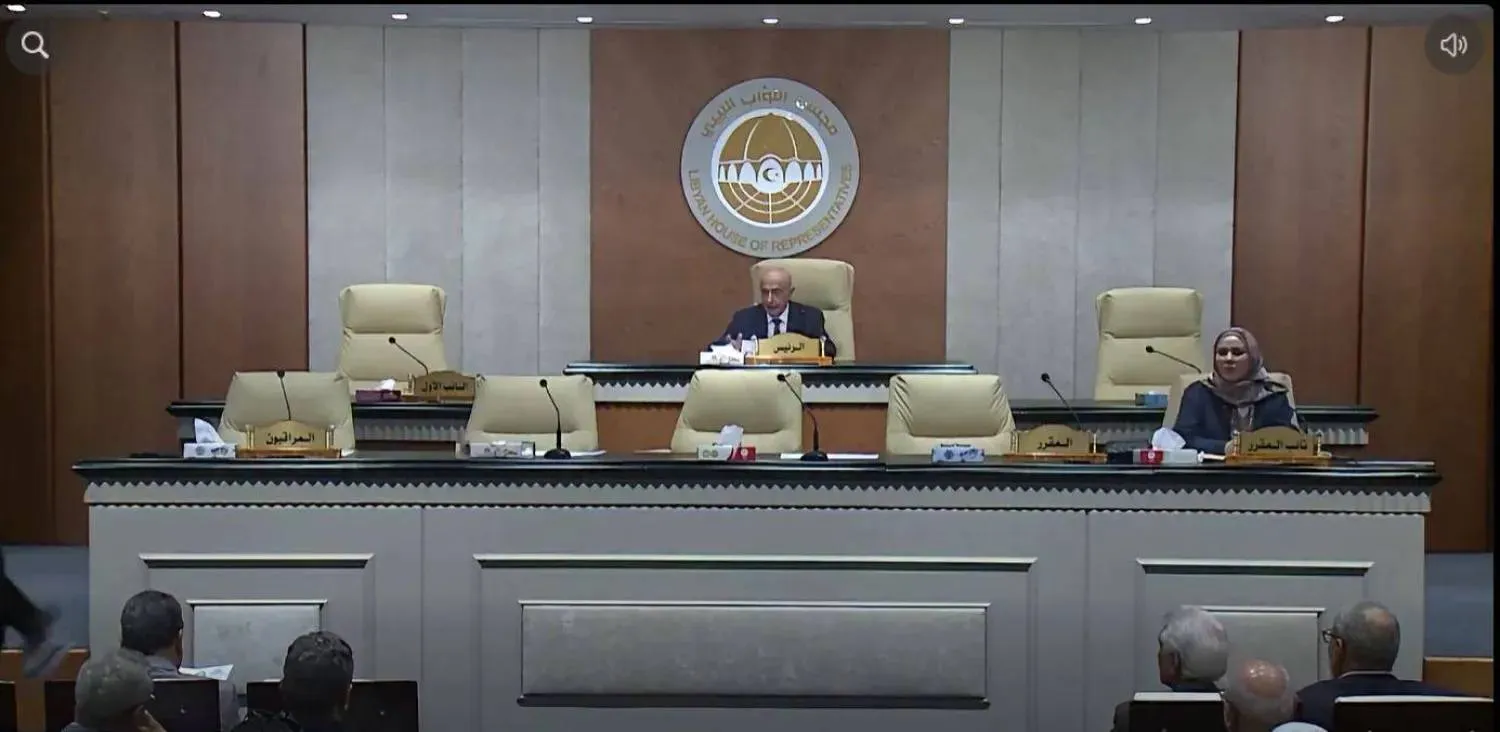
A still from the Libyan House of Representatives’ latest session on Sept. 15 (video posted by the House on its Facebook page)
TT

Can Libyan Lawmakers Force a Change in Parliament’s Leadership?

A still from the Libyan House of Representatives’ latest session on Sept. 15 (video posted by the House on its Facebook page)

A push to change the rules of Libya’s parliament and rotate its leadership has put a question to the Benghazi-based chamber: Can lawmakers unseat Speaker Aguila Saleh after nearly 12 years at its helm?

The effort has also raised questions about why a bloc opposed to Saleh’s “unilateral decision-making” is acting now, whether its campaign is tied to the “4+4” agreement, and whether that deal can be carried out.

The agreement is seen as a possible route out of Libya’s political divide through a unified executive authority that would lead the country to elections within two years.

The lawmakers opposing Saleh say they will press on with efforts to “reform parliament and change its leadership.”

They say they were blocked from holding a session on the issue in the middle of last week when the chamber’s Benghazi headquarters was closed on its leadership’s orders.

Issam al-Jehani, a prominent member of the bloc, said its 86 lawmakers could meet in any Libyan city where they could carry out their duties.

Their aim was “neither a conspiracy nor an attempt to take Saleh’s seat,” he said, but reform in response to Saleh’s unilateral decisions and determination to stay in office.

Other political figures say the campaign could splinter and fade. Its momentum, they argue, depends on the balance of power in eastern Libya and on regional pressure.

Lawmaker Ali al-Takbali expects it to lose steam. He told Asharq Al-Awsat that a similar call in March for a session to change parliament’s rules came to nothing.

He also questioned whether Saleh’s opponents could keep enough lawmakers together to hold a session to remove him. They may unite over a grievance, al-Takbali said, but become harder to assemble once they return home, particularly if some reconsider their position because of personal interests or tribal ties.

Fellow lawmaker Montaser al-Hassi warned that some members’ actions could split parliament. Lawmakers have the right to amend its rules, he said, but must do so through legal channels.

Libya has long been divided between two governments: the interim Government of National Unity led by Abdulhamid al-Dbeibah in Tripoli, and Osama Hammad’s parliament-appointed government, which runs the east and some southern cities and is backed by Libyan National Army commander Field Marshal Khalifa Haftar.

Under the “4+4” agreement reached late last month by representatives of the Government of National Unity and the Libyan National Army under UN auspices, a new presidential council and unified government would prepare the country for general elections within two years.

Some observers and political figures say regional countries regard Saleh’s continued leadership as a safeguard against a split in the legislature, which they describe as the only institution to have remained intact through Libya’s institutional divisions.

Analyst Hossam Fnish linked the turmoil in parliament to the “4+4” deal. He said the reform bloc’s insistence on changing the rules before holding sessions would delay incorporating the agreement into Libya’s constitutional declaration, hindering a deal that could lead to elections and end the divide.

The UN mission, he said, prefers to incorporate the agreement through a constitutional amendment before seeking Security Council endorsement.

Fathi al-Shibli, head of the Voice of the People party, questioned the reform bloc’s motives. Complaints about Saleh making decisions alone and sessions going ahead without a quorum had circulated for years without drawing objections from lawmakers, he said.

That, in his view, lent weight to suspicions that the dispute was a struggle between blocs backed by powerful interests, rather than a drive for reform.

Al-Shibli expects Saleh to remain in office until the UN mission calls for a constituent council to replace parliament and the High Council of State to implement the “4+4” agreement. He said both bodies oppose a change to Libya’s political landscape.

Political analyst Mohammed Mahfouz likewise described the parliamentary dispute as a contest between powerful groups in eastern and western Libya, each seeking to show the international community that it can control the political scene.

Saleh’s hold on his position rests on two factors, Mahfouz told Asharq Al-Awsat: whether he and his allies can absorb the current anger, and whether regional and Western countries support him.

Saleh’s two deputies may help him contain the challenge, Mahfouz said, because they too could face replacement.



China Says Israel Should Stop Its 'Forced Establishment' of West Bank Settlements

Cattle gather in an enclosure at a farm run by Israeli settlers near the Palestinian town of Duma in the Israeli-occupied West Bank, on October 13, 2026. (Photo by Ilia YEFIMOVICH / AFP)
TT

China Says Israel Should Stop Its 'Forced Establishment' of West Bank Settlements

Cattle gather in an enclosure at a farm run by Israeli settlers near the Palestinian town of Duma in the Israeli-occupied West Bank, on October 13, 2026. (Photo by Ilia YEFIMOVICH / AFP)

Chinese Foreign Minister Wang Yi told Israeli President Isaac Herzog that Israel should stop and reverse its "forced establishment" of West Bank settlements, China's foreign ministry said in a statement on Friday.

China has consistently held that the Palestinian question is the greatest historical injustice of this ‌century, Wang ‌told Herzog during a meeting ‌in ⁠Azerbaijan, the ministry ⁠added.

Wang had earlier said that promoting peace and reconciliation in the region is the "cornerstone" of China's Middle East policy

China believes that the "two-state solution" is the right path ⁠to a resolution and the ‌immediate priority ‌is to fully open access to the ‌Gaza Strip so a humanitarian "catastrophe" ‌is not allowed to spread, Wang added

At the same time, Israel should stop and reverse its forced establishment of ‌settlements in the West Bank, he said

China is ⁠willing ⁠to work with the international community to push all parties to return to dialogue and consultation as soon as possible and seek a political settlement of the conflict, Wang added

China has long been a supporter of the Palestinian cause and Beijing also has close ties with Israel's main regional foe, Iran.


Jbessa Gas Export Pipeline Targeted in Northeastern Syria, Fire Erupts, SANA Reports

File: Flames rise at Tishreen thermal power plant following an explosion, near Otaybah, Syria, September 30, 2026, in this screengrab from video obtained from social media. Social Media/via REUTERS
TT

Jbessa Gas Export Pipeline Targeted in Northeastern Syria, Fire Erupts, SANA Reports

File: Flames rise at Tishreen thermal power plant following an explosion, near Otaybah, Syria, September 30, 2026, in this screengrab from video obtained from social media. Social Media/via REUTERS

The Jbessa gas export pipeline in northeastern Syria was targeted in the al-Arabidi area, causing a fire, state news agency SANA reported on Thursday citing the director of the Syrian Petroleum Company's media office.

The company said in a statement that the 16-inch ‌pipeline exploded at ‌5.15 p.m. in an ‌area ⁠about 60 km ⁠from the city of Shaddadi. It did not specify the cause of the explosion, according to Reuters.

Technical teams isolated the damaged section by closing valves at the Jbessa gas plant and the ⁠Deir Ezzor gas station ‌in the al-Bughailiya area, ‌while firefighting and safety crews headed to ‌the site to secure the area, ‌the company said.

The extent of the damage and whether gas supplies had been disrupted were not immediately clear.

The explosion ‌followed a separate incident on Thursday morning in which the Baniyas-Homs ⁠oil ⁠products pipeline was damaged near the village of Hudeida in the western Homs countryside in what the company described as sabotage aimed at stealing fuel.

That incident caused a gasoline leak, the company said, adding that work was continuing to repair the damage and restore the line to service.


Netanyahu Says Spoke with Syria’s Sharaa on Sweida Unrest

People walk under a giant election billboard bearing a portrait of Israeli Prime Minister Benjamin Netanyahu's Likud party in Ramat Gan, on October 15, 2026. (AFP)
TT

Netanyahu Says Spoke with Syria’s Sharaa on Sweida Unrest

People walk under a giant election billboard bearing a portrait of Israeli Prime Minister Benjamin Netanyahu's Likud party in Ramat Gan, on October 15, 2026. (AFP)

Israeli Prime Minister Benjamin Netanyahu said on Thursday that he had previously spoken with Syrian President Ahmed al-Sharaa about violence towards the Druze community, in his first acknowledgement of direct contact.

Netanyahu did not say when exactly the call took place, but implied it had been during bloody clashes in southern Syria in July of 2025 involving Druze factions, Bedouin fighters and government security forces.

"I called al-Sharaa. It was a very short, very sharp conversation, and the slaughter stopped," Netanyahu said at an election rally with Israel's Druze community, according to footage aired by Israel's public broadcaster KAN.

The 2025 clashes erupted in Syria's Sweida province between armed Druze factions and Bedouin fighters, with government security forces and some tribal groups then intervening.

A committee set up by the Syrian government said it had documented 1,760 deaths.

Israel, which also has a Druze population, intervened militarily during the clashes, with strikes in Sweida and against government targets in Damascus, saying it was defending the minority community.

Government-aligned forces later withdrew from Sweida city, leaving a fragile ceasefire in place, and in July of this year Damascus said it had begun trying suspects over the violence.

A Syrian government source told the country's state news agency SANA on Thursday that Damascus "categorically rejects any attempt to politicize (Syria's Druze minority) or to involve it in Israeli propaganda and elections," without confirming nor denying whether the call between Netanyahu and Sharaa had taken place.

Since the December 2024 ousting of longtime Syrian ruler Bashar al-Assad, Israel has carried out hundreds of strikes in Syria and sent troops into a UN-patrolled buffer zone that had separated Israeli and Syrian forces in the Golan since 1974.

It has also carried out repeated incursions deeper into Syrian territory and has vowed to keep troops in a so-called "security zone" in southern Syria, where it seeks a broader demilitarized area.

Syria's new leaders have condemned Israeli military action in the country's south but have refrained from responding with force.

Despite the tensions, Syria and Israel have held several rounds of direct talks as they edge towards a security agreement.