Cheetah Cubs at Prague Zoo Doing Well After Strong Storms, their Mom’s Illness

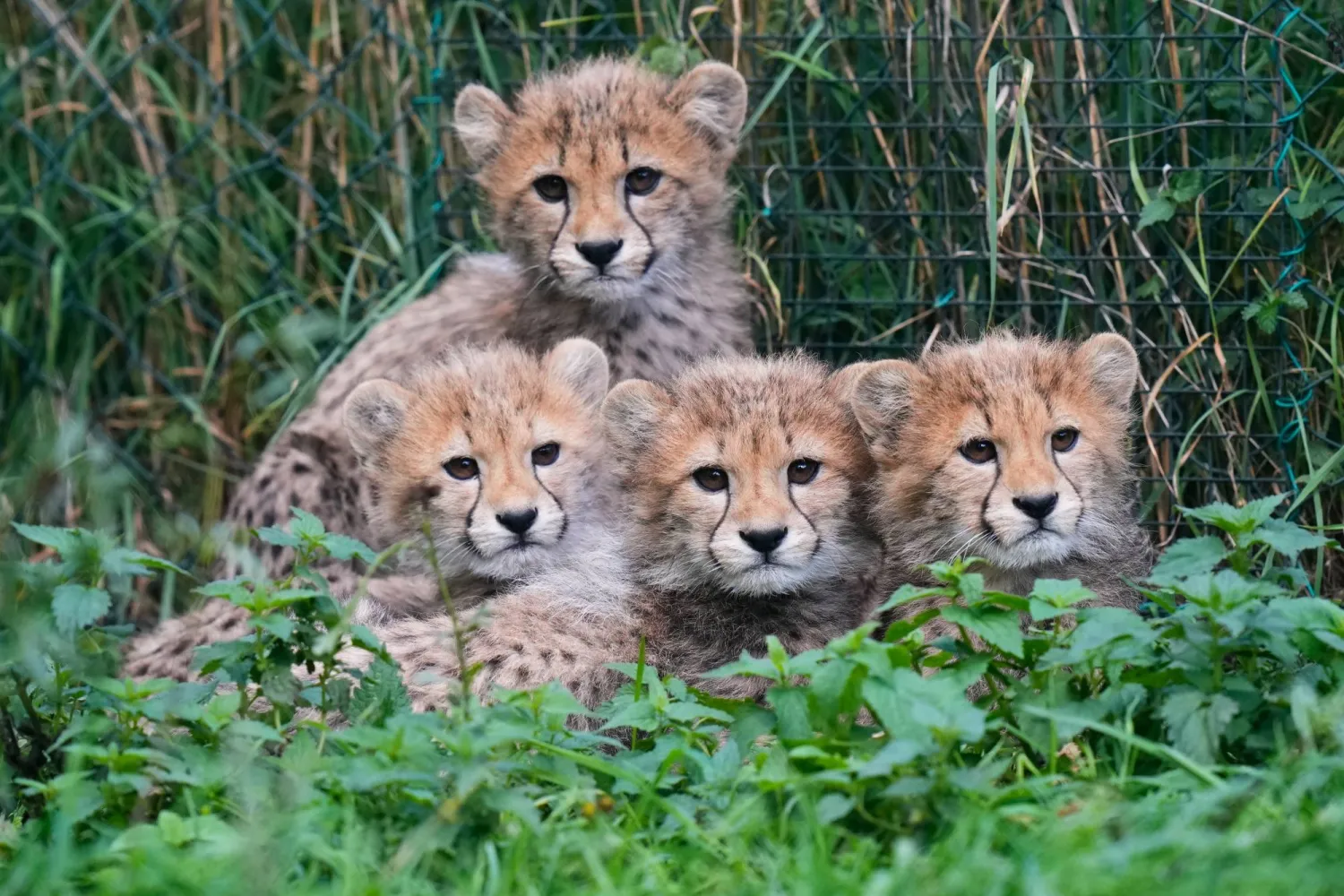
Four of the newly born cheetah quintuplets rest at their enclosure at the zoo in Prague, Czech Republic, Friday, Sept. 25, 2026. (AP Photo/Petr David Josek)
TT

Cheetah Cubs at Prague Zoo Doing Well After Strong Storms, their Mom’s Illness

Four of the newly born cheetah quintuplets rest at their enclosure at the zoo in Prague, Czech Republic, Friday, Sept. 25, 2026. (AP Photo/Petr David Josek)

Five cheetah cubs had to survive a weather scare and the illness of their mother after their birth at the Prague Zoo. But they are doing well now, the zoo said on Friday.

The zoo said the quintuplets — four males and one female — that were born on June 18 had faced a tough time from the start.

Their mother, Daenerys, opted to give birth in an outdoor enclosure with a period of strong storms hitting Prague soon after.

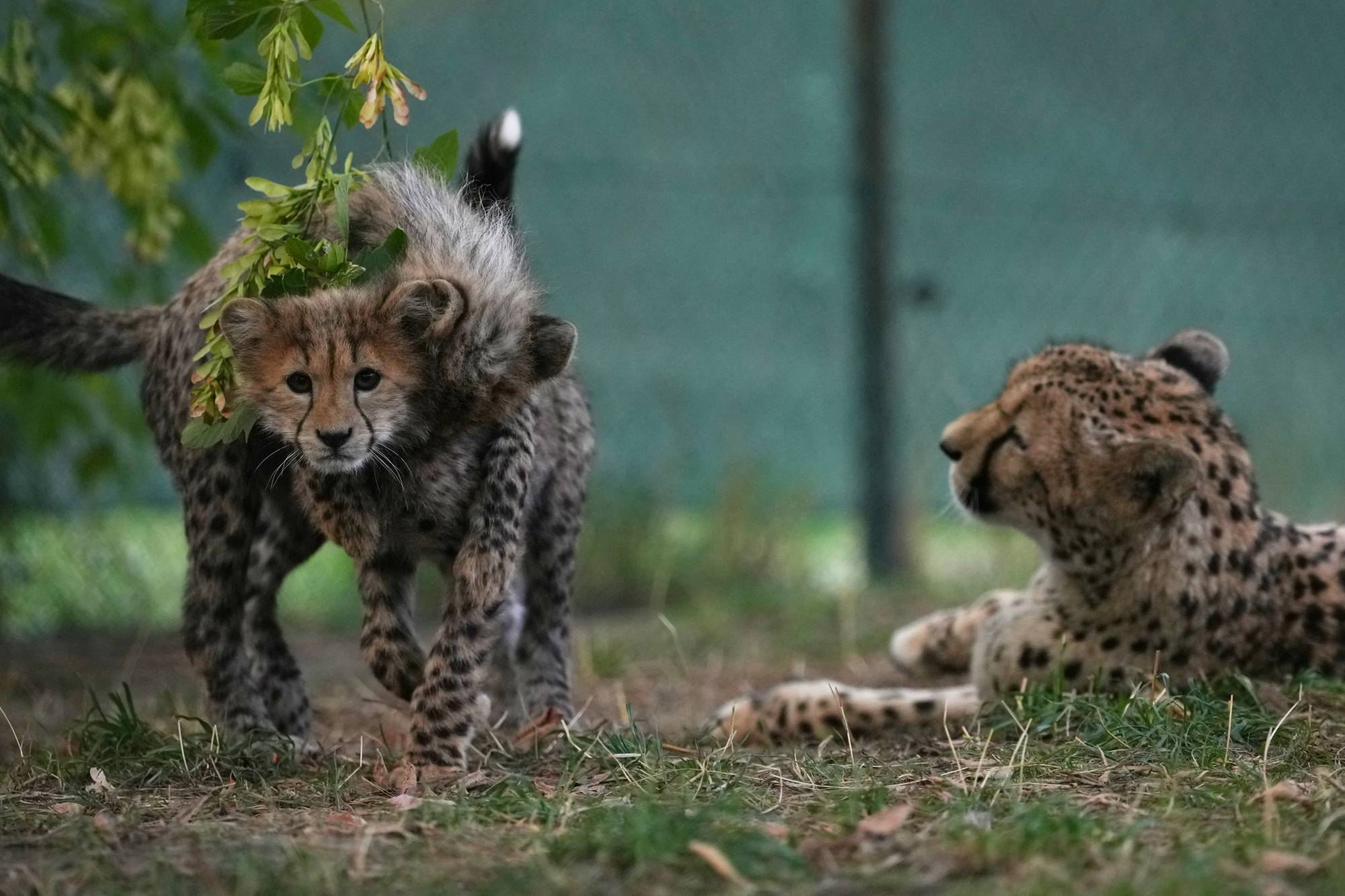
Despite her inexperience, Daenerys took “exemplary” good care of her first cubs under such weather conditions.

Daenerys protected the five from torrential rains, licking water from their fluffy fur to keep them dry, The Associated Press quoted curator Pavel Brandl as saying.

Two of the newly born cheetah quintuplets play by their mother, Daenerys, at their enclosure at the zoo in Prague, Czech Republic, Friday, Sept. 25, 2026. (AP Photo/Petr David Josek)

In the wild, the cheetah’s infant mortality is high because of predators, and cheetah cubs also are vulnerable to diseases such as pneumonia.

To make things worse, Daenerys suffered from an intestinal infection in August.

But despite all odds, the five looked lively and healthy on Friday.

“At this moment, everything seems fine, but it’s still a long run,” Brandl said.

He said that it might take a year before it’s clear that they will survive the crucial period after their birth.

Scientists say every cub is critical to saving the species, which is threatened with extinction.

Cheetahs are the fastest animals on land that can reach maximum speeds of between 70 and 75 mph (112 kph and 120 kph). It’s estimated that fewer than 7,000 of them remain in the wild.


IUCN: Indonesia Fires Threatens Critically-endangered Orangutan

This handout image taken on September 18, 2026 and released on September 19 by Indonesia's Ministry of Forestry and International Animal Rescue Indonesia (YIARI) shows a mother orangutan and her baby being evacuated by joint team members from the West Kalimantan Natural Resources Conservation Agency (BKSDA) and YIARI after they were trapped by smoke from forest and land fires in a palm oil plantation area in Pelang village, Ketapang, West Kalimantan. (Photo by Handout / Yayasan Inisiasi Alam Rehabilitasi Indonesia (YIARI) / AFP)
TT

IUCN: Indonesia Fires Threatens Critically-endangered Orangutan

This handout image taken on September 18, 2026 and released on September 19 by Indonesia's Ministry of Forestry and International Animal Rescue Indonesia (YIARI) shows a mother orangutan and her baby being evacuated by joint team members from the West Kalimantan Natural Resources Conservation Agency (BKSDA) and YIARI after they were trapped by smoke from forest and land fires in a palm oil plantation area in Pelang village, Ketapang, West Kalimantan. (Photo by Handout / Yayasan Inisiasi Alam Rehabilitasi Indonesia (YIARI) / AFP)

Wildfires that tore through Indonesian Borneo's vast tropical forests have piled pressure on critically endangered Bornean orangutans, the International Union for Conservation of Nature (IUCN) said Saturday.

Indonesia has been battling fires for weeks in parts of Borneo and Sumatra, sending suffocating haze across the islands and neighboring Malaysia and Singapore.

Fires are currently burning within habitats containing 52 percent of Borneo's orangutan population, including 13 of the 20 largest remaining populations, it said.

"Fire and smoke exposure impose measurable physiological, behavioral and ecological costs on orangutans in peat forest habitats," the conservation network said, according to AFP.

During haze, orangutans show signs of fat breakdown despite eating more and resting more, suggesting elevated energy demands likely from an immune system forced to work harder, it said.

Wildfires have also been reported in the habitats of five gibbon species across Sumatra and Borneo, the conservation network said.

"Gibbons breathe the same smoke-laden air as the people living alongside them, and there is every reason to expect they suffer similar respiratory harm, on top of habitat loss and disruption to the behaviors that keep wild populations viable."

As of Tuesday, Indonesia had rescued 100 animals, including 53 orangutans, that were threatened by the blazes, a forestry ministry spokesman said.

Conservationists call on the authorities to go beyond first response and implement prevention measures.

"Emergency response must be followed by sustained investment in preventing future fires," Ronna Saab of Forum Konservasi Orangutan Indonesia (FORINA) said in a statement.

Those measures include "protecting and rewetting peatlands, addressing drainage and deforestation, and ensuring burned forests are protected from subsequent conversion and appropriately restored," Ronna said.

The Indonesian government said more than 202,000 hectares of land were burnt countrywide between January and July, the latest available data.

The Nusantara Atlas project has put the number at closer to 900,000 hectares between January and August.


7th Person Killed by Bear in Russian Region in a Month

FILE PHOTO: Buyan, a 15-year-old male Siberian brown bear, looks out from a pool inside an open-air cage at the Royev Ruchey Zoo in the Siberian city of Krasnoyarsk, Russia, May 15, 2015. REUTERS/Ilya Naymushin/File Photo
TT

7th Person Killed by Bear in Russian Region in a Month

FILE PHOTO: Buyan, a 15-year-old male Siberian brown bear, looks out from a pool inside an open-air cage at the Royev Ruchey Zoo in the Siberian city of Krasnoyarsk, Russia, May 15, 2015. REUTERS/Ilya Naymushin/File Photo

A Russian woman has been fatally mauled by a bear in her garden, the seventh such death in her Siberian region this month, state investigators said, amid a nationwide spate of killings that experts blame on climate change and human incompetence.

A video released by investigators in Siberia's Krasnoyarsk region some 3,000 km (1,864 miles) east of Moscow showed them walking through a wooded area and inspecting the corpse of the brown bear which carried out the attack.

The state TASS news agency said the bear had killed the 51-year-old woman in the village of Voznesenka after she saw the creature trying to get into a pen in her garden where she kept domestic animals.

"The bear lunged at the woman. The predator was shot dead by a neighbor of the deceased," TASS reported, according to Reuters.

Experts cited in Russian media said that bears — which have attacked humans in at least 11 regions across Russia this year and killed at least ⁠20 people — have ⁠been forced to look further afield for food this year because an early and dry spring meant there was a lack of berries for them to feed on in September.

People are also guilty of leaving food waste out in the open where it attracts bears and of ignoring safety rules, the experts said, while in at least one region the authorities stand accused of failing to keep bear numbers down.

Shorter and milder winters, among other factors, have seen bear numbers more than double from 130,000 in 1990.

Investigators in Krasnoyarsk, home to nearly 27,000 of Russia's 308,000 brown bears according to environment ministry data, said ⁠on Wednesday they had opened a criminal case into the local environment ministry, accusing it of negligence that led to the deaths of six people — now seven, including the woman in her garden — in the region in September alone.

It said the ministry and other agencies had a responsibility to monitor and control the bear population and act promptly if people's lives were at risk.

"Despite numerous warnings of danger, officials from the ministry and other authorized officials failed to take measures to regulate the predator population and prevent their appearance in areas inhabited by people," investigators said in a statement.

"Monitoring data show that the brown bear population in the Krasnoyarsk region has increased 2.5-fold, reaching over 26,000 animals. Residents... have submitted more than 120 reports of brown bears entering the boundaries of settlements in more than 15 districts of the region, as well as in the cities of Krasnoyarsk, Zheleznogorsk and Zelenogorsk," they said.

Investigators warned people to avoid visiting forests and to postpone any plans to go mushroom and ⁠berry picking in the woods, ⁠a popular Russian pastime.

"If you encounter a large predator, you have virtually no chance of survival," the statement said.

Other people killed by bears in the Krasnoyarsk region this month include a 39-year-old male logger and two women out picking mushrooms.

In Siberia's Irkutsk region, a male pensioner who also went out mushroom picking was killed by a bear this month as were two men gathering wild plants in a forest.

In one of the most high-profile attacks this year, a bear attacked two tourists in their tent in the Altai region in August. It dragged one of the tourists, a 29-year-old woman, out of the tent, killed her, and then buried her in the forest.

And in the Siberian region of Tuva, ice hockey coach Alexander Kuzmenko — father of NHL player Andrei Kuzmenko — was killed this week by a bear while on a fishing trip.

The environment ministry has sought to play down the spate of attacks.

"In recent years, around 20 to 30 cases of bear attacks have been recorded annually," it told the RBC news outlet.

"The only abnormal spike was in 2014, when there were 166 cases. The thing is, nowadays everyone has a smartphone, and information spreads quickly via the internet and social media, which creates the impression that the problem is widespread."


In Vietnam… A Piano Concert to 150 Rescued Moon Bears

Fingers play what cages cannot (EPA)
TT

In Vietnam… A Piano Concert to 150 Rescued Moon Bears

Fingers play what cages cannot (EPA)

Rick Wakeman has played to all kinds of people around the globe, but he has now performed to an audience he had never encountered before – an enclosure of 150 bears.

The former Yes musician, who has gone on to have a prolific solo career, played the piano at a Vietnamese bear sanctuary.

“Before you ask, I won’t be playing the teddy bear’s picnic,” he joked ahead of the performance. Wakeman, who is a supporter of animal welfare causes and has rescue dogs and cats of his own, is conducting the concert to raise awareness of moon bears kept in cruel conditions for the extraction of their bile, according to The Guardian.

He said he was a bit worried about how hot it is going to be. “You know the heatwave we had in England? It’s double that,” he said. “They offered to rig up a fan for me, but I figured that will just blow more hot air around.”

His concert was performed live on a Yamaha grand piano positioned in Animals Asia’s bear sanctuary in the Tam Dao national park, and Wakeman had written some new compositions especially for rescued bears.

Asked whether the bears would enjoy the music, he said: “They’ve not got much choice, really. It’s a well-known fact that all animals react to music, especially gentle melodic music. So what I am going to do is piano music that is melodic, and I can only hope that they will come up to the perimeter of the sanctuary and have a listen.”

Wakeman has been sponsoring rescue bears since 2016 and recently adopted a new one: “He’s only 20 months old, a big fella, I went to see him today. He came out right to the edge and stood on his back legs and just stared at me, it was brilliant.”

Bile is extracted from bears for traditional Chinese medicine by putting a needle into their gall bladder and drawing it out.

The bears are kept in poor conditions in countries including China and in Vietnam, where it has just been banned, but where some bears are still in captivity in cramped enclosures.

It is the fourth-biggest market in the illegal wildlife trade in east Asia, resulting in a dramatic decline in the Asiatic black bear populations in Vietnam, with nearly a third of their numbers lost around the world in just 30 years.

Of the sanctuary, which he has been visiting this week, Wakeman said: “To see the bears be rehabilitated, having a life they never had before, some have never put their feet on grass before.”

He added: “They are so wonderful, that we can do such horrendous things to animals is beyond belief. Before this, they were chained in cages sometimes for 10 or 20 years in conditions where they couldn’t even turn around.”

He is playing to raise awareness for the bears still stuck in cages in Vietnam and to urge the government to get them released: “We have 150 bears at the sanctuary, but there are 125 bears left in cages in the old bear bile farms, and there are four dying a month. We have to get them out quick and into the sanctuary.”

Wakeman treats his rescue dogs and cats to music back at home in Suffolk. He said: “I had one cat who used to jump on the grand piano, and if I stopped playing he would put his paw in the strings and rattle them until I played again. I know if my dogs don’t like it, they will get up and walk out, and my cats don’t like metal, grunge or rap. They want a melody.”

Wakeman spends hours watching the bears. “If you see these bears it is hard to put into words, they are almost human the way they look at you,” he said.

“If you see them, you can’t help but be moved. They aren’t tame but they are very safe, very happy, they play, they romp. I witnessed two today jumping in a bubble bath and playing. They’ve got a life back,” he noted.

Dr. Jill Robinson, the founder and CEO of Animals Asia, said: “We are beyond blessed to have Rick’s support for Animals Asia and the bears.”

Robinson noted that “his love for them is immeasurable and can be heard in the beautifully haunting music he has written for them. We’re all so excited to hear his performance in the open air at our sanctuary in the stunning setting of Tam Dao national park. I can’t wait to see how the bears respond.”

Wakeman added: “I hope they lay down and have a listen, that would make my day. I would have a big grin on my face.”