Leadership Crisis in Hezbollah After Nasrallah's Assassination

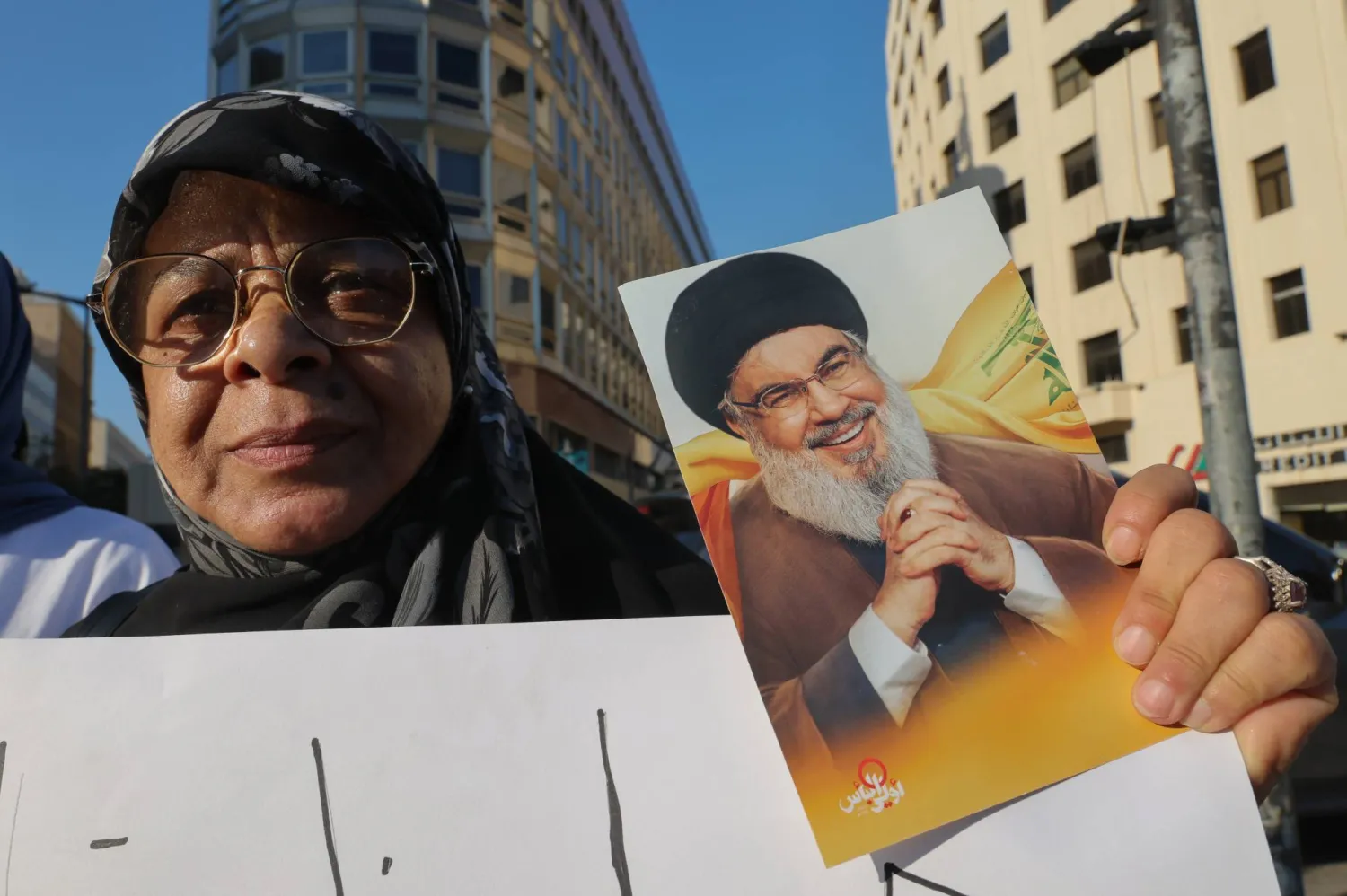
A woman carries a picture of the late Hezbollah leader Nasrallah as supporters of Hezbollah protest outside the Lebanese Government Palace in Beirut, Lebanon, 18 August 2026, rallying against direct Lebanese-Israeli talks.  EPA/WAEL HAMZEH
A woman carries a picture of the late Hezbollah leader Nasrallah as supporters of Hezbollah protest outside the Lebanese Government Palace in Beirut, Lebanon, 18 August 2026, rallying against direct Lebanese-Israeli talks. EPA/WAEL HAMZEH
TT

Leadership Crisis in Hezbollah After Nasrallah's Assassination

A woman carries a picture of the late Hezbollah leader Nasrallah as supporters of Hezbollah protest outside the Lebanese Government Palace in Beirut, Lebanon, 18 August 2026, rallying against direct Lebanese-Israeli talks.  EPA/WAEL HAMZEH
A woman carries a picture of the late Hezbollah leader Nasrallah as supporters of Hezbollah protest outside the Lebanese Government Palace in Beirut, Lebanon, 18 August 2026, rallying against direct Lebanese-Israeli talks. EPA/WAEL HAMZEH

Two years after the assassination of former Hezbollah Secretary-General Hassan Nasrallah, the group has not fully overcome the absence of the man who led it for more than three decades and transformed the secretary-general's office into a center of political, organizational, military, and popular influence that is difficult to replace.

Hezbollah will mark the second anniversary of the assassinations of Nasrallah and his successor, Hashem Safieddine, on Sunday with a public rally at Nasrallah's shrine in Beirut's southern suburbs. Its new Secretary-General, Naim Qassem, will speak at the event. Security measures will include closing roads leading to the shrine from the direction of the old airport road and Ziad Rahbani Highway and diverting traffic to other routes.

According to people close to the group and its opponents, current Secretary-General Naim Qassem does not appear to have succeeded in filling the vacuum left by his predecessor. At the same time, there has been an increasing shift in the center of decision-making within the group, with the room for internal initiative narrowing in favor of decisions coming directly from Iran.

The group's opponents say the issue is not simply a matter of the difference in charisma and popular presence between the two men, but also the nature of the role Nasrallah played within Hezbollah. He combined political, organizational, and military leadership, and served as the principal link with the group's supporters and its Iranian ally. Hezbollah today, by contrast, appears to have a more collective and structured leadership, but with a more direct Iranian role in shaping its choices and decisions.

While people close to Hezbollah believe that, despite the blows it has suffered, the group has managed to reorganize its ranks and maintain its cohesion under Naim Qassem, its opponents argue that the period following Nasrallah has exposed a leadership crisis and a decline in its ability to mobilize supporters, as well as internal divisions resulting from Qassem's performance.

A New Approach to Confronting the Challenges

Political writer Dr. Qassem Qassir, who is closely familiar with Hezbollah's position, acknowledges that after Nasrallah, the group "faced many internal and external obstacles" following a long period of centralized leadership during which Nasrallah held the reins of the organization for about 33 years, from 1992 until 2024, before his assassination under extremely difficult circumstances.

He notes that despite losing both of its secretaries-general, Nasrallah and Hashem Safieddine, along with a number of its cadres and leaders, Hezbollah succeeded in reorganizing its ranks and putting its security and organizational affairs in order under Sheikh Naim Qassem.

In remarks to Asharq Al-Awsat, Qassir says Hezbollah now faces new challenges, which has prompted it to adopt a different approach at both the domestic and external levels. He adds that while Hezbollah was previously a major regional player, it is now focusing to a much greater degree on its internal situation, southern Lebanon, and confronting Israel.

He continues that while Hezbollah is no longer the strongest political player on the domestic scene as it once was, it remains a major political force, and domestic and external actors continue to treat it as a key party in the Lebanese equation.

Asked about the charisma Nasrallah possessed, which many believe Qassem lacks, Qassir says there is no doubt that Nasrallah's charisma was distinctive. However, he describes Sheikh Naim as a highly important organizational and administrative figure who succeeded in reorganizing the group's ranks and preserving its cohesion during an extremely difficult period, given that Hezbollah is entering a new phase that requires a new approach at the political, military, and militant levels.

A Missing Leadership

Jad Al-Akhawi, head of the Lebanese Democrats Coalition and a Shiite opponent of Hezbollah, takes a different view. He says it is difficult to argue that Naim Qassem has so far succeeded in filling the vacuum left by Hassan Nasrallah.

The issue, he says, is not solely about charisma, but about the nature of the leadership Nasrallah built over more than three decades and his ability to combine organizational, political, and military leadership while maintaining direct communication with the group's supporters. Qassem, by contrast, came from a more organizational and ideological background than a popular one and spent decades serving as deputy secretary-general rather than as the group's primary center of gravity.

In remarks to Asharq Al-Awsat, Al-Akhawi says what stands out about Qassem's appearances is their format. He appears on screen, but without the direct interaction with supporters that was an essential part of Nasrallah's public image. Some of Qassem's appearances, he adds, appear to be so tightly controlled and produced that they can at times give the visual impression of an image or persona generated by artificial intelligence rather than that of a political leader interacting directly with his supporters.

He adds that Nasrallah was not merely a secretary-general, but for Hezbollah's supporters he was part of the mechanism for mobilization, persuasion, and decision-making. Naim Qassem, by contrast, has not yet demonstrated that he can inherit all of these functions collectively.

The question, therefore, is no longer simply whether Qassem can fill the vacuum left by Nasrallah, but whether Hezbollah itself can produce a comparable leadership after the collapse of a significant part of its former leadership structure.

The Decision-Making in Iran

Political activist and Lebanese University psychology professor Dr. Mona Fayad, for her part, focuses on Hezbollah's ability to mobilize people. She considers that ability to have declined significantly under Qassem's leadership, pointing to internal divisions within the group between those who support Qassem and those who oppose him, which she says have affected the way decisions are made and the current phase is managed.

Fayad believes Qassem's current performance "serves Israel," making it not in Israel's interest to target him. She also believes that decisions within Hezbollah now come directly from Iran, with the scope for Lebanese decision-making reduced to a minimum.

In this context, Fayad speaks of an Iranian "determination" to keep the Iranian ambassador in Beirut, saying his role goes beyond diplomatic work to include security responsibilities. She describes him as an "intelligence operative" whom Tehran seeks to keep in place to complete his missions.


G7 Agrees on Need to Avoid ‘Security Void’ in Lebanon After UN Force Mandate Ends

Under US pressure, the UN Security Council voted last year to end UNIFIL's mandate on December 31, 2026. (AFP)
TT

G7 Agrees on Need to Avoid ‘Security Void’ in Lebanon After UN Force Mandate Ends

Under US pressure, the UN Security Council voted last year to end UNIFIL's mandate on December 31, 2026. (AFP)

G7 foreign ministers agreed on "the need to avoid a security void" in Lebanon after UN peacekeepers pull out, French Foreign Minister Jean-Noel Barrot said on Tuesday after a meeting of the group in Paris.

They also backed "the need to move quickly toward a new security architecture" after the mandate of United Nations peacekeeping forces in Israel's neighbor expires at the end of the year, he said.

But Barrot acknowledged there had been no breakthrough on what should replace the United Nations Interim Force in Lebanon (UNIFIL), which has been in place since 1978 and now counts some 7,500 personnel from nearly 50 countries.

Under US pressure, the UN Security Council voted last year to end UNIFIL's mandate on December 31, 2026.

EU foreign policy chief Kaja Kallas told AFP in October that the bloc favored a UN peacekeeping mandate in south Lebanon.

Lebanese group Hezbollah drew the country into the broader Middle East war by attacking Israel, which responded with massive airstrikes and a ground invasion that Lebanon says have killed more than 4,300 people.

"I am hopeful that we will reach a consensus," said Barrot. "The objective is widely shared: the withdrawal of Israel (from southern Lebanon), the disarmament of Hezbollah (which is pro-Iranian), and the restoration of a strong state that holds a monopoly on the use of arms -- a state capable of ensuring the security and prosperity of all the populations and all the communities in Lebanon."

Israel now maintains troops in a self-declared occupied "security zone" running around 10 kilometers (six miles) inside Lebanon along the border.

"We underscored the need for a robust, credible, and long-lasting security architecture in Lebanon in support of the Lebanese Armed Forces," the ministers said in their final communique.

US Secretary of State Marco Rubio said on Monday that he had discussed the issue with President Emmanuel Macron and suggested that what replaces UNIFIL "doesn't have to be a military mission, it could be a civilian mission."

"We need a verification system trusted by everyone and trusted by both sides that both sides are complying with their obligations under the agreements that are in place," Rubio said.

A transitional mechanism utilizing UNIFIL forces is among the options on the table, a European diplomat said, asking not to be named.

But this could require a UN Security Council resolution and thus run into an American veto, the diplomat warned.

The Europeans are also pushing a proposal for an international military coalition tasked with supporting the Lebanese Armed Forces in their mission to disarm Hezbollah.

However, the formation of such a coalition faces hesitation from Italy, which "remains strongly committed to its presence in Lebanon but appears reluctant to join an ad hoc coalition", partly due to cost concerns, as such missions are not funded by the UN, diplomats said.


Lewis Hamilton in Egypt to Visit Gaza Humanitarian Aid Facilities

 British Formula One driver Lewis Hamilton, left, listens to Major General Khaled Megawer, governor of North Sinai, during his visit to Egypt's side of the Rafah crossing with Gaza Strip, in Rafah, Egypt, Tuesday, Nov. 10, 2026. (AP)
British Formula One driver Lewis Hamilton, left, listens to Major General Khaled Megawer, governor of North Sinai, during his visit to Egypt's side of the Rafah crossing with Gaza Strip, in Rafah, Egypt, Tuesday, Nov. 10, 2026. (AP)
TT

Lewis Hamilton in Egypt to Visit Gaza Humanitarian Aid Facilities

 British Formula One driver Lewis Hamilton, left, listens to Major General Khaled Megawer, governor of North Sinai, during his visit to Egypt's side of the Rafah crossing with Gaza Strip, in Rafah, Egypt, Tuesday, Nov. 10, 2026. (AP)
British Formula One driver Lewis Hamilton, left, listens to Major General Khaled Megawer, governor of North Sinai, during his visit to Egypt's side of the Rafah crossing with Gaza Strip, in Rafah, Egypt, Tuesday, Nov. 10, 2026. (AP)

Seven-time Formula 1 world champion Lewis Hamilton arrived at Egypt’s Rafah on Tuesday to visit organizations sending humanitarian aid to the war-torn Gaza Strip.

Hamilton has spoken out about humanitarian crises and conflict zones in the region, calling for peace. He has frequently posted on social media about children killed in Israeli airstrikes in Gaza and called for a ceasefire. He has also addressed other conflicts.

“I think we need to make sure we’re pushing to free Congo, free Sudan, free Syria, free Palestine. I think there’s a lot of peace that I’m hoping we get to at some stage,” Hamilton said last month.

While a ceasefire agreement reached last year has halted major combat operations, aid going into Gaza continues to fall far short of the agreed-upon minimum of 600 trucks a day.

Israeli forces have continued to advance into Gaza, expanding their control from 53% of the territory to at least 60%, an independent commission of UN experts said last month.

Israeli airstrikes continue across Gaza, and Israeli fire along the advancing front has killed at least 196 Palestinians, including 18 women, 32 boys and 11 girls, the commission said.

Hamilton toured Egypt’s Rafah border crossing with Gaza before visiting logistics warehouses operated by the Egyptian Red Crescent, which facilitates aid entry into Gaza.

At the crossing, Hamilton greeted aid workers with “Al-Salamo Alaykom,” an Arabic greeting meaning “peace be upon you.” He shook hands and briefly spoke with workers and officials.

Khaled Megawer, the governor of North Sinai, where Rafah is located, said the visit aims to help Hamilton learn about Egypt’s efforts to send aid to Gaza.

The visit comes after Hamilton made his 400th race start on Sunday at the Sao Paulo Grand Prix at Interlagos.

Hamilton, the first Black driver to race in F1, made his debut with McLaren in 2007. He is only the second driver in F1 to start 400 races following his former teammate Fernando Alonso, who achieved the milestone in 2024.


Israeli Fire Kills Father and Son in Gaza, Medics Say

 Palestinians inspect tents buried under rocks and earth a day after a large sandstone slab collapsed at a displacement camp, killing at least five people, including four children, according to health officials, in Deir al-Balah, central Gaza Strip, Monday, Nov. 9, 2026. (AP)
Palestinians inspect tents buried under rocks and earth a day after a large sandstone slab collapsed at a displacement camp, killing at least five people, including four children, according to health officials, in Deir al-Balah, central Gaza Strip, Monday, Nov. 9, 2026. (AP)
TT

Israeli Fire Kills Father and Son in Gaza, Medics Say

 Palestinians inspect tents buried under rocks and earth a day after a large sandstone slab collapsed at a displacement camp, killing at least five people, including four children, according to health officials, in Deir al-Balah, central Gaza Strip, Monday, Nov. 9, 2026. (AP)
Palestinians inspect tents buried under rocks and earth a day after a large sandstone slab collapsed at a displacement camp, killing at least five people, including four children, according to health officials, in Deir al-Balah, central Gaza Strip, Monday, Nov. 9, 2026. (AP)

Israeli forces ‌killed at least three Palestinians, including a father and his 13-year-old son, in the Gaza Strip on Tuesday, local health officials said.

Medics said Fadi Rajab and his son Abubakr were killed in an airstrike that hit the roof of a displacement shelter in the Zeitoun neighborhood in Gaza City, while a ‌third person ‌was killed by gunfire in Khan ‌Younis, ⁠in the south ⁠of the enclave.

The Israeli military did not immediately comment on either of the incidents.

A US-brokered ceasefire last year called for the eventual reconstruction of Gaza, but little progress has been made. Negotiators ⁠have failed to agree on ‌terms for ‌Hamas to disarm or for Israel to withdraw its ‌troops, which control about two-thirds of ‌the territory and from which residents have been ordered to leave.

Israel says Hamas is trying to regroup and refill its arsenal, while ‌Hamas says it is committed to the ceasefire agreement and accuses ⁠Israel ⁠of trying to undermine it.

At least 1,600 Palestinians have been killed in Israeli attacks in Gaza since the ceasefire agreement, according to the territory's health officials, while Israel says four soldiers have been killed.

Palestinian authorities say more than 74,000 people have been killed in Israel's assault on Gaza, launched after Hamas-led fighters killed about 1,200 people in southern Israel on October 7, 2023.