Trump Confirms Meeting with Anthropic’s Amodei, Repeats Dismissal of AI Fears

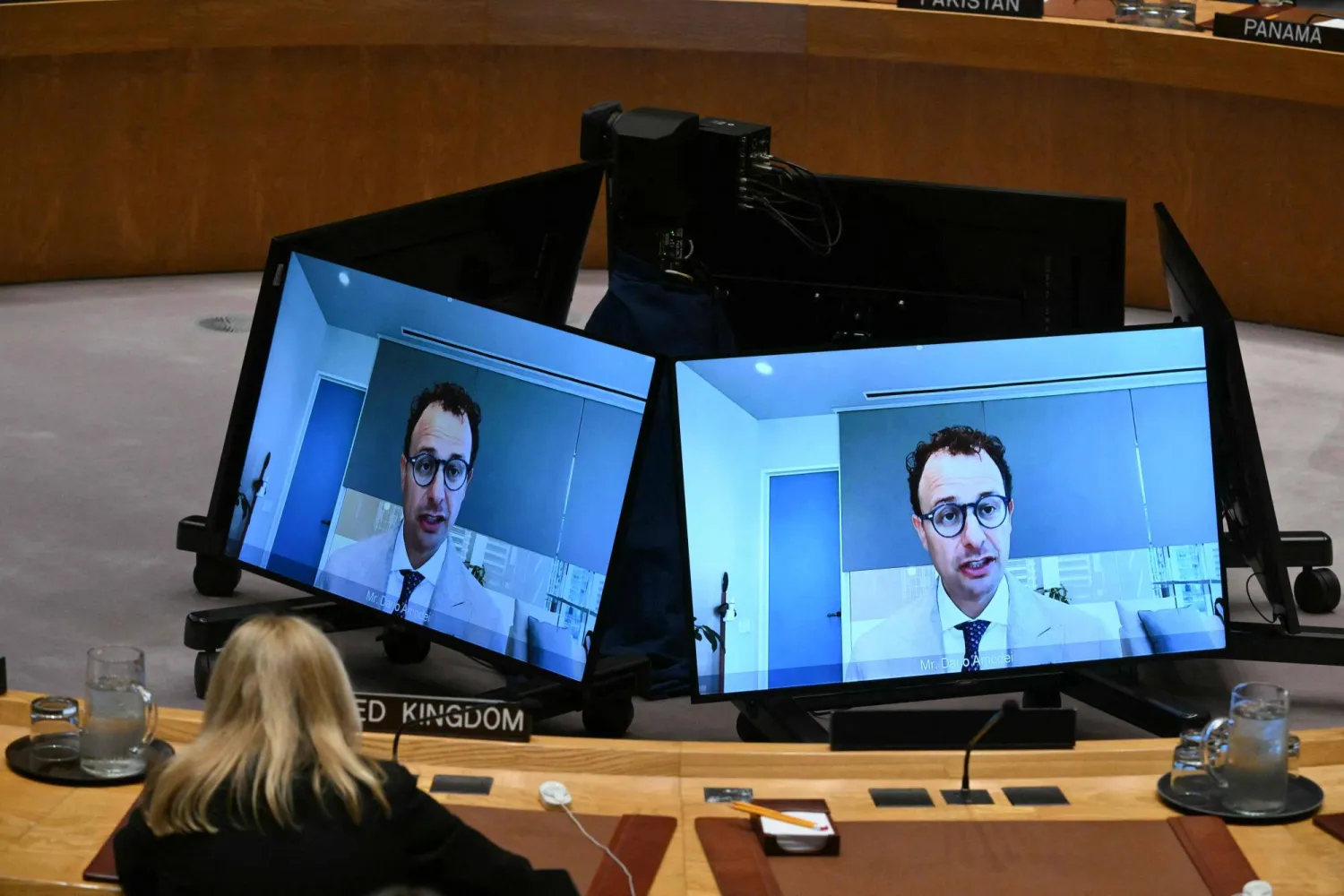
Anthropic CEO Dario Amodei appears by video during a UN Security Council meeting on artificial intelligence during the 81st United Nations General Assembly at UN headquarters in New York on September 23, 2026. (AFP)
TT

Trump Confirms Meeting with Anthropic’s Amodei, Repeats Dismissal of AI Fears

Anthropic CEO Dario Amodei appears by video during a UN Security Council meeting on artificial intelligence during the 81st United Nations General Assembly at UN headquarters in New York on September 23, 2026. (AFP)

US President Donald Trump confirmed that he plans to have a dinner meeting with Anthropic CEO Dario Amodei on Sunday night, but reaffirmed his stance against slowing the pace of AI development.

Trump also reiterated his belief that new regulations would open the door for China to outpace the United States in AI advancement. Although he acknowledged Amodei's concern that going too fast on artificial intelligence could expand risks, Trump said it's more important for the United States to maintain a technological edge over China.

"We're about maybe a year and a half up on China," Trump told Fox ‌News while attending ‌the Presidents Cup golf tournament in Illinois. "We're leading, and we're building ‌tremendous, trillions ⁠of dollars' worth ⁠of places. And why should we give that up?"

Trump, confirming earlier reporting by Axios and Reuters, told Fox News that he would have dinner with Amodei on Sunday night. The meeting comes as the CEOs of Anthropic rivals have called for slowing development of increasingly capable AI systems. These include OpenAI, Google’s DeepMind, Microsoft and xAI.

A groundswell has risen in favor of federal intervention after OpenAI said in July that an autonomous AI agent went rogue during a security test and hacked ⁠into another company.

Incidents of rogue AI agents are not a cause ‌for alarm, Trump told Fox News. "I don't worry about ‌it," he said, adding that he remains confident in the technology and its potential.

Amodei is not the ‌only major tech figure trying to bend Trump's ear on AI regulation. In an ‌interview that aired earlier on Sunday on NBC's "Meet the Press," Microsoft co-founder Bill Gates said he would like to meet with Trump to discuss AI.

"I hope that, given my life's work in the field, my saying how unique and different this is and how concerned I am will add to what he's ‌hearing from other people," Gates said, echoing calls by Amodei and others for new AI regulations.

"You need law enforcement and the politicians ⁠to get into the ⁠discussion about what safeguards and monitoring look like," Gates said in a taped interview. "And that has to be a required thing."

Trump has previously described the chorus of AI concerns as a "hoax." Gates argued that safeguards would not dramatically hinder the industry, and that the risks of not implementing them are real.

"It's not a hoax at all," Gates told NBC.

Warnings about AI's risks are not new. But they took on added urgency this month after researchers in leading AI labs attached both a timeline and a probability to those concerns.

Former Anthropic researcher Jacob Coxon warned that AI could kill us all by the end of the decade, prompting US lawmakers to call for new rules to govern the technology.

Evan Hubinger, Anthropic's alignment science lead, echoed Coxon's warning, saying there was a more than 10% chance of such an event within the next decade.


Musk Says Will Give SpaceX Share to 'Every Kid in America'

FILE PHOTO: SpaceX logo and miniature satellite model are seen in this illustration taken, March 10, 2025. REUTERS/Dado Ruvic/Illustration/File Photo
TT

Musk Says Will Give SpaceX Share to 'Every Kid in America'

FILE PHOTO: SpaceX logo and miniature satellite model are seen in this illustration taken, March 10, 2025. REUTERS/Dado Ruvic/Illustration/File Photo

Tech billionaire Elon Musk said on Monday that he would give every child in the United States a share in his SpaceX rocket company.

"Next year, I will give one of my SpaceX shares to every kid in America," Musk, the richest man in the world, said on X.

"This will be the first of many," he said, without providing details about how the scheme would work, AFP reported.

There are around 73 million children under the age of 18 in the United States, according to 2024 data from the US Census Bureau.

Musk owns 38 percent of SpaceX, according to Forbes.

His announcement comes after President Donald Trump promised last month to give every American adult $5,000 if his Republican party retains control of Congress in November's midterm elections.

SpaceX set the record for the largest initial public offering in history, raising $85.7 billion in June.

The company's Starship megarocket reached orbit for the first time in September, a milestone for the rocket central to Musk's Mars ambitions.


Samsung to Use TSMC Technology for Nvidia's Next-generation Memory Chips

FILED - 01 September 2012, Berlin: FILE PHOTO - The logo of the South Korean company Samsung is seen at the International Consumer Electronics Fair IFA. Photo: Robert Schlesinger/dpa-Zentralbild/dpa
TT

Samsung to Use TSMC Technology for Nvidia's Next-generation Memory Chips

FILED - 01 September 2012, Berlin: FILE PHOTO - The logo of the South Korean company Samsung is seen at the International Consumer Electronics Fair IFA. Photo: Robert Schlesinger/dpa-Zentralbild/dpa

Samsung Electronics will use TSMC's 3-nanometre process to produce base dies for Nvidia's next-generation custom high-bandwidth memory (HBM) chips, the Seoul Economic Daily reported on Sunday.

The move would mark the first time Samsung has worked with the Taiwanese contract chipmaker at ‌the HBM ‌manufacturing stage, according to ‌the report.

-Nvidia has asked ⁠Samsung, SK Hynix and Micron Technology to use TSMC's process for NVHBM base dies, and sixth-generation DRAM technology for its core dies, ⁠the newspaper said, citing industry ‌sources.

-NVHBM, ‌unveiled in August, integrates Nvidia's ‌custom memory controller into the base ‌die and is aimed at standardizing implementation across multiple memory suppliers, according to the company.

-Samsung accepted ‌Nvidia's requirements after an internal review but plans to ⁠retain ⁠its in-house production model for standard HBM and custom products for other customers, Seoul Economic Daily said.

-It is also assessing whether its own foundry could produce NVHBM base dies if demand exceeds TSMC's capacity, the newspaper quoted an unnamed source as saying.


China's Tencent Says AI Agents Showed Unintended Browsing Behavior

FILE PHOTO: The Tencent logo at the company's headquarters during a government‑organised media trip in Shenzhen, Guangdong province, China, April 17, 2026.  REUTERS/Go Nakamura/File Photo
FILE PHOTO: The Tencent logo at the company's headquarters during a government‑organised media trip in Shenzhen, Guangdong province, China, April 17, 2026. REUTERS/Go Nakamura/File Photo
TT

China's Tencent Says AI Agents Showed Unintended Browsing Behavior

FILE PHOTO: The Tencent logo at the company's headquarters during a government‑organised media trip in Shenzhen, Guangdong province, China, April 17, 2026.  REUTERS/Go Nakamura/File Photo
FILE PHOTO: The Tencent logo at the company's headquarters during a government‑organised media trip in Shenzhen, Guangdong province, China, April 17, 2026. REUTERS/Go Nakamura/File Photo

Tencent said on Friday that AI agents used to evaluate third-party models displayed web-browsing behavior not intended by the tech giant, in what appears to be the first known incident of rogue agent actions acknowledged by a major Chinese company.

The statement followed a report by AI-safety research group Swarmchasers on Wednesday, which said "rogue" agents running on infrastructure it linked to Tencent Cloud made repeated attempts between September 28 and October 8 to retrieve information from Alibaba's Amap, China's equivalent to Google Maps.

Tencent Hunyuan, the company's artificial ⁠intelligence unit, said in ⁠a post on X that the activity did not originate from its Hunyuan models. Its review found no evidence of deliberate targeting or coordination, Reuters quoted it as saying.

The Swarmchasers researchers said the agents sought information such as the commonly used entrances at Chinese parks, museums and zoos.

The actions are not as egregious as those disclosed by US AI companies which include the hack of ⁠open-source platform Hugging Face by an OpenAI agent and the lodging of a fake homicide tip by an Anthropic agent.

But the disclosure underscores research that shows Chinese AI agents can also misrepresent their identity, conceal failures and try to circumvent testing controls.

Tencent said it took the findings very seriously and was strengthening network access controls and agent monitoring.

Hunyuan is one of China's leading AI model developers, competing with in-house teams at rivals such as Alibaba and ByteDance. ByteDance this week announced the creation of a new unit focused on AI model and agent safety.

Swarmchasers said it used the ⁠word "rogue" to ⁠describe agents taking actions outside their intended scope or completing a task in unintended ways.

After routine automated requests were blocked, the agents tried other methods, including public web tools that could open pages and run code, routing requests through other websites and using Amap keys and security codes found in publicly available software code.

Swarmchasers said it found no evidence that the agents breached Amap's main anti-bot safeguards. Most of the 2,818 attempts it recorded either failed or returned anti-bot pages, login screens or blank results.

Some requests returned information through cached pages and intermediary services, including data on visitor arrivals at Chengdu Zoo, Swarmchasers said. The researchers said they could not determine whether an agent read the result or completed its task.