Oil Prices Spike after Trump Rejects Iran Truce Offer

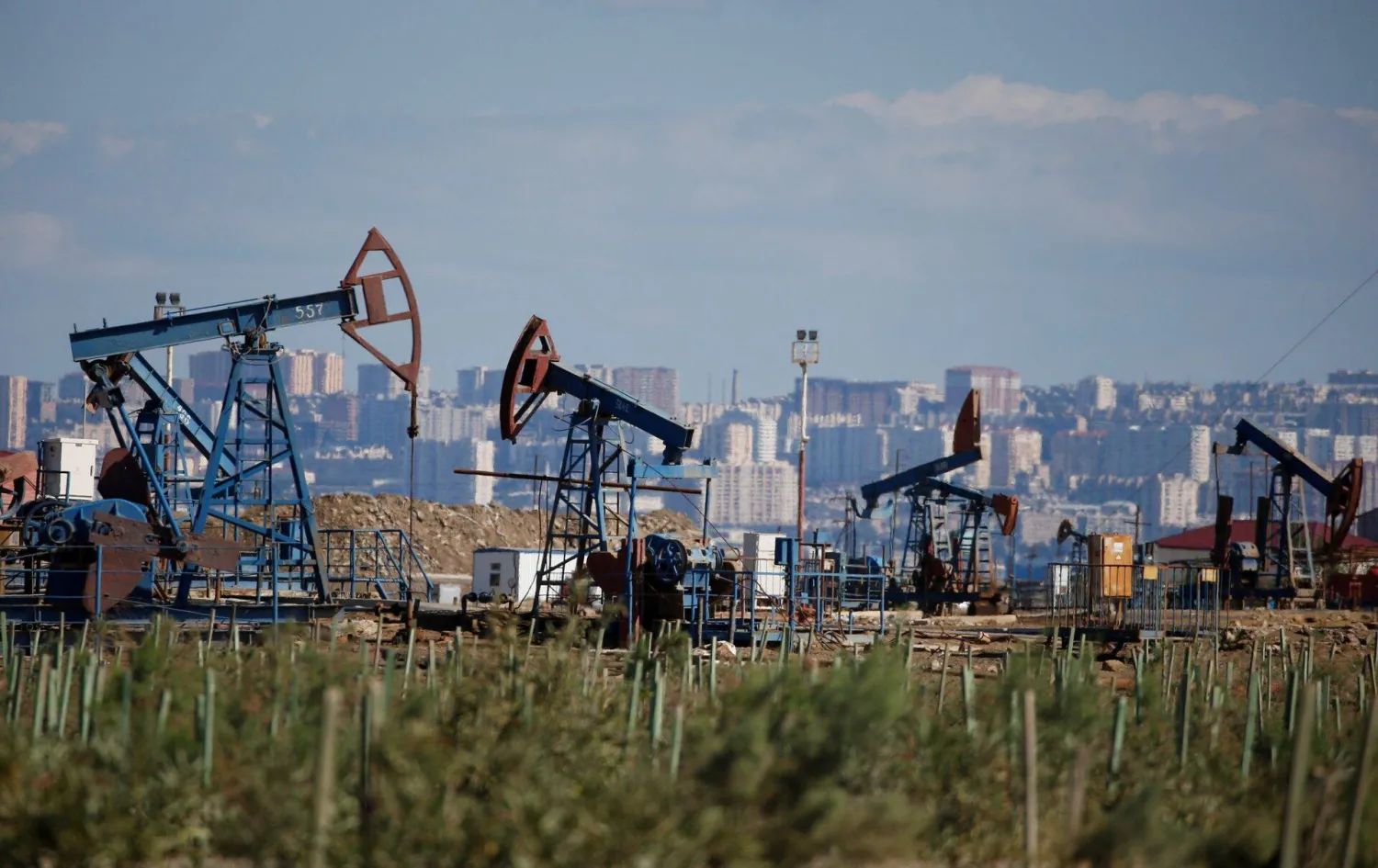
Oil rigs operate in a field on the shores of the Caspian Sea in Azerbaijan's capital, Baku (Reuters)
TT

Oil Prices Spike after Trump Rejects Iran Truce Offer

Oil rigs operate in a field on the shores of the Caspian Sea in Azerbaijan's capital, Baku (Reuters)

Oil prices spiked with bond yields Monday as Donald Trump's rejection of an Iranian offer of a seven-day truce stoked inflation concerns, while stocks were mixed as traders look ahead to the release of key US data.

Tehran last week set out a plan at the UN General Assembly for a halt in hostilities that would see the Strait of Hormuz reopened, which would ease a crippling supply crisis that has jacked up costs around the world, said AFP.

The waterway is key to the world's energy supply and is now central to the conflict between the US and Iran, particularly with Houthis seizing Yemen's entire Red Sea coast, including the Bab al-Mandab Strait, a vital shipping lane.

However, the US president told reporters outside the White House "I reject their proposal".

Still, he told Axios that he expects negotiations to resume.

"They want to make a deal, but it is not the deal that I want to make," he told the news platform. "It is what we would have maybe agreed to a year ago."

"They overplayed their hand," Trump added, in the interview published Sunday.

Citing sources familiar with the matter, Axios reported that indirect talks between Washington and Tehran could take place as early as Monday.

Iran was still standing by its conditions for reopening the Strait, including the release of frozen assets, the lifting of sanctions on its oil and an end to the US naval blockade.

Oil prices, which fell more than two percent Friday on news of the offer, bounced back at the start of the new week, with Brent back above $106 a barrel.

That stoked inflation concerns again, and weighed on stock markets.

Seoul shed more than two percent as it reopened after a long break, while Tokyo, Shanghai, Manila, Bangkok and Jakarta also dropped.

There were gains in Hong Kong, Sydney, Singapore and Wellington.

Bond yields climbed, with the average on a gauge of world bonds topping four percent last week for the first time since 2007, according to Bloomberg.

The rise in prices puts the focus back on the Federal Reserve ahead of its next policy meeting at the end of October, with CME's FedWatch tool putting the chances of a second successive interest rate hike at more than 65 percent.

Before that decision is made, investors will see the release of the bank's preferred gauge of inflation this week as well as a key jobs report that could play a vital role in policymakers' thinking.

"Middle East tensions have flared again after President Donald Trump rejected Iran's latest proposal to reopen the Strait of Hormuz," wrote Stephen Innes at Quintex Intel.

"Oil has pushed higher, Asian equities are softer, and suddenly the brief Friday reprieve in global fixed income looks more like an intermission than the end of the show."

Still, he added: "The market is still pricing some probability that everyone eventually finds their way back to the table, even if they continue to spend the next few weeks shouting across it first."


Asian Shares are Mixed with Tech Stocks Volatile, and Oil Falls on Trump's Russian Sanctions Waiver

Passersby walk past a stock market indicator board in Tokyo, Japan, 15 October 2026. EPA/FRANCK ROBICHON
TT

Asian Shares are Mixed with Tech Stocks Volatile, and Oil Falls on Trump's Russian Sanctions Waiver

Passersby walk past a stock market indicator board in Tokyo, Japan, 15 October 2026. EPA/FRANCK ROBICHON

Asian shares were mixed Monday as volatility in technology stocks persisted, while US equity futures edged higher ahead of another week of American corporate earnings results.

Oil prices fell more than 1% after US President Donald Trump’s decision to waive sweeping sanctions on Russia, including on Russian energy, The Associated Press said.

A sell-off of technology shares from Asia to Wall Street recently put downward pressure on stock markets, as investor concerns grow over the sustainability of the artificial intelligence boom.

South Korea’s benchmark Kospi index was up 1.1% to 5,729.58 on Monday, after falling sharply last week. The Kospi is down more than 18% over the past month, and still well below the 9,000 mark it crossed in June at its peak on the global AI frenzy.

Samsung Electronics was up 0.7%, while memory chipmaker SK Hynix fell 0.9%.

Japan’s Nikkei 225 lost 0.8% to 64,799.03. Japanese chip equipment maker Tokyo Electron lost 2.1%, and OpenAI investor SoftBank Group dropped 3.6%.

Hong Kong’s stock market was closed because of a holiday. The Shanghai Composite index edged 0.2% higher to 3,722.20, after China reported better-than-expected growth of 4.5% for its economy in the July-September quarter.

CXMT, China’s leading memory chipmaker, fell more than 7% despite the company forecasting a strong profit for the first nine months.

Taiwan’s Taiex fell 1%. Shares of Taiwan Semiconductor Manufacturing Co., or TSMC, the world’s biggest contract chipmaker, were down 0.6%.

Australia’s S&P/ASX 200 was 0.3% higher at 8,832.20.

India’s Sensex edged down 0.1%.

Indonesia’s benchmark stock index fell another 5% to its lowest level since 2020, after it plunged over 11% on Friday following a warning from index provider MSCI that it would downgrade the country from its “emerging market” status.

On Friday, Wall Street’s benchmark S&P 500 declined 1.1%. The Dow Jones Industrial Average fell 0.3%, and the technology-heavy Nasdaq composite sank 2.1%.

Investors this week are watching for more big corporate earnings results from the US, including Meta, Netflix, General Motors, Tesla and IBM. Strong company earnings have been one factor that’s been keeping US stocks robust lately.

Oil prices were down early Monday, with Brent crude, the international standard, falling 1.8% to $107.86 per barrel.

Benchmark US crude dropped 1.6% to $97.43 per barrel.

Oil fell after Trump on Friday signed an executive order to put new broad US sanctions against Russia on hold just days before they were to come into effect, drawing disappointment from Ukraine, with the move likely resulting in more energy exports from Russia.

Trump's decision came not long after he said earlier this month he had reached a diesel deal with Russia in an attempt to bring down elevated US fuel prices ahead of the Nov. 3 midterm elections.

But even with the decline, oil prices have remained elevated compared with those seen before the Iran war. Global oil supply risks are still high amid tensions in the Middle East, including uncertainty surrounding oil transport in the Strait of Hormuz, adding upward pressure to prices.

The US dollar fell slightly to 158.09 Japanese yen from 158.10 yen. The euro was trading at $1.1231, down from $1.1234.


Anthropic Commits 5% of Its Stock to a New 'Public Benefit' Fund

FILE PHOTO: An Anthropic logo is displayed at Moscone Center during the Dreamforce 2026 technology summit in San Francisco, California, US, September 17, 2026. REUTERS/Carlos Barria/File Photo
TT

Anthropic Commits 5% of Its Stock to a New 'Public Benefit' Fund

FILE PHOTO: An Anthropic logo is displayed at Moscone Center during the Dreamforce 2026 technology summit in San Francisco, California, US, September 17, 2026. REUTERS/Carlos Barria/File Photo

Anthropic said Sunday it is committing 5% of its shares to a new “public benefit” fund, with the fund's worth potentially increasing as its shares grow in value.

The shares will go to the Anthropic Public Benefit Fund, a new entity within the company, The Associated Press said.

The fund “will have increased flexibility and scale, enabling us to pursue our mission in new ways: for example, we might explore large donations to traditional nonprofits or direct distributions to specific populations,” Anthropic said in a blog post. It gave labor market impacts as an example, saying that while it has already committed $200 million to study the effects of artificial intelligence, “given the pace of AI progress, bolder approaches may be needed.”

CEO Dario Amodei and the company’s five other cofounders established Anthropic as a public benefit corporation, a designation that for-profit companies select to balance financial goals and social impact.

They have also pledged that they will donate 80% of their wealth. An equity donation match program, in which about half of the company's employees participate, lets workers pledge equity that Anthropic matches.

When combined with Sunday’s announcement, Anthropic said roughly 20% of its shares will be dedicated to the “public good,” plus any additional percentage that could be added if the company’s valuation reaches specific milestones.

Anthropic is planning a massive initial public offering as soon as November.


Syria, World Bank Agree to Set Up Fund for Recovery and Reconstruction

FILE PHOTO: A view of the Syrian central bank, after the ouster of Syria's Bashar al-Assad, in Damascus, Syria, January 12, 2025. REUTERS/Firas Makdesi/File Photo
TT

Syria, World Bank Agree to Set Up Fund for Recovery and Reconstruction

FILE PHOTO: A view of the Syrian central bank, after the ouster of Syria's Bashar al-Assad, in Damascus, Syria, January 12, 2025. REUTERS/Firas Makdesi/File Photo

Syria and the World Bank have agreed to set up a multi-donor ‌trust ‌fund focused ‌on ⁠recovery and reconstruction, they ⁠said in a joint statement on ⁠Sunday, as Damascus ‌aims to ‌rebuild after ‌a ‌more than decade-long civil war.

The fund aims ‌to provide concessional financing, ⁠investment guarantees, technical ⁠support, and capacity building, said Reuters.