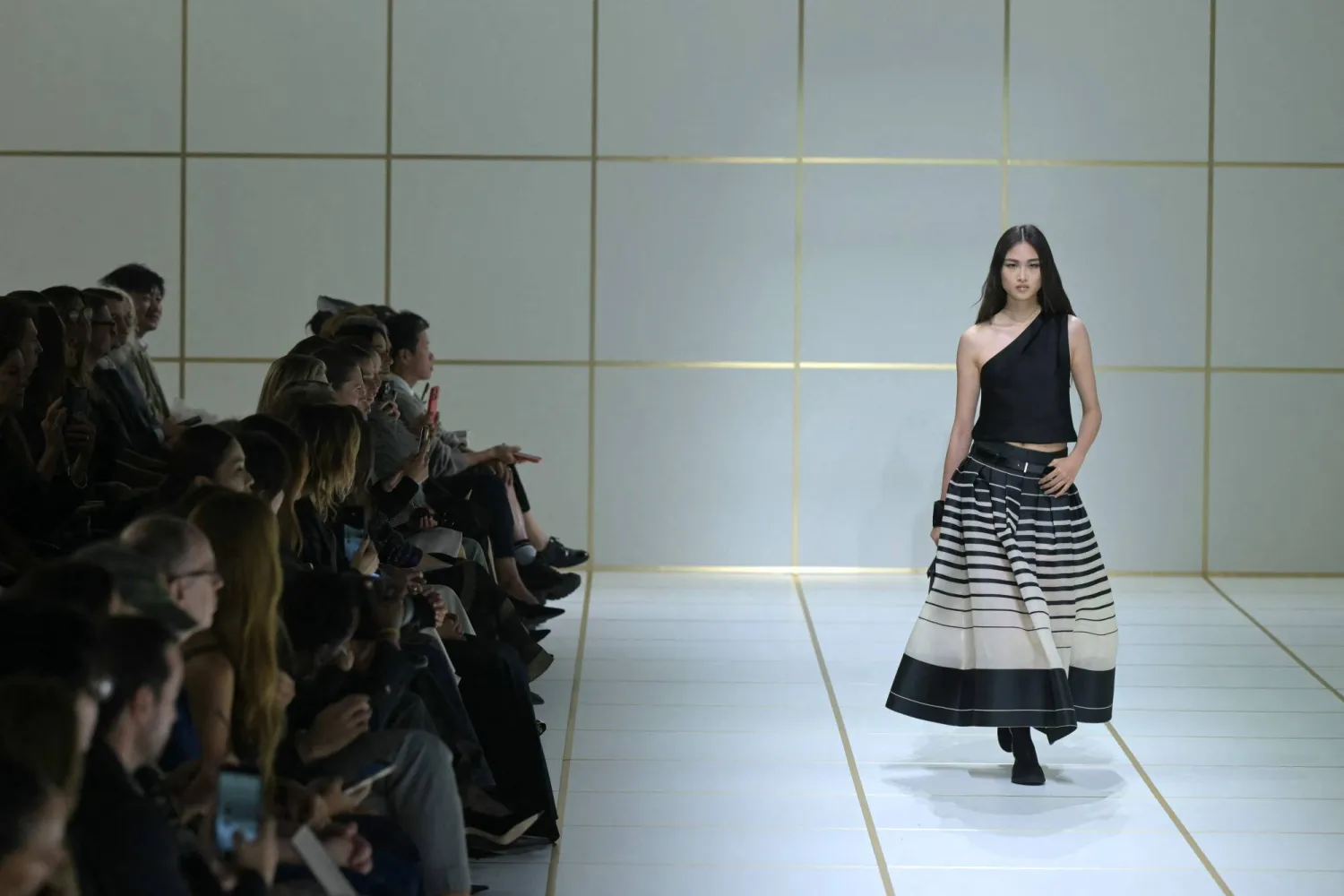
Women's Fashion Week Kicks Off in Paris

A model walks the runway during the Giorgio Armani collection show as part of Women's Spring/Summer 2027 Milan's fashion week, on September 27, 2026. (Photo by Stefano Rellandini / AFP)
TT

Women's Fashion Week Kicks Off in Paris

A model walks the runway during the Giorgio Armani collection show as part of Women's Spring/Summer 2027 Milan's fashion week, on September 27, 2026. (Photo by Stefano Rellandini / AFP)

Paris Women's Fashion Week opens Monday with a debut show from South African brand MaXhosa Africa and a fresh collection from new-ish Canadian trendsetters Matieres Fecales, look to lift the gloom surrounding the sector.

A total of 67 catwalk shows for 2027 Spring-Summer have been planned for this Fashion Week, with dozens of other brands set to show their designs in private viewings and events around the French capital.

Industry big beasts Christian Dior and Saint Laurent will send their models out on Tuesday.

It could be a last show for Saint Laurent's Belgian designer Anthony Vaccarello, who has been the driving force behind the brand's success for the past decade but is reportedly heading for the exit.

If his departure is confirmed, he is unlikely to be the only creative director heading for the chop as label owners and chief executives look to revive their fortunes in a tough commercial environment for luxury brands.

At Balenciaga, Italian designer Pierpaolo Piccioli is reportedly in the sights of parent company Kering, having failed in the difficult task of maintaining sales levels achieved by his predecessor Demna, according to specialist blog Miss Tweed.

At Chloe, artistic director Chemena Kamali, in the job since 2023, is also being pushed towards the door over a lack of profitability, according to investigative outlet Glitz.

"There were the 'golden years' (for the sector) after Covid, a peak in 2023 and then a luxury market that stabilized," Pascal Morand, executive president of the French Haute Couture and Fashion Federation, told AFP.

"The major groups, mid-sized brands and young designers are not affected in the same way. Markets, outlets and business models are evolving," he said.

Although sales are falling for many brands, there are bright spots.

Since his arrival a year ago at the helm of Chanel, Matthieu Blazy has created a buzz and sales frenzy at the classic French label, with customers queueing outside some boutiques for his latest collections.

His Spring-Summer show takes place next Monday.

Another brand with reason for cheer is MaXhosa Africa, a luxury knitwear group founded in 2010 by textile designer Laduma Ngxokolo, who has already shown collections privately in Paris but has now been invited to join the official program.

On a mission to promote South African culture and the traditions of the Xhosa people, Ngxokolo counts Michelle Obama and Beyonce as fans.

With his first show on Monday, he will be hoping to emulate the success of Matieres Fecales, the Canadian brand which first appeared in March last year but has gone on to dress a host of celebrities and A-listers.

Its unusual name -- which means fecal matter in French -- was chosen to ensure that people who bought the brand's clothing only wanted it for the design, rather than the name on the label.

After events by Julie Kegels, Weinsanto, and Hodakova, the Matieres Fecales show at 7:00pm (1700 GMT) will bring the first day of Paris Fashion Week to a close.


Germany’s Adidas Raises Full-Year Profit Outlook After Record Quarter

 The logo of Adidas is seen on a Gazelle sneaker for sale at a shop in Berlin, Germany, May 2, 2024. (Reuters)
The logo of Adidas is seen on a Gazelle sneaker for sale at a shop in Berlin, Germany, May 2, 2024. (Reuters)
TT

Germany’s Adidas Raises Full-Year Profit Outlook After Record Quarter

 The logo of Adidas is seen on a Gazelle sneaker for sale at a shop in Berlin, Germany, May 2, 2024. (Reuters)
The logo of Adidas is seen on a Gazelle sneaker for sale at a shop in Berlin, Germany, May 2, 2024. (Reuters)

German sportswear maker Adidas on Tuesday raised its full-year profit outlook and reported a 37% increase in third-quarter operating profit, lifted by a US tariff refund and full-price sales.

Adidas, which competes with rivals including Nike, has this ‌year benefited ‌from demand for ‌its ⁠retro apparel and ⁠a soccer World Cup boost as it races to roll out new styles.

Third-quarter operating profit rose to a record €1.008 billion ($1.1 billion) from €736 ⁠million a year earlier.

The company ‌said operating profit for the ‌full year would be around €100 million ‌more than previously expected.

Adidas' tariff refund, in the wake of a US court ruling, totaled ‌around €200 million.

The company said it would reinvest ⁠around €100 ⁠million in the fourth quarter, resulting in a new 2026 operating profit forecast of €2.5 billion, up from a previous forecast of €2.3 billion.

Adidas made the statements in an unscheduled earnings release ahead of its full earnings report scheduled for October 29.


UK Luxury Brand Mulberry Posts 18% Rise in First-Half Sales, Shares Gain

Mulberry handbags are seen for sale in a Mulberry store in Manhattan, New York City, US, November 24, 2021. (Reuters)
TT

UK Luxury Brand Mulberry Posts 18% Rise in First-Half Sales, Shares Gain

Mulberry handbags are seen for sale in a Mulberry store in Manhattan, New York City, US, November 24, 2021. (Reuters)

British luxury ‌handbag maker Mulberry reported an 18% jump in first-half sales on Monday, driven by resilient demand for its heritage bags and a higher share of full-price sales, sending its shares nearly 4% higher in early trading.

The company said trading was in line with the ‌board's expectations.

Mulberry ‌maintained its medium-term ‌goals ⁠after sales for the ⁠26 weeks ended September 26 rose 18.2% in constant currency.

CEO Andrea Baldo's "Back to the Mulberry Spirit" strategy has focused on the company's British heritage and ⁠craftsmanship and growing the brand ‌with less ‌discounting.

"The growth in full-price sales is particularly encouraging, ‌demonstrating that our collections are ‌resonating with customers across our key markets," Baldo said.

Shares of the company rose as much as 7.4% ‌to 246 pence in early trade. Sales growth was led ⁠by ⁠the US, where revenue rose 28%, while sales in Europe excluding the UK increased 23%. UK sales were up 10%.

Mulberry's Christopher Kane London Fashion Week show boosted brand visibility, customer engagement and traffic across sales channels, the company said.

Final first-half results will be published on November 19.


Western Brands Under Pressure as 'Pre-owned' Luxury Booms in China

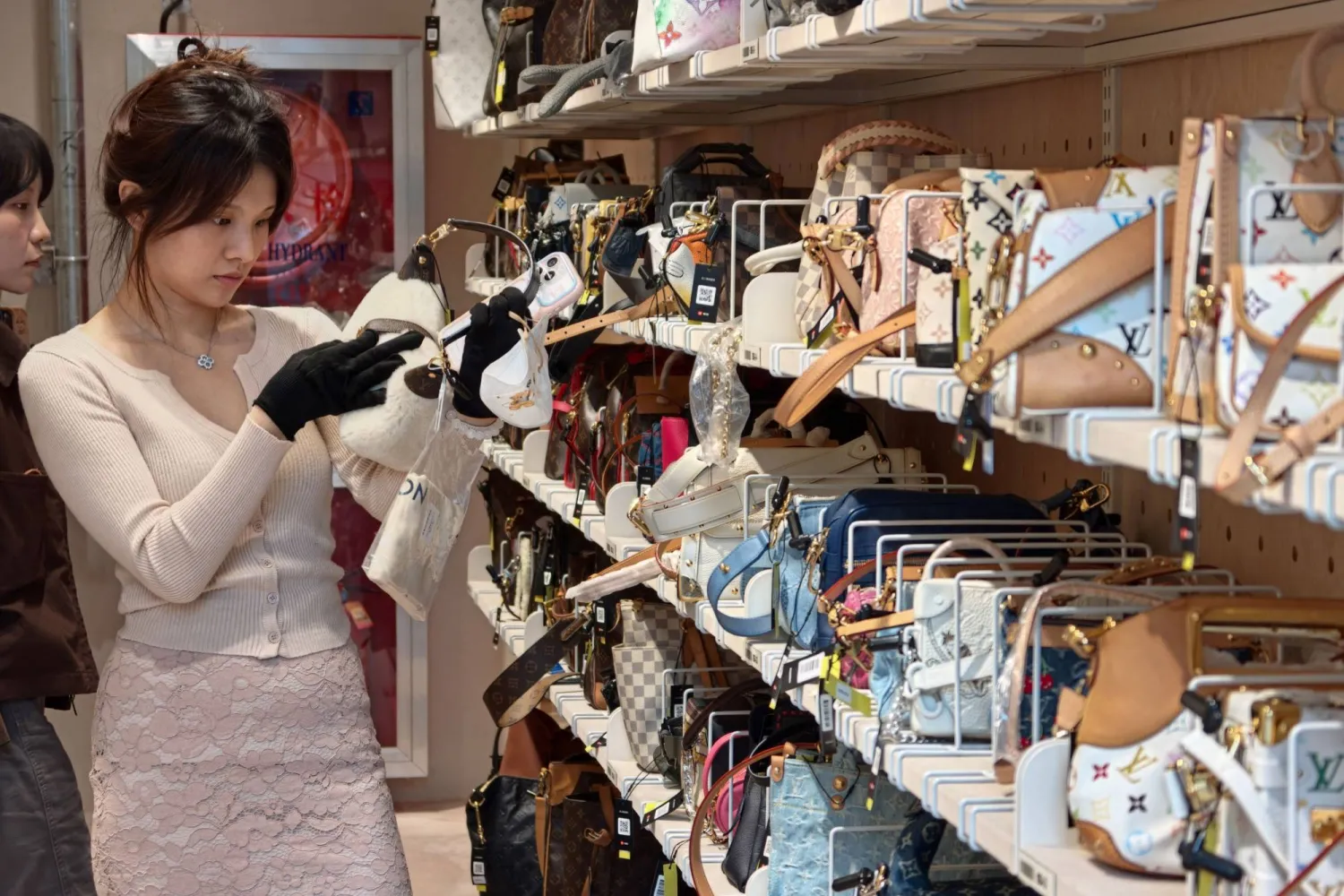
This picture taken on October 14, 2026 shows a customer browsing purses among secondhand luxury goods at the Zhuanzhuan superstore in the Jing'an District in Shanghai. (Photo by Pedro PARDO / AFP)
TT

Western Brands Under Pressure as 'Pre-owned' Luxury Booms in China

This picture taken on October 14, 2026 shows a customer browsing purses among secondhand luxury goods at the Zhuanzhuan superstore in the Jing'an District in Shanghai. (Photo by Pedro PARDO / AFP)

With China's economy still struggling to recover from the pandemic, even global fashion icons are beginning to feel the pinch as consumers turn instead to the second-hand market or buy upstart new homegrown brands.

Chinese were once massive buyers of luxury Western brands, accounting for around a third of worldwide spending and earning firms such as LVMH and Hermes billions of dollars.

But consumers' belt-tightening has forced them to rethink their strategies, with Louis Vuitton closing five stores in mainland China in the past two years -- including a chocolate boutique in Shanghai -- while Galeries Lafayette shut its Beijing flagship in May.

"People used to compare who had spent more," dance teacher Yuan told AFP at a new retail space in central Shanghai filled with luxury handbags, belts and jewelry items -- all second hand.

"But now everyone compares who got a better deal and spent less," the 24-year-old said at the two-story warehouse-style store in the center of the Chinese financial hub.

After plunging as much as 19 percent in 2024, mainland China's personal luxury market contracted another three to five percent in 2025, according to consultancy Bain & Company.

LVMH recently blamed a "slowdown in demand in China" for a drop in organic sales in the third quarter in its fashion and leather goods unit, a slump expected to be mirrored in its peers' results.

China's second-hand luxury market meanwhile exploded 15-20 percent in 2025, according to Bain & Company.

And domestic industry consultancy Insight & Info Consulting estimates total sales reached 38.4 billion yuan ($5.7 billion) in 2025, while forecasting it could top 100 billion yuan by 2030.

At the new Shanghai store Super Zhuanzhuan, shoppers have to wear black gloves to avoid their greasy fingers touching the products.

Customer Phoebe Ma, 24, said that when her mother's generation was young, China "wasn't so developed" and people were initially familiar with only a handful of luxury brands.

"Consequently, they formed a deep-seated impression that, OK, Louis Vuitton was the absolute best and most prestigious," the freelancer told AFP.

"I just feel that the [LV] monogram is dated. It suits my mother's generation, but Gen Z would rather buy trendy Korean brands," she said.

Chen Luo, head of China consumer research at Bank of America, said shoppers were moving away from associating luxury solely with social status and towards "self-identity, distinction, experience, quality, emotional value (and) cultural relevance".

"Apart from that, China's retail landscape is very digital/social media driven, and China's digital ecosystem is also very unique," Luo told AFP. "Foreign brands should work very hard to stay relevant in this context."

Adding to the headwinds for Western brands is growing cultural and legal friction.

LVMH recently successfully sued Chinese beverage chain Molly Tea for trademark infringement over a four-petal floral pattern resembling the French firm's monogram.

But the lawsuit sparked an online backlash after Chinese internet users and state media pointed out that the motif shares roots with ancient Chinese traditional patterns.

"It feels a bit absurd," said shopper Echo Wang, 31, who works in marketing.

"Molly Tea may be doing well in China, but it's nowhere near Louis Vuitton's global profile... I think some people feel the lawsuit was inappropriate," she told AFP.

LVMH management called its intellectual property "an absolute key asset", but admitted the furor had "had a negative impact".

Analysts emphasize that China remains vital for the global luxury industry.

"In our view, China will still be an important market, although it may not be a growth engine in two to three years," said Luo.

"Luxury spending is normally rebounding in sync with the economy, as usually the wealthy class will be among the first to benefit from economic recovery."