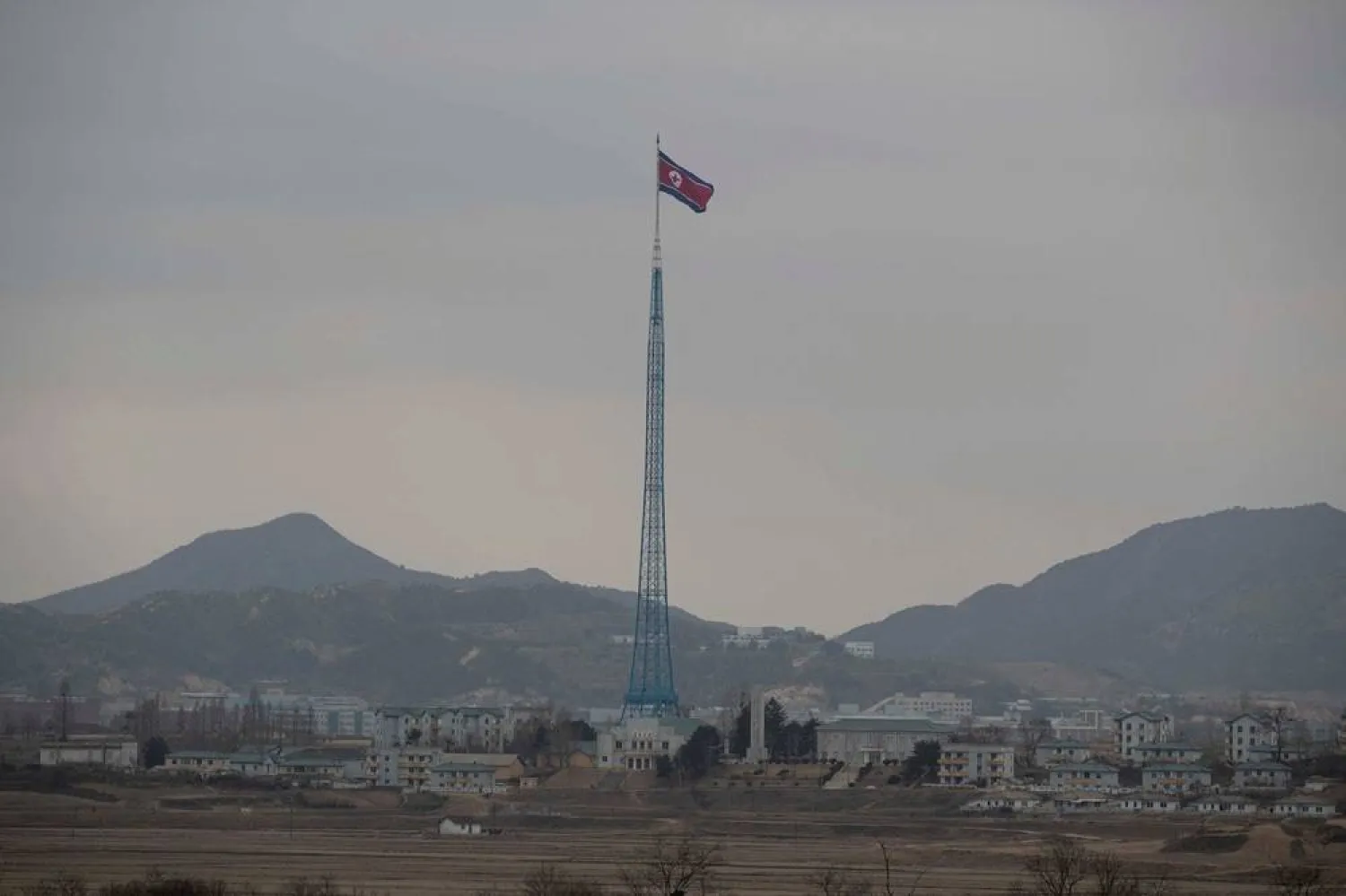
Seoul: North Korean DMZ Landmine Blasts 'Violation of Armistice'

North Korean propaganda village "Gijungdong" is seen from a South Korea's observation post inside the JSA during a media tour at the Joint Security Area (JSA) on the Demilitarized Zone (DMZ) in the border village of Panmunjom in Paju, South Korea, 03 March 2023. (Reuters)
TT

Seoul: North Korean DMZ Landmine Blasts 'Violation of Armistice'

North Korean propaganda village "Gijungdong" is seen from a South Korea's observation post inside the JSA during a media tour at the Joint Security Area (JSA) on the Demilitarized Zone (DMZ) in the border village of Panmunjom in Paju, South Korea, 03 March 2023. (Reuters)

The blasts that wounded three South Korean soldiers last week were apparently caused by North Korean mines, Seoul said Tuesday, accusing Pyongyang of an armistice violation and warning of "corresponding measures".

One soldier lost a foot due to the explosions in the Demilitarized Zone (DMZ), the heavily mined buffer zone that has divided the two Koreas since their 1953 armistice.

The northern and southern boundaries of the zone are among the world's most heavily fortified frontiers and landmine incidents have previously heightened tensions between the two Koreas, which remain technically at war.

South Korean Defense Minister Kang Shin-chul spoke before a parliamentary hearing a day after his ministry said North Korean mines were "highly suspected" of causing the two explosions last week.

"This is a clear violation of the armistice agreement, and since North Korea bears responsibility, we will take corresponding measures," AFP quoted him as saying.

The military "has a range of necessary measures at our disposal, and we will implement them in stages", he added, without giving details.

The minister said that dense vegetation in the area had hampered the work of mine detectors, and that South Korean forces were in the DMZ to clear the area in advance of an operation with the UN Command.

That operation would assess terrain changes caused by North Korean forces south of the Military Demarcation Line, which marks the nations' effective border.

Hong Sung-pyo, senior researcher at the Seoul-based Korea Institute for Military Affairs, said it was reasonable to conclude that the mines were North Korean.

"In practical terms, the only forces operating in the DMZ area are the South Korean, US and North Korean militaries," he told AFP.

"Given the interoperability between South Korean and US forces, there would be little reason for the US military to have laid any mines there."

Yang Jin-hyeok of the Joint Chiefs of Staff told lawmakers that a site investigation on Tuesday discovered an unexploded North Korean plastic anti-personnel mine.

Seoul and Pyongyang remain technically at war since the Korean conflict ended in a truce, not a peace treaty.

Since 2024, after North Korean leader Kim Jong Un designated South Korea as his country's "principal enemy", Pyongyang's military has laid mines and built anti-tank barriers along the frontier as part of efforts to permanently seal it off.

During the operation, Pyongyang also blew up the northern parts of inter-Korean roads no longer in use.

Minister Kang said Tuesday that the North Korean mines linked to the September 21 incident were believed to have been laid as part of Pyongyang's border fortification work.

There was no mention of last week's blasts on North Korean state media.

In a 2015 incident, two South Korean soldiers were seriously wounded in a landmine blast on the southern side of the DMZ, with one losing both legs.

Seoul concluded that North Korean troops had crossed the Military Demarcation Line to plant the mines, an accusation Pyongyang denied.

The incident prompted South Korea to resume anti-Pyongyang loudspeaker broadcasts along the border.

But Yang Moo-jin, former president of the University of North Korean Studies in Seoul, said that there is "very little South Korea can realistically do" in retaliation for the latest blasts.

"Resuming loudspeaker broadcasts would do more harm than good, particularly because residents in border areas would bear much of the disruption," he told AFP.

"That effectively leaves Seoul with few options beyond demanding an apology from North Korea and seeking assurances that such an incident will not happen again" -- unless it is willing to risk heightened military tensions and further escalation, he added.


Russia Resumes Attacks on Ukraine's Kherson Region after Local Truce Ends

Women who are internally displaced persons from the Kherson region look on at the backyard of their house, which was damaged during a Russian drone strike, amid Russia's attack on Ukraine, in Odesa, Ukraine November 2, 2026. REUTERS/Nina Liashonok
TT

Russia Resumes Attacks on Ukraine's Kherson Region after Local Truce Ends

Women who are internally displaced persons from the Kherson region look on at the backyard of their house, which was damaged during a Russian drone strike, amid Russia's attack on Ukraine, in Odesa, Ukraine November 2, 2026. REUTERS/Nina Liashonok

Russia on Monday resumed attacks on Ukraine's Kherson region, after the end of a local ceasefire in the area, the longest truce in the war raging between the neighbors since 2022, Kyiv said.

A rare pause in fighting, brokered by US First Lady Melania Trump, ended on Sunday after starting on Tuesday. The ceasefire enabled a humanitarian mission to the Russian-occupied city of Oleshky and for hundreds of stranded citizens to leave, AFP said.

It was the longest pause in fighting between the neighbors in the war -- now in its fifth year -- which has killed hundreds of thousands and displaced millions.

"At around 8:00 am this morning, Russian occupiers attacked a car with a drone in the Korabelny city district" of Kherson, local authorities said in a statement, adding that a 62-year-old woman and 73-year-old man were wounded and hospitalized.

Russia refused a Ukrainian offer to extend the truce, a senior Ukrainian figure told AFP on Sunday.

Kherson's regional governor Oleksandr Prokudin had warned local people to be particularly vigilant when the ceasefire ended.

Ukraine's military alleged Russia used the pause in fighting to "fortify its positions".

Russian attacks also killed one person in Izium, a city in the country's north-eastern Kharkiv region, the local governor there said.

US-mediated talks between Russia and Ukraine are set to resume this month.

The Kremlin has repeatedly rejected calls for a wider ceasefire and said it intends to press on with its full-scale offensive to seize the rest of eastern Ukraine.


Iranians Have Left Doha Talks, Draft Proposal for US Deal Being Circulated, Official Says

An Iranian woman holds Iran's national flag on a street in Tehran on November 1, 2026. (AFP)
TT

Iranians Have Left Doha Talks, Draft Proposal for US Deal Being Circulated, Official Says

An Iranian woman holds Iran's national flag on a street in Tehran on November 1, 2026. (AFP)

Iranian negotiators have left talks with Qatari mediators aimed at ending the war with the United States, and a draft proposal is being circulated with a follow-up meeting possible, an official briefed on the talks said on Monday.

The negotiators departed on Sunday, though not because of difficulties in the negotiations, the official said, without providing further details on the draft proposal.

Iran's foreign ministry spokesperson said the basis of the talks is a seven-step plan ‌Iran drew up ‌in September to reopen the Strait of ‌Hormuz ⁠and end the ⁠US naval blockade on Iran, with Tehran now suggesting that proposal could be implemented on a faster timeline under a deal.

The spokesperson, Esmaeil Baghaei, said deputy Foreign Minister Kazem Gharibabadi had been in Doha to facilitate the exchange of messages with Washington via Qatari intermediaries.

"Our demands have been ⁠articulated very clearly and transparently. These demands are ‌reasonable and logical: no final ‌agreement can be initiated, nor can the Strait of Hormuz be ‌reopened or secured, unless the US naval blockade ‌is brought to an end, Iran's demands are respected, and Iran’s legitimate requirements are addressed,” Baghaei said.

On Saturday, Qatari broadcaster Al Jazeera quoted Iran's Foreign Minister Abbas Araghchi as saying that under ‌a deal the Strait of Hormuz could be opened within a two-day timeline rather than within ⁠the seven ⁠days originally envisaged.

Iran's initial proposal was rejected by US President Donald Trump.

The latest round of diplomacy comes amid concerns that the conflict could escalate again after Tuesday's midterm elections in the United States. Asked about Tehran's view on the midterms, Baghaei said Tehran did not expect elections to "give birth to a new US."

Trump has said the United States would not launch new attacks on Iran before the vote and that talks with Tehran have been productive, though he has not ruled out further military action.


Iran Says Considering Two-day Plan to Reopen Hormuz

Image published by the Iranian government's media website showing Foreign Ministry Spokesperson Esmaeil Baqaei during a press conference
TT

Iran Says Considering Two-day Plan to Reopen Hormuz

Image published by the Iranian government's media website showing Foreign Ministry Spokesperson Esmaeil Baqaei during a press conference

Iran's foreign ministry on Monday said it was considering a two-day plan to reopen the Strait of Hormuz if the US agrees to its conditions, having previously proposed a one-week timeline, AFP said.

"The possibility of implementing this plan in two days is another indication of Iran's good-faith approach. We have stated that, if Iran's demands are met, it would be possible to restore security to the Strait of Hormuz and resume the negotiating process within a short period," said foreign ministry spokesman Esmaeil Baqaei, adding that the "exchange of messages is still ongoing" via mediators.