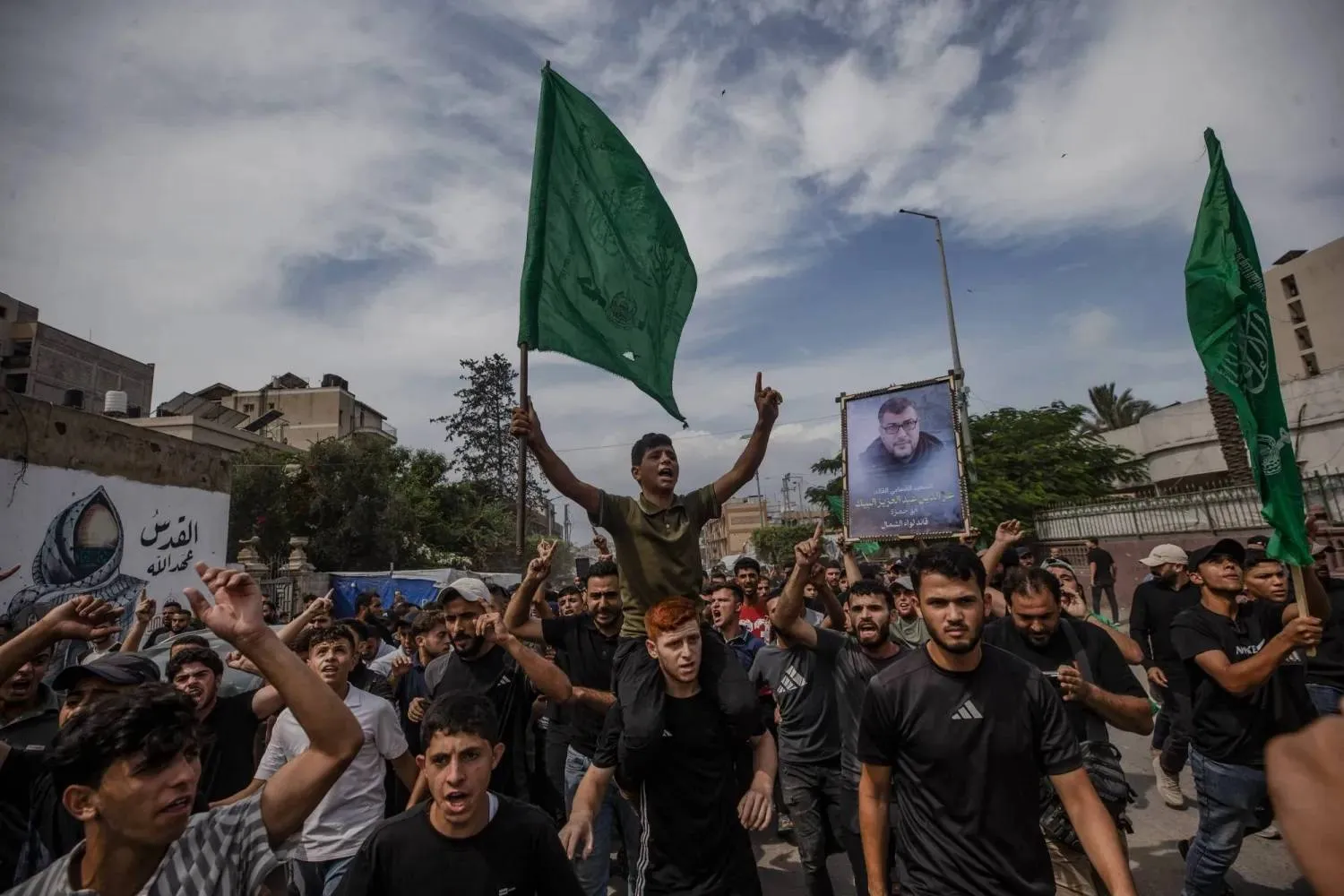
Israel Kills Commander of Hamas Armed Wing’s Northern Brigade

Palestinians attend the funeral of Izz al-Din al-Beik and his aide, Mohannad Abu Foul, in Gaza City on Tuesday. (EPA)
TT

Israel Kills Commander of Hamas Armed Wing’s Northern Brigade

Palestinians attend the funeral of Izz al-Din al-Beik and his aide, Mohannad Abu Foul, in Gaza City on Tuesday. (EPA)

Israel killed Izz al-Din al-Beik, commander of Hamas’s Qassam Brigades Northern Brigade, in a dawn strike on an apartment in northwestern Gaza City yesterday, four Hamas sources told Asharq Al-Awsat. Israeli officials also announced his killing.

The sources said al-Beik, known as “Ashmawi,” died immediately when three missiles struck the apartment in the Al-Nasr neighborhood. They said the missiles were probably fired by warplanes to ensure he was killed.

The body of his personal aide, Mohannad Abu Foul of Jabalia refugee camp, was found that morning.

Israeli Prime Minister Benjamin Netanyahu and Defense Minister Israel Katz announced the operation. The Israeli military later said it had killed al-Beik, accusing him of planning attacks and trying to rebuild the Northern Brigade after it suffered heavy losses in the war.

The strike hit at 3:30 a.m., an Asharq Al-Awsat correspondent reported. Fire engulfed the apartment and burned for more than half an hour before civil defense crews put it out.

The Israeli military appeared to have used missiles that caused intense fires, which could kill a target through either the blast or the toxic smoke they produced.

Israel’s Channel 12 gave a different account of the number of missiles fired. It said two struck the room where al-Beik was sleeping, followed by three more in case he had been in another room and to ensure he was dead.

The building stands beside another hit in a similar daylight strike about two months ago. That attack killed Adham Nasman, the Qassam Brigades’ Gaza Brigade operations commander, who had played a prominent role in the Oct. 7, 2023, attack.

Previous attempt

Al-Beik survived an assassination attempt in late May, days after the killings of Izz al-Din al-Haddad and Mohammed Odeh. The two had led the Qassam Brigades in Gaza in succession after Mohammed Sinwar.

That strike killed Imad Aslim, deputy commander of the Gaza Brigade and commander of its Zeitoun Battalion. Sources told Asharq Al-Awsat at the time that Aslim had been due to meet al-Beik and the brigade’s new commander, Mohannad Rajab. Neither al-Beik nor Rajab had arrived when the strike hit.

Al-Beik’s killing came about two weeks after Israel killed Mohammed al-Yazouri, commander of the Qassam Brigades’ Khan Younis Brigade, and Nail Abu Obeid, commander of its Rafah Brigade. Both had replaced commanders killed by Israel in similar operations.

The Qassam Brigades have lost most of their longtime leaders and military council members. The latest strikes indicate that Israel is targeting members appointed to its new military council to replace them.

Hamas sources have previously told Asharq Al-Awsat that the group’s structure is flexible and that it quickly replaces commanders who are killed.

Who Was Al-Beik?

Al-Beik, 48, was from the Falouja area of Jabalia refugee camp, a major Hamas stronghold. A prominent member of the group for years, he joined in the late 1990s after becoming active in mosques.

He began working with the Qassam Brigades when the second intifada broke out and became heavily involved in resisting Israeli incursions into Jabalia camp and the nearby town of Beit Lahiya. He was among the first to use Yassin anti-armor projectiles against a major Israeli operation in Jabalia in 2004.

Hamas sources told Asharq Al-Awsat that al-Beik led one of the Qassam Brigades’ first special units in Jabalia, now known as the Nukhba.

He then commanded the camp’s Imad Aqel, or western, Battalion for many years before becoming the Northern Brigade’s intelligence chief. He took command of the brigade after Ahmed al-Ghandour was killed in November 2023.

As intelligence chief, al-Beik was regarded as a favorite of Mohammed Odeh, then the Qassam Brigades’ intelligence chief for Gaza, the sources said. The two were close and both came from Jabalia camp.

The sources said al-Beik led efforts to thwart what became known during the war as the “Generals’ Plan,” which they said aimed to displace residents of northern Gaza. He stayed with his fighters in direct battles against Israeli forces, they said.

One Hamas source who knew him well described al-Beik as a skilled sniper and a popular figure who had also overseen Northern Brigade operations for a time. He survived several attempts on his life before and during the war.

In one attempt inside Jabalia camp during the latter half of the war, his aide was killed but al-Beik escaped.


Bilal Erdogan: Developments in Syria Will Restore Shared Ties Between Beirut, Tripoli and Turkish Cities

Bilal Erdogan, the son of Turkish President Recep Tayyip Erdogan, center, waves to his Lebanese supporters outside a mosque after Friday prayers in Tripoli, northern Lebanon, Friday, Nov. 13, 2026. (AP)
TT

Bilal Erdogan: Developments in Syria Will Restore Shared Ties Between Beirut, Tripoli and Turkish Cities

Bilal Erdogan, the son of Turkish President Recep Tayyip Erdogan, center, waves to his Lebanese supporters outside a mosque after Friday prayers in Tripoli, northern Lebanon, Friday, Nov. 13, 2026. (AP)

Bilal Erdogan, son of Turkish President Recep Tayyip Erdogan, called on Friday for greater regional unity to confront attacks on Gaza, the West Bank, southern Lebanon and Syria, voicing hope that recent developments in Syria would revive historic trade and economic ties between Lebanese, Syrian and Turkish cities.

Erdogan, President of the Board of Trustees of the Knowledge Dissemination Foundation, made the remarks in the northern city of Tripoli on the second day of his visit to Lebanon, where he was welcomed by political and religious figures and locals.

Speaking after prayers at the Grand Mansouri Mosque, his first stop in the city, Bilal Erdogan said he had brought a message from his father to the Lebanese people, aimed at strengthening relations and bonds of brotherhood between the two countries.

He also voiced hope for an end to war and conflict in Lebanon, paving the way for stability, recovery and prosperity similar to the development Türkiye had experienced over the past 24 years.

"God willing, this visit will help end the war in Lebanon and bring prosperity and recovery, as happened in Türkiye over the past 24 years," Bilal Erdogan said.

Turning to Syria, said recent developments could help restore the historic ties and shared economic interests linking cities across Lebanon, Syria and Türkiye.

"God willing, with the recent developments in Syria, the bonds of shared destiny between Beirut, Tripoli, Antakya, Damascus, Gaziantep and Istanbul will be restored, as they were in the past," he said.

"The people of these cities will once again engage in trade, cooperation, partnership and brotherhood."

He stressed the need to revive cooperation between Tripoli and cities in Syria and Türkiye, strengthening economic and social ties and reconnecting communities across the region.

Addressing Israeli attacks, Bilal Erdogan said regional unity and solidarity could deter further assaults and prevent wars from continuing.

He cited what he described as genocide in Gaza, violations against villages and homes in the West Bank, destruction in southern Lebanon and attacks in Syria.

“Those demolishing homes and seizing land in Gaza, the West Bank, Syria and southern Lebanon would not dare continue if the region's peoples stood united,” he said.

Bilal Erdogan toured Tripoli's old markets, the Mevlevi lodge, citadel and several Ottoman-era mosques.

He is due to visit Kouachra in the northern Akkar region on Saturday to meet residents of Turkmen descent before traveling to Beirut for talks with Prime Minister Nawaf Salam, who will host a luncheon in his honor to conclude the visit.

He kicked off his Lebanon visit on Thursday with meetings with President Joseph Aoun, Parliament Speaker Nabih Berri, former Progressive Socialist Party leader Walid Jumblatt, Lebanon's Grand Mufti Sheikh Abdel Latif Derian and Greek Orthodox Metropolitan of Beirut Elias Audeh.


UN Rights Chief Demands Houthis Return Body of Yemeni Staff Member

UN High Commissioner for Human Rights Volker Turk delivers a statement at the United Nations Offices in Geneva, on September 16, 2025. (AFP)
TT

UN Rights Chief Demands Houthis Return Body of Yemeni Staff Member

UN High Commissioner for Human Rights Volker Turk delivers a statement at the United Nations Offices in Geneva, on September 16, 2025. (AFP)

The UN's ‌human rights chief on Friday demanded the return of the body of a Yemeni staff member of his office who died of unknown causes weeks ago after being held in Houthi custody for more than two years.

Mohammad el-Shami's family learned of his death on October 30, more than a month after it occurred, but ‌they have received no ‌explanation of the cause ‌or ⁠circumstances. El-Shami ⁠had been held by the Houthi militia since June 6, 2024.

"Our colleague must be laid to rest in a dignified manner, in accordance with the wishes of his family – which was denied contact with him ⁠for two years while he ‌was in detention," ‌said United Nations High Commissioner for Human Rights Volker ‌Turk.

His family said the Houthis had ‌agreed in principle to an investigation in a statement earlier this week. "Do not allow Mohamed to die twice: once when he was taken from ‌his family and disappeared, and again when the truth about his ⁠fate ⁠is allowed to disappear from the world."

There was no immediate comment from the Houthis, who have previously alleged those detained were part of a spy network working for the United States and Israel.

More than 70 UN employees and dozens of humanitarian workers remain in detention in Yemen. A video circulating this week appeared to show one of them "confessing", Turk's office said, voicing fears that the group may be subject to torture or ill-treatment.


Palestinian Teen Reunites with Family After Month in Israeli Jail

The mother of Ezzedine al-Lahalia, a 15-year-old Palestinian teenager, kisses him as they reunite in the village of Al-Jib in the Israeli-occupied West Bank, late on November 12, 2026, after his release from an Israeli prison where he had spent a month in detention. (AFP)
TT

Palestinian Teen Reunites with Family After Month in Israeli Jail

The mother of Ezzedine al-Lahalia, a 15-year-old Palestinian teenager, kisses him as they reunite in the village of Al-Jib in the Israeli-occupied West Bank, late on November 12, 2026, after his release from an Israeli prison where he had spent a month in detention. (AFP)

Looking tiny in his adult-size grey prison jumpsuit, 15-year-old Palestinian Ezzedine al-Lahalia appeared stunned as his mother embraced him after a month in an Israeli jail.

His first request was a child's wish for his favorite food: stuffed cabbage and shawarma.

The teenager, who had been charged with throwing stones, was reunited with his family Thursday night in an emotional scene witnessed by an AFP photographer.

Ezzedine's mother held back tears as she kissed his cheeks, while the older men released alongside him greeted their wives and children.

Then Israeli troops fired tear gas, interrupting the families' reunions.

Lahalia, from the West Bank city of Sair, reunited with his family in the village of Al-Jib near Jerusalem, where Israeli authorities typically release Palestinian prisoners on Thursdays.

"After the Israelis brought the prisoners out, after we had received them, they fired tear gas," Ezzedine's mother, Rania Jaradat told AFP, adding that the scene was reminiscent of when soldiers took the boy from the family home on October 14, 2026.

"They were afraid that the families would assemble near the gate and celebrate," she said.

After Lahalia's release, she said, "the first thing he asked for was stuffed cabbage and shawarma". She happily complied.

He was released after the family paid 5,000-shekels (around $1,500) in bail.

As the eldest of five, his absence was particularly felt by his younger siblings.

"They're happy that I've returned, but they were very distressed while I wasn't with them," Ezzedine told AFP.

According to the Addameer Prisoner Support and Human Rights Association, 9,300 Palestinians are currently held in Israeli jails, including 350 minors.

Earlier this week, the military said it had shot a 14-year-old in a group of boys it suspected of throwing stones at a passing car in the north of the West Bank.

The Israeli human rights group B'Tselem noted an increase in deaths of Palestinians after the easing of open-fire rules in 2022 for stone throwers.