Settler Attack on West Bank Village Injures Israeli Forces, Drawing Rare Rebuke

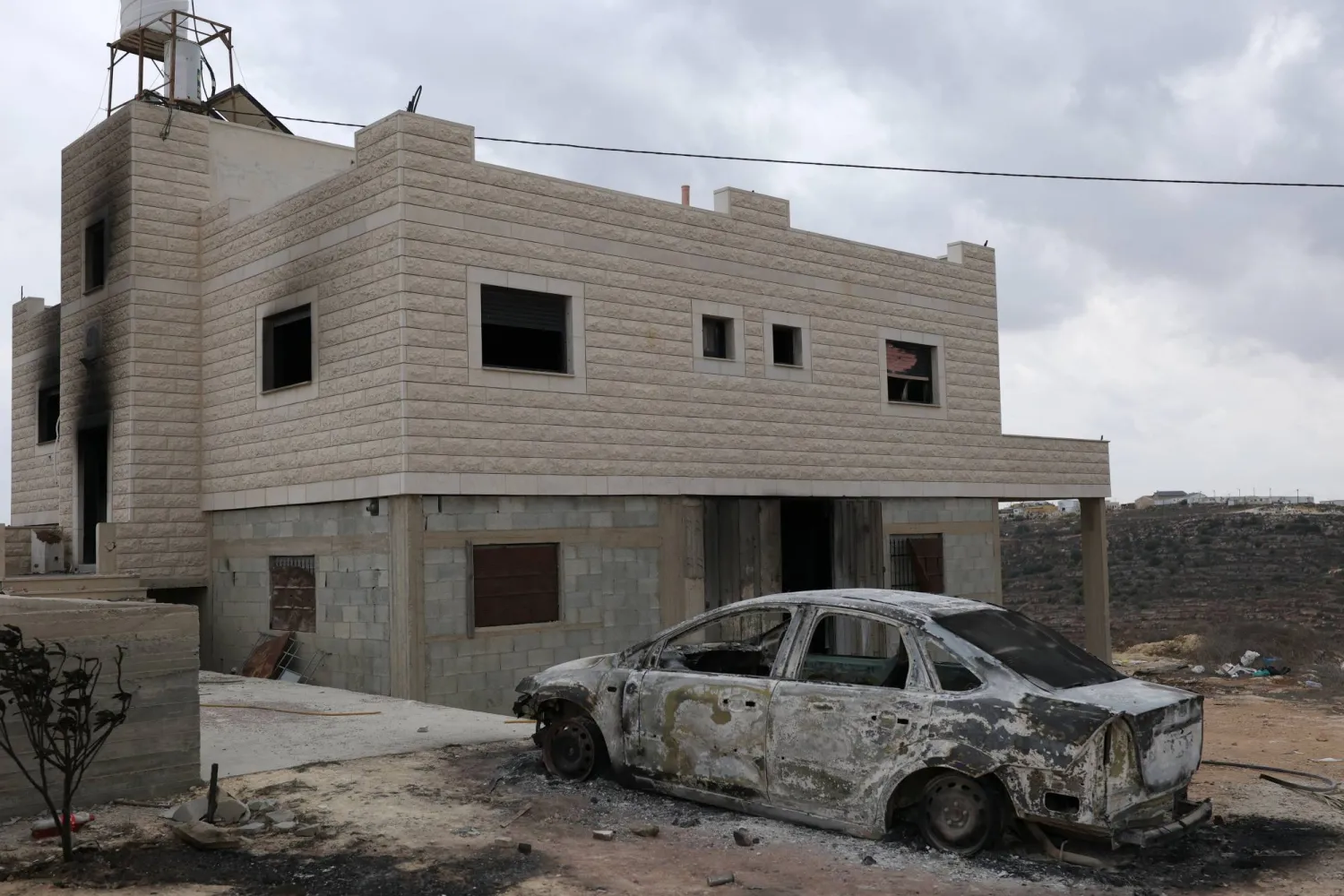
A burned-out car stands outside a damaged building in the West Bank village of Jalud, south of Nablus, 29 September 2026. (EPA)
TT

Settler Attack on West Bank Village Injures Israeli Forces, Drawing Rare Rebuke

A burned-out car stands outside a damaged building in the West Bank village of Jalud, south of Nablus, 29 September 2026. (EPA)

More than 100 Israeli settlers attacked a Palestinian village in the occupied West Bank early Tuesday, drawing condemnation from the US and from the Israeli government after they injured three members of the security forces.

The raid, and attacks on other West Bank villages on Tuesday, came amid mounting international criticism of settler violence, which Israeli Prime Minister Benjamin Netanyahu downplayed last week.

Settlers stormed the village of Jalud in the northern West Bank as the military attempted to accompany a Palestinian family back to their home after they had been displaced by settler attacks two months earlier.

The Israeli military said "more than 100 Israeli rioters" were in the area overnight and soldiers and border police tried to disperse them.

"As a result of the clashes, three Israel Border Police officers were lightly injured," it said in a statement.

One person was arrested and two minors were taken in for questioning, police said.

The military said the settlers had blocked roads, set tires on fire and thrown rocks at security forces, also setting fire to Palestinian buildings and vehicles in the village.

It added that the attack had prevented the return of the family, who had been displaced "following several incidents of (Israeli) nationalist crime against them".

- 'No justification' -

Israel has occupied the West Bank since 1967 and has been accelerating settlement expansion there. Some 500,000 Israeli settlers live among three million Palestinians.

Netanyahu condemned the attack, which he blamed on "a small group of rioters".

Their actions "cause great harm to that community and interfere with our forces as they carry out their mission", he said.

President Isaac Herzog, who holds a largely ceremonial role, called the attack "a moral stain, an assault on the rule of law and our most fundamental values". Such criticism from Israeli official is rare for attacks in which the victims are Palestinian.

The US State Department told AFP that "we condemn criminal violence by any party in the West Bank and support appropriate investigations, legal accountability, and judicial processes for those responsible".

Settler attacks against Palestinians including beatings, vandalism and arson averaged six a day in the first half of the year, according to the United Nations.

Recent weeks have also seen high-profile attacks against Israelis in the West Bank, including the shooting dead of a settler by a Palestinian.

Israel has voiced outrage and imposed diplomatic repercussions on several Western countries that imposed sanctions against products from Israeli settlements in the West Bank, which are illegal under international law.

- Rising settler ambitions -

Mahmoud al-Toubasi, a member of the family seeking to return to Jalud, told AFP that he and his relatives had left the house more than two months ago, and that it had been occupied by settlers until the attack on Tuesday.

"My wife, my son and I went to the house in the car, accompanied by an army vehicle in front of us and another behind us," he said.

Settlers attacked the group upon their arrival at the house and were pushed back by soldiers with pepper spray, he added.

"We were not physically injured, but we suffered some choking from the pepper spray," Toubasi said.

In a separate attack on Tuesday, dozens of settlers from hilltop outposts raided the Palestinian village of Al-Mughayyir, northeast of Ramallah, residents told AFP.

An AFP journalist saw at least five burnt-out cars as a result.

In a separate incident in the town of Beitunia near Ramallah, dozens of settlers came to hold a prayer for the Jewish holiday of Sukkot using loudspeakers, Mayor Ribhi Dawla told AFP.

"This gathering is a dangerous precedent," he said. "There are ambitions for settlements in the area, they placed a caravan in the western part of the town and installed an iron gate."

In another incident on Tuesday evening, the Palestinian Red Crescent reported that its crews were "treating three people who were assaulted and beaten by settlers in the Jamala area near Ramallah" and taking them to hospital.

Violence has increased in the West Bank since the start of the Gaza war in October 2023, with Israeli soldiers or settlers killing at least 1,111 Palestinians in that period, including both gunmen and civilians, per an AFP tally based on data from the Palestinian health ministry.

Israeli figures show at least 49 Israelis, including civilians and security personnel, have been killed in Palestinian attacks or during Israeli military operations during the same period.


Iraq Orders Army to Enter Jurf al-Sakhar as Confrontation with Kataib Hezbollah Escalates

A member of the Popular Mobilization Forces holds a flag of the Kataib Hezbollah group during a protest to condemn air strikes on their bases, outside the main gate of the US Embassy in Baghdad, Iraq December 31, 2019. (Reuters)
TT

Iraq Orders Army to Enter Jurf al-Sakhar as Confrontation with Kataib Hezbollah Escalates

A member of the Popular Mobilization Forces holds a flag of the Kataib Hezbollah group during a protest to condemn air strikes on their bases, outside the main gate of the US Embassy in Baghdad, Iraq December 31, 2019. (Reuters)

Iraq ordered the army to enter later this week the main stronghold of the Iran-backed Kataib Hezbollah group, following a push by the prime minister to disarm the fighters.

Iraq has been facing mounting US pressure to curb Iran's influence and rein in Tehran-backed armed groups, which Washington designates as terrorist organizations -- a difficult task in a country long caught between the two rivals.

On Monday, PM Ali al-Zaidi "ordered the armed forces to enter" Jurf al-Sakher, government spokesman Haidar al-Aboudi told the state news agency INA, adding that "a deadline has been set for the armed faction to exit the area".

A security source told AFP that the deadline was Friday.

The decision came after the government said on Saturday that an investigation committee had confirmed oil smuggling in the Jurf al-Sakhar area, south of Baghdad.

It ordered those implicated, without identifying them, to be referred to the judiciary, and dismissed nine officials, including from the security, intelligence and oil sectors.

But Kataib Hezbollah said in a statement on Sunday that al-Zaidi's office was "fabricating lies", adding that it was being subjected to "the largest blackmail operation aimed at forcing" it to abandon its weapons.

Tensions have surged between al-Zaidi and the faction since the premier vowed to ensure that armed groups would hand over their weapons to the state -- a long-standing US demand.

- Caught between rivals -

Successive Iraqi governments have long struggled to balance relations between the US and Iran, whose influence has grown significantly in Iraq since the 2003 US-led invasion that toppled former ruler Saddam Hussein.

Whenever tensions rise between Washington and Tehran, their repercussions are often felt in Iraq, a country still trying to move past decades of conflict and instability.

Al-Zaidi, who came to power early this year, has pursued closer ties with Washington, with Iraqi political sources telling AFP that his relationship with Tehran has been strained.

Al-Zaidi paid a surprise visit to Iran earlier this month, with Foreign Minister Fuad Hussein saying that it aimed to help narrow the differences between Tehran and Washington, without elaborating, as efforts to end the Middle East war have stalled in recent weeks.

Washington accuses Iran of using Iraq's economy to evade sanctions, and has previously sanctioned Iraqi individuals, including an oil official and businessmen, for blending Iraqi and Iranian oil.

Pro-Iran armed groups have long targeted US interests in Iraq and stepped up their attacks across the region in support of Tehran during the Middle East war, triggered by US-Israeli strikes on Iran.

- Confrontation -

Senior Iraqi politicians told AFP that al-Zaidi had repeatedly said he was ready to "confront" groups if they do not disarm.

A senior Iraqi politician said that "it has become personal" between al-Zaidi and Kataib Hezbollah, adding that political leaders were working to defuse tensions.

Kataib Hezbollah has recently issued several statements criticizing the prime minister, accusing him of corruption and threatening his government.

The group has maintained a presence in Jurf al-Sakhar for more than a decade, after helping recapture the area from the ISIS group.

The vast area, which includes villages and agriculture lands, has since mostly become a militarized zone controlled by the Iran-backed armed group, with little publicly known about what lies inside.

It was the target of the first strike in Iraq blamed on the United States during the Middle East war.


Iran’s Proxy in Iraq Rakes in Hundreds of Millions Through Oil Smuggling

Iraqi Prime Minister Ali al-Zaidi is seen at an event in Baghdad on Sunday. (INA)
TT

Iran’s Proxy in Iraq Rakes in Hundreds of Millions Through Oil Smuggling

Iraqi Prime Minister Ali al-Zaidi is seen at an event in Baghdad on Sunday. (INA)

Iran's most powerful armed ally in Iraq has been raking in hundreds of millions of dollars from oil stolen from the state, Iraqi officials say, prompting the prime minister to ready his security forces to confront the armed faction.

Prime Minister Ali al-Zaidi has launched his toughest challenge yet to the group Kataib Hezbollah by cracking down on an oil smuggling network it has run for years, senior security, army, police and oil officials told Reuters.

They said the smuggling, carried out with accomplices among some security and oil officials, has robbed the government of hundreds of millions of dollars dating back to 2021.

Kataib Hezbollah, branded a terrorist organization by the US, is one of dozens of armed pro-Iranian groups that have semi-official status in Iraq. It denies the smuggling and calls the crackdown part of a campaign to seize its weapons.

"We are therefore being subjected to the greatest campaign of blackmail aimed at forcing us to relinquish the weapons of dignity that have upheld sovereignty and ‌protected the rights ‌of Iraqis at multiple stages," the group said in a statement.

The Iranian-backed armed groups have resisted repeated calls by both al-Zaidi and US President Donald Trump to disarm, and have struck US troops and targets in Saudi Arabia and the United Arab Emirates in solidarity with Tehran since the United States and Israel launched their war against Iran in February.

Jasim al-Bahadli, an Iraqi security analyst specializing in studying armed Shiite groups aligned with Iran, said the government anti-smuggling campaign has become a political confrontation with the faction.

"Al-Zaidi is effectively challenging a group with deep security, political and economic influence, and that carries significant risks for both sides," he said.

"More broadly, it appears to ⁠be an attempt to contain the influence of Iran-backed armed groups by targeting economic networks that underpin ‌their power, particularly after Kataib Hezbollah resisted government efforts to bring armed factions more firmly ‌under state control."

GOVERNMENT INVESTIGATION

In 2021, a drone attack targeted Mustafa al-Kadhimi, then prime minister, in what his office said was an assassination attempt after security forces ‌clashed with supporters of pro-Iranian factions.

So far, nine senior security and oil officials have been dismissed following a high-level government investigation into oil ‌smuggling, focused on Jurf al-Sakhar in Babil province, a Kataib Hezbollah stronghold about 50 km (30 miles) south of Baghdad.

Al-Zaidi has ordered all suspects to be referred to the courts, and dismissed the Babil police chief, the province's intelligence and security commanders and the director of the state-run Oil Pipelines Company (OPC).

Now he has ordered senior military and security commanders to deploy additional forces around Jurf al-Sakhar and prepare for the entry of government troops into the town, potentially bringing ‌the government into a direct confrontation with fighters.

SIPHONED CRUDE

The groups have built up arsenals that include assault rifles, machineguns, anti-tank guided missiles, mortars, rockets, armed drones and, according to Iraqi ⁠security reports and assessments, some short-range ballistic ⁠and cruise missile capabilities supplied by Iran or derived from Iranian systems.

Two security sources who took part in an inspection mission on Saturday to Jurf al-Sakhar said investigators had found evidence that smugglers had punctured a crude oil pipeline and siphoned crude into makeshift storage pits dug in the ground.

The 26-inch pipeline carries at least 200,000 barrels per day of crude, according to an Iraqi Oil Ministry document reviewed by Reuters.

The sources said investigators found concealed pumping equipment inside several hangars used to avoid aerial surveillance while loading tanker trucks with siphoned crude. Investigators also found a small oil refinery concealed in the area, the sources said.

Two Iraqi oil officials with direct knowledge of the investigation said it was too early to quantify losses without knowing how long the tapping points had been operational, but estimated the value of crude potentially siphoned since 2021 could amount to hundreds of millions of dollars.

The crackdown is set against a backdrop of mounting US pressure on Iraq over the role of pro-Iranian groups in the country's oil sector.

In May, Washington sanctioned Iraq's deputy oil minister, alleging he had facilitated the diversion of Iraqi oil for the benefit of Iran and its proxy militias. Sanctions were also imposed on armed faction leaders and networks Washington said were exploiting Iraq's oil wealth to finance Tehran-aligned groups.

Reuters reported in 2024 that a fuel oil smuggling network had raked in $1 billion for Iran and its proxies.


Yemen Govt Forces Beef up Defenses in Lahj

Houthi forces take over from Dhubab to Bab al-Mandeb after government forces withdraw from the area, in Taiz Governorate, Yemen, in this still image taken from a handout video released November 15, 2026. (Reuters)
TT

Yemen Govt Forces Beef up Defenses in Lahj

Houthi forces take over from Dhubab to Bab al-Mandeb after government forces withdraw from the area, in Taiz Governorate, Yemen, in this still image taken from a handout video released November 15, 2026. (Reuters)

The military confrontation between Yemeni government forces and the Houthi group is entering a new phase following the withdrawal of Southern and Joint Forces from positions along the West Coast and Bab al-Mandab.

In Mari and Taiz, the battles continue amid escalating airstrikes targeting the group’s positions and military capabilities.

The Yemeni parliament, manhole, is moving to finalize a draft law classifying the Houthis as a terrorist organization and criminalizing their activities and funding sources.

Field sources said that fierce fighting erupted between government forces and the Houthis on the western fronts of Raghwan district in Marib province. The clashes lasted for hours across several sectors.

To the south in Lahij, government and Southern forces are reorganizing their deployment lines and reinforcing fortifications following their withdrawal from the Bab al-Mandeb and Dhubab airport axes through the Kahboub and Al-Suqya areas.

According to field sources, current missions are focused on reinforcing defensive lines in Lahij and securing the western and northern entrances to the interim capital, Aden, and fortifying positions and monitoring passages to prevent infiltration attempts or any potential Houthi military movements.

This deployment follows an announcement by Southern forces that they are repositioning, as Lahij’s fronts undergo field shifts after the Houthis seized Al-Maqatirah district and areas in Al-Madaribah district. These developments make securing Aden’s western entrances and reinforcing defensive positions a top priority.

Politically, the parliament has stepped up efforts to finalize a draft law classifying the Houthis as a terrorist organization. The move aims to criminalize the group’s activities, dry up its funding sources, and prosecute those involved in its operations both locally and internationally.

In a statement following a virtual meeting chaired by Speaker Sultan al-Barakani, parliament said completing the legislative process has become a national, regional, and international necessity after peace opportunities and political options were exhausted, and as the group continues attacking civilians, state institutions, waterways, and economic interests.

Parliament noted that the draft bill to designate the Houthis was first introduced during a session in the city of Seiyun in April 2019, before a decision was postponed to give peace efforts a chance.

However, according to the statement, the group pressed ahead with its military operations and attacks inside and outside Yemen, including targeting Saudi Arabia and its civilian and economic facilities.