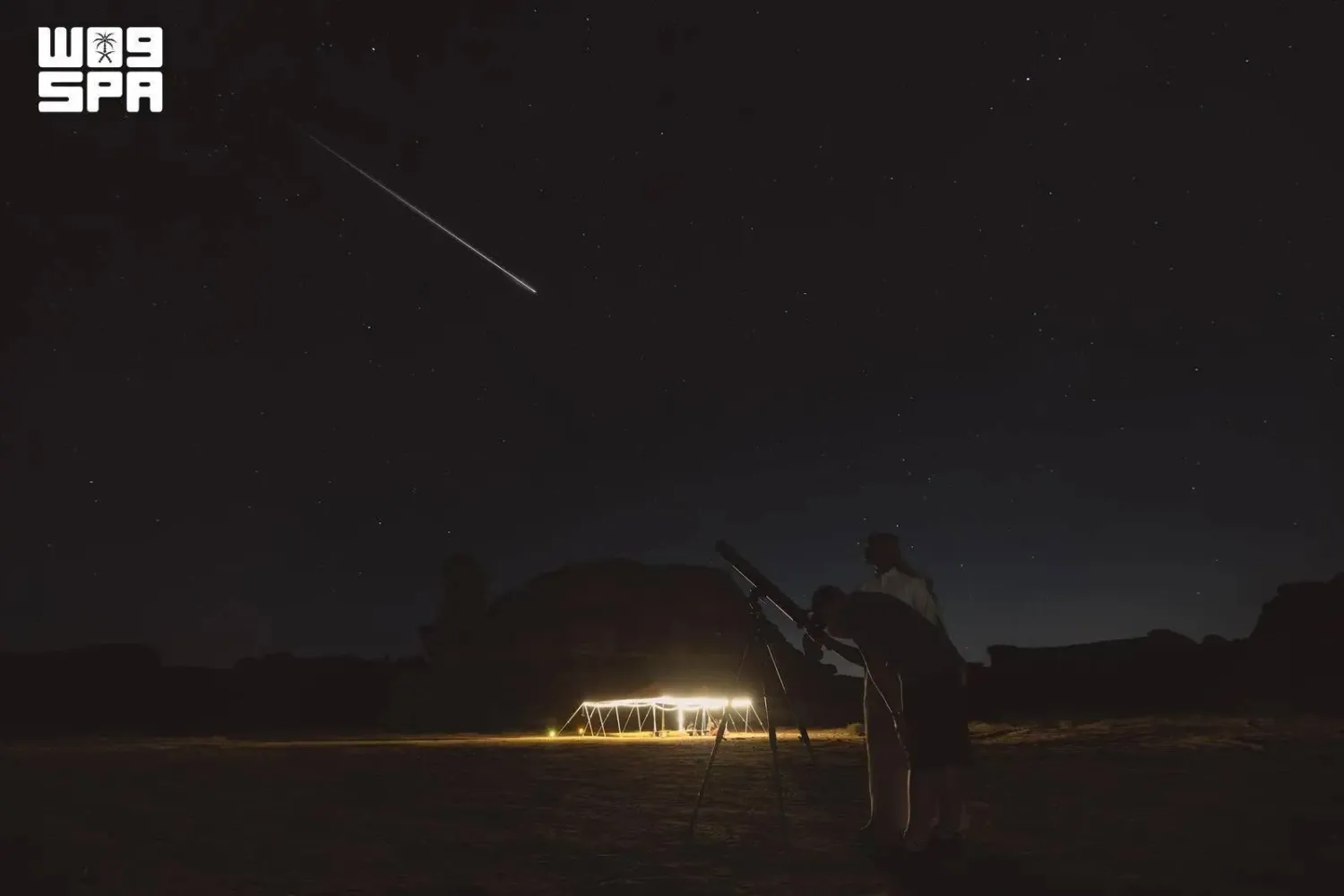
AlUla Skies 2026 Returns with Exceptional Celestial Experiences

The AlUla Skies Festival will take place from November 6-15. (SPA)
TT

AlUla Skies 2026 Returns with Exceptional Celestial Experiences

The AlUla Skies Festival will take place from November 6-15. (SPA)

Saudi Arabia’s AlUla Moments announced the return of AlUla Skies Festival, taking place from November 6-15, bringing 10 days of extraordinary experiences that celebrate the wonder of the skies. From hot-air balloons floating above the landscape at sunrise to immersive evenings beneath a canopy of stars, the festival offers visitors a spectacular new way to experience AlUla.

Designed as a celebration of nature, adventure, and astronomy, the event transforms AlUla’s dramatic desert landscapes into a destination for sky-inspired experiences, combining aerial adventures with cultural and entertainment programming, reported the Saudi Press Agency on Tuesday.

By day, guests can experience sunrise hot air balloon flights and aerial views over AlUla’s landscapes, while evenings will feature balloon glow shows, stargazing experiences, moonlight cinema, and wellness sessions, creating a unique blend of nature, culture, and immersive entertainment.

Timed to coincide with a period of moonless skies from November 7-12, with the New Moon on November 9, the 2026 edition offers ideal conditions for observing faint celestial objects. The festival will also coincide with the Leonid Meteor Shower on November 15, when visitors could see up to 20 meteors per hour with minimal moonlight interference.

As AlUla continues to grow as a leading destination for nature-based and experiential tourism, the festival offers visitors a chance to reconnect with the night sky and experience the landscapes from entirely new perspectives.

Among the headline moments of this year’s program is AlUla Skyrise, where guests can join a shared sunrise hot air balloon flight, rising above the landscapes of AlUla. The experience operates daily throughout the festival, with flights taking place from approximately 6:00-7:00 am, following early-morning transfers, briefing and boarding. Guests will also be served Saudi coffee and dates before take-off, with refreshments provided following the flight.

Visitors can also enjoy the Hot Air Balloon Glow Show, taking place at Hegra on November 6 and 7 and at Elephant Rock on November 13 and 14. The evening spectacle combines illuminated hot air balloons with music, lighting, projection, fire performers, and aerial trapeze artists, culminating in a choreographed grand finale.

Guests can join a shared sunrise hot air balloon flight, rising above the landscapes of AlUla. (SPA)

For those seeking a more accessible option, the Tethered Hot Air Balloon Experience offers gentle ascents with panoramic views of AlUla’s landscapes, making it ideal for families, first-time visitors, and photography enthusiasts. Payment is available on-site, with no advance booking required.

The festival will also feature VOX Moonlight Cinema at Our Habitas AlUla, across the 10-day program, with screenings scheduled throughout the festival.

For astronomy enthusiasts, the Stargazing at AlUla Fort experience will operate on November 6, 7, 10-12 and 13-15 from 19:00-23:00. The experience will feature five telescopes focused on planets and constellations, alongside guided observations led by a trained astronomer and a Rawi, who will provide cultural and storytelling context.

The 2026 program will also introduce Sunset Stillness wellness experiences at Our Habitas AlUla, featuring Guided Meditation, Sound Immersion and Conscious Connected Breathwork, taking place on November 13 and 14 from 17:00-18:00.

AlUla Skies Festival will bring stargazing experiences and hikes under the stars with Husaak, all set against AlUla’s sandstone mountains, canyons and heritage sites. With the festival taking place during a period of moonless skies, visitors can experience a range of daytime and night-time activities against AlUla’s dark desert skies.

The festival also highlights AlUla’s designation as the region’s First Dark Sky Park destination, with four areas officially designated as International Dark Sky Parks by DarkSky International, including AlGharameel Nature Reserve, Sharaan National Park and Wadi Nakhlah Nature Reserve. Together, these protected areas reinforce AlUla’s commitment to preserving its natural environments, reducing light pollution, while promoting sustainable tourism and offering visitors some of the region’s best stargazing conditions.

AlUla Skies Festival forms part of the AlUla Moments calendar, a year-round program celebrating art, culture, heritage, nature and adventure, and reinforces AlUla as a leading global destination for experiential travel.


Portugal Storm Alert Closes Schools

View of a flooded area after storm Leo passed by Alcacer do Sal, Portugal, February 5, 2026. (Reuters)
TT

Portugal Storm Alert Closes Schools

View of a flooded area after storm Leo passed by Alcacer do Sal, Portugal, February 5, 2026. (Reuters)

Portugal will shut schools and non-essential public services on Wednesday, with the government urging people to shelter from winds potentially reaching 140 kilometers (85 miles) per hour.

"All those who can should stay at home," Interior Minister Luis Neves told a press conference on Tuesday at the civil protection service's headquarters.

Eight of the country's districts, including the capital Lisbon, are on the highest red alert for extreme weather, with Storm Charles expected to reach mainland Portugal on Wednesday morning after passing the island of Madeira late Tuesday.

Forecasts of downpours have raised fears of floods, especially in cities, like those which devastated the Iberian nation in early 2026.

Between January 22 and February 16, Portugal was battered by six successive storms which authorities said left at least seven dead. Some Portuguese media put the toll higher at nearly 20 direct and indirect victims.

The Iberian peninsula is especially exposed to extreme weather patterns, such as heatwaves and periods of heavy rains, supercharged by man-made climate change.


British Writer John Harrison Wins 2026 Booker Prize for ‘The End of Everything’

British author John Harrison poses after winning the 2026 Booker Prize for his novel "The End of Everything" at the awards ceremony in London, Britain, 09 November 2026. (EPA)
TT

British Writer John Harrison Wins 2026 Booker Prize for ‘The End of Everything’

British author John Harrison poses after winning the 2026 Booker Prize for his novel "The End of Everything" at the awards ceremony in London, Britain, 09 November 2026. (EPA)

British author ‌John Harrison has won the 2026 Booker Prize for his novel, "The End of Everything," a dystopian satire that the prize says probes the limits of human understanding, becoming the oldest winner in the literary award's history at age 81.

Harrison's 13th novel follows Phillip Tennent and his elderly aunt Marnie on England's south coast years after social order has broken down ‌and mysterious entities ‌known as the iGhetti have arrived.

The ‌Booker ⁠judges unanimously selected ⁠the 198-page book, saying it "turns you upside down, raises a wry smile and, surprisingly, given the subject matter, leaves you with a twinge of optimism."

The victory was the first Booker Prize for Harrison, whose career as a ⁠novelist and critic spans six ‌decades and includes acclaimed science ‌fiction and fantasy works.

His win also marks ‌a rare triumph for speculative fiction.

Mary Beard, ‌chair of the judging panel, described the book as "the politics of now seen through the lens of the future", saying it depicts a society grappling ‌with a catastrophe its inhabitants do not fully understand.

Accepting the £50,000 ($67,235) prize at ⁠a ⁠ceremony in London, Harrison said literary awards remained important in a "landscape of industrialized fiction."

Speaking to the Booker Prize in August, Harrison said his novel was inspired by the 2008 financial crisis and asks what happens when "all of our expectations and explanations of the world become an ongoing disaster, but we still have to make a life."

Harrison beat a shortlist that included former Booker winners Douglas Stuart and Marlon James.


Fossil Fuel Emissions Fall Due to Iran War, Renewables, Research Finds

Vessels at the Strait of Hormuz, as seen from Musandam, Oman, November 9, 2026. (Reuters)
TT

Fossil Fuel Emissions Fall Due to Iran War, Renewables, Research Finds

Vessels at the Strait of Hormuz, as seen from Musandam, Oman, November 9, 2026. (Reuters)

Global fossil fuel emissions are projected to fall slightly in 2026 due to the expansion of renewable energy and the oil price shock sparked by the Iran war, researchers said Tuesday.

Emissions from the burning of oil, gas and coal -- the main drivers of climate change -- rose by 0.9 percent per year on average in the past decade, hitting a record high in 2025, according to the Global Carbon Budget report.

But they are expected to drop by 0.4 percent in 2026, according to the research, published as nations meet at the UN's COP31 climate summit in Antalya, Türkiye.

It would be the first annual drop since 2020, when the Covid pandemic paralyzed the global economy, trade and transport.

This year, the US-led war in Iran and closure of the Strait of Hormuz played a role in driving emissions down as it caused a drop in oil consumption amid soaring crude prices, the researchers found.

The deployment of solar panels, wind farms and electric vehicles also contributed to the drop. Two thirds of the increase in global energy demand is being met by solar and wind power and electric vehicles, the report found.

"A decline in fossil CO2 emissions is encouraging, but a reduction driven partly by geopolitical shocks is not a sustainable climate solution," said Pierre Friedlingstein, director of the Global Carbon Budget Office at the University of Exeter in Britain.

"The long-term answer remains the rapid deployment of clean energy technologies," said Friedlingstein, who led the study published in the journal Earth System Science Data.

- Rebound looms -

Corinne Le Quere, a climate change science professor at the University of East Anglia, noted that emissions rebounded when economies recovered following shocks such as Covid or the global financial crisis.

A rebound is likely "when the oil tensions go away", she said in a media briefing.

Oil-related emissions are projected to drop 1.9 percent last year but it was "likely a short-term response to the energy shock triggered by the Iran conflict", the researchers said.

Gas emissions are set to fall 0.3 percent while those from coal use will rise 0.6 percent.

Overall, fossil carbon dioxide emissions are expected to reach 38.2 billion tons in 2026.

Including emissions from land-use change such as deforestation, total CO2 emissions are projected to rise to 43.3 billion tons, from 42.8 billion tonnes last year.

The researchers said land-use emissions are projected to rise partly due to peat fires and forest degradation in southeast Asia, associated with drier conditions linked to this year's exceptionally strong El Nino climate pattern.

The report found that the world's carbon budget -- the amount of CO2 that can be emitted before global warming exceeds 1.5C above pre-industrial levels -- stands at 150 billion tons.

The researchers calculated that at the current, the carbon budget would be exhausted in less than four years.

Nations agreed at the 2015 UN climate talks in Paris to keep global warming "well below" 2C above pre-industrial levels, while pursuing efforts to limit it to 1.5C.

But the United Nations declared in September that the long-term 1.5C target would be missed in a matter of years.

Scientists say it is crucial to reduce greenhouse gas emissions from fossil fuels to limit the period of "overshoot" above 1.5C and bring temperatures back down as quickly as possible.