What Does Activating the 7700, 7600 and 7500 Emergency Codes Mean in Aviation?

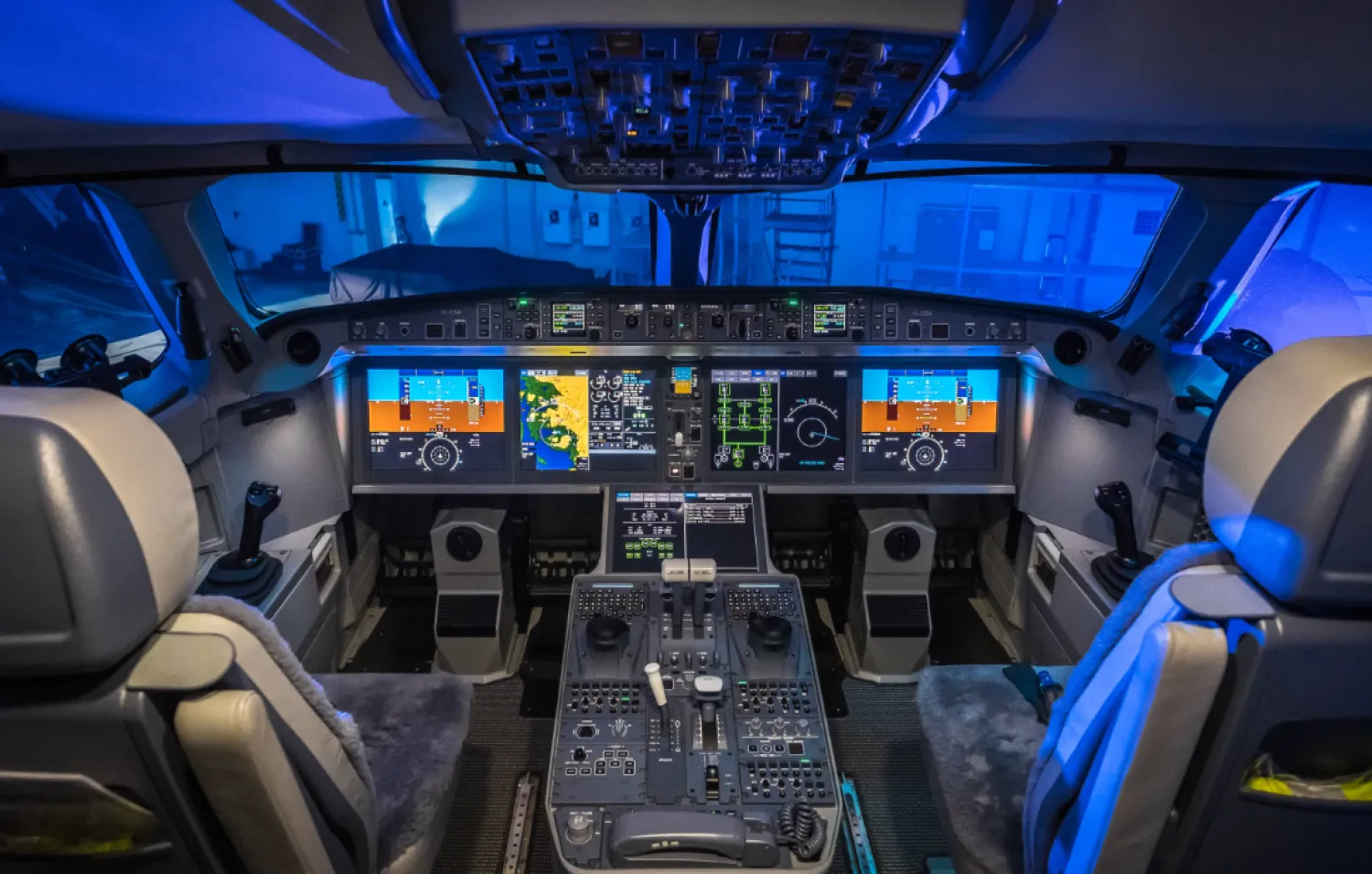
An illustration showing the layout of a modern glass cockpit, with advanced digital displays and the center pedestal located between the captain's and first officer's seats. The transponder used by pilots to enter the three-digit emergency codes 7700, 7600 and 7500 is located in this area. The codes are then displayed on air traffic controllers' radar screens. (Wikipedia)
TT

What Does Activating the 7700, 7600 and 7500 Emergency Codes Mean in Aviation?

An illustration showing the layout of a modern glass cockpit, with advanced digital displays and the center pedestal located between the captain's and first officer's seats. The transponder used by pilots to enter the three-digit emergency codes 7700, 7600 and 7500 is located in this area. The codes are then displayed on air traffic controllers' radar screens. (Wikipedia)

In aviation, flights operate according to carefully defined scenarios, but behind the apparent calm of the cockpit lies a coded digital language capable of changing the situation in the skies within seconds.

The recent incident involving a Flydubai flight, during which the emergency codes 7700 and then 7500 were activated, has again drawn attention to the strict and largely unseen protocols used by air traffic control centers to manage complex emergencies.

Between the emergency signal for a technical failure and the dramatic shift to the code indicating unlawful interference, how do the "shadow soldiers" on the ground manage a crisis involving an aircraft suspended between the sky and the ground until its wheels reach the safety of the runway?

The Silent Code and the Geography of Risk in Air Traffic Control Centers

Air traffic control centers monitor air traffic through continuous radio signals transmitted by the aircraft's transponder. When a cockpit crew faces a serious predicament, words can become a burden, and pressing buttons on the aircraft's equipment becomes the fastest means of signaling for help.

These distress signals appear on ground radar screens as flashing signals with distinctive colors that immediately draw the controller's attention. Internationally, they are known as "squawk codes," as designated by the International Civil Aviation Organization (ICAO).

Code 7700 represents the first technical and operational line of defense. It signals a major general emergency, which may range from critically low fuel or engine failure to serious medical emergencies, requiring an immediate response to secure a landing route.

But the danger takes on a different dimension when the code changes to 7500, the code for unlawful interference and hijacking. This alarming signal tells ground operations that the cockpit may have fallen under the control of an outside party, or that the safety of the aircraft and its passengers is under an imminent threat involving weapons or intimidation.
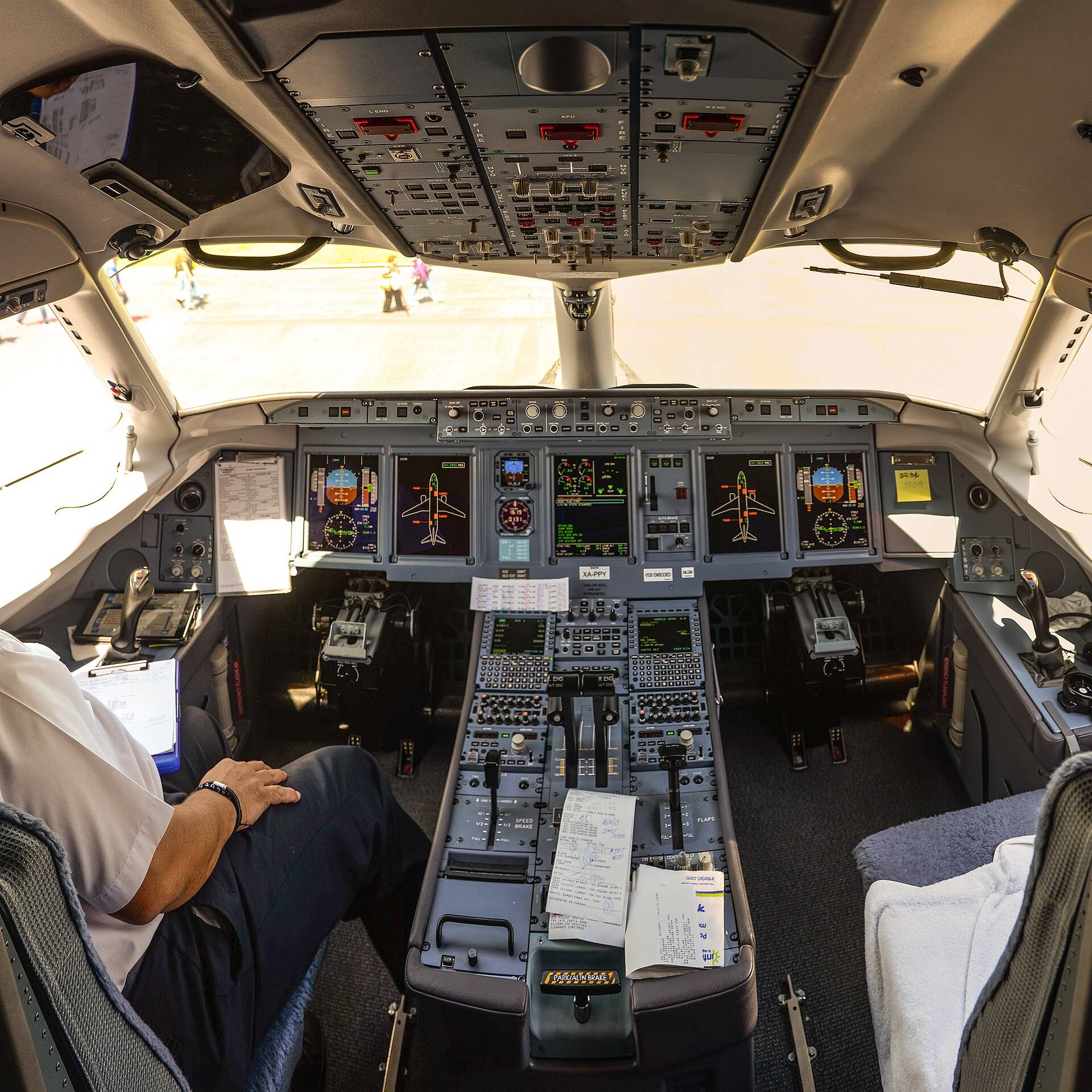
An image showing the layout of aircraft cockpits (Wikipedia)

The Mystery of Radio Silence and Decoding Code 7600

Between these two dangers is the other well-known code, 7600, which is used to indicate a complete failure of the aircraft's radio communications systems.

This code presents a unique challenge. The aircraft becomes "deaf and mute" in the sky, unable to receive instructions from the ground or transmit reports, while remaining visible on radar screens. Air traffic control handles code 7600 based on a clear assumption: controllers assume the pilot will follow the original flight plan precisely and begin clearing the airspace ahead of the aircraft based on its expected route.

The greatest danger lies in the overlap between these codes. Code 7600 may result from an innocent electrical failure, but in other scenarios it could be a deliberate maneuver by hijackers who have disconnected communications equipment to isolate the aircraft. This puts air traffic control centers on maximum alert as they work to resolve the ambiguity and determine that it has not developed into a 7500 situation.

Airspace Surgery and Securing Clear Routes

Once air traffic controllers detect the technical emergency code 7700, they begin what amounts to precise surgery in the surrounding airspace. Controllers immediately stop managing normal commercial traffic flow and focus their full attention on securing a route for the aircraft in distress.

All nearby aircraft receive decisive instructions to change altitude and move away from the affected aircraft's flight path, leaving the surrounding airspace completely clear and protected against any potential collision.

Ground authorities give the aircraft in distress absolute priority over all other flights and completely exempt it from the standard speeds and altitudes normally used in air navigation. Within minutes, control towers coordinate with ground authorities at the destination airport, positioning firefighting and rescue vehicles along the runway in preparation for a landing that may require urgent mechanical intervention.

Concealment Protocol and Management of Security Intervention

The situation inside operations centers changes completely if the alert becomes the hijacking code 7500. At that point, the crisis ceases to be a general aviation event and becomes a national security matter subject to the sovereign laws of the countries involved.

Strict international instructions require air traffic controllers to follow a protocol of radio silence and concealment. They are completely prohibited from using language over open radio frequencies that could indicate a hijacking or the presence of a security threat, in order to avoid provoking the perpetrators inside the cabin if they are listening to air traffic communications.

In such circumstances, the controller resorts to routine, coded messages, asking the pilot to reconfirm the aircraft's squawk code as a verification measure. If the pilot re-enters or confirms code 7500, or is unable to respond while the signal continues, the highest-level security plans are activated, and responsibility for managing the crisis immediately shifts from civilian authorities to air defense and armed forces leadership.

The Military Response and the Possibility of Extreme Measures

Fighter jets are deployed under what is known as an immediate scramble as soon as the 7500 security code is confirmed, to intercept and surround the civilian aircraft in the air.

Military pilots maintain carefully calculated safety distances that allow them to observe the cockpit visually, assess the situation inside, and verify the identity of those flying the aircraft amid the imposed radio silence or a communications failure indicated by code 7600.

This military escort is an extremely sensitive precautionary and sovereign measure intended to prevent the aircraft from approaching vital facilities or densely populated major cities.

Countries also take into account extreme scenarios. When conclusive evidence indicates that an aircraft has been turned into a flying bomb directed at destroying a strategic facility, a military shoot-down remains a last and painful option available to senior leaders to protect national security.

The Isolated Parking Area and the Transfer of Authority on the Ground

An aircraft facing a security threat indicated by code 7500 does not take the usual routes toward the airport's main gates. Instead, air traffic control directs it through completely isolated routes toward a remote area within the airport known as the isolated parking area.

This area is located at the far edges of the airfield, away from passenger terminals, critical infrastructure, and major fuel storage facilities, in order to minimize losses in the event of an explosion or act of sabotage.

Once the aircraft's wheels touch down on this isolated section of the airfield and it comes to a complete stop, the legal and operational authority of air traffic controllers ends.

The control tower closes its operational file, and law enforcement forces, counterterrorism units, and security negotiation teams take over on the ground. They begin dealing directly with the hijackers under tactical plans designed to save lives and take control of the cabin.

The Sequence of Codes: Between the Reality of the Threat and Human Error

The sequence and overlap of emergency codes during a single flight raises a state of heightened alert and deep analysis among aviation experts and investigators.

Under aviation conventions, this sequence has two possible explanations. The first points to a genuine escalation of the incident, in which the situation begins with a mechanical or technical failure indicated by code 7700 or a communications failure indicated by code 7600. A party then exploits the resulting chaos or sudden descent to seize control of the cockpit, forcing the crew to escalate the alert to code 7500.

The second explanation involves a technical human error under extreme pressure. Because the numbers on the control panel are close to one another, a pilot under intense fear and nervous stress could enter the hijacking code instead of the general emergency or communications failure code.

Despite the possibility of error, air traffic control protocols and aviation authorities worldwide require the sequence to be treated as a genuine security threat, and the military and security alert is not lifted until the aircraft has landed, been fully searched, and the safety of its passengers and crew has been confirmed.

More Than 400,000 Protest Across France

Protesters light flares at the Porte de Vincennes during a demonstration in favor of purchasing power, the protection of public services, and fiscal and social justice, in Paris on October 24, 2026. (Photo by Dimitar DILKOFF / AFP)
TT

More Than 400,000 Protest Across France

Protesters light flares at the Porte de Vincennes during a demonstration in favor of purchasing power, the protection of public services, and fiscal and social justice, in Paris on October 24, 2026. (Photo by Dimitar DILKOFF / AFP)

Clashes erupted in Paris as a mass march drew to a close Saturday, with more than 400,000 people rallying across France over school funding and soaring living costs in a fresh challenge to President Emmanuel Macron’s government.

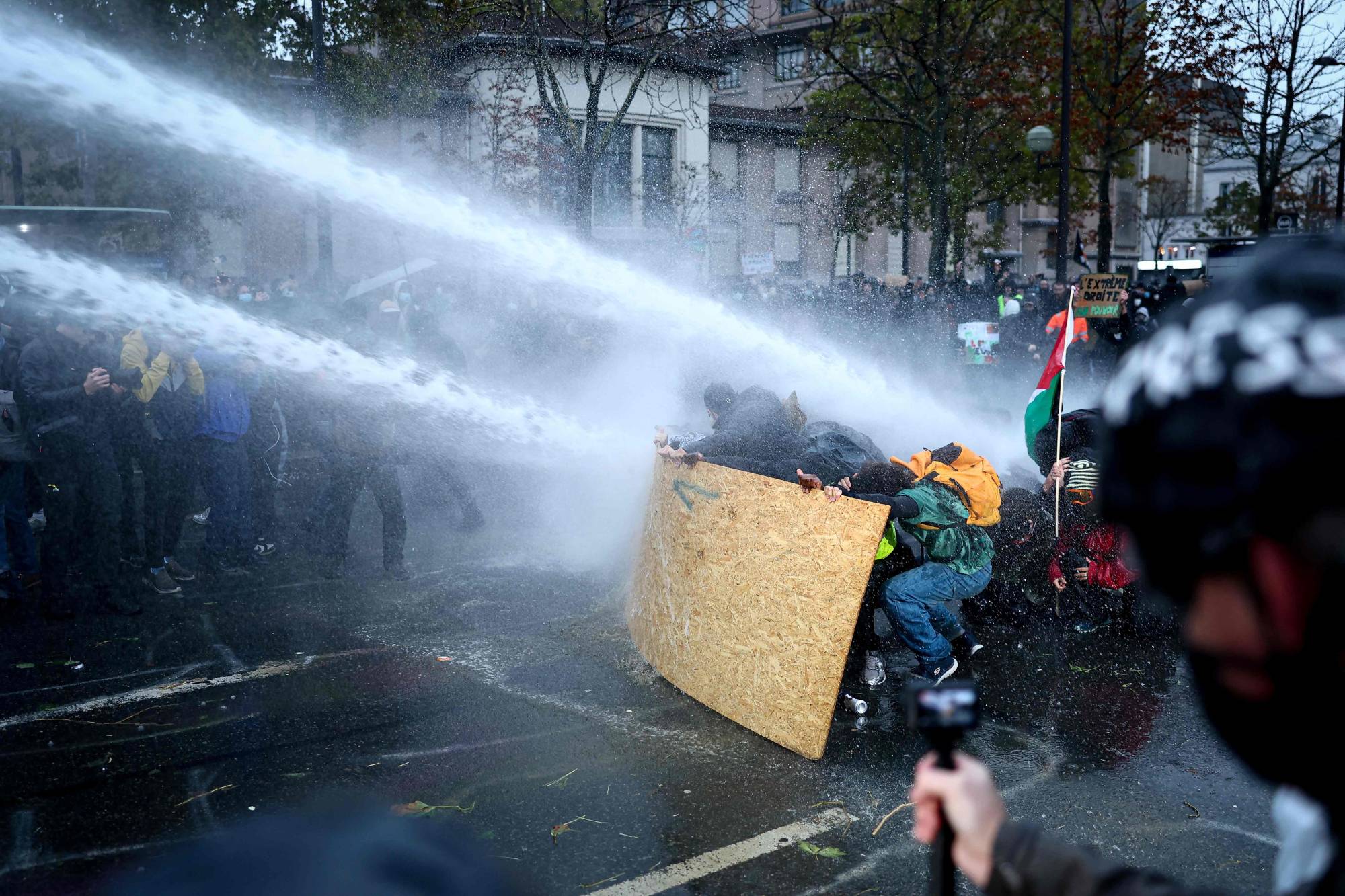
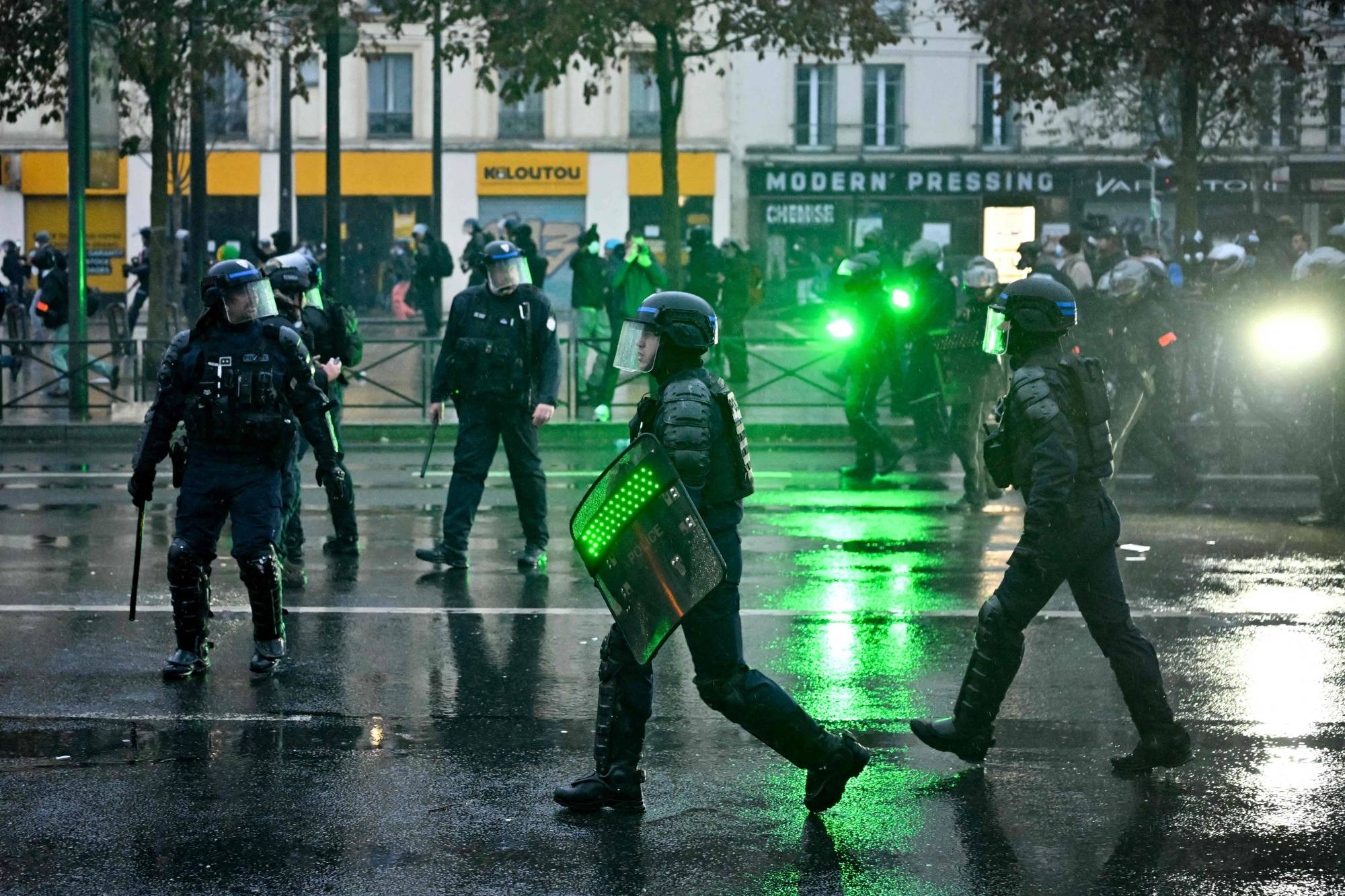
The Paris march began peacefully, a week after widespread rioting and looting during protests across the country. Near its endpoint at Porte de Vincennes, some protesters threw projectiles while police fired volleys of tear gas and used water cannons to disperse people.

The Interior Ministry put nationwide turnout at 410,000, while the CGT union estimated nearly 800,000. The ministry’s estimate included 110,000 in Paris, where authorities had confined the march to the city’s southeastern edge, away from the center.

Elsewhere in France, police used tear gas in Lyon, Clermont-Ferrand and Strasbourg and water cannons in Nice and Nantes, French media reported. In Marseille, officers fired tear gas during clashes with several dozen people near the march’s endpoint.

The Paris prosecutor’s office said 64 people had been arrested in connection with Saturday’s demonstration and 40 placed in police custody. Those arrested included six minors. Most arrests concerned suspected weapons offenses or participation in a group preparing violence or property damage, the office said.

The unrest is testing Macron's authority in the final months of his presidency before voters choose his successor in May. The stakes are high: the far-right National Rally has accused his government of failing to protect the public and urged people to channel their anger into votes for them.

Interior Minister Laurent Nuñez had announced a nationwide deployment of up to 70,000 officers, backed by helicopters, armored vehicles and water cannons.

Protesters take cover behind a wooden panel as a water canon is launched during a demonstration in favor of purchasing power, the protection of public services, and fiscal and social justice, in Paris on October 24, 2026. (Photo by Sameer AL-DOUMY / AFP)

Trade unions led the procession, followed by protesters in raincoats carrying flags and handmade placards.

Camille Chesnier, 27, said she had been unable to find work despite having an engineering degree and a master’s degree.

“There are enormous numbers of people in the same situation as me but who aren’t privileged and who find themselves living on the streets and in squats and, frankly, it’s very tough,” she said.

A small protest became a national movement What began last month as a protest over staff shortages at one high school southeast of Paris has spread nationwide, drawing students demanding better schools and workers seeking higher wages and pensions.

In Paris, Bénédicte Pittion, a 46-year-old teacher, marched through steady rain with her 16-year-old daughter, Garance, a high school student. Both had supported the movement from the start, but this was their first protest together.

“The young people who have been demonstrating have not been heard, and as a parent and as a teacher, I stand with them,” The Associated Press quoted Pittion as saying.

Garance said she had been “really scared” to attend after seeing images of last weekend’s violence, but argued that staying away would hand the government a victory.

Public middle and high schools lost 15.4 million teaching hours in the 2024-25 school year because absent teachers were not replaced, according to Education Ministry figures. That amounted to 7.5% of scheduled teaching time.

Macron met high school representatives Friday. They said he had promised to overhaul university admissions, but called for protests to continue until concrete measures are announced.

Organizers from the “yellow vest” protest movement called for another day of rallies Oct. 31 to defend the right to demonstrate.

Some protests were banned Soumaya Abed, a 58-year-old nurse wearing a red CGT union vest, said she had been joining protests for more than 30 years, but had never seen one start at Porte d’Italie, on the capital's outskirts.

“They are using what happened last week as an excuse to quiet protesters,” she said. “But it won’t stop the movement. It won’t stop students from demanding better conditions in schools.”

In Marseille, police put attendance at 17,000, while the CGT union estimated 100,000. In the southwestern city of Toulouse, 26,500 people joined the protests, according to authorities. Authorities had banned rallies in cities including Lyon, Nice and Montpellier.

Trade unions have criticized the bans, calling them violations of freedom of expression, which is protected by the constitution.

Thousands also marched Saturday in Orléans, south of Paris, in a separate peaceful protest against the far right as Marine Le Pen’s National Rally held a two-day congress in the city.

Macron, a centrist, has entered the crisis in the final stretches of his term with his popularity at its lowest since he took office in 2017. He has said that the measures are needed to protect city centers, businesses and public buildings.

Nuñez acknowledged Monday that police had lost control in some cities during last weekend’s unrest, when more than half a million people took to the streets and some 3,000 shops across France were damaged or looted amid street violence not seen in years.

He offered to resign, but Macron refused the offer.

Shops board up and museums close Gendarmes stood guard Saturday beneath the Arc de Triomphe and shopkeepers boarded up storefronts across Paris. Near the Saint-Lazare train station Saturday, Akram Ahmed, a 34-year-old contractor, was boarding up an optician’s shop.

“I got the call last night,” he said. “The owner seemed desperate. He said I was saving his life.”

Major museums, including the Louvre, Orsay Museum, Picasso Museum and Grand Palais — where a major Cézanne exhibit is on display — were shuttered Saturday.

Police officers face protesters near Porte de Vincennes during a demonstration in favor of purchasing power, the protection of public services, and fiscal and social justice, in Paris on October 24, 2026. (Photo by NICOLAS TUCAT / AFP)

Art Basel, one of the world’s most prestigious contemporary art fairs, opened to the public Friday, but only for the day, with the threat of unrest prompting organizers to cancel the weekend program.

Students and workers are angry Student groups want 250,000 more places in higher education and an end to selection through Parcoursup, the national admissions system.

Their joint 10-point plan also calls for more teachers and repairs to schools and universities.

They are also seeking help with everyday costs: an extra 200 euros ($224) a month in student grants and a rent freeze in public student housing.

Energy prices in France were 21.3% higher in September than a year earlier, helping drive overall inflation to 3.1%, according to the national statistics agency, INSEE.

Paris protester Louis Ledoux--Xatard voiced frustration over inequality.

“Looking at countries like the United States, we don’t want to end up like them, where part of the population has everything and the others have nothing,” he said.

“I never imagined that I’d be taking to the streets so much before my thirties.”


North Korea's Kim Returns Home after Visit to Chinese Border City

01 October 2026, North Korea, Pyongyang: FILE PHOTO - A photograph released by North Korea's official Korean Central News Agency (KCNA) on September 30, 2026, shows North Korean leader Kim Jong-un addressing a ceremony at Kim Il Sung University in Pyongyang marking the 80th anniversary of the country's top university. Photo: -/YNA/dpa
TT

North Korea's Kim Returns Home after Visit to Chinese Border City

01 October 2026, North Korea, Pyongyang: FILE PHOTO - A photograph released by North Korea's official Korean Central News Agency (KCNA) on September 30, 2026, shows North Korean leader Kim Jong-un addressing a ceremony at Kim Il Sung University in Pyongyang marking the 80th anniversary of the country's top university. Photo: -/YNA/dpa

North Korean leader Kim Jong Un returned home on Saturday after making a day-long trip to the Chinese border city of Dandong, Beijing's state media reported, though the purpose of the unannounced visit was not immediately clear and there was no mention of talks with his counterpart Xi Jinping.

Kim is thought to have crossed into China via a major border bridge that officially opened last week, 12 years after its completion, deepening economic ties between China and diplomatically isolated North Korea.

Neither North Korea nor China disclosed Kim's visit in advance. South Korean lawmaker Youn Kun-young said Kim was "understood" to have met Chinese Premier Li Qiang on Saturday.

A readout from China's Xinhua news agency did not mention talks between Kim and Xi or Li. Instead, it said Wang Huning, Beijing's top political advisor, accompanied Kim in Dandong and "saw him off" at the bridge at the end of the trip.

The aims and outcomes of Kim's visit were murky, but China is North Korea's largest trading partner and a vital source of diplomatic, economic and political support for Pyongyang.

Xinhua quoted Wang as saying the visit was significant for "consolidating public goodwill towards the friendship... (and) deepening political mutual trust and jointly pursuing cooperation and development".

He also said China and North Korea should expand personnel exchanges, economic cooperation and strategic coordination, "to foster a peaceful and stable external environment for safeguarding their respective sovereignty, security and development interests", according to Xinhua.

Wang conveyed Xi's "cordial greetings and best wishes" to the North Korean leader.

The trip fell near the date both countries use to mark the entry of Chinese troops into the Korean War. Kim attended a memorial ceremony to fallen soldiers and visited an automobile factory, Xinhua said.

China's top diplomat, Wang Yi, also took part in the events, it added.

Youn, the South Korean lawmaker, said he had been briefed on Friday that a visit was likely.

The trip could send a "positive signal" about a possible US-North Korea summit, he said in a statement sent to AFP.

World leaders are preparing for November's APEC summit in China's Shenzhen, where it has been speculated that Kim may meet US President Donald Trump.


Iran's Pezeshkian Blames US for Interim Deal Failure, Urges New Try

Iranian President Masoud Pezeshkian attends the leaders' summit of the 17th meeting of the Conference of the Parties (COP 17) to the Convention on Biological Diversity (CBD), in the Armenian capital of Yerevan on October 16, 2026. (Photo by AFP)
TT

Iran's Pezeshkian Blames US for Interim Deal Failure, Urges New Try

Iranian President Masoud Pezeshkian attends the leaders' summit of the 17th meeting of the Conference of the Parties (COP 17) to the Convention on Biological Diversity (CBD), in the Armenian capital of Yerevan on October 16, 2026. (Photo by AFP)

Iranian President Massoud Pezeshkian, in remarks broadcast on state TV on Saturday, blamed the United States for the failure of an interim deal with Iran, but said there should be a new attempt at concluding it.

"We were having negotiations, the (Americans) messed everything up...I still think we should go and conclude it," Pezeshkian said.

Washington is preparing for the possibility of a prolonged confrontation with Tehran, amid growing reports that the United States could launch fresh strikes against Iran before or after the US congressional midterm elections, despite President Donald Trump's insistence that the war could end soon.

US Ambassador to the United Nations Mike Waltz said Washington could maintain its blockade of Iranian ports for the foreseeable future and continue increasing economic pressure on Tehran, while expressing hope that Iran would return to meaningful negotiations over its nuclear program.

Trump, meanwhile, said the United States could take control of Iran and seize its oil. US Ambassador to Türkiye Tom Barrack did not rule out an American strike against Iran as early as this weekend, saying Trump had repeatedly given Tehran opportunities to reach an agreement.