Nike Plans More Job Cuts to Boost Sputtering Turnaround, Forecasts Steep Revenue Drop

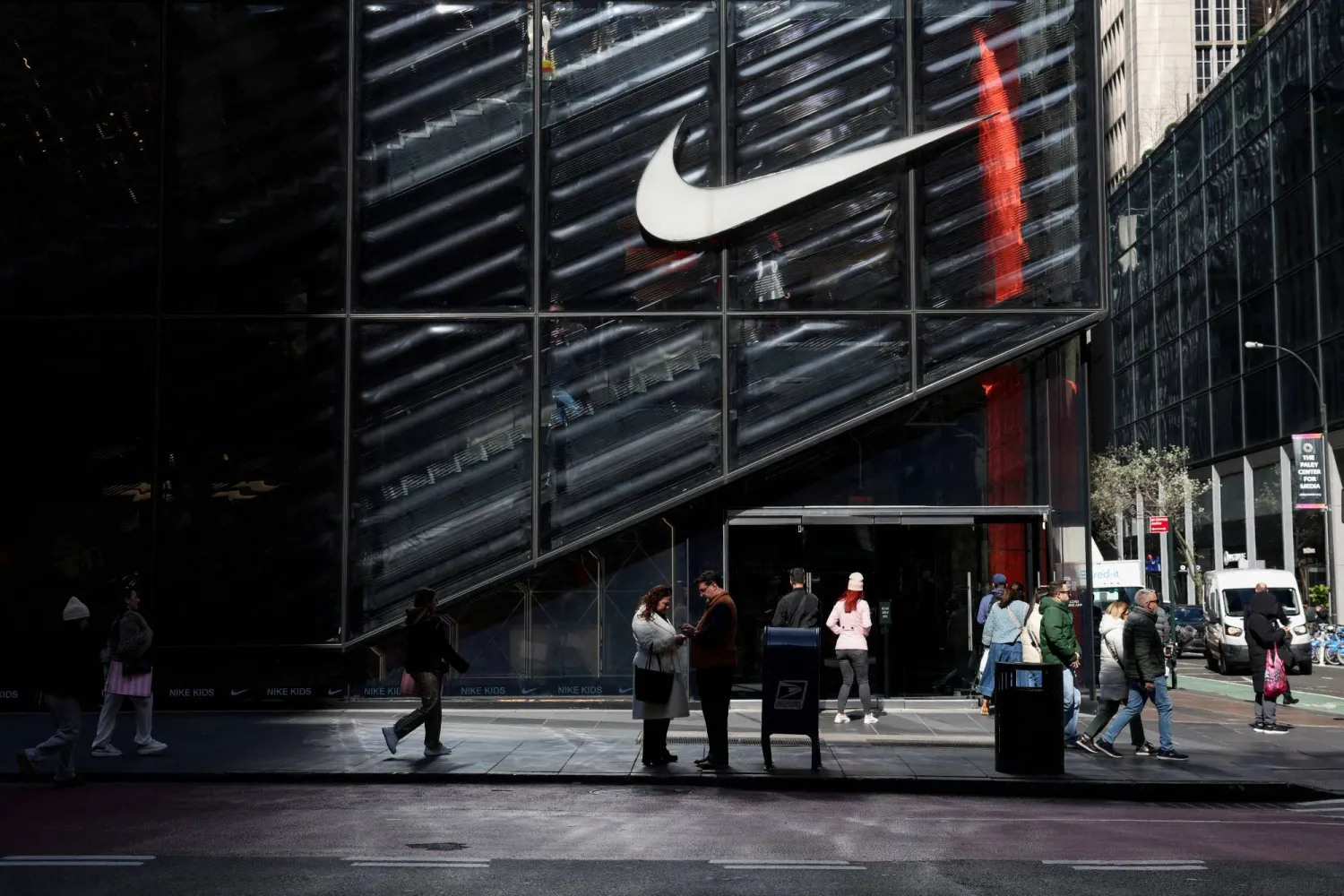
People walk past a Nike store in New York City, US, April 2, 2025. (Reuters)
TT

Nike Plans More Job Cuts to Boost Sputtering Turnaround, Forecasts Steep Revenue Drop

People walk past a Nike store in New York City, US, April 2, 2025. (Reuters)

Nike is deepening its restructuring under CEO Elliott Hill as its woes in China intensify, announcing a plan to cut more jobs and shake up its global business divisions after the sportswear giant projected a surprisingly steep drop in full-year revenue.

The tepid forecast on Thursday underscored that Nike's challenges will likely persist for at least several more quarters — especially in China, where sales tumbled 26% on a constant-currency basis in the first quarter — adding to investor unease about the pace of Hill's turnaround. Its shares fell 8.5% in extended trading.

The company has been working to revive growth during the first two years of Hill's tenure by refocusing on key sports such as running and by rebuilding relationships with wholesale retailers. But analysts say its worries have in large part stemmed from a failure to release enough new, compelling products, leading to an uptick in promotions and discounts.

"Our Nike performance business is not yet large enough to offset the pressure we're seeing in Nike sportswear, Jordan brand, and Greater ‌China," Hill said on ‌a post-earnings call. Reviving those weak areas of Nike's business "will take time," he said, pointing to a ‌deliberate ⁠reduction in the ⁠volume of Jordan retro launches.

The company, which also missed analysts' expectations for first-quarter revenue, unveiled changes to its operating model, including job cuts and a move to three geographic regions — Americas, Asia Pacific and Greater China, and EMEA — instead of four. It plans to open a new campus in India "with strong capabilities and access to talent."

Nike said the company does not yet know the number of roles that will be cut under the restructuring. It will begin notifying employees in 2027.

The program, building on previous rounds of layoffs, including one announced earlier this year, is expected to deliver about $2.5 billion in savings through fiscal 2031, with the majority set to be realized in fiscal years 2029 and 2030.

Nike expects its revenue to decline in the ⁠high single digit in fiscal 2027. Analysts, on average, estimate full-year revenue to drop about 2%, according ‌to data compiled by LSEG.

"There is nothing inherently wrong with the (restructuring) plans, but they do ‌suggest that Nike's current model is not really fit for purpose, which in turn raises the question of why these changes were not made sooner," ‌said Neil Saunders, managing director of GlobalData.

CHINA SALES PLUMMET, AGAIN

China, historically a profit-driver for Nike, has shown particular weakness in recent quarters ‌as international rivals and domestic sportswear groups gain traction. Investors remain focused on any signs of improvement, which analysts say will hinge in large part on local product innovation.

Sales in China have fallen for nine consecutive quarters, with the slowdown accelerating in the reported period. The region accounts for about 15% of Nike's annual revenue and is its third-largest market after North America and Europe, the Middle East and Africa.

The company recently said that starting in January, it will pull ‌online sales rights from some of its biggest retail partners in China — a high-stakes bet that tighter control over pricing and distribution can revive its fortunes.

But the digital cleanup will take "multiple seasons," ⁠Hill warned on Thursday, adding that near-term ⁠revenue and profitability in China will take a hit.

Analysts have also questioned whether the abrupt measures, though likely to help Nike address rampant discounting, will convince Chinese consumers that they want what Nike is selling.

"Nike does not have a channel problem in China, but rather a product problem," BNP Paribas senior analyst Laurent Vasilescu has said in a research note, adding that he was surprised by the company's short timeframe to shut down online wholesale in China.

Sales in North America, Nike's biggest region, rose 2% on a constant-currency basis, in one sign of relative strength in the first quarter. Nike's performance business, specifically, contributed to the growth, benefiting from the World Cup, Hill said.

Adding to the company's challenges, French soccer star Kylian Mbappe ended a two-decade-long partnership with Nike in September and joined Swiss-based rival On.

Nike's quarterly sales fell about 4% to $11.21 billion in the first quarter, compared with analysts' average estimate of $11.32 billion.

Its gross margin, however, rose 60 basis points to 42.8% in the quarter ended August 31, helped by lower warehousing and logistics costs.

Hill said Nike would update its targets through the fiscal year, beginning in November, as it works through the restructuring plan.

The company had withdrawn annual forecasts in October 2024 to provide then new-CEO Hill with some flexibility to assess its business.

S&P Dow Jones Indices removed Nike from the S&P 100 in September as part of a quarterly rebalancing after 18 years in the index of blue-chip companies.


AI Helps Cosmetic Giants Overcome Perfume’s Nasal ‘Paradoxes’

 Artificial intelligence is increasingly being used to develop new perfumes. (AFP)
Artificial intelligence is increasingly being used to develop new perfumes. (AFP)
TT

AI Helps Cosmetic Giants Overcome Perfume’s Nasal ‘Paradoxes’

 Artificial intelligence is increasingly being used to develop new perfumes. (AFP)
Artificial intelligence is increasingly being used to develop new perfumes. (AFP)

There may be a hint of bergamot in the top notes and sweet iris as a follow-up, but there is a noticeable dose of Artificial Intelligence emerging in new perfumes, according to industry specialists.

The traditional world of perfumes has not been able to turn up its nose to new technology and algorithms even though the industry insists that human sensorial expertise can never be fully replaced.

The US cosmetics giant Estee Lauder opened a perfume innovation center in Paris in 2025 that uses AI to mix savoir faire and cutting edge technology and help its billion dollars brands that include Jo Malone of London, Kilian Paris, Le Labo and Tom Ford Beauty, according to Lucas Nanini, the group's vice president for fragrance innovation.

He tests some of the new formulas uncovered on visitors to the Maison des Parfums.

"AI will allow us to work on what we call 'paradoxes'," Nanini told AFP. "For example, how can we create an oil that is rich, yet fine enough to be diffused?"

AI helps perfumers identify oils with properties that would take them years to develop by manual trial and error.

Machine intelligence also helps with regulatory tasks. Nanini highlighted the time it takes to check whether different countries allow each ingredient in a perfume.

With a single click he can now verify whether an ingredient from the one thousand-plus used is legal in a specific country as well as the maxium concentration allowed.

AI can also be used to find molecules to substitute for certain animal-derived ingredients.

Civet, taken from the glands of African civet and other cats in the species, was traditionally used to give perfume a musky tone but has been phased out in the face of animal rights protests.

- Fast fragrance -

International Flavors and Fragrances (IFF), another major US player, estimates that AI cuts between 25 and 30 percent of the time needed to develop and make a perfume.

With niche perfumes taking a bigger share of a growing market, enterprises like Givaudan of Switzerland and Robertet of France have heavily invested in tools to help them find new molecules.

IFF has developed its own AI tools using decades of internally collected data.

One suggests ingredients that complement each other and is used by IFF perfumer Tanguy Guesnet.

"Every perfumer is searching for that 'accord' -- that combination -- that will spark the emotion of tomorrow," he said.

The tool looks at the molecules in a single ingredient and suggests others with similar characteristics. Mint essence, for example, contains menthone, and the tool can propose other ingredients that also include the compound.

"Some pairings might seem obvious, while others might appear a bit outlandish, but that is precisely the richness of the tool," said Guesnet.

"It stimulates creativity and so I consider highly original combinations."

Not everyone is convinced by the AI revolution, however.

Guillaume Teule, co-founder of the French fragrance house Helius, insisted that he remains in control of how a scent develops. "I maintain my own vision."

"Much like in music, resonances and dissonances emerge when you start altering ingredients -- and it is precisely these dissonances that are interesting, and which only a human being knows how to leverage effectively," he said.

"I don't believe any AI would have suggested 'Angel'," he said of Thierry Mugler's so-called 'gourmand' fragrance launched in 1992 and considered revolutionary because of its sweet notes.

"It was like a stone thrown into a pond, when it was first released," commented Teule.


Cartier-Owner Richemont Quarterly Sales Beat Estimates as Jewellery Demand Continues

 A rock crystal and diamond bracelet by Cartier, estimated at US$1-2 million, during a preview ahead of Christie's auction in Geneva, Switzerland, November 5, 2026. (Reuters)
A rock crystal and diamond bracelet by Cartier, estimated at US$1-2 million, during a preview ahead of Christie's auction in Geneva, Switzerland, November 5, 2026. (Reuters)
TT

Cartier-Owner Richemont Quarterly Sales Beat Estimates as Jewellery Demand Continues

 A rock crystal and diamond bracelet by Cartier, estimated at US$1-2 million, during a preview ahead of Christie's auction in Geneva, Switzerland, November 5, 2026. (Reuters)
A rock crystal and diamond bracelet by Cartier, estimated at US$1-2 million, during a preview ahead of Christie's auction in Geneva, Switzerland, November 5, 2026. (Reuters)

Cartier-owner Richemont reported a faster-than expected quarterly sales increase on Friday, helped by continued demand for its jewellery and bumper growth in the United States and Japan.

The company, which also owns Swiss watch brands Piaget and IWC, said its sales rose by 13% when measured in constant currencies to €5.95 billion ($6.58 billion) in the three ‌months to the end ‌of September.

The figure beat analyst ‌forecasts ⁠for €5.89 billion in ⁠a consensus compiled by Visible Alpha.

Although a slowdown from the 20% growth rate in the prior quarter, the figure showed the resilience of Richemont's largely jewellery-based business and a strong performance in the United States, Japan and Europe, where sales ⁠increased by 15% or more.

The Swiss-based ‌company, which makes ‌brooches, earrings and necklaces under the Cartier, Buccellati, Van Cleef & ‌Arpels and Vhernier brands, has bucked the trend ‌in a struggling luxury industry thanks to its higher exposure to jewellery, with its jewellery brands accounting for about 75% of its revenues.

Sales of Richemont's jewellery ‌unit grew 14% in the quarter, while those of its specialist watchmakers division ⁠rose ⁠12%.

The company, which does not report quarterly earnings, said its first-half net profit improved to €2.53 billion from €1.81 billion a year earlier, ahead of analyst forecasts for €2.26 billion.

"The group delivered a strong first half, carried by sustained excellent performance of our Jewellery Maisons, robust growth at our specialist watchmakers and solid momentum at our fashion and accessories Maisons, despite a challenging fashion market," Richemont Chairman Johann Rupert said in a statement.


Frasers Executive David Epstein Becomes Hugo Boss CEO after Takeover

FILE PHOTO: Plastic toilet cabins are reflected in a window with the logo of Hugo Boss fashion company in central Moscow, Russia, May 8, 2025. REUTERS/Maxim Shemetov//File Photo
TT

Frasers Executive David Epstein Becomes Hugo Boss CEO after Takeover

FILE PHOTO: Plastic toilet cabins are reflected in a window with the logo of Hugo Boss fashion company in central Moscow, Russia, May 8, 2025. REUTERS/Maxim Shemetov//File Photo

Hugo Boss said on Thursday CEO Daniel Grieder would step down and leave the company at his own request, effective January 1, 2027.

The German fashion group said David Epstein from Frasers Group will ⁠succeed him as ⁠CEO, Reuters reported.

Frasers Group, already Hugo Boss's largest shareholder, took majority control of the company in October after raising its stake above 50%, months ⁠after an unsuccessful 2 billion euro takeover bid.

The move follows a series of leadership changes at Hugo Boss this year. In September, the company named Michael Murray, chief executive of Frasers Group, as chairman of its supervisory board.

The British retailer, ⁠controlled ⁠by billionaire Mike Ashley, has been expanding its presence in the premium and luxury segments.

Epstein has served as chief brand partnerships officer at Frasers Group since 2024, overseeing brand partnerships across its Sport, Premium, and Luxury businesses.