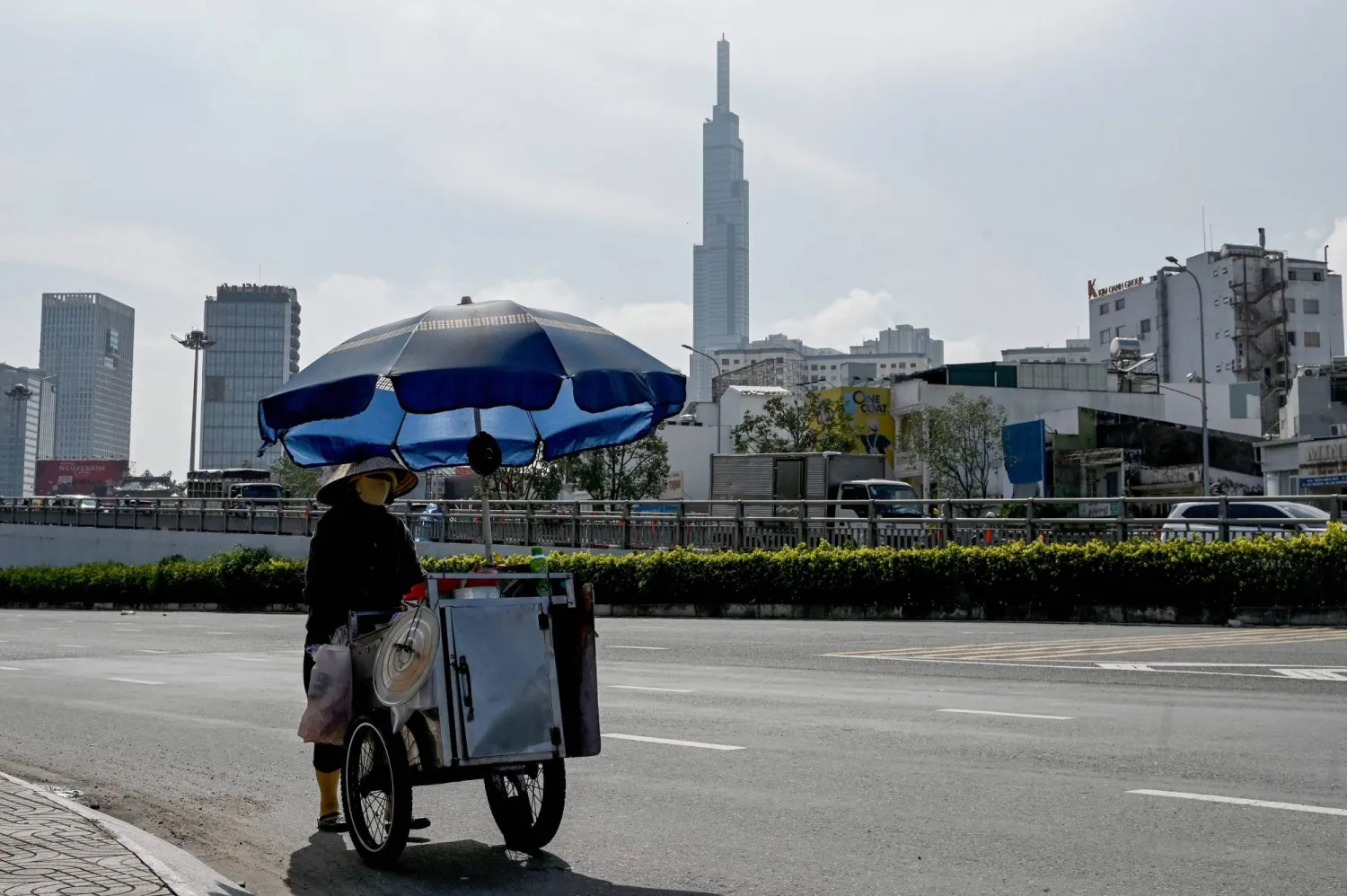
World Food Prices Near Four-year High in September

A street food vendor pushes a cart along the road in Ho Chi Minh City on October 2, 2026. (Photo by Nhac NGUYEN / AFP)
TT

World Food Prices Near Four-year High in September

A street food vendor pushes a cart along the road in Ho Chi Minh City on October 2, 2026. (Photo by Nhac NGUYEN / AFP)

World food prices rose in September to their highest in nearly four years as logistics disruptions and weather concerns affected crop markets, the United Nations' Food and Agriculture Organization said.

Fears about a severe El Nino weather pattern have pushed international sugar prices to an 18-month high, while a war-related collapse in Black Sea trade pushed wheat futures to a three-year peak early last month.

The FAO ⁠Food Price Index, ⁠which tracks monthly changes in international prices for a basket of food commodities, averaged 136.0 points, up from a revised 134.0 for August and the highest reading since November 2022.

FAO's benchmarks for cereal, sugar and vegetable oil ⁠prices all rose last month, though meat and dairy quotations fell.

“We are seeing a persistent and increasingly broad-based build up in global commodity prices, as disruptions in the Strait of Hormuz and the Black Sea combine with climate shocks, putting pressure on energy, transport and key food commodities,” FAO Chief Economist Maximo Torero said, according to Reuters.

“If sustained, these pressures will soon pass through to consumer food ⁠prices, especially ⁠in food and energy import-dependent countries,” he said in a statement.

In a separate report, FAO kept its forecast for global cereal production in 2026 almost unchanged at 2.979 billion metric tons, 2.1% below the previous year's peak but still the second-largest harvest on record.

FAO cut its forecast for world cereal trade in 2026/27 by 0.7% from September, citing lower wheat and maize export expectations due largely to constrained Black Sea shipping routes.


Eurozone Inflation Hits Three-year High at 3.8% in September

FILE PHOTO: The logo of the European Central Bank (ECB) is pictured outside its headquarters in Frankfurt, Germany, April 26, 2018. REUTERS/Kai Pfaffenbach/File Photo
TT

Eurozone Inflation Hits Three-year High at 3.8% in September

FILE PHOTO: The logo of the European Central Bank (ECB) is pictured outside its headquarters in Frankfurt, Germany, April 26, 2018. REUTERS/Kai Pfaffenbach/File Photo

Eurozone inflation jumped to 3.8 percent in September, the highest level in three years, as the war in the Middle East fueled a surge in energy costs, official data showed Friday.

The figure for the 21-country euro area was up sharply from 3.2 percent in August and remains well above the European Central Bank's two-percent target, raising the likelihood of another interest rate increase.

The September reading published by the statistical office of the European Union was slightly higher than the 3.7 percent forecast by economists for Bloomberg.

As the US war against Iran drags on, the conflict has caused major disruptions to fuel supplies from the Middle East, including from the Strait of Hormuz, a key energy trade route.

Energy price increases surged to 18.8 percent in September, up from 14.3 percent a month earlier, AFP quoted Eurostat as saying.

Core inflation, which strips out volatile energy and food prices, rose to 2.5 percent last month from 2.4 percent in August.

Meanwhile, food and drinks inflation increased to 1.4 percent from 1.1 percent in August.

Eurozone inflation was last above 3.8 percent in September 2023, when it stood at 4.3 percent.


Airbus Delivered Around 72 Aircraft in September

The logo of Airbus is picuted at the Airbus facility in Montoir-de-Bretagne near Saint-Nazaire, France, March 4, 2022. REUTERS/Stephane Mahe
TT

Airbus Delivered Around 72 Aircraft in September

The logo of Airbus is picuted at the Airbus facility in Montoir-de-Bretagne near Saint-Nazaire, France, March 4, 2022. REUTERS/Stephane Mahe

Airbus delivered around 72 aircraft in September, almost matching 73 a year earlier, industry sources said.

Airbus declined comment on the provisional delivery total ahead of a monthly industrial bulletin due ‌on October ‌8, said Reuters.

If confirmed, the ‌tally ⁠would be higher ⁠than the visible total of tracked deliveries estimated by analysts in the mid to high 60s. Jefferies analysts ⁠estimated 68 deliveries.

The pick-up ‌in ‌pace follows concerns about ‌the effect of delays in ‌the system including any impact from the latest industrial glitch involving parts for ‌the A321neo, as well as existing shortages of ⁠engines ⁠and other parts.

Commercial CEO Lars Wagner said this week that he was "very confident" of meeting the full-year target of around 870 jets, which Airbus has informally defined as 850 to 890.


Saudi Arabia Heads Into 2027 With Strong Recovery, More Diverse Growth Drivers

Saudi Arabia’s financial district (SPA) 
TT

Saudi Arabia Heads Into 2027 With Strong Recovery, More Diverse Growth Drivers

Saudi Arabia’s financial district (SPA) 

Saudi Arabia enters 2027 with a markedly different fiscal outlook, forecasting a strong economic recovery after a contraction linked to lower oil production, while its expanding non-oil economy increasingly cushions the impact of oil-related shocks.

The preliminary budget statement projects real GDP growth of 12.8 percent in 2027, following an expected contraction of 3.6 percent in 2026, alongside a budget deficit estimated at 3.6 percent of GDP.

The government plans to maintain investment spending and diversify growth sources while gradually reducing the deficit in the coming years.

Economists told Asharq Al-Awsat that the figures reflect a gradual shift in growth and revenue sources. Oil remains central to public finances and exports, but the economy now has a broader range of activities capable of generating growth and income.

Saudi Arabia projects expenditure of SAR 1.392 trillion ($371 billion) in its 2027 budget, against revenue of SAR 1.202 trillion ($320.5 billion), leaving an anticipated deficit of SAR 190 billion ($50.5 billion).

Three Revenue Scenarios

The preliminary budget outlines three revenue scenarios for 2027-2029, with annual government spending held at approximately SAR 1.392 trillion.

Under the baseline projection, revenue is estimated at SAR 1.202 trillion, producing a deficit of around SAR 191 billion. The higher-revenue estimate puts receipts at SAR 1.261 trillion and the deficit at SAR 132 billion, while the lower-revenue projection assumes revenue of SAR 1.134 trillion and a shortfall of SAR 259 billion.

The estimates reflect a broad range of possible fiscal outcomes amid uncertainty surrounding oil markets and the global economy. They also illustrate the government’s ability to accommodate revenue fluctuations through changes in the deficit rather than tying expenditure entirely to short-term shifts in revenue.

Spending and Fiscal Sustainability

Abdullah Almeer, assistant professor of economics at King Fahd University of Petroleum and Minerals, said maintaining elevated spending despite the projected deficit reflects a policy of using public finances to support growth and fund structural economic transformation.

He described the anticipated deficit of 3.6 percent of GDP as part of an effort to balance economic stimulus with fiscal sustainability, emphasizing that its implications depend on the nature of the expenditure it finances.

Infrastructure and development investment could strengthen growth and expand non-oil activities, he explained, whereas higher unproductive recurrent spending could increase debt burdens, financing costs and pressure on reserves.

Almeer estimated Saudi public debt at 30-33 percent of GDP, noting the government’s continued use of domestic and international financing instruments, including sukuk and bonds.

Expanding Non-Oil Revenue

Almeer highlighted the growing contribution of non-oil revenue, which covered approximately 17 percent of total expenditure in 2015, compared with 36 percent in 2025.

He attributed the shift to economic expansion, private-sector growth and investment in infrastructure, tourism and digital transformation.

Investments associated with the National Investment Strategy, the expansion of the Public Investment Fund and the Regional Headquarters Program have also stimulated non-oil sectors, he noted, estimating that more than 700 international companies have established regional headquarters in Riyadh.

External Risks

Almeer identified regional and global geopolitical developments as major risks to the 2027 budget, particularly through their effects on oil and commodity markets and shipping.

A global slowdown accompanied by higher energy prices could weaken demand for Saudi oil and non-oil exports, while persistent inflation and elevated interest rates could increase private-sector financing costs.

Higher global commodity, service and shipping costs could also feed into domestic prices. Saudi inflation is projected at 2.1 percent in 2026.

Almeer identified real non-oil GDP growth as the key indicator to monitor in 2027, alongside inflation, non-oil revenue coverage of expenditure, Saudi unemployment, private-sector contributions to GDP and the debt-to-GDP ratio.

Economic Transformation

Financial and Economic adviser Hussein Alattas said the 2027 budget figures demonstrate a focus on sustaining economic growth alongside fiscal sustainability, rather than merely controlling expenditure or reducing the deficit.

He stressed that continued investment in economic transformation projects aims to strengthen the private sector and increase non-oil contributions while maintaining spending levels capable of supporting growth.

Alattas further highlighted the rise in non-oil revenue from approximately SAR 166 billion in 2015 to SAR 505 billion in 2025 as evidence of structural economic change rather than a temporary increase in receipts.

The expansion of private enterprise, tourism, services, industry, technology and investment has broadened the economy’s capacity to generate income, he underlined.

Oil Remains a Pillar

Alattas argued that nearly a decade after the launch of Vision 2030, economic diversification has moved beyond planning and initiatives to produce tangible results in the economy and public finances.

However, reduced sensitivity to oil-price fluctuations does not mean oil has lost its importance. Crude remains a major source of government revenue and exports, leaving public finances exposed to changes in prices and production.

He explained that the difference lies in the expanding non-oil economy and its growing ability to generate income and growth.

The essence of Saudi Arabia’s economic transformation, Alattas concluded, is not abandoning oil but building an economy capable of continuing to grow and expand under varying oil-market conditions.