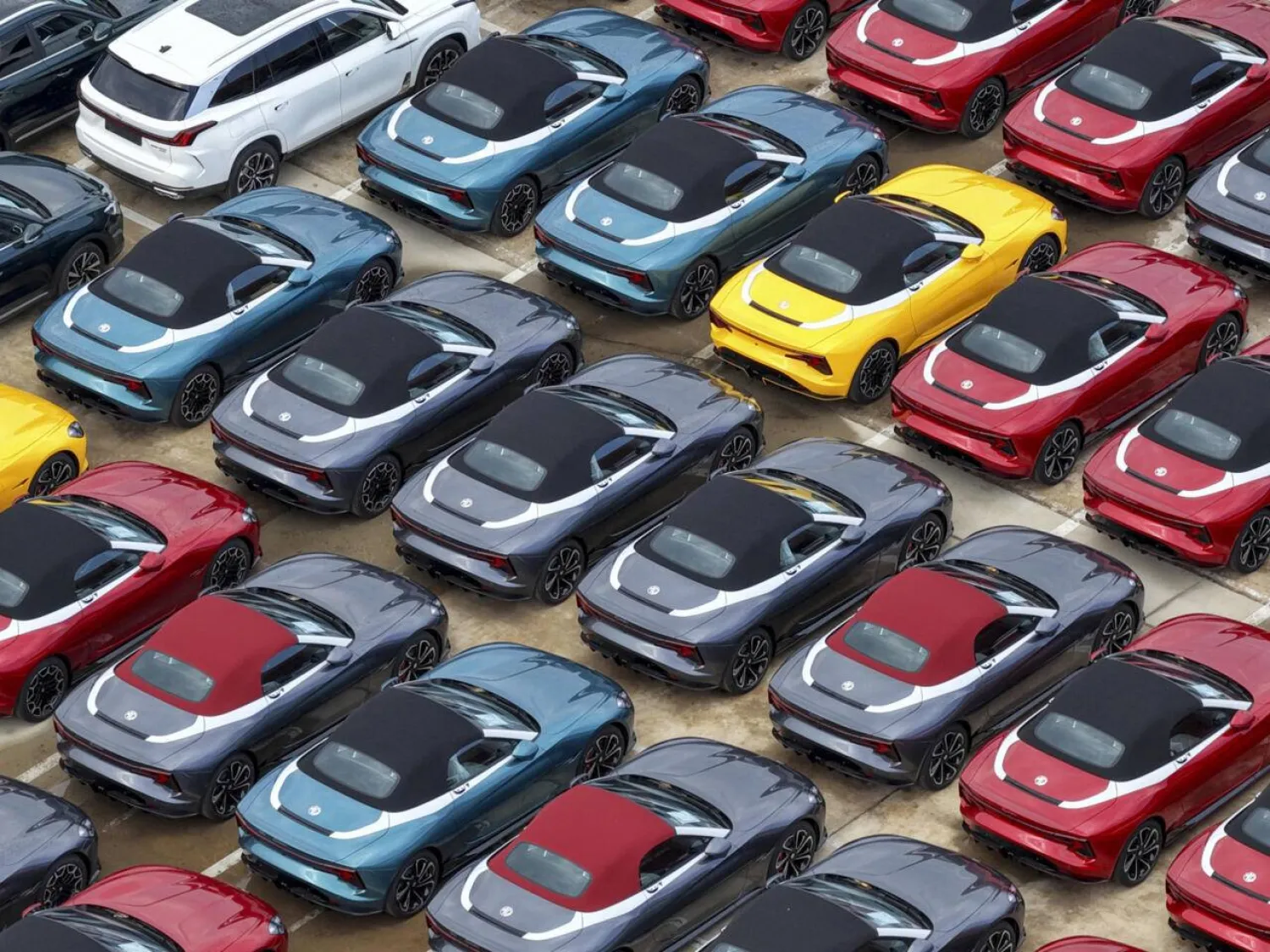
EU, China to Hold Beijing Talks to Avert Trade War

Brussels toughened its stance towards Beijing to defend businesses from what it believes is unfair competition in critical sectors including cars. CN-STR/AFP/File
TT

EU, China to Hold Beijing Talks to Avert Trade War

Brussels toughened its stance towards Beijing to defend businesses from what it believes is unfair competition in critical sectors including cars. CN-STR/AFP/File

EU trade chief Maros Sefcovic will head to Beijing on Thursday for two days of make-or-break meetings with Chinese officials to try to stave off a trade war.

The European Union has toughened its stance towards Beijing to defend businesses against what it believes is unfair competition in critical sectors including cars.

Increasingly European leaders and observers warn of a "China Shock 2.0", used to describe Chinese firms' shift into more high-tech manufacturing, which is threatening many traditional EU industries.

The first shock in the early 2000s saw a glut of cheap, more low-tech exports from China hurt manufacturers not just in Europe but around the world.

EU and Chinese officials have been locked in talks since June to address Brussels' concerns about the current trade imbalance.

The EU is simultaneously preparing to boost its trade defense toolbox -- but Beijing has threatened to retaliate against any moves targeting China.

Sefcovic raised the stakes for this week's meetings in summer when he warned the EU expected "tangible results by October" from the process.

But experts cautioned against expecting too much from this week's meetings.

"There may be a few crumbs, but I would not expect any kind of major breakthrough," Penny Naas, director of the Brussels office of German Marshall Fund of the United States (GMF) think tank, said.

There could be "agreements on some specific issues, rather than any broad settlement of the trade relationship", said Zhu Tian, professor of economics at the China Europe International Business School (CEIBS) in Shanghai.

It is clear Brussels is aware the talks won't solve all of its woes, with the commission working in parallel on new tools to protect European industries, which are expected to be presented to leaders in December.

- 'Worrying trends' -

What the EU wants is to cut its trade deficit with China.

It hit around 360 billion euros in 2025, meaning the EU imported far more from the Asian nation than it exported there. China has a lower figure of around $292 billion but expects the deficit to rise further this year.

The EU's trade enforcement chief, Denis Redonnet, said sectors facing "sustained and abnormal" import increases included machinery, textiles, basic metals and chemicals.

There were "potentially worrying trends for almost a quarter of all imports into the EU at the moment", driven mainly by Chinese goods, Redonnet told the European Parliament last week.

Sefcovic said the EU wanted to deliver on three main objectives including tackling export surges from China to the bloc's market, especially in critical sectors, and increasing exports from Europe to China.

Brussels also wanted "a system of export licensing for rare earths and other products" after major producer China introduced restrictions on them last year.

Europe hopes to manage Chinese exports through voluntary limits, for example on hybrid cars shipped to the bloc, but an EU official said Brussels wants to include other products. Beijing has said it firmly opposes import quotas.

China has limited room for maneuver because of weak domestic demand, which means the government relies on exports to sustain growth levels.

- Diversifying suppliers -

Since the bloc does not expect significant changes by China, the EU official, speaking on condition of anonymity, said it was also steaming ahead with preparing new tools.

Several EU nations including France have pushed for a "European equivalent of Section 301" -- the trade tool US President Donald Trump used to probe foreign practices Washington deems discriminatory, and retaliate with tariffs.

Responding to reports last week about such a tool, Beijing warned it would "respond resolutely" to "discriminatory restrictive measures".

The EU knows they are not empty threats: China previously retaliated against the bloc's trade defense moves with duties on European cognac, and conducted anti-dumping probes into pork and dairy products.

Brussels is also developing a tool that would support businesses, through funding, to diversify their suppliers in critical sectors.

It is still unclear, however, how far the EU as a whole would be willing to go against China -- for fear of provoking Beijing.

Germany, which is especially exposed since its biggest trading partner is China, has been especially cautious -- though Berlin's stance has hardened as it worries Chinese overcapacities are hurting its export-led economy.

Europe has "the ability to do something more aggressive to stem this China 2.0 shock", GMF's Naas said. "The question is, will they?"


Saudi Stocks End Week Lower

A silhouetted man in front of a trading screen in Saudi Arabia (Reuters)
TT

Saudi Stocks End Week Lower

A silhouetted man in front of a trading screen in Saudi Arabia (Reuters)

Saudi stocks closed lower on Thursday, extending losses for a second consecutive session as heavyweight shares, led by Maaden and Saudi National Bank, came under pressure alongside several other listed companies.

The benchmark Tadawul All Share Index (TASI) fell 0.4% to close at 10,159 points, shedding 41 points, with total trading turnover reaching approximately SAR 3 billion ($800 million).

Al Rajhi Bank shares declined 0.4%, while Maaden dropped 2.4%. Saudi National Bank fell 1.5%, and ACWA Power slipped 0.4%.

Among individual stocks, Tihama led the losers, falling 6% to SAR 14.77, followed by Raoom Trading, which declined 5.1%. Saudi Re also shed more than 5% to close at SAR 28.

Shares of Retal Urban Development, Amana Cooperative Insurance, Al-Babtain Power and Telecommunication, ADES Holding, Saudi Research and Media Group (SRMG), Luberef, Al Majdiah, East Pipes Integrated Company and Dallah Healthcare also ended the session lower, with losses ranging from 3% to 4%.

In contrast, Jarir Marketing gained 3%, while Advanced Petrochemical and Saudi Enaya Cooperative Insurance rose more than 2% each.


South Korean Exports Hit $1 Trillion for 1st Time on AI Demand

FILE PHOTO: A general view of the construction site of the Yongin semiconductor cluster in Yongin, South Korea, July 21, 2026.  REUTERS/Kim Hong-Ji/File Photo
FILE PHOTO: A general view of the construction site of the Yongin semiconductor cluster in Yongin, South Korea, July 21, 2026. REUTERS/Kim Hong-Ji/File Photo
TT

South Korean Exports Hit $1 Trillion for 1st Time on AI Demand

FILE PHOTO: A general view of the construction site of the Yongin semiconductor cluster in Yongin, South Korea, July 21, 2026.  REUTERS/Kim Hong-Ji/File Photo
FILE PHOTO: A general view of the construction site of the Yongin semiconductor cluster in Yongin, South Korea, July 21, 2026. REUTERS/Kim Hong-Ji/File Photo

South Korea's exports for the year have soared to $1 trillion for the first time, the trade ministry said on Thursday, thanks to surging demand for chips, computers and AI investment.

The country is a tech powerhouse and home to Samsung Electronics and SK hynix, two of the world's three biggest makers of memory chips that are key to driving the global AI boom.

An online statement said the figures proved Asia's fourth-largest economy was "a global export powerhouse" as it hit the milestone shortly after 2 pm (0500 GMT) on Thursday.

Only the United States, China and Germany have hit the milestone so far in 2026.

Total exports for all of 2025 came in at $700 billion, AFP quoted the trade ministry as saying.

"This year, semiconductors and computers drove overall export growth, bolstered by increased AI investment by global big tech companies," the ministry said.

Despite uncertain export conditions such as the Iran war, "key items" like petroleum products, ships and televisions performed well, while cosmetics and pharmaceuticals recorded "all-time highs".

"This achievement holds historical significance, as it marks a 10,000-fold increase in export volume over the 62 years since the $100 million export milestone was first reached in 1964," the ministry said.

President Lee Jae Myung said in his annual budget speech to parliament this month that 21.3 trillion won ($16 billion) would be allocated to chipmaking and artificial intelligence, spanning data centers to robotics.

The country will double spending on AI and semiconductors in 2027 to a record high, he added, pledging to use the technology to turn the military into a "smart, elite force".

Samsung and SK hynix announced plans in June to invest more than 4,755 trillion won in South Korea, marking a record level of corporate investment in the country.

South Korean chipmakers saw profits and their share prices skyrocket this year as frenzied demand for AI infrastructure squeezes the global supply of memory chips.

The boom has also spurred chip engineers and other workers to seek higher payouts in tense negotiations at companies including Samsung and SK hynix.

In September, Seoul announced plans for a 162.3 trillion won "Future Fund" next year, aimed at channeling record tax revenues from the country's chip boom into long-term growth.

Lee on Thursday thanked South Koreans for the milestone, stressing that it needs to turn into "sustainable growth".

"We will enhance the competitiveness of our core industries and foster future growth engines, such as AI and biotechnology," he said in a statement.

"We will also actively support the expansion of Korean consumer goods -- including K-beauty and K-food -- into the global market."


IMF Reaches Agreement with Egypt to Unlock $2.3 Billion in Funds

Egyptian President Abdel Fattah el-Sisi and IMF Managing Director Kristalina Georgieva. (Reuters file photo)
TT

IMF Reaches Agreement with Egypt to Unlock $2.3 Billion in Funds

Egyptian President Abdel Fattah el-Sisi and IMF Managing Director Kristalina Georgieva. (Reuters file photo)

The International Monetary Fund said on Wednesday that it had reached an agreement with Egypt to unlock a disbursement of about $2.3 billion in funds, subject to approval by the IMF's board, as the country nears the end of its $8 billion loan program.

Egypt would receive about $1.5 billion under the IMF's 48-month loan program after completing the final review, along with roughly $800 million under the Resilience and Sustainability Facility.

"The authorities’ successful implementation of their economic reform program and proactive response to the implications ⁠of the Middle East ⁠war have helped preserve macroeconomic stability and supported Egypt’s resilience in the face of a series of external shocks," Reuters quoted the IMF as saying in a statement.

Egypt's program with the IMF was expanded to $8 billion in March 2024.

The global lender said Egypt's economy remained resilient despite heightened regional tensions, with growth reaching 5.1% in the fiscal year ending June 2026, supported by a recovery in Suez Canal and petroleum-related activity and continued strength in manufacturing, tourism and communications.

The fund stressed that exchange-rate flexibility should remain the first line of defense against external shocks, with interventions limited to containing excessive volatility.

Egypt raised interest rates, by 100 basis points, in October for the first time since March 2024, a move welcomed by the IMF as a commitment to price stability amid heightened international oil prices and uncertainty.