


Horniman Museum's New Gallery to Open in February

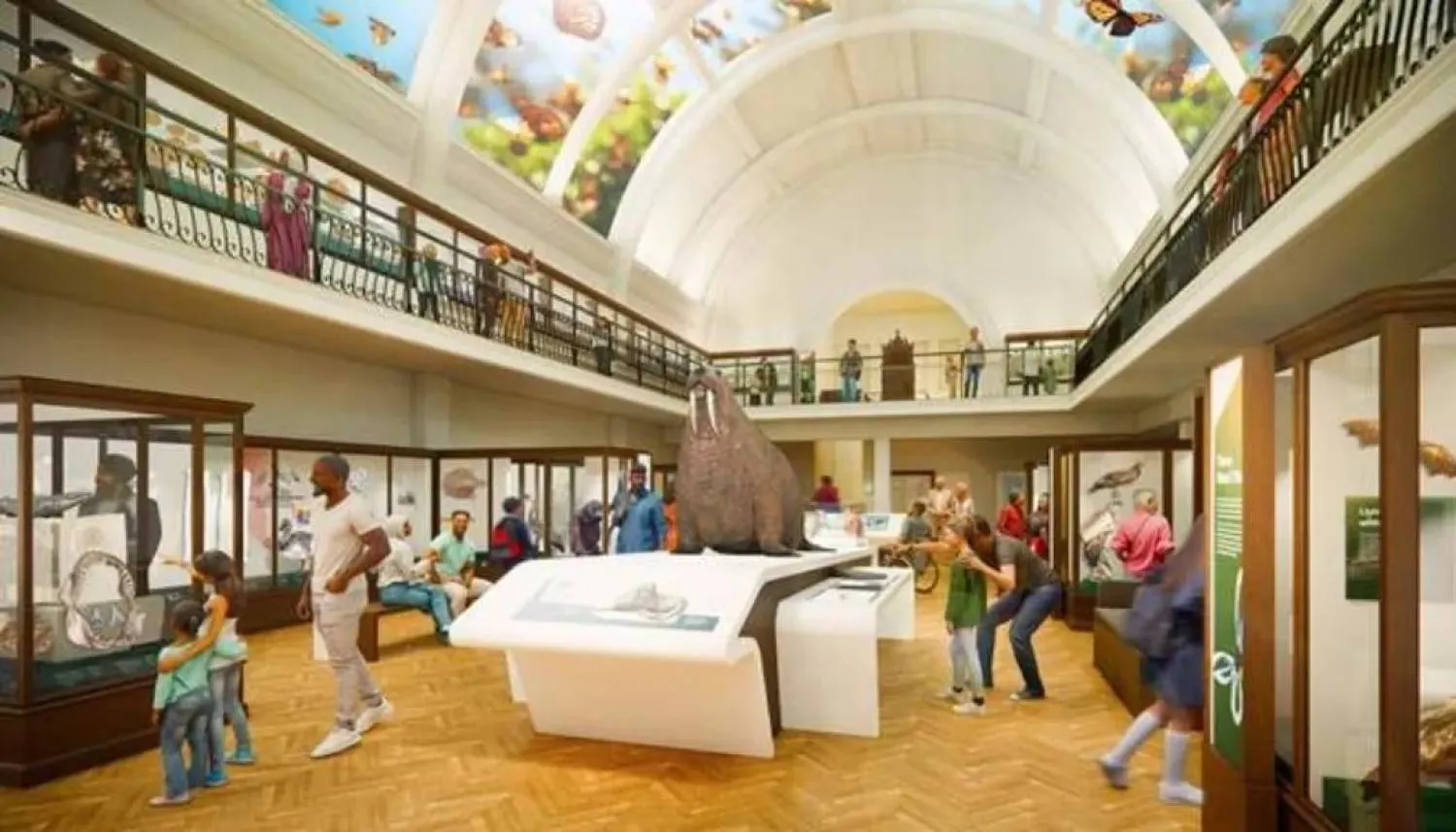
The Nature Gallery hopes to explore people's connection to and reliance on nature (Horniman Museum)
TT

Horniman Museum's New Gallery to Open in February

The Nature Gallery hopes to explore people's connection to and reliance on nature (Horniman Museum)

The Horniman Museum is set to open its new Nature Gallery in February 2027, marking the final phase of the museum's £12.5 million Nature + Love transformation project, supported by The National Lottery Heritage Fund.

The south-east London museum said the fully refurbished space, previously named the Natural History Gallery, had been reimagined to celebrate the variety of life on earth and explore humankind's place within, and impact on nature, according to BBC.

Michael Salter-Church MBE, chairman of the museum, said: “Opening these wonderful new spaces marks the end of the Horniman's extraordinary 125th anniversary year.”

The Nature Gallery will combine more than 2,300 objects from the Horniman's collection, including its famously overstuffed walrus, as well as artist commissions and multisensory activities.

These include a ceiling projection showcasing life on the planet, a display on plastic pollution by a Deptford school and a hands-on nature discovery zone focused on local wildlife.

The museum said the gallery explored human connection to and reliance on nature, stories of extinction and climate change, and ideas about how people can shape the planet's future.

It is one of a number of developments at the Horniman as part of its Nature + Love project, and is being supported by a £30,000 crowdfunding campaign, which has raised more than £14,000 to date.



Sunken Silk Road City Reveals Central Asia's Lost History

Little is known about the history of the settlement under Kyrgyzstan's largest lake. Vyacheslav OSELEDKO / AFP
TT

Sunken Silk Road City Reveals Central Asia's Lost History

Little is known about the history of the settlement under Kyrgyzstan's largest lake. Vyacheslav OSELEDKO / AFP

The sun had barely risen, but diving volunteer Elizaveta Bodrova was already raring to plunge into the cold waters of Lake Issyk-Kul, where the ruins of a once-thriving city have lain submerged for centuries.

Situated on an ancient trading route between China and Europe, little is known about the history of the settlement under Kyrgyzstan's largest lake or how it came to be flooded an estimated 800 years ago.

Together with a team of around 20 scientists, Bodrova is helping uncover its past, findings that could shape our understanding of the history of Central Asia and beyond.

"The visibility isn't very good today, but I hope we'll still be able to find the boundary of the settlement," the 42-year-old told AFP with a smile, before hopping off a motorboat into the depths below.

The project, which began in 2024 and is funded by the Russian Academy of Sciences, is the first major exploration of the site since it was rediscovered in the 19th century.

- 'Blind spot' -

The settlement is located at the heart of what was once the Silk Road, a trading route that linked China to the Mediterranean from the 2nd century BC until the mid-15th century.

Although often associated with nomads, what is now Kyrgyzstan has been inhabited by multiple civilizations throughout its history, among them Turkic dynasties that traded between Europe and China.

"This is actually a blind spot in history, even though it is right in the center of Central Asia," expedition director Maxim Menshikov, who was steering the boat, said of the ruins.

"It is a very important chapter in the history of humankind, because it was the period that linked East and West during the Middle Ages. The Silk Road is not merely the history of a single region, it is the history of Eurasia as a whole," he added.

The section of Silk Road that passed through the settlement during its existence is thought to have been under the control of the Karakhanids, a Turkic dynasty that controlled much of Central Asia from the 9th to early 13th centuries.

Researchers believe the city, the name and population of which are not known, may have covered up to five square kilometers (nearly two square miles).

Accurately dating the remains has been difficult.

But traces of two cemeteries discovered at the site suggest they were built during the early Islamization of the region.

Among the discovered remains was a decorated public building, possibly a mosque, public bath or religious school.

- Like 'Pompeii' -

After several hours scouring the lakebed, the divers returned to dry land with their spoils: the remains of animal bones and pottery shards.

"The bones that have been found will enable archaeologists to determine their diet and age of the remains, as well as the diet of the people who lived in this region," said Viktor Pozdnyakov, a diver and laboratory assistant on the expedition team.

"The pottery will enable us to date the finds and determine the approximate period more precisely. And, of course, to understand where it was produced, how and by what method," the 22-year-old added.

Back at base, the artefacts are carefully preserved, catalogued and recorded.

Among those in better condition was a child's chamber pot, known as a "tuvaq".

"In fact, these are still in use today in Central Asia and the Caucasus," said Menshikov, pointing to it as evidence of the daily life in the city.

Although known to researchers since the 19th century, the site has only been systematically explored in recent years by Russian and Kyrgyz teams.

The researchers hope their work will improve understanding of Central Asian history.

"You could compare this research to that of Pompeii," said Menshikov, referring to the largely preserved ruins of an ancient Roman city buried by an eruption of Mount Vesuvius in 79 AD.

"They had a highly developed civilization and culture. And in an instant, nature simply destroyed it all," he said.

What submerged the city under Issyk-Kul remains a mystery.

Among the theories is that the settlement sank to the bottom of the lake following a landslide, or that it was gradually flooded by a "tectonic dam" -- a natural damming of a water body that could have occurred following an earthquake.

The probable cause was a "past seismic disaster," said Andrei Strelnikov, a geologist with the Russian Academy of Sciences.


Saudi Culture Ministry to Launch Quarter Tone Exhibition at Fenaa Alawwal Center in Riyadh

The Saudi Culture Ministry will oversee the national pavilion with participation from several entities
TT

Saudi Culture Ministry to Launch Quarter Tone Exhibition at Fenaa Alawwal Center in Riyadh

The Saudi Culture Ministry will oversee the national pavilion with participation from several entities

The Ministry of Culture is scheduled to launch the Quarter Tone exhibition next Wednesday at Fenaa Alawwal Center, where it will run through November 7. The art exhibition offers a sensory experience exploring the intersection between music and visual art.

The Quarter Tone exhibition is an artistic project conceived by artist Naseer Shamma. Its concept uses sawdust and wood remnants generated from the making of the oud to create visual artworks that transform the material from its traditional function into compositions evoking sound, maqam, and rhythm, SPA reported.

The exhibition will be accompanied by a diverse cultural and artistic program featuring discussion sessions with artists and researchers addressing the relationship between sound and place, memory, and identity.

The exhibition will welcome visitors from 10:00 a.m. to 10:00 p.m. throughout the week and from 5:00 p.m. to 10:00 p.m. on Fridays.


KSGAAL Opens Fifth Annual International Conference on Arabic Language and Culture

The conference highlights the pivotal role of the Arabic language in shaping cultural identity - SPA
TT

KSGAAL Opens Fifth Annual International Conference on Arabic Language and Culture

The conference highlights the pivotal role of the Arabic language in shaping cultural identity - SPA

The King Salman Global Academy for Arabic Language (KSGAAL) opened its fifth annual international conference today in Riyadh, convening prominent researchers, linguists, and cultural scholars from Saudi Arabia and abroad for a two-day forum.

The conference highlights the pivotal role of the Arabic language in shaping cultural identity, collective memory, and intellectual discourse, while exploring its contributions to civilizational exchange, translation, and intercultural dialogue, SPA reported.

Sessions explore six key themes: language and cultural identity, language and civilizational interaction, language and intellectual and artistic creativity, language and digital culture, language and cultural policies, and language and the prospects for the cultural future.

The gathering serves as an international platform to exchange scholarly expertise, discuss emerging research in linguistic sciences, and advance initiatives that strengthen the presence of the Arabic language across global academic and cultural spheres.
