


War-weary Northern Israelis Rethink Loyalty to Netanyahu before Election

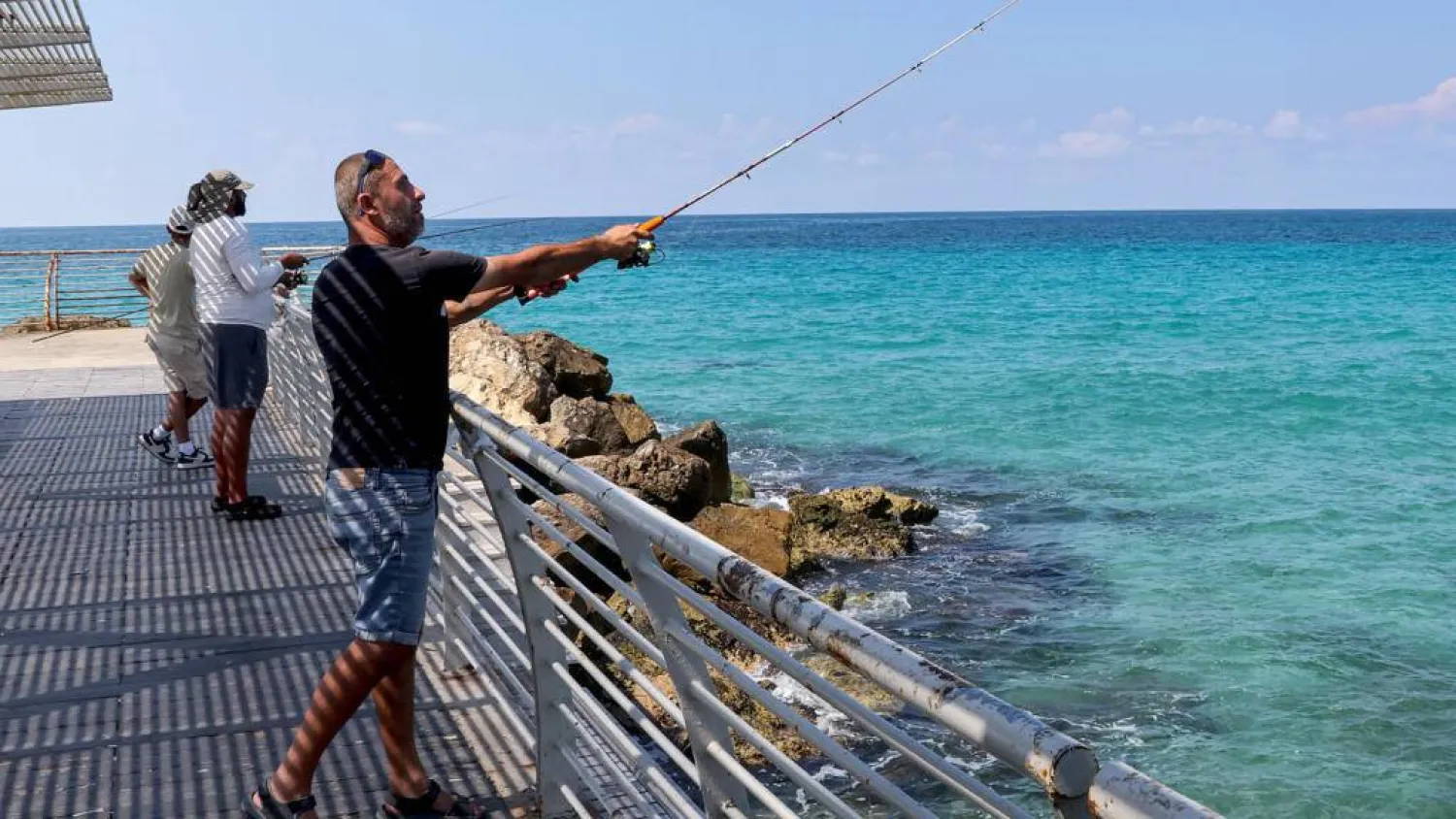
Nahariya resident Maxim Zarbaylov says he is considering not backing Netanyahu for the first time. JACK GUEZ / AFP
TT

War-weary Northern Israelis Rethink Loyalty to Netanyahu before Election

Nahariya resident Maxim Zarbaylov says he is considering not backing Netanyahu for the first time. JACK GUEZ / AFP

On Israel's border with Lebanon where Hezbollah fired thousands of rockets and drones, previous backers of Prime Minister Benjamin Netanyahu say they are rethinking how they will vote in the first election since the war.

"Many I know were right-wing and were Bibi supporters, and today they're not," said plant nursery owner Sigal Malachi, using a nickname for Israel's longest-serving premier.

In traditional strongholds of Netanyahu support, many told AFP they could no longer back his right-wing government in the October 27 vote, accusing it of failing to secure a lasting quiet with the militants.

Hezbollah, an Iran-backed Lebanese militant group, began firing into Israel in October 2023 in support of Hamas following the deadliest-ever attack on the country.

The barrages altered life in northern communities, displacing tens of thousands of Israelis and forcing people like Malachi to close shop for several years.

Northern Israelis are accustomed to incoming fire from the Lebanese side of the border, but they say that round of conflict was more intense.

"We grew up with Katyushas (rockets) and bombs," said Malachi, whose plant nursery reopened in March.

"This war was different."

She described that "if you went outside, within a second you'd be running" for shelter.

The war was halted with a fragile ceasefire in November 2024, but evacuees were not allowed home until early 2025.

Life began slowly returning to normal, until the northern front reopened after the outbreak of the Iran war.

Maxim Zarbaylov, who was born in the former Soviet Union but has long lived in Nahariya, the northernmost Israeli town on the Mediterranean, is among those wavering.

"All my life I voted for (Likud), for Bibi Netanyahu... But this year I want to vote for (Gadi) Eisenkot," he said, referring to the former military chief who is Netanyahu's main election rival.

Hezbollah has repeatedly dragged Lebanon into conflicts with Israel, most recently in March with rocket fire at Israel in support of Iran.

Israel has in turn seized what it calls a "security zone" in Lebanon, where authorities say Israeli attacks have killed more than 4,300 people.

At least 48 Israeli civilians and 30 soldiers have died on the Lebanese front since 2023.

- 'Psychological catastrophe' -

The prolonged violence has left border residents in limbo.

"After October 7 we don't sleep well anymore," Malachi said.

"I've thought about leaving. But the roots are so deep that I'm staying."

In Shlomi, an Israeli border town, the enemy is a tangible presence behind a hill.

Shadi Tuma, who owns a supermarket there, prides himself on running the only one that remained open.

"This area is under a trauma we haven't seen before. There's anger. The government is unable to provide a comprehensive response," he said.

"It's a huge psychological catastrophe. Not everyone is able to cope with a war that lasts three years."

The war has cracked the local support base for Netanyahu, Tuma said.

In the last elections in 2022, the premier's Likud party won 43 percent of the vote in Shlomi, compared with 23 percent nationwide.

Residents who backed Netanyahu "now want change because they no longer trust this government," Tuma said.

He said the high cost of living was a major complaint.

"Many people I see are struggling to make it to the end of the month."

For Tuma, the conflict is also personal.

He was born in Lebanon, the son of a fighter with the South Lebanon Army, a militia that fought alongside Israel in the 1980s and that had many fighters granted Israeli citizenship.

- 'Feel protected' -

The war could have shifted longstanding political loyalties in towns like Nahariya, a sleepy resort of about 70,000 people.

In 2022, 38 percent of voters there chose Likud.

But Zarbaylov says there is anger over the failure to stop Hamas' unprecedented assault on the country.

"What happened on October 7, Bibi could have prevented it, but he didn't," he said.

"The army, the top commanders, the chief of staff, could have prevented it."

Others believe only the current hawkish coalition can protect them.

Patrice Haddad retired to Nahariya from Paris a year ago, drawn by the town's "charm".

Israel's "Law of Return" allows any Jew anywhere in the world to immigrate and automatically receive citizenship.

Adjusting to life under the rockets was not simple at first.

"We were told we had 30 seconds to find shelter" after sirens blared, he said. "In reality, sometimes we only had 15, sometimes less."

For his first election as an Israeli, he has made his choice.

"The left in Israel has done a lot of harm, it wanted to give up territories," he said.

"It's important to vote for the right, because for me, with a government like Netanyahu's, we will feel protected."



Tens of Thousands Expected in Paris for High School Protests

The unrest has erupted with just months to go before the 2027 election to choose a successor to centrist President Emmanuel Macron. Jean-Christophe VERHAEGEN / AFP
TT

Tens of Thousands Expected in Paris for High School Protests

The unrest has erupted with just months to go before the 2027 election to choose a successor to centrist President Emmanuel Macron. Jean-Christophe VERHAEGEN / AFP

Tens of thousands of demonstrators are expected on the streets of Paris on Tuesday as France's powerful trade unions join high school students rallying for better conditions in a wave of protests marked by clashes with police.

Students have blocked the entrances to hundreds of high schools for 15 to 17-year-olds since late September, complaining of missing teachers, overloaded timetables, dilapidated classrooms and buildings that cannot cope with rising temperatures.

While many protests have been peaceful, some demonstrators have lit dustbin fires, destroyed bus shelters or clashed with riot police, who have responded with batons, tear gas and riot-control rounds, AFP said.

The government says 215 students and 715 police officers have been injured since the start of the movement, with a 15-year-old losing a hand on Monday after, according to a police union source, he picked up a sting-ball grenade fired by riot officers.

The unrest has erupted with just months to go before the 2027 election to choose a successor to centrist President Emmanuel Macron after his maximum two terms in office.

More protests are expected across the country on Tuesday after teaching was disrupted at 589 of the country's 3,700 lycees and 32 universities, according to the education ministry and a student union.

Authorities are expecting some 20,000 to 40,000 demonstrators in Paris.

Prime Minister Sebastien Lecornu's office has called for "peaceful" gatherings, calling for a return to "a structured, legal and democratic form of opposition".

The head of the CGT labor union Sophie Binet has said its members would be there to "protect high-school students".

- 'Disproportionate police repression' -

Several unions and rights groups have accused the police of using disproportionate force against the protesters.

Amnesty International late Monday said the French authorities should "put an end to the disproportionate police repression seen in recent days during student protests".

"The images and testimonies widely circulated over the past week raise alarming concerns about the dangerous use of tear gas, batons and policing techniques by the police," Amnesty's Anne Savinel-Barras said.

The police have launched 10 internal investigations into allegations of brutality since the protests started, Interior Minister Laurent Nunez said late Monday.

The government has sought to address the grievances, while accusing the hard-left France Unbowed (LFI) party of being behind the movement.

Veteran LFI presidential candidate Jean-Luc Melenchon has strongly supported the protests, while calling for non-violent methods.

Since the start of the movement, 24 schools have been burned or ransacked, according to the education ministry.

More than 5,000 people, 87 percent of them minors, have been arrested.

Lecornu's office said 85 teaching staff have also been injured.

The prime minister has sought to address the issue of missing teachers and renovating buildings that are dilapidated.

The government is also pushing legislation to make those responsible for damaging public property pay for repairs themselves, instead of using public funds.

Lecornu has said the draft law could allow compensation payments to be recovered from family allowances and housing benefits while ensuring a minimum income.

Union leader Binet has said it would "end up targeting the most vulnerable families".


Australia's Opposition Vows 'Largest Cut to Immigration' in Country's History

Net overseas migration -– the net gain or loss to the population through movement to and from Australia -– stood at 292,100 in the year to March, data showed last month. DAVID GRAY / AFP/File
TT

Australia's Opposition Vows 'Largest Cut to Immigration' in Country's History

Net overseas migration -– the net gain or loss to the population through movement to and from Australia -– stood at 292,100 in the year to March, data showed last month. DAVID GRAY / AFP/File

Australia's conservative opposition vowed on Tuesday to implement the "largest cut to immigration" in the country's history if it takes power.

The Liberal-National party alliance has governed Australia for much of the postwar period but has slumped into third place in the opinion polls under pressure from the insurgent far-right One Nation party, which has vowed radical cuts to immigration.

Net overseas migration -- the net gain or loss to the population through movement to and from Australia -- stood at 292,100 in the year to March, data showed last month.

On Tuesday, Liberal Party leader Angus Taylor said under his government that would be cut to 100,000 for the first two years, AFP said.

"Australia should be a home, not a hotel," Taylor told journalists, saying the country needed "breathing space".

He said the Coalition would also cut temporary visas issued by 650,000 over four years should it win the next election, scheduled to take place in 2028.

"We are a country, not a campground," National Party leader Matt Canavan said, saying the plans would help "take back our country".

Australia's ruling Labor Party has also vowed to get tougher on immigration.

Last month, interior minister Tony Burke announced plans to reduce migration by curbing "visa hopping", tightening rules on students and working holiday makers as well as cracking down on overstayers.

Opinion polls show One Nation, for decades a fringe group led by provocateur Pauline Hanson, has become Australia's most popular party in recent months.

On Tuesday Hanson said Labor and the Liberals "have both been dragged kicking and screaming into the immigration debate by One Nation".

"Australians cannot trust Liberal or Labor to follow through on their promises," she said on X.


Seoul Weighs Steps to Force North Korea Landmine Apology

A South Korean military guard post is seen through a military fence at Imjingak peace park near the Demilitarized Zone (DMZ) dividing the two Koreas, in Paju on September 30, 2026. Jung Yeon-je / AFP
TT

Seoul Weighs Steps to Force North Korea Landmine Apology

A South Korean military guard post is seen through a military fence at Imjingak peace park near the Demilitarized Zone (DMZ) dividing the two Koreas, in Paju on September 30, 2026. Jung Yeon-je / AFP

South Korea is considering measures to force an apology from North Korea over a recent landmine blast that injured three soldiers inside the Demilitarized Zone, its defense ministry said Tuesday.

A joint South Korean-UN investigation concluded that two landmines that exploded in the DMZ last month were planted by North Korean forces about a year ago, prompting Seoul to demand an official apology, reported AFP.

It has also called on the nuclear-armed North to remove any other mines planted on the southern side of the Military Demarcation Line (MDL) that runs through the DMZ, the heavily fortified frontier that has divided the Korean Peninsula since the 1953 armistice.

Pyongyang has denied responsibility, with Kim Yo Jong, the powerful sister of North Korea's leader, slamming the call for an apology as "despicable".

"We are not ruling out any options or prejudging anything when it comes to additional measures," defense ministry spokeswoman Chung Bin-na told reporters Tuesday when asked if steps were being planned to force an apology from Pyongyang.

Bin-na did not offer specifics about what actions might be employed.

Landmine incidents in the DMZ have previously heightened tensions between the two Koreas, which remain technically at war.

In 2015, two South Korean soldiers were seriously wounded in a landmine blast on the southern side of the DMZ, with one losing both legs.

Seoul concluded at the time that North Korean troops had crossed the MDL to plant the mines, an accusation Pyongyang denied.

Since 2024, Pyongyang's military has laid mines and built anti-tank barriers along the frontier as part of efforts to permanently seal it off.

During the operation, North Korea also blew up the northern sections of inter-Korean roads no longer in use.