
Purple Reign: Philippines Seeks to Keep Grip on Ube Throne

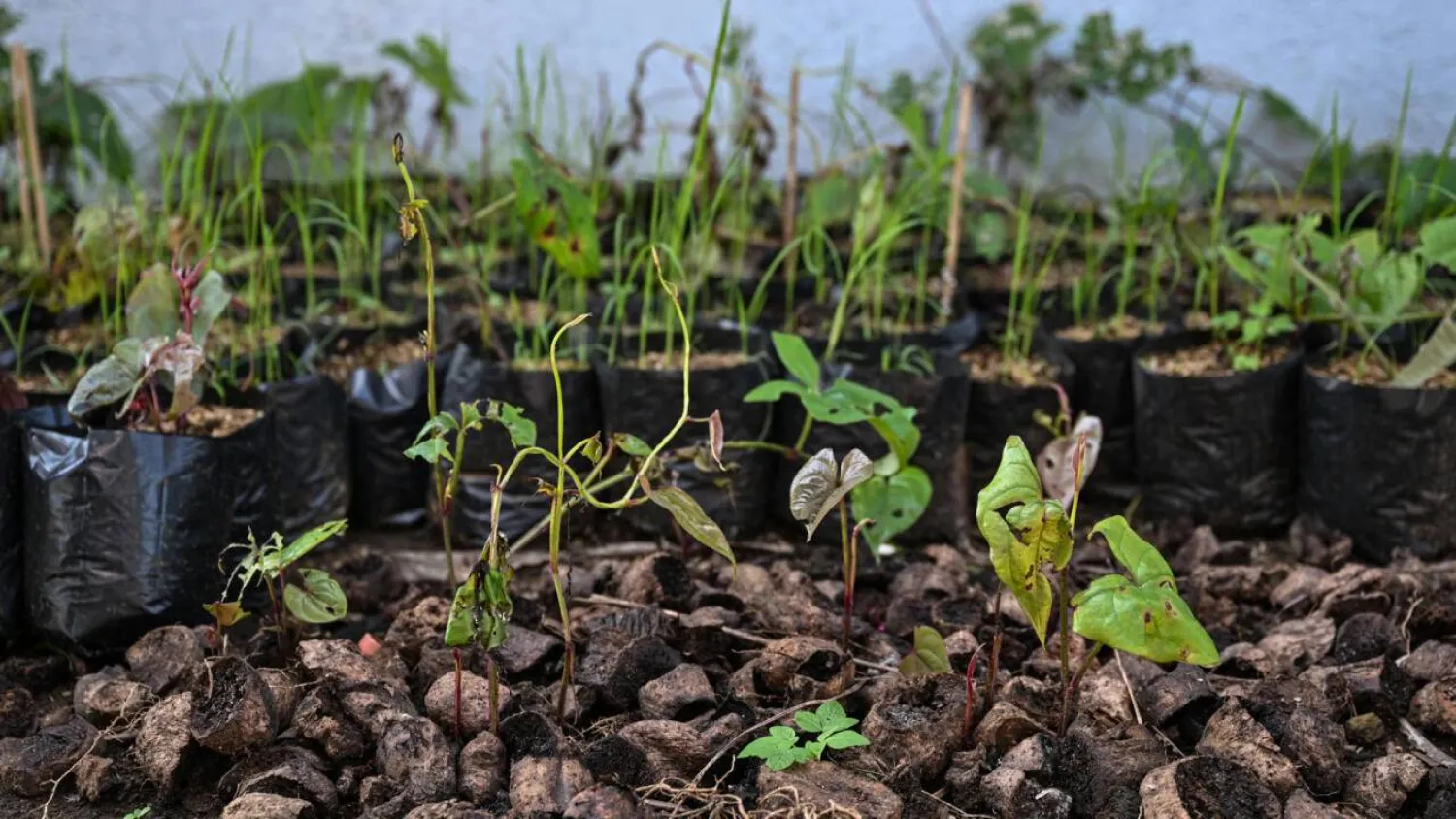
Purple yam sprout at a farm in Padre Garcia, Batangas province. Jam STA ROSA / AFP
TT

Purple Reign: Philippines Seeks to Keep Grip on Ube Throne

Purple yam sprout at a farm in Padre Garcia, Batangas province. Jam STA ROSA / AFP

The Philippine ube has become a trend-setting sensation from Los Angeles to London to Seoul, with the humble yam's bright purple hue drawing lines outside coffee shops and bakeries and millions of views on social media.

But keeping pace with the international boom has proven tricky for the archipelago nation's overwhelmingly smallholder farmers, with yields declining and some unable to commit to the plant's nine-month growing time.

Fears that biopiracy might take a chunk out of the blossoming market, meanwhile, have prompted the government to announce a ban on the export of the raw form of the yam.

Standing in his ube field south of Manila, farmer-exporter Al Bonifacio told AFP he was in favor of doing whatever it took to protect the crop from any growers overseas trying to cash in on the craze.

"Purple is so royal and is very pleasing to the eye," the 59-year-old said with a smile during a visit to his one-hectare (2.5-acre) ube farm.

"Our greatest fear is, if we are not able to supply ube to the world, someone (else) will step in."

Sold as powder, extract, paste, or frozen puree, ube is easily mixed into coffee, pastries, ice cream, spreads and even make-up.

At a Tokyo gelato shop, ube importer JP Mercado told AFP the Japanese market was expanding rapidly after the craze first hit neighboring South Korea.

"It's really taken off like wildfire," he said as a batch of powder was slowly stirred into gelato, turning it a bright purple.

"I think social media has been hugely impactful," he said, adding his client list ranged from small cafes to luxury hotels.

- Rooted in history -

Ube was a staple of Philippine gardens as long as 5,000 years ago, boiled and eaten by families as a substitute to rice when their provisions ran out.

Beloved for its mildly sweet, nutty flavor and velvety texture, it later evolved into a party food, consumed as a jam or stewed with sticky rice balls in coconut milk.

Demand exploded locally this decade, most memorably during a purple bread mania that swept the archipelago in the darkest days of the Covid-19 pandemic.

"I'm super-obsessed with ube," university student Kym Trivino told AFP as she sipped an ube-matcha concoction at one of Manila's largest shopping malls.

Baker Diane Bustos said her company now sells seven types of ube cookies.

"It took over matcha. That's really something that we Filipinos should be really proud of," she said, referring to the bright green tea powder popularized by Gwyneth Paltrow and other celebrities.

But as ube mania grows globally, clouds loom at home.

Bonifacio told AFP the country's small farmers widely lacked the facilities for post-harvest storage and processing, while access to marketing and financing lagged.

Planting to harvest takes at least nine months, too long for most Filipino farmers who preferred the shorter growing period for beans, squash or bittergourd to feed their families, the farmer added.

Bonifacio said he had been forced to scour the rest of the country for raw ube to meet his growing export commitments, a process that can double his costs.

"We have the land, but quality planting materials are not always available," Leonilyn Ladao, a local agriculturist, told AFP.

- A battle for the future -

"Last year's production was just 12,483 tons," Jose Zalde Samson, from the country's plant industry bureau, told AFP of the five-year low.

Industry officials blamed typhoons, which hit key ube farming regions. For the first half of 2026, production was up around 17 percent.

"The government has only started promoting ube in the past two to three years as demand spiked," Samson explained.

"Before the ube craze, it was a niche market," he said, adding it had lagged behind high-value crops like bananas, mangoes and coffee.

With the pressure on, the government is now working on how it can boost supply.

"We are looking at how (the growing season) can be shortened to six months," Samson said.

With neighbors like Thailand and Vietnam now getting into the game, the Philippines is acting to protect its crown.

"We don't want to export it to countries that could use Philippine ube varieties to compete with us," Agriculture Secretary Francisco Tiu Laurel said last month while revealing the ban on raw ube exports.

"We've had data that tubers were being (surreptitiously) exported," Samson said, declining to provide further details.

In Tokyo, ube importer Mercado said he backed the Philippine government's move, which he believed would protect the country's cultural heritage.

"Ube really is, I would say, very interlocked with the Filipino identity," he said.

Bonifacio the farmer agreed.

"(We) are stewards of the ube industry," he said, looking out over his crop.

"We have a stake in this. We have to protect it."


Ready, Set, Snooze: Sleep-deprived Japanese Compete for Best-rested

© Selim CHTAYTI / AFP
TT

Ready, Set, Snooze: Sleep-deprived Japanese Compete for Best-rested

© Selim CHTAYTI / AFP

In diligent, exhausted Japan, self-described elite "competitive sleepers" vied to lie down, relax and nap the fastest and deepest in a contest organized by a mattress company.

The Tokyo competition, dubbed "Matt Race", saw dozens of participants fitted with sleep tracking devices sprawl on comfy mattresses to slumber for up to 90 minutes Monday, competing for the top prize of over two million yen ($14,000).

"Japan is often described as a country suffering from sleep deprivation, and people here are very diligent," Riichiro Nakama, creative director at organizer Koala Sleep Japan, the mattress company.

Inside a dimly lit room, participants slept with monitors attached to their heads, some cradling stuffed toys in their beds, reported AFP.

"By turning it into an event like this, I think we can get people to sleep together, raise interest in sleep," Nakama said.

OECD data showed in 2021 that Japanese people slept an average seven hours 24 minutes a day -- the least of all OECD nations within the group -- with experts citing long working and commuting hours and a busy nightlife economy as among contributing factors.

"It was over in an instant. I almost wish I could have slept a little longer," participant Chisato Honda, 32, told AFP.

"It was a happy competition," he added.

The winner was chosen based on how quickly and soundly they slept.

"I want to live on my own, so I think I'll use the money for the moving costs," said Suimii, the contest winner who only gave her nickname.

"I also want a bed like a princess's, so I think I'll buy that bed."


Next Artemis Mission on Track for 2027, but Anything Can Happen, Astronaut Says

A banner of the Artemis program is seen outside of the Vehicle Assembly Building (VAB) at Kennedy Space Center, in Cape Canaveral, Florida, on September 30, 2026. (AFP)
TT

Next Artemis Mission on Track for 2027, but Anything Can Happen, Astronaut Says

A banner of the Artemis program is seen outside of the Vehicle Assembly Building (VAB) at Kennedy Space Center, in Cape Canaveral, Florida, on September 30, 2026. (AFP)

The next mission under NASA's Artemis moon program could still launch next summer as planned, but "anything can happen" given the remaining development work for the two lunar landers needed for the mission, one of the Artemis III astronauts told Reuters.

NASA's third Artemis mission will be the first to involve the program's moon landers — SpaceX's Starship and Blue Origin's Blue Moon.

Unlike Artemis II, the spacecraft will stay in Earth's orbit to perform crewed docking demonstrations with Orion, a capsule whose job is to transfer the astronaut crew to the landers after getting them into space.

"The biggest thing is having faith in the team to pull together, with the same ‌rationale that anything ‌can happen," Artemis III mission specialist Andre Douglas said in an interview ‌on ⁠Monday, when asked ⁠if Artemis III is still on track for launch next year.

Douglas, 40, fellow NASA astronauts Randy Bresnik and Frank Rubio, as well as Italian astronaut Luca Parmitano, were tapped this year as the crew for Artemis III, seen as a key rehearsal before NASA attempts to put astronauts on the lunar surface in 2028 in Artemis IV.

Both companies' lunar landers have had schedule delays while facing an unchecked list of complex development tasks, such as demonstrating the ability to store and delicately transfer super-cooled propellants in ⁠space and dock with another object in orbit.

"Those are the major ones," ‌Douglas said of the milestones the contractors need to ‌achieve before the mission.

While some industry sources doubt the landers will be ready in time for a 2027 ‌mission, NASA has been optimistic, with administrator Jared Isaacman citing good progress for "the parts that ‌are in NASA's greatest control," referring to the NASA-owned Orion and its Space Launch System rocket.

Starship and Blue Moon have received billions of dollars in NASA funding while their development remains privately managed, a commercial-focused contracting model that has given NASA relatively little control over the manner and speed with which the companies build their ‌landers.

"We just have to keep putting our heads down, leaning forward, and trying to meet the ideal timeline, which would be June of ⁠next year," said ⁠Douglas, who works with both SpaceX and Blue Origin on their lander development.

He added that he and other NASA officials plan to meet with SpaceX and Blue Origin over the next few months to determine their spacecraft's readiness.

The Artemis III mission had originally been planned as the program's first moon landing until February, when Isaacman imposed sweeping program changes that turned Artemis III into an extra practice mission. The agency is pressed to return to the moon quickly as it races China, which is targeting 2030 for its own first moon landing.

Artemis III will be the first trip to space for Douglas, who spent years shadowing the Artemis II crew as a backup. A systems engineering scholar and naval architect, Douglas has a background in the US Coast Guard that taught him how to be adaptable to rapid change, he said.

"I learned in the military that the plan only lasts for 10 minutes," he said. "You have expectations, but then you're also ready in the background for change."


Nobel Medicine Prize Goes to 3 Scientists for Research into Brain Activity

Nobel Medicine Prize Goes to 3 Scientists for Research into Brain Activity
TT

Nobel Medicine Prize Goes to 3 Scientists for Research into Brain Activity

Nobel Medicine Prize Goes to 3 Scientists for Research into Brain Activity

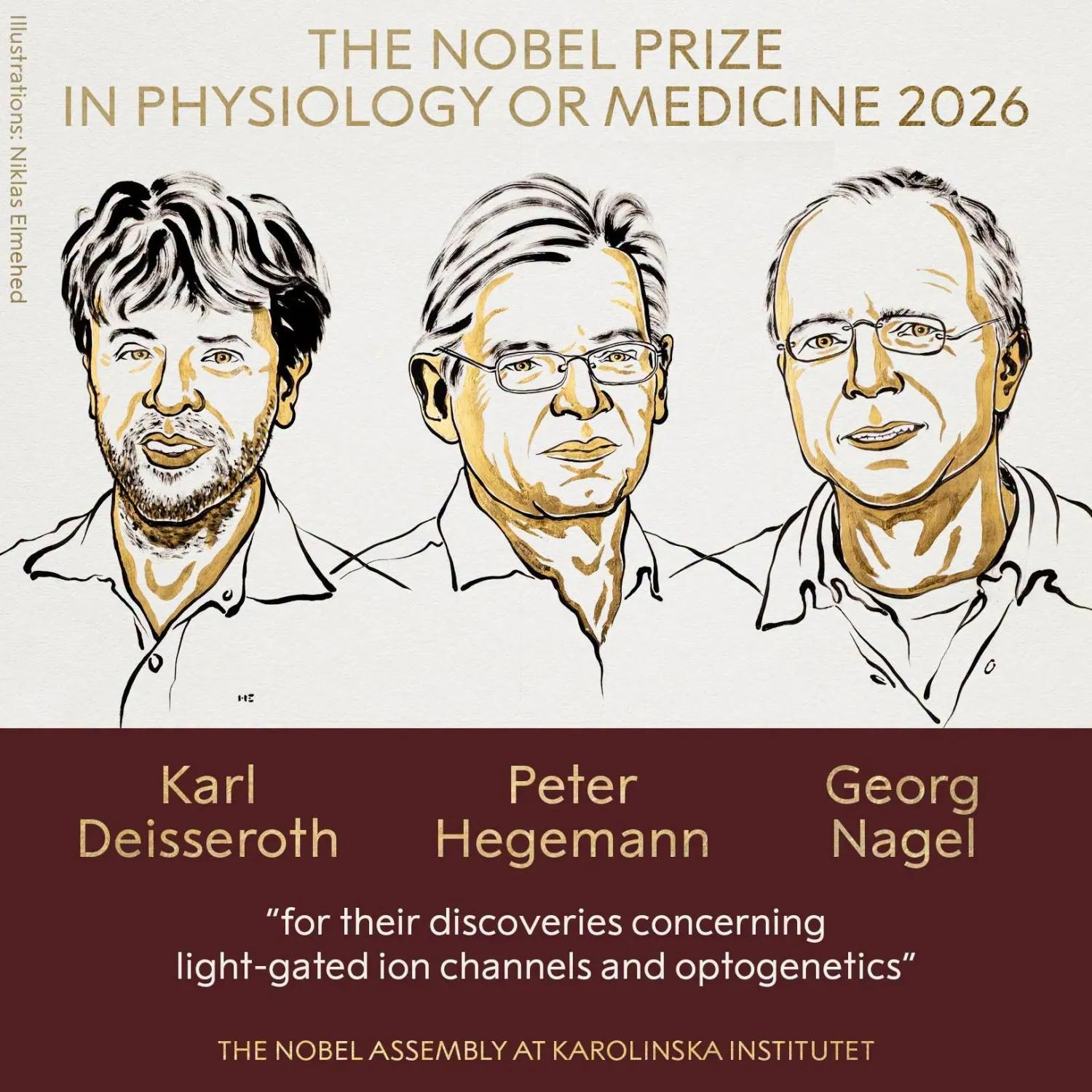
The Nobel Prize in medicine was awarded Monday to three scientists whose work led to a tool that uses light to help unravel how the brain works.

Karl Deisseroth, Peter Hegemann and Georg Nagel have carried out research into light-gated ion channels and optogenetics. The Nobel Assembly lauded their work and said their tool is now being used in laboratories around the world to reveal the brain’s mysteries.

Deisseroth, 54, is a Howard Hughes Medical Institute investigator and Stanford University professor in California. Hegemann, 71, is at Humboldt University in Berlin, and Nagel, 73, most recently worked at the University of Würzburg, also in Germany, the assembly said.

The work that won the 2026 Nobel Prize in medicine Optogenetics opened what the Nobel assembly called a new era in neuroscience following the discovery of a light-controlled switch to turn on and off nerve cells and circuits in the brain to better learn how it works. The research has started unraveling the pathways that lead to behavior and disease.

The breakthrough began when Hegemann explored how a single-celled type of green algae can swim toward light. He and Nagel discovered a particular protein that, when illuminated by blue light, opens a channel to create an electrical impulse. Putting that protein into other cells makes them light-sensitive.

Deisseroth then worked with the gene that controls that protein to create a light-controlled switch for nerve cells in the brains of living mice.

“People usually think about light as a way of collecting information to observe things,” he said. “But this is the opposite of that. This is using light to control things, to make things happen, and to do it in a very precise way.”

Deisseroth first developed tiny fibers to deliver light to cells modified with the light-sensitive gene and said there now are other techniques to switch on or off neurons being studied.

Optogenetics is mostly a research technique to learn how specific neurons and neural circuits work, which can then lead to development of treatments, including regimens for autism and schizophrenia that other scientists are pursuing, he said. A technique he called direct optogenetics is being used to test a treatment for a genetic form of vision loss called retinitis pigmentosa.

Why the research is important Brain cells communicate in milliseconds, and optogenetics for the first time offered scientists a way to control them at the same speed in a laboratory, said Patrick Forcelli, the chairman of the pharmacology and physiology department at Georgetown University, whose lab uses optogenetics.

Now a mainstay in neuroscience labs, the field has moved from using fixed maps of brain activity to building functional wiring diagrams. It has also jump-started additional techniques to explore neural complexity.

“It has let us go from a ‘Rand McNally’ road atlas of the brain to something more akin to ‘Google Earth,’” Forcelli said in an email.

The University of Pittsburgh’s Jeremy Berg was at the U.S. National Institutes of Health in the early 2000s when it awarded Deisseroth major funding for “this vision of optogenetics that was pretty much spot-on the way it played out.”

“It’s a very precise set of tools for doing experiments about how the brain works that are pretty hard to do any other way,” Berg said.

Abdel El Manira, a member of Nobel Assembly, said the impact of optogenetics goes beyond the understanding of a healthy brain.

“It has also helped reveal how specific brain circuits are disrupted, with implications for conditions such as blindness, depression, addiction and dementia," El Manira said. "Yet despite these extraordinary advances, the brain still holds countless mysteries, with much more left to learn and discover. And optogenetics has given us a powerful means to take on these challenges.”

Deisseroth had just gone to bed when he learned of the award Deisseroth, a self-described night owl, said he was up late in his Northern California home working on papers and emailing students. He had just gone to lie down when he got the call from the Nobel Assembly.

“No real sleep was achieved,” he told The Associated Press in a phone call an hour after the announcement.

He said the next task on his to-do list was to pack school lunches for his children, who were still sound asleep.

“That’s my one obligation I have in the next few hours, to make sure I make their sandwiches,” he said.

Thomas Perlmann, the secretary of the medicine committee, said he was able to reach all three winners Monday. The AP could not immediately reach Hegemann and Nagel.

Medicine prize kicks off Nobels week The prize was announced at the Karolinska Institute in Stockholm, kicking off Nobels week. The prize money this year is 12 million Swedish kronor (about $1.2 million), whether for an individual, small group of laureates or organization.

Last year, the prize went to three scientists researching the immune system.

Monday's medicine prize is followed by the physics prize on Tuesday, chemistry on Wednesday and literature on Thursday.

After Friday’s peace prize is awarded, the Nobel Memorial Prize in Economic Sciences will be announced on Oct. 12.