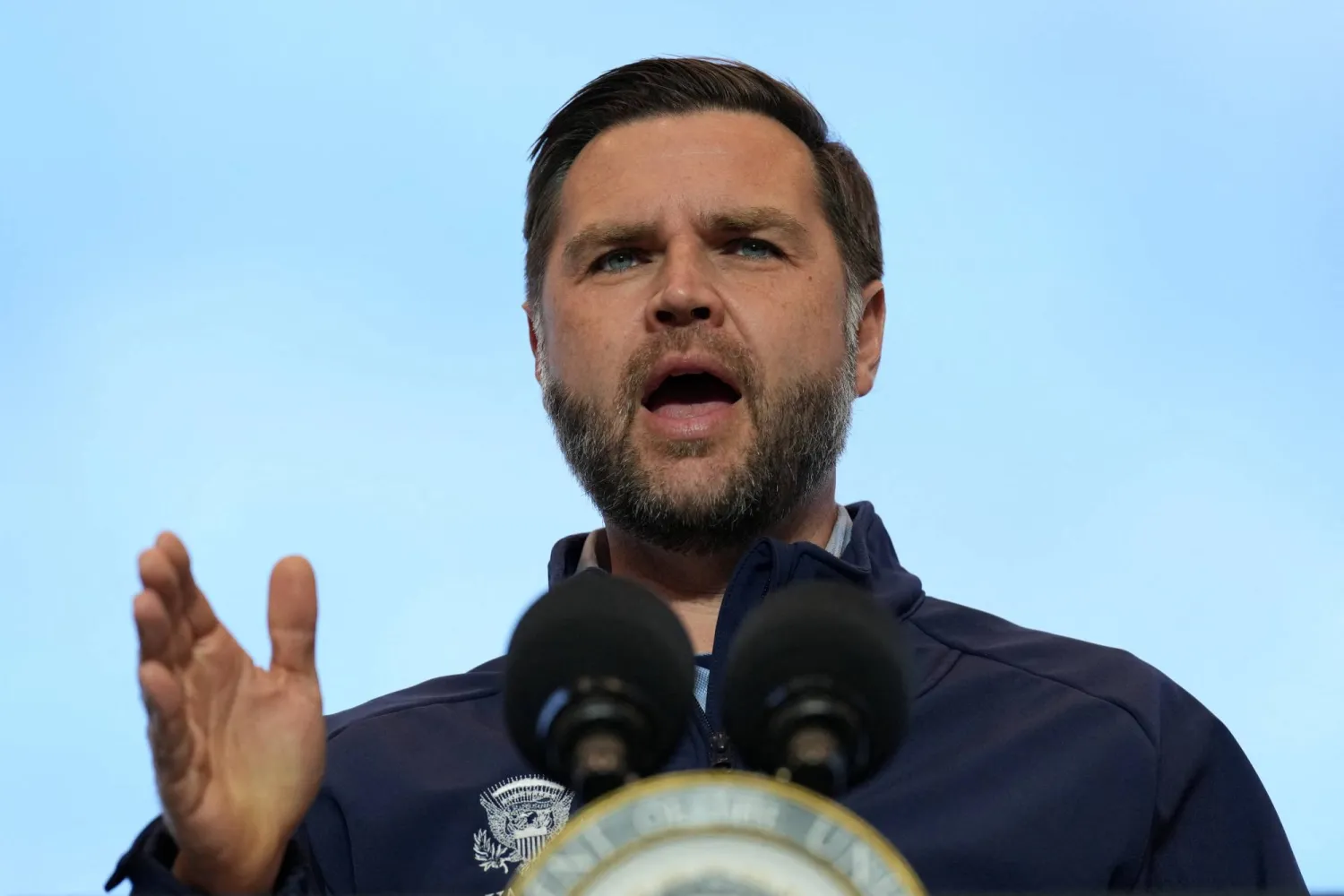
Vance Says Iran Must Cut Enrichment to End War

US Vice President JD Vance speaks at a campaign rally at Fairbanks International Airport in Fairbanks, Alaska, US, October 5, 2026. (Jacquelyn Martin/Pool via Reuters)
TT

Vance Says Iran Must Cut Enrichment to End War

US Vice President JD Vance speaks at a campaign rally at Fairbanks International Airport in Fairbanks, Alaska, US, October 5, 2026. (Jacquelyn Martin/Pool via Reuters)

US Vice President JD Vance said in an exclusive interview with Reuters that Iran must make a “meaningful” reduction in its nuclear enrichment capacity to satisfy US demands and end the countries’ seven-month war, even as Washington was unsure how Tehran makes decisions in negotiations.

Vance, a longtime skeptic of US involvement in foreign wars, has taken a leading role in negotiating a settlement to the conflict and brokered a provisional peace agreement in September that quickly fell apart. The war has jolted global energy markets and become a political liability for President Donald Trump and fellow Republicans ahead of November midterm elections.

Speaking on Monday after a campaign trip in Alaska, Vance said any agreement would require Iran to reduce its nuclear enrichment capacity, rather than offer assurances of future nuclear drawdowns.

"If you don't want a nuclear weapon, then why do you need 60% enriched ‌fuel? And if ‌you want to show commitment to not building a nuclear weapon, don't build highly ‌enriched ⁠fuel. That's a very ⁠basic threshold issue," Vance said.

"I think if they want to show a commitment to not building a nuclear weapon, they would do something meaningful on their enrichment capacity."

Iran and the US have exchanged proposals in recent weeks aimed at ending the war and reopening the Strait of Hormuz, a vital global energy shipping route. Trump rejected Tehran's latest offer and has warned that military operations could intensify after the midterms.

Vance said the US remained open to an agreement but would require concrete Iranian nuclear concessions.

"We're not going to trade words for actions," Vance said.

UNCLEAR HOW IRAN MAKES DECISIONS, SAYS VANCE

Complicating matters, Vance said Washington is uncertain ⁠who makes decisions in Tehran.

Vance said the US was in talks with Iranian President ‌Masoud Pezeshkian and Foreign Minister Abbas Araghchi. But it was unclear how much authority ‌they wield within Iran's power structure, he said, after joint US-Israeli strikes at the start of the war killed Supreme Leader ‌Ali Khamenei.

"One of the things we picked up on is it's not totally clear how their country makes decisions," ‌Vance said. Separately, Trump said on Tuesday his "biggest problem" is no one knows who is running Iran.

Iran's Foreign Ministry spokesperson said on Sunday that US officials are well aware of who their Iranian counterparts are and how Iran's decision-making system works.

"The problem is actually the opposite: it lies in the contradictory positions and mixed messaging from US officials," Esmaeil Baghaei told a weekly press conference.

Vance told Reuters he ‌has held personal conversations with field commanders to gauge battlefield conditions. He dismissed concerns over critical munitions shortages and added that while Iranian troops are periodically able to strike ⁠commercial ships in the Strait ⁠of Hormuz, they are largely unable to prevent energy exports through the waterway.

The war — and its $3 billion monthly price tag — has become a key issue on the campaign trail. Higher energy prices have put Trump and Republicans on the defensive in competitive states that will decide control of Congress.

Vance has sought to temper criticism of Trump’s handling of the conflict, telling voters they should not let that issue keep them from backing Republicans in next month's elections.

In Alaska, Vance rallied for Republican Senator Dan Sullivan, who is locked in a tight reelection battle with Democratic challenger Mary Peltola. Trump carried Alaska by 13 percentage points in 2024, but rising everyday costs have put the state in play.

Before speaking with Reuters, Vance focused much of his speech on affordability concerns, especially around energy. Alaska's remote locale makes consumer goods more expensive, and energy production is a key industry.

Rally attendees roared when Sullivan nearly introduced Vance as the president of the US, rather than the vice president. Vance is seen as a leading Republican contender to succeed Trump in the White House.

Vance told Reuters afterward that he had not decided whether to seek the presidency in 2028.

"I'm inherently a procrastinator," he said. "I really haven't thought about it much."


Nearly a Quarter of World's Children Live in Conflict Zone

Palestinian children play at a displacement camp in Deir al-Balah, central Gaza Strip, Thursday, Nov. 19, 2026. (AP Photo/Abdel Kareem Hana)
TT

Nearly a Quarter of World's Children Live in Conflict Zone

Palestinian children play at a displacement camp in Deir al-Balah, central Gaza Strip, Thursday, Nov. 19, 2026. (AP Photo/Abdel Kareem Hana)

Nearly a quarter of the world's children are currently living in a conflict zone, a record rate since statistics were first recorded in the 1990s, the charity Save the Children said on Thursday.

"Almost one in four children worldwide are now living in conflict zones, the highest number since records began in 1990," the London-based charity said, according to Reuters.

"The figure represents an increase of more than 50% in a decade, jumping from 378 million in 2015 to 589 million in 2025," it added.

The report was titled "Stop the War on Children: Changing the Odds" and drew on statistics from the Peace Research Institute Oslo (PRIO).

The percentage of children living in conflict zones has doubled from 10 percent in the mid-1990s to 23.4 percent in 2025.

"These record-high figures are a stark reminder that conflict is devastating the daily lives, education, health and future prospects of hundreds of millions of children," said Gudrun Ostby, a research professor at PRIO.

"Unless greater efforts are made to protect children in conflict settings, the consequences of today's wars will be felt for decades to come," he added.

The report defines conflict zones as areas existing within a 50-kilometer radius in which at least one armed attack took place.

Africa has the largest number of children living in conflict zones, at about 260 million, or 44 percent of the total across the globe, the report found.

Rates have surged in the Middle East as well, from 52 million children in 2024 to 67 million in 2025, a 29 percent increase.

An average of two in five children in Africa and the Middle East are living in conflict zones, it added.

"The scale of this crisis is rapidly growing, and the systems meant to protect children are being pushed to breaking point," said Inger Ashing, chief executive of Save The Children International.


China and Russia Say they and US Agree on Boosting Fuel Supplies, Dialogue on Nuclear

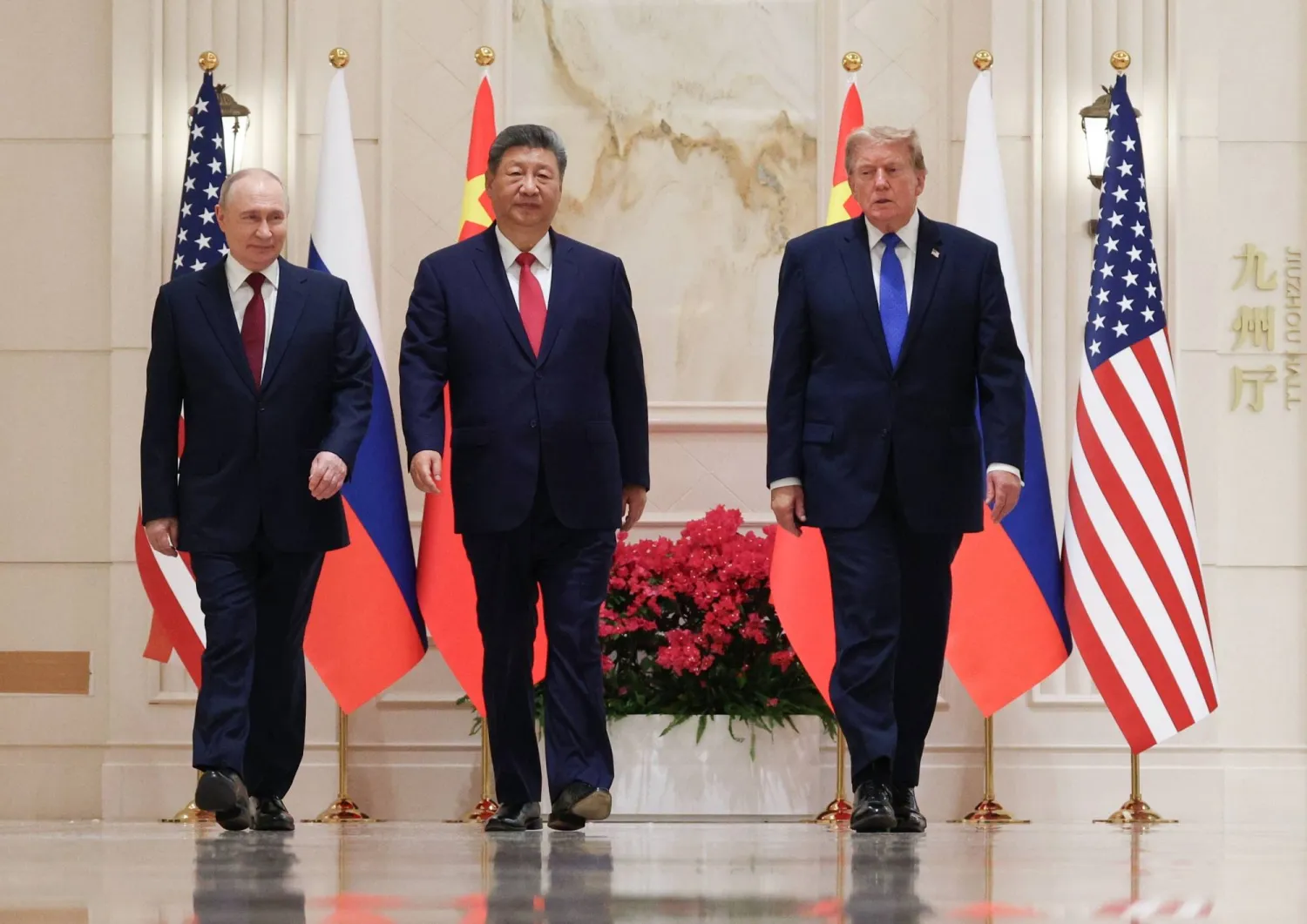
(L-R) Russian President Vladimir Putin, Chinese President Xi Jinping and US President Donald Trump arrive to attend a trilateral meeting on the sidelines of the Asia-Pacific Economic Cooperation (APEC) summit at the Qilin Shanzhuang State Residence in Shenzhen, China, 19 November 2026.  EPA/VYACHESLAV PROKOFYEV/SPUTNIK/KREMLIN POOL
(L-R) Russian President Vladimir Putin, Chinese President Xi Jinping and US President Donald Trump arrive to attend a trilateral meeting on the sidelines of the Asia-Pacific Economic Cooperation (APEC) summit at the Qilin Shanzhuang State Residence in Shenzhen, China, 19 November 2026. EPA/VYACHESLAV PROKOFYEV/SPUTNIK/KREMLIN POOL
TT

China and Russia Say they and US Agree on Boosting Fuel Supplies, Dialogue on Nuclear

(L-R) Russian President Vladimir Putin, Chinese President Xi Jinping and US President Donald Trump arrive to attend a trilateral meeting on the sidelines of the Asia-Pacific Economic Cooperation (APEC) summit at the Qilin Shanzhuang State Residence in Shenzhen, China, 19 November 2026.  EPA/VYACHESLAV PROKOFYEV/SPUTNIK/KREMLIN POOL
(L-R) Russian President Vladimir Putin, Chinese President Xi Jinping and US President Donald Trump arrive to attend a trilateral meeting on the sidelines of the Asia-Pacific Economic Cooperation (APEC) summit at the Qilin Shanzhuang State Residence in Shenzhen, China, 19 November 2026. EPA/VYACHESLAV PROKOFYEV/SPUTNIK/KREMLIN POOL

China, Russia and the US agreed Thursday to seek reforms at the United Nations, increase oil supplies and engage in dialogue to reduce nuclear risks at a three-war meeting, according to Chinese and Russian officials.

The declaration followed a historic meeting among US President Donald Trump, China’s Xi Jinping and Russia’s Vladimir Putin in Shenzhen.

The declaration did not mention the wars in Ukraine or Iran, two issues that Trump said he raised with the leaders earlier in the day. The US has not released the document.

Xi later called the meeting positive, constructive and “fruitful.”

The statement said the leaders are committed to advancing UN reforms “to more effectively address global challenges," to increase the production and supply of oil products to ensure a stable flow of energy, and to work to reduce nuclear risks and prevent nuclear proliferation.

“We are really making history,” Trump said. “The United States, Russia and China are uniquely positioned to discuss how to reduce the number of nuclear weapons on Earth and also to lessen the risk of those weapons being used."

Xi, meanwhile, earlier said the meeting would focus on "promoting world peace.” Putin, for his part, harkened back to the three countries’ shared history as “victors in World War II,” saying that “we hold joint responsibility for maintaining international peace.”

The last nuclear arms pact between Russia and the United States, known as New START, expired in February, and Trump has said he wants “a new, improved and modernized” deal that includes China. But China has less motivation to accept limits given that its arsenal of more than 600 warheads is far smaller than the more than 5,000 warheads believed to be in each of the US and Russian stockpiles.

Before the three-way meeting — which lasted more than an hour on the sidelines of the Asia-Pacific Economic Cooperation Summit — the US president had a separate one-on-one with Xi, their third substantial meeting this year.

The US president praised their friendship and their shared interest in having oil shipped through the Strait of Hormuz, a key waterway for oil shipments from the Middle East that was repeatedly shut because of attacks in the Iran war. Trump suggested he would push Xi to buy more agricultural products from America.

Xi said that relations between the US and China have been “generally stable and improved” during Trump's presidency. The official Chinese news agency Xinhua reported that Xi discussed Taiwan with Trump and said the two countries needed to improve communication on economic and trade issues.

Trump also added a separate sit-down with Putin, marking the first time the leaders have held talks since their discussions in Alaska last year that failed to broker a deal on Russia’s war in Ukraine.

“Wonderful things can come out of this — or at least start,” Trump said, calling Putin “my friend."

“We’ve had a great relationship for many years,” Trump said after shaking hands with Putin. Their meeting lasted roughly 40 minutes.


Trump, Xi, Putin Begin Historic Meeting with Ukraine War on Agenda

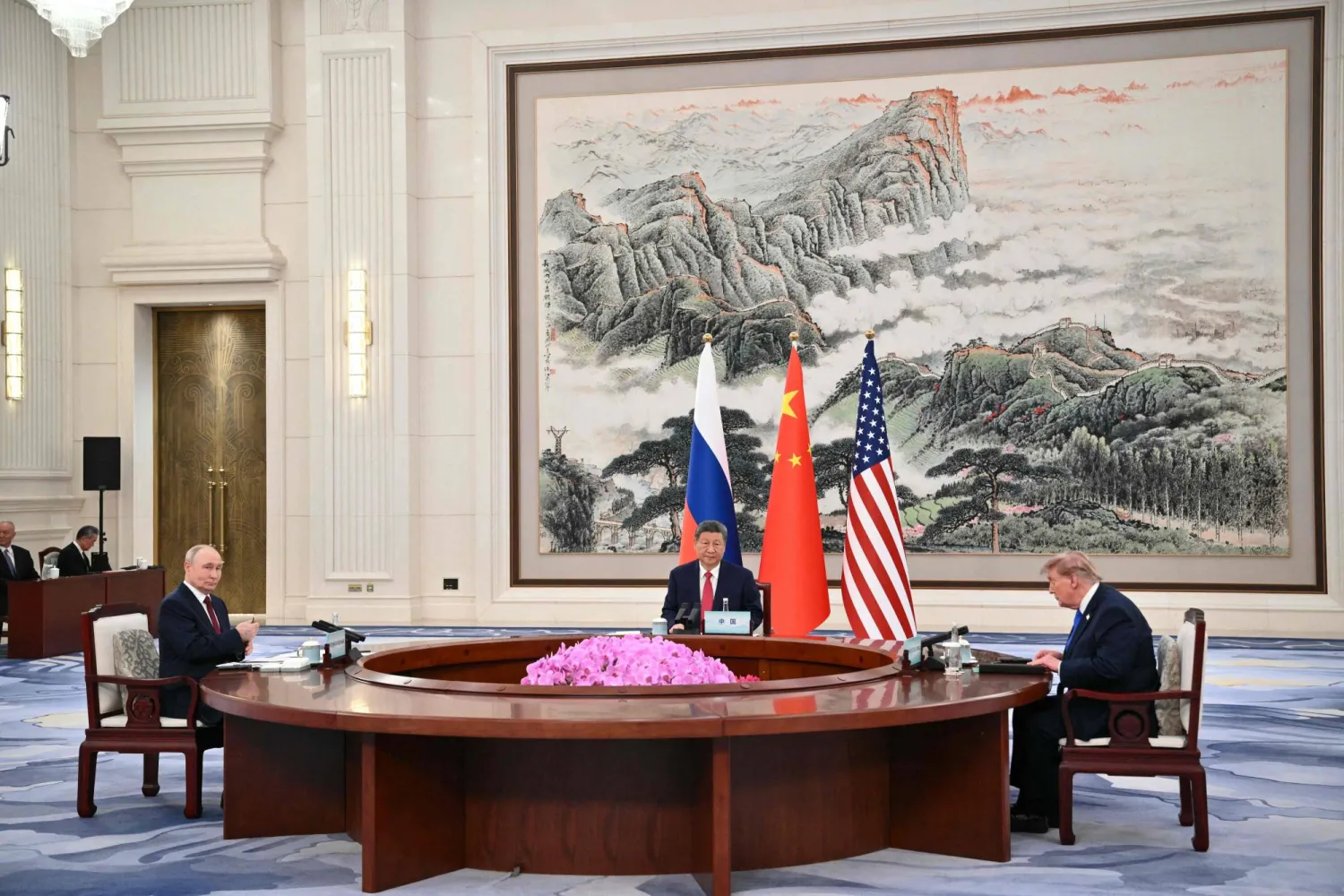
China's President Xi Jinping (C), US President Donald Trump (R) and Russia's President Vladimir Putin (L) take part in a trilateral meeting at Kylin Villa on the sidelines of the Asia-Pacific Economic Cooperation (APEC) Summit in Shenzhen, in China's southern Guangdong Province, on November 19, 2026. (Photo by Mandel NGAN / AFP)
TT

Trump, Xi, Putin Begin Historic Meeting with Ukraine War on Agenda

China's President Xi Jinping (C), US President Donald Trump (R) and Russia's President Vladimir Putin (L) take part in a trilateral meeting at Kylin Villa on the sidelines of the Asia-Pacific Economic Cooperation (APEC) Summit in Shenzhen, in China's southern Guangdong Province, on November 19, 2026. (Photo by Mandel NGAN / AFP)

US President Donald Trump and Chinese and Russian counterparts Xi Jinping and Vladimir Putin began an unprecedented three-way meeting on Thursday, where they said they will discuss the war in Ukraine and nuclear arms control.

Sat around a big round table in a villa in the southern Chinese city of Shenzhen, on the sidelines of an Asia-Pacific summit, the leaders of the world's biggest nuclear powers took turns to give opening remarks.

"We are really making history," Trump said. "The three of us have a great deal to discuss.”

“No peace was ever forged by declining opportunities for engagement.”

Putin said the three countries have "numerous shared interests in the settlement of regional conflicts, including obviously the conflict in Ukraine.”

Unlike Trump and Putin, Xi - who Chinese state media said was presiding over the meeting - did not make a reference to Ukraine, but said: "History tells us that when major powers live in harmony, the world is at peace. When major powers clash, the world falls into turmoil."

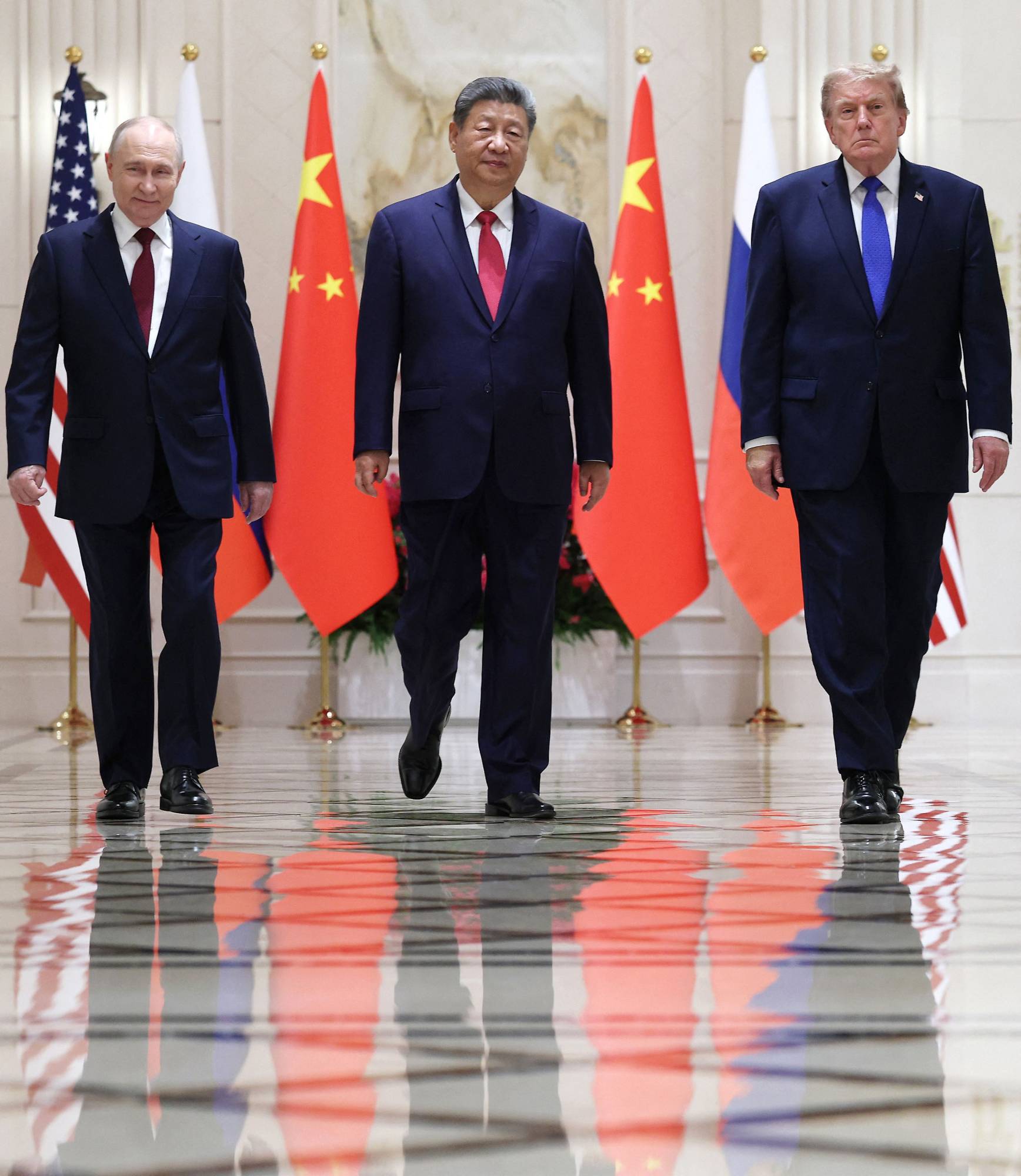
China's President Xi Jinping (C), US President Donald Trump (R) and Russia's President Vladimir Putin (L) arrive for a trilateral meeting at Kylin Villa on the sidelines of the Asia-Pacific Economic Cooperation (APEC) Summit in Shenzhen, in China's southern Guangdong province, on November 19, 2026. (Photo by Win McNamee / POOL / AFP)

The trilateral is unlikely to produce major agreements, analysts say, given deep differences over Ukraine, Iran, nuclear weapons and trade. But it has unnerved smaller countries that fear their interests might be disregarded.

Before the meeting, Trump met Xi and Putin separately, referring to both as friends, Reuters reported.

Trump said both he and Xi felt strongly about oil having to flow through the Strait of Hormuz, which has been ⁠disrupted by the ⁠Iran war. Xi has not mentioned Ukraine or Iran in any of his remarks during the two-day summit so far.

Patricia Kim, foreign policy fellow at the Brookings Institution, said China would not want to be seen as brokering a deal over Ukraine, given the "problematic optics" of Kyiv and European leaders not taking part.

"Xi has characterized the Russia-Ukraine war as fundamentally a European problem, making Beijing even less inclined to assume responsibility for resolving it," Kim said.

Speaking to Fox News earlier, Trump highlighted the pomp surrounding his arrival for the summit, which contrasted with the more muted greeting of other leaders, including Putin. Japanese Prime Minister Sanae Takaichi landed without any welcoming ceremony.

Japan's relations with China have soured since Takaichi's remarks in 2025, when she said Japan could deploy its military if a Chinese move on Taiwan also threatened its ⁠territory.

Takaichi, who cut an isolated figure throughout the summit, said Tokyo's position on Taiwan had not changed since 1972.

Japan and Taiwan this week reported Russian military aircraft incursions as Moscow displayed it can still project power in Asia despite being busy in Ukraine. On Taiwan, Xi told Trump the US must "do the right thing" to avoid major setbacks in their relationship.

Xi greeted Trump at the airport, the first time he has done so with any visiting leader since becoming president, reciprocating his counterpart's gesture at Joint Base Andrews in September when they last met. The leaders also briefly hugged.

"This is a great president, one of the great presidents of China, and he's never gone to the airport to meet somebody," Trump said.

"And not only that, the fanfare, the beauty, the pageantry, the thousands of people, the young children, the soldiers, the whole thing. It was great respect, and I appreciate that. That's a big win for us. It's a big win for China too."

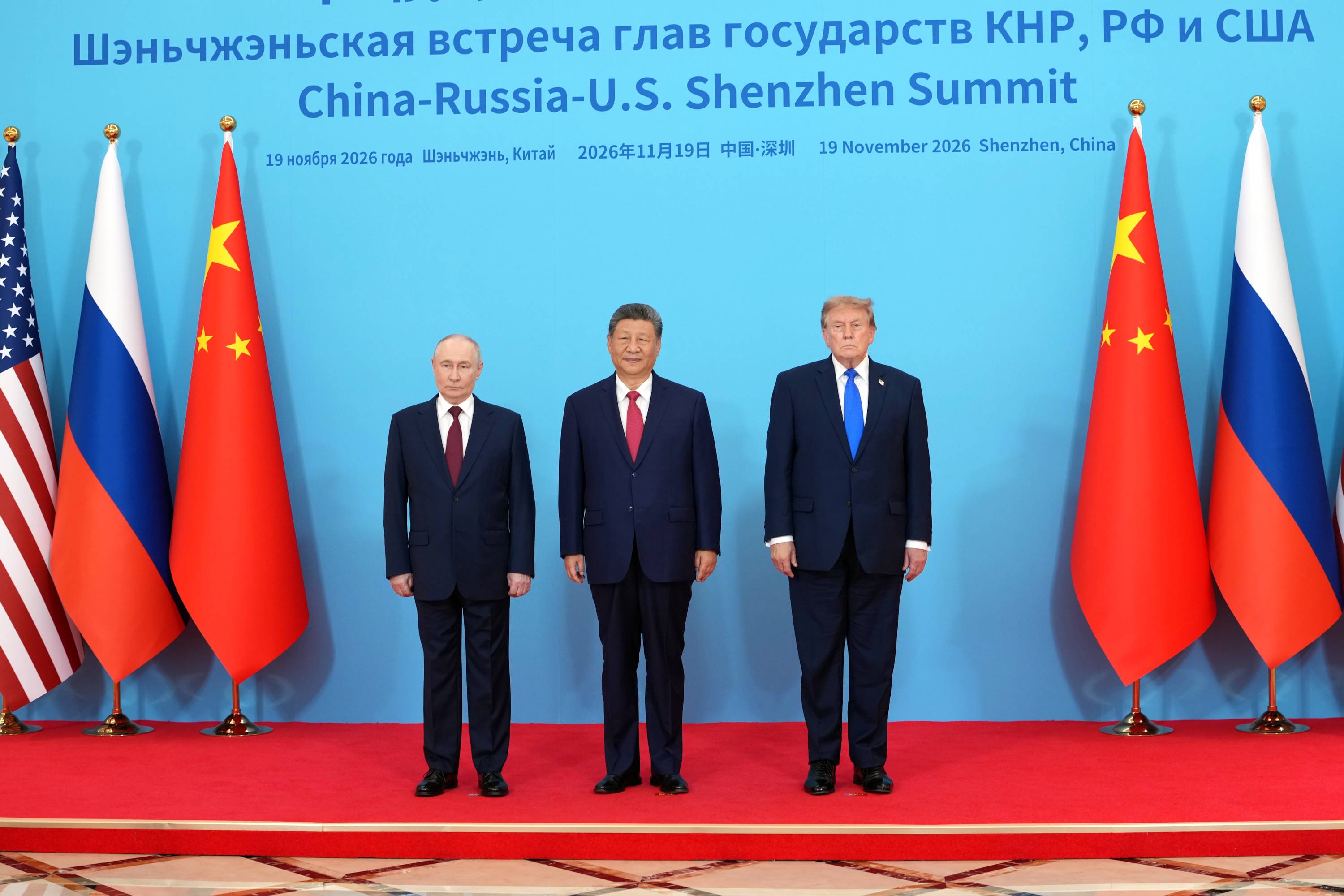
President Donald Trump, right, Chinese President Xi Jinping, center, and Russian President Vladimir Putin, pose for photo, prior to their trilateral meeting, at the Kylin Villa in Shenzhen, China, Thursday, Nov. 19, 2026. (Doug Mills/Pool Photo via AP)

Trump arrived after Xi and Putin delivered pointed speeches denouncing Western trade "protectionism" and sanctions.

During Thursday's APEC proceedings, Xi called for "free and open" trade. Western leaders say China's growth model favoring industrial strength over consumers is unfair and creates destabilizing global trade imbalances.

Putin, fresh from a setback in his war against Ukraine after the ⁠crippling of a key bridge linking ⁠Crimea to Russia, said Russia was key for food and energy security in the Asia-Pacific.

Trump, reeling from a mid-term election loss and the Nvidia spy scandal, told the audience the US has been a Pacific power for hundreds of years.

Trump has insisted nuclear arms control be a central topic of the summit, despite China's repeated objections to joining talks with Washington and Moscow, which have far larger nuclear arsenals.

“It’s not an easy thing to do - give them up,” Trump told Xi and Putin at the start of their meeting.

The leaders have plenty of reasons to appear together but far fewer to agree on substance, given differences over Ukraine, Iran, nuclear weapons, trade and China's military buildup, said Craig Singleton of the Foundation for Defense of Democracies.

"A photograph could serve all three men well," Singleton said, adding that he thought the "agenda is much harder to agree on."

Trump's talks with Xi come after an extension of their trade truce this month, but also amid growing tension over reports of Nvidia chips being diverted to China through Southeast Asia, raising questions about the effectiveness of US export curbs and the future of Chinese access to advanced technology.

"This is Beijing's worst nightmare. China wants chip access that it can negotiate with the president. It may get chip restrictions written into law by both parties," Singleton said.