Saudi Arabia Prepares New Pathways for Its Companies to Enter the Syrian Market

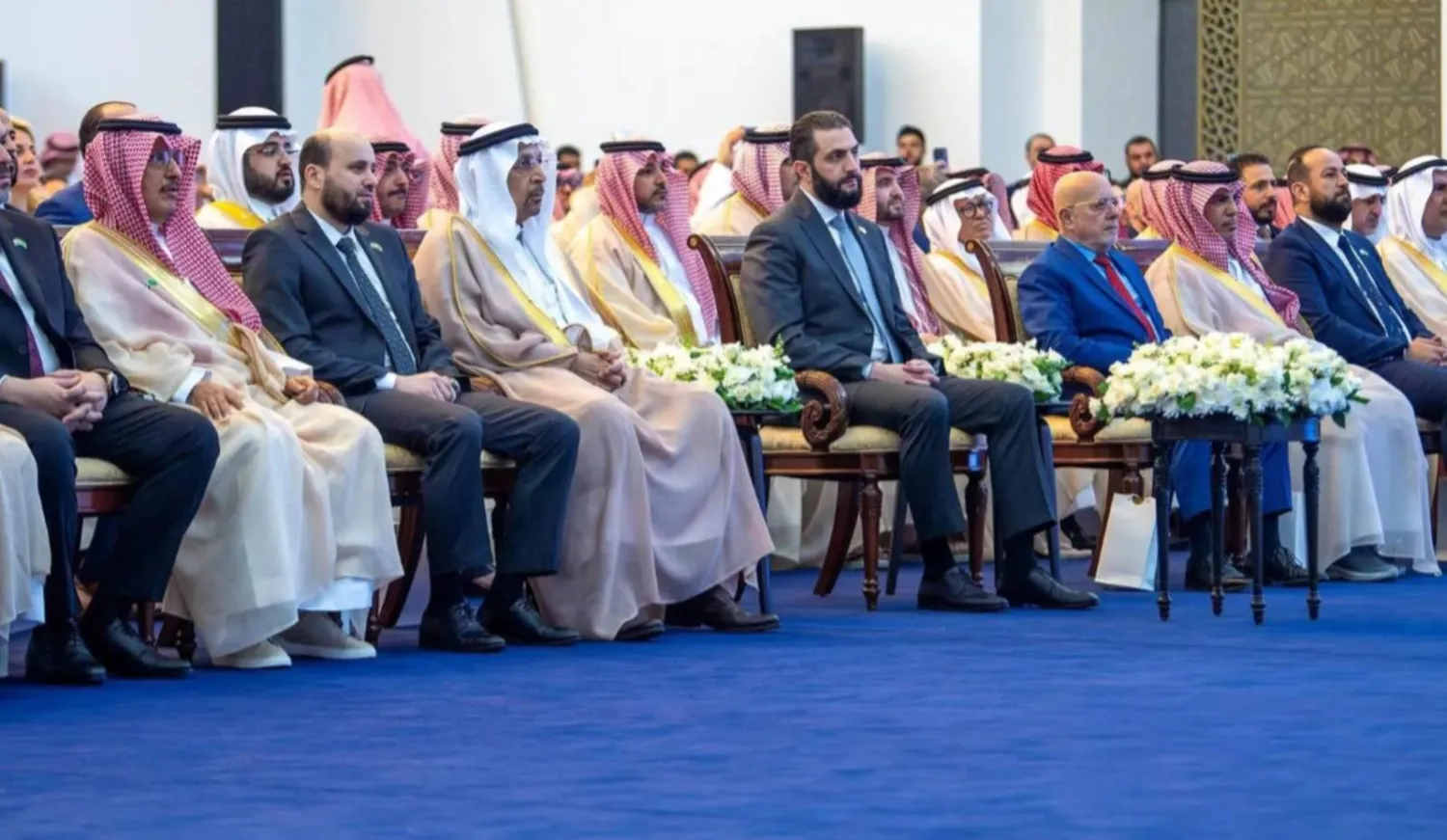
Syrian President Ahmed Al-Sharaa with businesspeople during the Saudi-Syrian Investment Forum in Damascus (SPA)
TT

Saudi Arabia Prepares New Pathways for Its Companies to Enter the Syrian Market

Syrian President Ahmed Al-Sharaa with businesspeople during the Saudi-Syrian Investment Forum in Damascus (SPA)

Asharq Al-Awsat has learned that the Saudi-Syrian Business Council is currently working on around three new pathways that are still being developed as part of an institutional framework aimed at facilitating the entry of Saudi companies into the Syrian market and paving the way for new sector-specific projects in the coming stages.

Saudi-Syrian economic relations have developed since last year, following the arrival in Damascus of a high-level Saudi delegation led by then Investment Minister Khalid Al-Falih. The delegation included more than 130 businesspeople and investors, reflecting the scale of official and economic interest in strengthening trade and investment ties between the two countries.

The visit saw the signing of more than 47 agreements and memorandums of understanding across 11 vital sectors, with total investments exceeding $6.4 billion. They covered real estate, infrastructure, telecommunications and information technology, industry, and other sectors.

Coordination with the “Syrian Sovereign Fund”

According to the information, a mechanism has been established to coordinate with the Syrian Investment Authority to form a joint team to study the development of land and sea logistics corridors. This would include facilitating direct access for exports and temporary admission procedures for equipment used to carry out projects.

In parallel, the Federation of Saudi Chambers has opened a direct channel with the Syrian sovereign fund to follow up on investment opportunities available to the Saudi private sector and support communication with relevant authorities in the Syrian market.

The council was established as Syria prepares for a new phase of reconstruction and development, creating opportunities for the Saudi private sector to participate in investment projects and various economic sectors, drawing on its financing and investment capabilities and its experience in project development.

Since its establishment, the council has begun preparing an action plan for 2025-2030 aimed at strengthening sustainable economic cooperation between Saudi Arabia and Syria, highlighting investment opportunities, supporting strategic partnerships, and facilitating trade and logistics procedures for Saudi companies' exports.

The plan focuses on enabling the Saudi private sector to benefit from reconstruction and development opportunities in Syria by supporting exports, simplifying procedures, and strengthening regulatory frameworks that provide a more favorable environment for investors. It focuses on sectors including infrastructure, trade and export development, real estate development, tourism, industry, and food security.

New Investments

In this context, Mohammed bin Abdullah Abu Nayyan, chairman of the Saudi-Syrian Business Council, said the council includes a number of senior Saudi officials and investors with international business activities, strengthening its ability to support trade and investment relations between the two countries and achieve its objectives.

The Saudi-Syrian Business Council delegation visited the Syrian capital, Damascus, last August, with the participation of 180 Saudi businesspeople. It held joint meetings and more than 15 meetings with government officials, in addition to eight sector-focused meetings and workshops addressing investment opportunities, challenges, and areas of cooperation.

During the visit, the delegation announced the “Sham View” project by Saudi real estate development and investment company Tharaa, with investments exceeding $1 billion. It also launched construction work on the Narcissus Damascus Hotel, owned by Saudi hotel and resort group Boudl.


Saudi Arabia Signs 12 Aviation Agreements at ICAO Conference in Montreal

 Saudi Arabia signed bilateral air transport services agreements during the conference - SPA
Saudi Arabia signed bilateral air transport services agreements during the conference - SPA
TT

Saudi Arabia Signs 12 Aviation Agreements at ICAO Conference in Montreal

 Saudi Arabia signed bilateral air transport services agreements during the conference - SPA
Saudi Arabia signed bilateral air transport services agreements during the conference - SPA

Saudi Arabia, represented by the General Authority of Civil Aviation (GACA), has concluded its participation in the 7th Worldwide Air Transport Conference (ATConf/7), organized by the International Civil Aviation Organization (ICAO) in Montreal, Canada, from November 16 to 20.

Led by GACA President Abdulaziz Al-Duailej and comprising 44 representatives from 18 national entities, the delegation achieved key outcomes, including signing 12 agreements, memoranda of understanding, and records of discussion, submitting eight working papers, holding over 32 bilateral meetings, and hosting a special edition of the Future Aviation Forum, SPA reported.

During the conference, Saudi Arabia signed bilateral air transport services agreements with Belize, Samoa, Cambodia, and Jordan; MoUs with Saint Lucia, Antigua and Barbuda, Montenegro, Cabo Verde, and Türkiye; and records of discussion with Macau, the Congo, and Equatorial Guinea to expand international cooperation and air connectivity. The delegation also presented eight working papers addressing economic regulation, sector resilience, investment, innovation, and sustainable growth, while participating in ICAO deliberations shaping the future of global air transport.

Al-Duailej and the delegation held bilateral talks with ICAO Council President Toshiyuki Onuma, ICAO Secretary General Juan Carlos Salazar, Airports Council International (ACI) representatives, Bombardier, and 24 national delegations to explore sector development and exchange expertise. Additionally, in his capacity as Chair of the Executive Council of the Arab Civil Aviation Organization (ACAO), Al-Duailej presided over the eighth coordination meeting of regional civil aviation organizations to align positions ahead of upcoming assembly proceedings.

On the sidelines of the event, Al-Duailej—who also chairs the Steering Committee of the Riyadh-based Regional Safety Oversight Organization for the Middle East and North Africa (MENA RSOO)—received the formal accession documents from Syria and Lebanon, bringing the organization's membership to 10 states.

GACA also organized a special edition of the Future Aviation Forum in Montreal ahead of its next edition in Riyadh from April 19 to 21, 2027, further cementing the Kingdom's standing as a global aviation hub in line with Saudi Vision 2030.


EU Proposes Tax on Big Tech to Boost Budget

European Council President Antonio Costa arrives at the EU Council for a EU-UK Summit, in Brussels on November 20, 2026. (Photo by NICOLAS TUCAT / AFP)
TT

EU Proposes Tax on Big Tech to Boost Budget

European Council President Antonio Costa arrives at the EU Council for a EU-UK Summit, in Brussels on November 20, 2026. (Photo by NICOLAS TUCAT / AFP)

The EU put forward plans to tax the world's biggest digital companies to fund its next budget Saturday, as it seeks to bridge divisions among member states over the bloc's long-term funding.

European Council President Antonio Costa unveiled a new spending proposal that slashes by 204 billion euros ($224 billion) a plan initially put forward by the European Commission, which some countries had slammed as too onerous.

"I believe this proposal can bring us closer to a final agreement," Costa told a press conference in Brussels.

EU countries have been squabbling over the size of the next budget, with Germany leading calls for major cuts after the commission last year proposed a two-trillion-euro budget for the 2028-2034 period.

Berlin criticized a revised proposal published last month that suggested slashing the bloc's future seven-year budget by 140 billion euros.

Costa, who represents the EU's 27 states, is seeking to reach a deal by the end of the year balancing contributions from member states with new sources of revenue for the bloc.

Among these could be a tax on digital firms that the draft Costa presented Saturday says will concern companies with an annual turnover for digital activities of at least 50 million euros in the EU as well as a global turnover of more than 750 million euros.

They would be subjected to "an annual contribution corresponding to 3 percent of the annual net turnover from online advertising, digital intermediation services and user-generated data", according to documents shared by the council.

The plan is likely to provoke US President Donald Trump's ire since his administration has reacted angrily to EU fines and moves against Big Tech under its content and competition rules in recent years.

The draft also includes plans for a levy on electronic waste and higher tobacco taxes, AFP reported.

The document will be at the center of hours of fraught talks when EU leaders meet in Brussels next week.

Costa is pushing for a deal in December, amid EU fears that a delay would push talks into a fraught election year in 2027 with worries about what potential Eurosceptic victories in France and elsewhere would mean for future dealmaking.

Once EU states find an agreement, they will have to negotiate with parliament -- a task that also promises to be difficult.

Key budget lawmaker Siegfried Muresan warned the EU Parliament would block the spending plan if member states continued to ignore its concerns.

"We think that the debate... is focused too much on cuts," he said this week.

Germany is part of a grouping with five other so-called "frugal" EU members, including Sweden, which expressed skepticism this week over new taxes.

"It's money taken from somewhere else. It won't solve the financial equation," Swedish Europe Minister Jessica Rosencrantz said.

"The focus should be on the expenditure side, where the volume needs to go down" and the national contribution "needs to go down", she added on Thursday.

Costa does not only have to contend with the frugals' demands.

France, the second-biggest EU economy and a net contributor to the budget, argues the bloc needs sufficient means to match the rising challenges it faces.

Meanwhile, 17 countries from southern, central and eastern Europe have formed a group known as the "Friends of Cohesion" and are pushing for greater funding to support agriculture and regional development.


Saudi Arabia Agrees to Store Additional 16 Million Barrels of Crude in Japan

The Saudi Minister of Energy and Minister of Industry and Mineral Resources met with the Turkish Minister of Environment, Urbanization and Climate Change on the sidelines of the 31st Conference of the Parties to the United Nations Framework Convention on Climate Change (COP31) in Antalya. SPA
TT

Saudi Arabia Agrees to Store Additional 16 Million Barrels of Crude in Japan

The Saudi Minister of Energy and Minister of Industry and Mineral Resources met with the Turkish Minister of Environment, Urbanization and Climate Change on the sidelines of the 31st Conference of the Parties to the United Nations Framework Convention on Climate Change (COP31) in Antalya. SPA

Saudi Minister of Energy and Minister of Industry and Mineral Resources Prince Abdulaziz bin Salman bin Abdulaziz and Japan’s Minister of Economy, Trade and Industry Akazawa Ryosei have reaffirmed the strong and longstanding strategic partnership between the two countries and discussed ways to further strengthen bilateral cooperation, particularly in the energy sector.

The ministers held a virtual meeting on November 9.

Following discussions within the joint task force established in May 2026, the two countries confirmed that the Kingdom regards Japan as a strategic partner and attaches great importance to supporting Japan's long term energy security through reliable and stable crude oil supplies.

Japan expressed its deep appreciation to Saudi Arabia for its stable and reliable supply of crude oil.

The Kingdom has already begun to replenish the joint oil stockpiling tanks in Japan.

Recognizing the longstanding importance of the Joint Crude Oil Stockpiling Project since its establishment in 2010 and the effectiveness it recently demonstrated, Japan intends to lend the Kingdom crude oil storage capacity of 16 million barrels, alongside the existing 8 million barrels storage, using Japan's national stockpiling facilities on a time-bound basis.

Japan also intends to purchase up to 8 million barrels of crude oil from Saudi Arabia for its national stockpile reserves, subject to favorable market conditions and the completion of necessary internal procedures.

Japan and the Kingdom will cooperate under “POWERR Asia,” announced by Japan, to enhance energy security in Asia, based on the AZEC Ministerial Work Program for Strengthening Oil Stockpiling presented at the AZEC Ministerial Meeting held on October 8.

The Work Program outlines future measures, including the development of both institutional frameworks and infrastructure for oil stockpiling in Asia, cooperation with oil-producing countries, and coordinated emergency responses.

The ministers welcomed the continued engagement between the two countries and expressed their shared aspiration to further strengthen the strategic energy partnership between Japan and Saudi Arabia.

Both ministries will continue their constructive engagement to explore further energy cooperation and avenues for further enhancing the existing joint crude oil stockpiling scheme and maximizing its potential.

Meanwhile, Prince Abdulaziz met with Turkish Minister of Environment, Urbanization and Climate Change Murat Kurum on the sidelines of the 31st Conference of the Parties to the United Nations Framework Convention on Climate Change (COP31) in Antalya, Türkiye.

The two ministers explored ways to strengthen cooperation on climate action, reviewed developments at COP31 and discussed efforts to meet the goals of the Paris Agreement in a manner that takes into account countries’ national circumstances and contributes to balanced and inclusive outcomes.