


Trump Says Putin Agrees to Major Release of Diesel to US, Global Markets

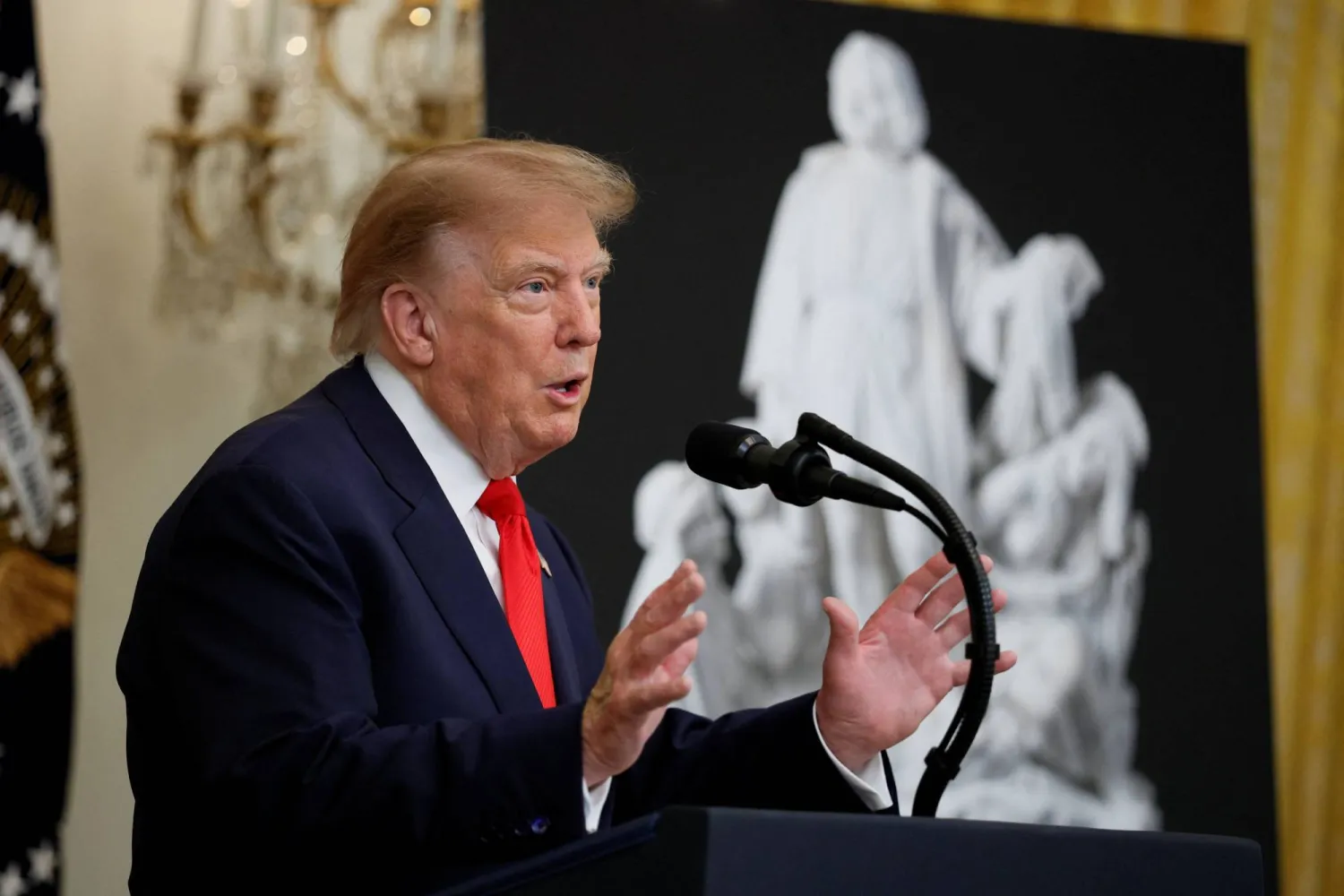
US President Donald Trump speaks during a Columbus Day celebration in the East Room of the White House in Washington, DC, US, October 9, 2026. (Reuters)
TT

Trump Says Putin Agrees to Major Release of Diesel to US, Global Markets

US President Donald Trump speaks during a Columbus Day celebration in the East Room of the White House in Washington, DC, US, October 9, 2026. (Reuters)

President Donald Trump said on Friday that Russia had agreed to immediately supply diesel to US and global markets in an effort to lower fuel prices ahead of the US midterm elections, although analysts said the amounts would likely not reduce prices greatly. 

The move comes as the price of diesel, used in agriculture, heating homes and trucking, is near a record high. The November 3 congressional elections will determine control of Congress. 

Trump said on social media he had a "highly successful" discussion with President Vladimir Putin in which they agreed that Russia will immediately supply more than 300,000 metric tons of diesel to US and global markets. 

An envoy for Putin, Kirill Dmitriev, praised cooperation between Russia and the United States on diesel and energy in a post ‌on X shortly ‌after the call. 

The unusual move comes after the US imposed sanctions on Russian energy companies ‌over ⁠Russia's full-scale war ⁠with Ukraine that began in 2022. 

Ukrainian President Volodymyr Zelenskiy criticized Trump's move. "Gifts to Putin will not bring peace or any benefit to the civilized world. Russia will 'repay' the diesel with further terror and perfidy," he said on X. 

The US Treasury Department issued a general license on Friday allowing importation of Russian diesel until April 7. 

Trump said Russia would supply another 500,000 tons in November and a further 1 million tons "immediately thereafter." Even more would follow, Trump said, "based on the condition of their diesel refineries," which have been damaged by Ukrainian attacks. 

'NOTHING BURGER' 

Analysts said the agreement was unlikely to lead to sustained lower fuel prices. "I cannot overstate how much of a nothing burger ⁠this is," Rory Johnston, an oil market researcher and founder of CommodityContext.com, said on ‌X, adding that Russia usually exports much more diesel when its refinery fleet is ‌not under attack. 

The 300,000 tons to be immediately delivered is equal to about 2.25 million barrels of diesel. The US exports about ‌1.5 million barrels of diesel per day. 

"It's clearly not a fix, but another stream to aid a very tight diesel ‌market," said Jim Mitchell, an analyst at consultancy Wood Mackenzie. 

Diesel prices, which can drive inflation, are up 70% since the US and Israel launched the war with Iran on February 28. The wars in Iran and Ukraine have triggered a severe global fuel supply crunch, pushing average US diesel prices to $6.28 a gallon on Thursday, according to the AAA motorist group. 

The price climb is despite two recent moves by ‌Trump to boost supplies of the fuel: pressuring allies to release emergency reserves and expanding access to tax-exempt red-dyed diesel, which is normally used for farm equipment. 

US diesel futures fell ⁠sharply following news of ⁠the deal and were trading at $4.64 a gallon, down more than 4.8%. 

"Lower prices for Americans, especially our Great Farmers, Ranchers, and Truckers, is my Greatest Priority," Trump said. 

DEFENSE PRODUCTION ACT 

Three industry sources said earlier on Friday that Trump will issue a directive in the coming days to some US department heads to find ways to control diesel prices. 

The directive, which they said could take the form of a presidential memo, will push officials to find ways to bypass local and state regulations blocking energy production and use the Cold War-era Defense Production Act to increase output of oil and fuel. 

Under the DPA, the president can authorize US-backed loans or loan guarantees to expand domestic manufacturing of critical materials and to require companies to prioritize government contracts for essential goods. 

The White House has been weighing how to use the DPA to expand refining capacity as the war with Iran exposes US vulnerability to supply disruptions and price spikes. 

Refining executives told administration officials last month that federal money would be better directed toward making refineries more efficient or expanding plants rather than financing a new refinery, which would be more costly and take years to complete. 


Two Powerful Earthquakes and Multiple Aftershocks Rock Panama

Rescue workers walk past a building damaged by the 7.7-magnitude earthquake in Panama City, Panama, 09 October 2026. (EPA)
TT

Two Powerful Earthquakes and Multiple Aftershocks Rock Panama

Rescue workers walk past a building damaged by the 7.7-magnitude earthquake in Panama City, Panama, 09 October 2026. (EPA)

A second powerful 6.6 magnitude earthquake struck Panama Friday afternoon following a series of aftershocks, the US Geological Survey said. It came after a magnitude 7.7 quake shook the Central American country, collapsing buildings near its epicenter and prompting evacuations.

The first earthquake shook Panama on Friday morning, collapsing buildings near its epicenter and prompting evacuations across the country.

The quake, which was felt as far away as neighboring Colombia, was centered about 10 kilometers (6 miles) southwest of the remote community of Pitaloza Arriba, in the central province of Herrera, the US Geological Survey said. It struck at a depth of 10 kilometers (6 miles).

The USGS initially reported the quake as magnitude 8, then revised it to 7.6 and later to 7.7.

Visibly shaken residents of Panama City gathered outside as they waited for news of the quake’s impact on Friday.

“We felt it very strongly. It knocked things over in the kitchen, but we’re okay, though we’re very scared," Rosendo Domínguez, 60, who is from Herrera province, where the earthquake struck, told The Associated Press by phone. “Everyone is outside, scared.”

Multiple aftershocks continued to rattle Panama, including several measuring magnitude 5.8, 5.5 and 5.2. Seismologists at the University of Panama recorded more than 45 aftershocks, though many were too weak to be felt.

Calls for calm and reports of collapsed buildings Panamanian President José Raúl Mulino called for calm on Friday, writing on X: “What happened should not be used to cause alarm or disorder.”

Omar Smith of the National Civil Protection Service said on the Telemetro Reporta news channel that damage was concentrated in the central provinces of Veraguas, Herrera and Los Santos. He said there were no reports of damage in the capital, which is known for its hundreds of skyscrapers.

Smith said several injuries have been reported, including one person struck by debris from a partially collapsed structure in the city of Penonomé, around 93 miles (150 km) from the capital. He confirmed a partial collapse and cracks at the cathedral in the district’s main square, as well as damage in the governor’s office building and the Dos Continentes hotel. No casualties were immediately reported.

Local news outlets also reported that the Church of San Atanasio, a colonial-style Catholic church in Panama’s Los Santos province, had collapsed. The church was declared a National Historic Heritage Site in 1938. Elsewhere, including in Veraguas province, large fissures ran along roadways.

Tocumen International Airport in Panama City, one of the region's busiest airports with more than 20 million travelers in 2025, said it would temporarily suspend operations and activated evacuation plans. It said operations would resume once security conditions have been checked.

The Panama Canal Authority said operations were continuing normally along the key global trade route. It said its priority was the safety of employees, vessels and crews and that specialized technical teams were inspecting facilities for possible damage.

Tsunami warnings

The last major earthquake to cause widespread damage in Panama struck in 1991. A magnitude 7.4 quake, centered in nearby Costa Rica killed 23 people, injured 559, and left thousands of people homeless in the border Bocas de Toro region.

Earthquakes are common, especially along Panama's border with Costa Rica and its Pacific coast, because of the interaction of several tectonic plates, including Cocos, Nazca, and Caribbean plates.

Panama lies along the “Ring of Fire,” a 40,000-kilometer (25,000-mile) arc of volcanoes and fault lines around the Pacific Basin, where most of the world’s earthquakes occur.

The National Weather Service issued a tsunami warning Friday for the coasts of Panama, Colombia, Ecuador, Nicaragua and Guatemala. It warned that waves ranging from 3 to 9 feet (1 to 3 meters) above tide may occur in some coastal areas of Panama.

Alerts were also issued in El Salvador and as far as Chile’s Easter Island, about 3,500 kilometers (2,175 miles) off Chile’s mainland coast. Chile's government placed the island under a precautionary advisory.

Nearby countries sent messages of support Friday afternoon. Colombian President Abelardo de la Espriella, whose country was recently hit by earthquakes, expressed his solidarity with the Panamanian people and their government during what he called “difficult times.”

“Panama is not alone! You can count on Colombia’s support and our full willingness to provide whatever assistance is needed,” he wrote on X.

The US Embassy in Panama said it was “closely monitoring” the aftermath of the quake and accounting for the welfare of its citizens in Panama, a well-known retirement destination for Americans.


Vance Expresses Doubts about Pentagon Plan to Livestream Fort Hood Shooter’s Execution

 Vice President JD Vance speaks at a rally at the Allen County Regional Airport, Friday, Oct. 9, 2026, in Lima, Ohio. (Samuel Corum/Pool Photo via AP)
Vice President JD Vance speaks at a rally at the Allen County Regional Airport, Friday, Oct. 9, 2026, in Lima, Ohio. (Samuel Corum/Pool Photo via AP)
TT

Vance Expresses Doubts about Pentagon Plan to Livestream Fort Hood Shooter’s Execution

 Vice President JD Vance speaks at a rally at the Allen County Regional Airport, Friday, Oct. 9, 2026, in Lima, Ohio. (Samuel Corum/Pool Photo via AP)
Vice President JD Vance speaks at a rally at the Allen County Regional Airport, Friday, Oct. 9, 2026, in Lima, Ohio. (Samuel Corum/Pool Photo via AP)

Vice President JD Vance cast doubt Friday on whether the Pentagon will livestream the execution of Fort Hood shooter Nidal Malik Hasan in December but told reporters that if it is livestreamed, “I’m not going to be watching it.”

The Republican vice president said, “I don’t know that that’s actually going to happen,” when asked about the plans that the Pentagon confirmed Thursday. But Vance then tried to set aside the controversy over the shocking plans for a public execution and said Hasan’s crimes should not be forgotten.

Hasan was convicted of killing 13 people and injuring 32 others in a shooting spree at the military base in 2009.

“So whatever the controversy is about the method of the execution, I hope that people don’t forget that this is a guy who brutally murdered a lot of innocent people,” Vance said.

“Now, that said, I mean, look, if it’s ultimately livestreamed, I’m not going to be watching it,” he added.

Vance is a convert to the Catholic Church, which has long opposed capital punishment.

Earlier Friday morning, the head of the US Conference of Catholic Bishops condemned the US government’s decision to livestream Hasan's execution.

“It is with shock and great sorrow that I have learned of the Department of War’s decision to publicly livestream the execution,” Archbishop Paul S. Coakley, president of the conference, said in a statement. He added that the decision was “a barbaric promotion of a culture of death and must be reconsidered.”

Earlier, President Donald Trump told a White House event that Hasan will be getting “the death penalty through firing squad. And he deserves it.”

Trump, who approved Hasan's execution, called him “a maniac.”

The president approved the method of execution by firing squad days after a failed attempt to execute Christa Pike by lethal injection late last month pushed Tennessee’s governor to halt further executions in that state this year.

Defense Secretary Pete Hegseth said the military hasn’t executed a service member by firing squad since World War II. The last military execution took place on April 13, 1961, when Army Pvt. John Bennett was executed by hanging.

Trump, who has long been a vocal supporter of capital punishment, didn’t mention the plans that the Pentagon has announced to livestream the execution so that the broader public can see it.


2 Men Deny Carrying Out Surveillance for Iran of Israeli Embassy in UK

FILE PHOTO: Armed police officers stand guard on a road outside the perimeter of the RAF Fairford airbase, in Fairford, Gloucestershire, Britain, September 28, 2026. REUTERS/Toby Shepheard/File Photo
TT

2 Men Deny Carrying Out Surveillance for Iran of Israeli Embassy in UK

FILE PHOTO: Armed police officers stand guard on a road outside the perimeter of the RAF Fairford airbase, in Fairford, Gloucestershire, Britain, September 28, 2026. REUTERS/Toby Shepheard/File Photo

Two Iranian nationals accused of being tasked by Iran to carry out hostile surveillance on the Israeli Embassy in London, Britain's oldest synagogue and other Israeli or Jewish targets pleaded not guilty on Friday.

Nematollah Shahsavani, 41, and Alireza Farasati, 22, appeared at London's Old Bailey court and denied a single offence under the National Security Act.

They were remanded in custody ahead ⁠of their trial, ⁠which is due to begin in April, Reuters reported.

The pair are among several individuals who have been charged in separate cases with acting on behalf of Iran in Britain.

Britain has recently accused Iran of being ⁠behind a suspected plot targeting the US-linked RAF Fairford military base, with seven men arrested and then released on bail.

Iran has denied any involvement in hostile activity in Britain, including the alleged RAF Fairford plot, after which the US removed its B-1 bombers from the base.

Shahsavani, a dual Iranian-British national, and Iranian national Farasati are alleged to have gathered ⁠information ⁠and undertaken reconnaissance in July and August 2025 on behalf of the Iranian intelligence services.

Their list of alleged targets included the Israeli Embassy, the Israeli Consulate and London's Bevis Marks Synagogue. Judge Bobbie Cheema-Grubb said one alleged target also included an unnamed individual "of intelligence interest" to Iran.

After they were charged in March, Britain's Foreign Office said it had summoned Iran's ambassador to the UK.
