
After 20 Years, Sofia Coppola’s ‘Marie Antoinette’ Movie Has Come Home to Versailles

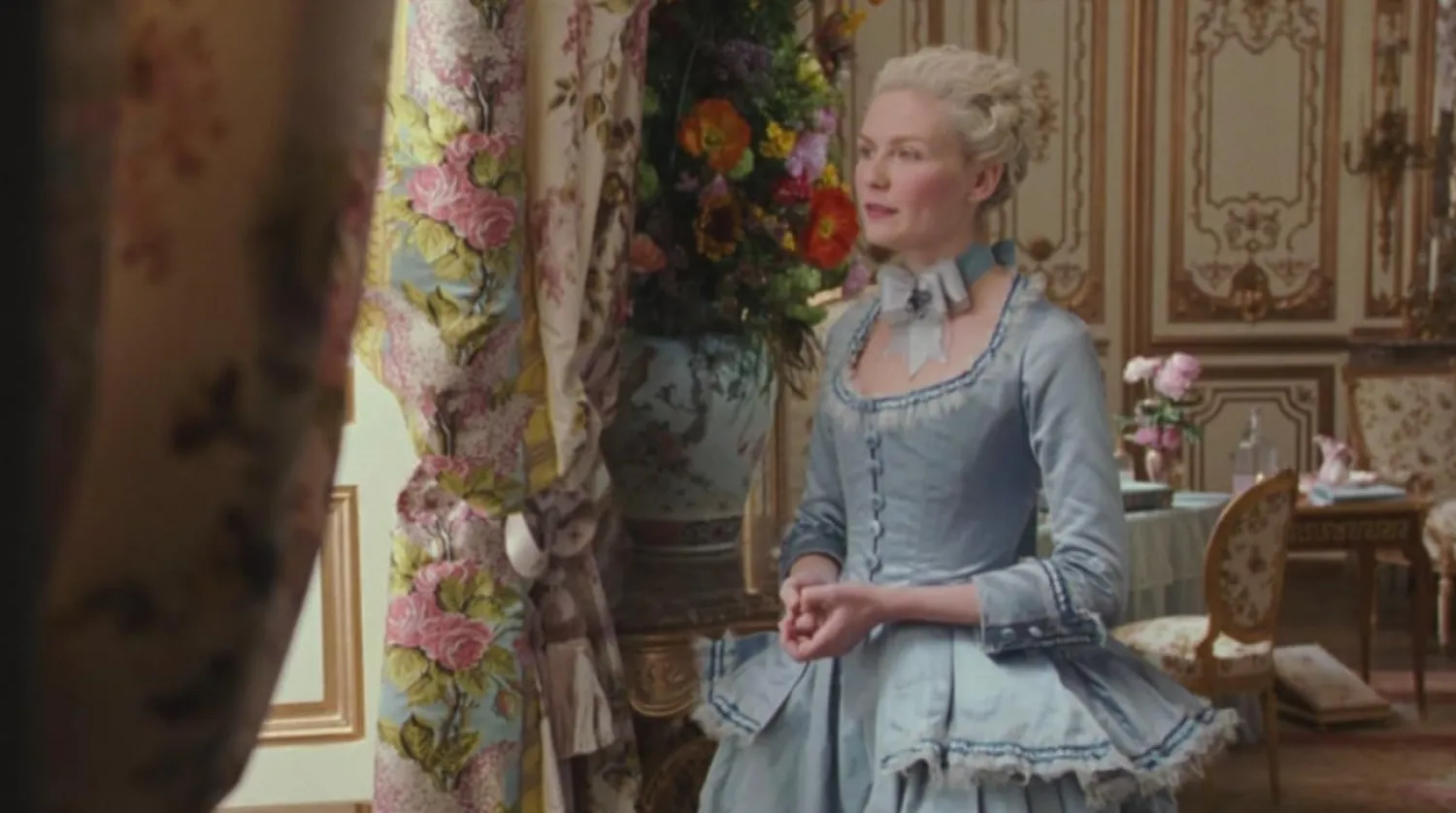
Filming Kirsten Dunst as Marie Antoinette on set (imdb)
TT

After 20 Years, Sofia Coppola’s ‘Marie Antoinette’ Movie Has Come Home to Versailles

Filming Kirsten Dunst as Marie Antoinette on set (imdb)

Paris: Laura Cappelle

In 2006, the American director’s whimsical, candy-colored “Marie Antoinette” divided audiences with its Manolo Blahnik shoes and contemporary soundtrack. Yet the film has since become a classic, and Versailles is honoring its 20th anniversary with an exhibition at the Petit Trianon, the small chateau on the royal estate given to the queen for her private use in the 1770s, where part of “Marie Antoinette” was filmed.

Curated by Hélène Delalex and Laurent Salomé and running through Jan. 24, the show brings back Milena Canonero’s Oscar-winning costumes alongside props, sketches and photographs. In Marie Antoinette’s private rooms, mannequins recreate some of the movie’s frames.

And Coppola is revisiting “Marie Antoinette” onscreen, too. As she made the film 20 years ago, someone was watching closely: her mother, Eleanor, who shot almost 100 hours of behind-the-scenes footage with the goal of making a documentary.

Eleanor Coppola died in 2024 without completing the project, but her daughter has completed it for her. The movie “Making Marie Antoinette,” a time capsule of the film and of a young director finding her way, will be released in US theaters on Oct. 23.

In a recent video interview, Coppola, 55, talked about stepping back into Versailles, fighting for the film’s female perspective and watching hip-hop cut-ups of “Marie Antoinette” on TikTok. These are edited excerpts from the conversation.

Were you surprised when Versailles reached out to you about this exhibition?

Yes, I was really surprised — it was like being offered the Petit Trianon to put our posters up. It was surreal to be there again, in the real home of Marie Antoinette, with the costumes from our version.

I thought it was cool that the curators were interested in the preparation materials and research, so I was excited to open up the boxes that I had in my storage at my family home in Napa Valley. Anne Seibel, the art director, also saved a lot of things, and Milena Canonero, our great costume designer, tracked down different pieces and put the accessories together to bring it all back. We even recreated some of the lighting that was used in the film.

What do you remember about how you felt while making it?

It was really stressful and overwhelming, because I’d never taken on anything of that scale. There were just so many people there in order to pull it off, so many extras and crew. I think I had that sort of youthful naïveté — I don’t think I would take on something like that now.

But I had a really clear vision in my head, and I was really trying to do a different kind of period movie. The ones that I had grown up with were very big tableaux, based on paintings. I always felt like you were looking back at history, and I wanted this to feel like you’re jumping back in time and you’re alive with the characters. When I visited the real private rooms of Marie Antoinette, I was struck by the fact that the fabric was this bright turquoise color. At that time, you never saw that in period films: It was always muted, dusty earth tones.

The depiction of ennui and aimlessness connects it to some of your other films. What did you draw on to bring it to life?

I was trying to imagine what Marie Antoinette’s emotional life was like, and I could see parallels in LA at the time when I was writing the script in the early 2000s. I saw women shopping when they didn’t have anything else to do, to fill their time. It was my version of what I could imagine that might be like.

Were you taken aback by the controversy over the anachronisms in the movie when it came out?

It was disappointing that some people were really offended by it. To me, it’s hard to imagine that the modern music was so offensive to people, and it’s done a lot now. I knew that it was a little bit obnoxious and rebellious for an American to make that story, but you don’t ever really know how things are going to be received.

You lived in France for a few years after “Marie Antoinette.” What is your relationship nowadays to the country?

My husband [Thomas Mars, of the band Phoenix] is actually from Versailles. Their home was right down the street from the Petit Trianon. They moved away in more recent years, but we had holidays there, which was wild. My daughter Romy was born in Paris, and I feel really grateful that I still get to spend time there. I grew up with French New Wave films, and I’ve always felt supported by French culture.

The film’s reputation seems to have changed considerably since its release. Do you feel that?

Definitely. I feel like it has a whole new audience of young people. My daughters show me these edits to hip-hop songs on TikTok, which I love. It’s been a fun surprise, because usually your movies aren’t talked about afterward. A lot of mothers and daughters say that they watch it together, or men come up to me and say that that was their gay coming-out.

The film has a strong female gaze, and that registers differently today. Did you have to fight for that perspective when you made it?

My mom shot almost 100 hours of documentary footage on set. I helped edit it recently, and there’s a lot of me pushing for the female point of view of the story. That was really important to me, and it was interesting to see that men on the crew did not understand this idea or were resisting it. It just didn’t exist in filmmaking at that time. Nowadays, the guys I work with are much more open.

The documentary you edited based on your mother’s footage, “Making Marie Antoinette,” will be out in the US in October. Why did it take so long to come back to it?

Only a very small amount was used for a DVD bonus at the time, and we went on with our lives — I was having kids and I forgot about it. Then during the pandemic, my family was all together at home in Napa. My mom got the footage out to look at it, and I had never seen it before. It was amazing for me to see like all the details that she caught, all of the craftsmanship: the costumes, the wigs, the flowers.

And she really wanted to do something with it. She passed away two years ago now, but at the end of her life, it was really important to her that we got this film done. I promised her that I would. I’ve worked a lot this last year with an editor and a friend of my mom’s, trying to think of how she would want it made — even though it’s hard for me to have perspective, because I’m in it, and it’s embarrassing to see my young self.

Why?

I am not as assured of asserting myself. I’m kind of finding my way as a young director. And I thought maybe that would be interesting for other young people interested in film, to see that there is a process of how you evolve as a creative person.

It’s also me seeing through my mother’s eyes, her watching her daughter work. It was very emotional to work on, and I felt like it was a gift that she left for me.

The New York times


Egypt Recovers Remains of Napoleon's Sunken Fleet Off Alexandria

Tableware from Napoleon's sunken fleet (Egyptian Ministry of Tourism and Antiquities)
TT

Egypt Recovers Remains of Napoleon's Sunken Fleet Off Alexandria

Tableware from Napoleon's sunken fleet (Egyptian Ministry of Tourism and Antiquities)

Egypt marked World Underwater Cultural Heritage Day with an exhibition titled "Napoleon's Fleet: Tales Told by the Sea" at the National Museum of Egyptian Civilization (NMEC), highlighting one of the most significant historical events associated with the country's underwater archaeological heritage.

The exhibition tells the story of the French fleet that sank off the coast of Alexandria during Napoleon Bonaparte's campaign in Egypt. Through a collection of archaeological artifacts, it sheds light on the events surrounding the fleet's sinking while offering insights into the daily lives and activities of sailors aboard the ships.

The exhibition features approximately 235 artifacts displayed for the first time, including objects recovered from the wrecks of Napoleon's fleet and selected from the collections of the Department of Underwater Antiquities.

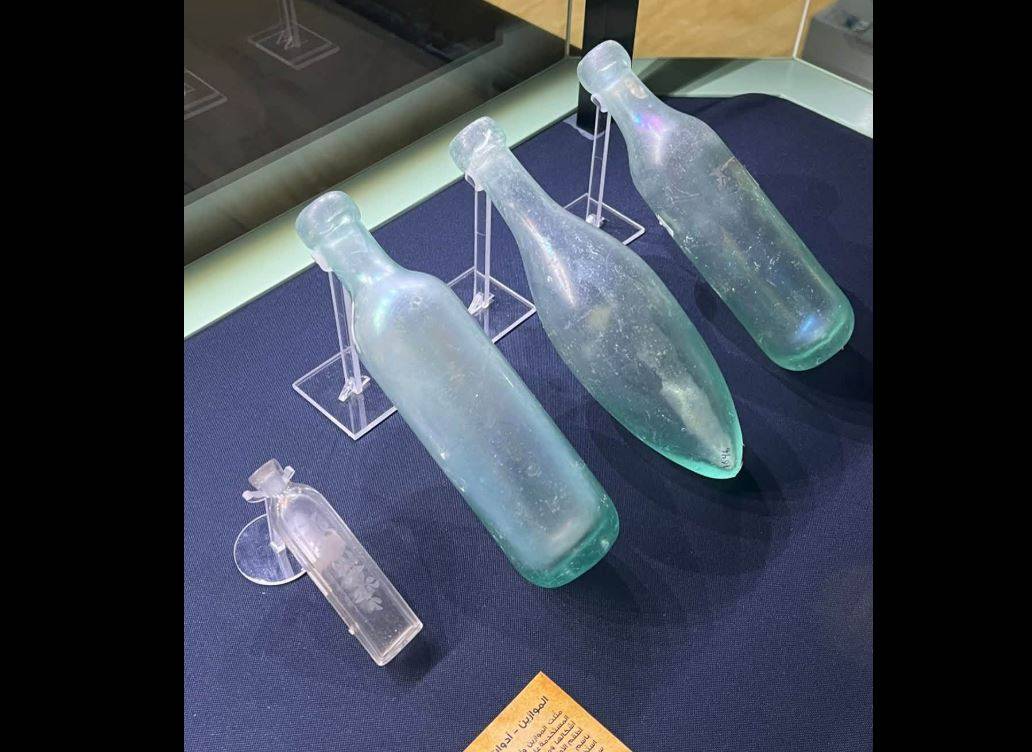
Some artifacts from the sunken fleet (Ministry of Tourism and Antiquities)

Other exhibits come from several museums, including the Maritime Museum, the Alexandria National Museum and the National Museum of Egyptian Civilization, according to a statement issued Monday by Egypt's Ministry of Tourism and Antiquities.

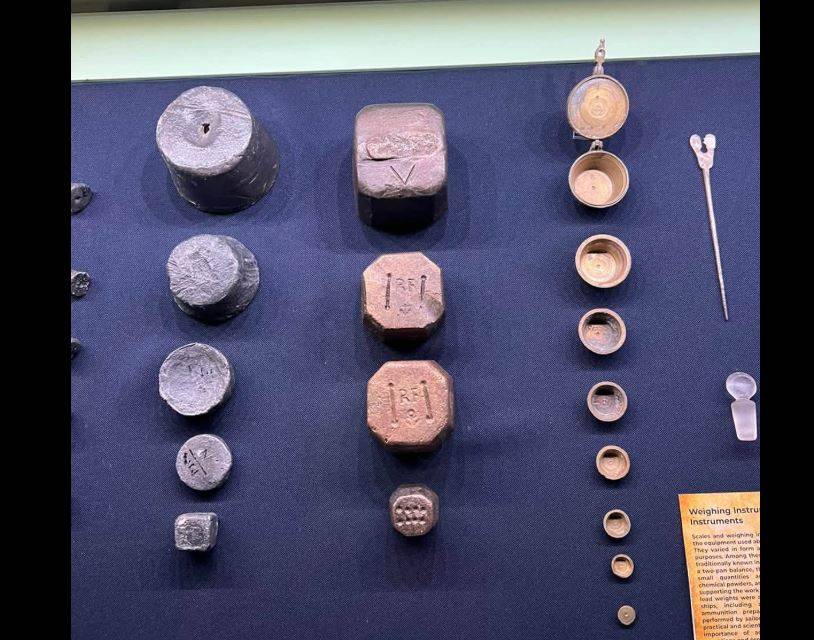
Among the exhibits are gold coins, navigation and writing instruments, cooking utensils used by crew members, and weapons recovered from the shipwreck sites. Together, the objects provide a comprehensive picture of maritime and military life during that period.

The exhibition will run for three months in the Egyptian Textile Hall at the National Museum of Egyptian Civilization.

It forms part of the ministry's efforts to highlight the importance of underwater cultural heritage as a rich source of physical evidence documenting historical events, figures and civilizations.

Such discoveries also contribute to archaeological research and scholarship, allowing historians to reexamine aspects of the past through evidence recovered from the sea.

The exhibition offers visitors an opportunity to explore a distinctive part of Egypt's heritage through original artifacts preserved underwater for centuries, each providing evidence of a significant historical period and revealing stories of maritime life at the time.

Archaeologist Dr. Hussein Abdel-Bassir, director of the Antiquities Museum at the Bibliotheca Alexandrina, said the exhibition's significance lies in its ability to bring back an entire world that disappeared beneath the water, leaving behind details waiting to be rediscovered and interpreted.

Some of the weighing scales used aboard the fleet (Ministry of Tourism and Antiquities)

"On August 1, 1798, Abu Qir Bay witnessed one of the most important naval battles in modern history," Abdel-Bassir explained.

"Napoleon's French expedition had arrived in Egypt just weeks earlier, pursuing an ambitious military, political and scientific project. But the French fleet suffered a devastating blow at the hands of the British fleet under Admiral Horatio Nelson in the Battle of the Nile."

He said the French ships were reduced to wreckage, shattering France's ambitions to dominate the Mediterranean, while the waters off Alexandria preserved the remains of that historic moment.

"What is fascinating is that the sea, which witnessed the struggle between empires, preserved not only the remains of ships and cannons but also details of the everyday lives of the men aboard them," he said.

"A small artifact can sometimes tell history more effectively than a grand monument. A coin, a personal belonging, a piece of tableware or part of a ship's equipment allows us to see history from a human perspective, rather than through the eyes of rulers and generals."

Abdel-Bassir said perhaps the most important lesson offered by Napoleon's sunken ships is that history never truly disappears.

"Sometimes history simply changes its location. It may leave the pages of books for the seabed, or transform from a written account into a silent artifact. But it remains there, waiting for someone to discover it, understand it and bring it to life for new generations," he said.

The archaeologist also described the celebration of World Underwater Cultural Heritage Day, coinciding with the 30th anniversary of Egypt's General Department of Underwater Antiquities, as an important opportunity to reconsider the future of the field.

Three decades of archaeological work, he said, provide an opportunity to assess what has been accomplished and develop an ambitious vision for what should be achieved in the decades ahead.


Denmark to Propose Mobile Phone Ban in Schools in 2027

22 October 2026, Schleswig-Holstein, Kiel: A man's hand reaches for a smartphone. (dpa)
TT

Denmark to Propose Mobile Phone Ban in Schools in 2027

22 October 2026, Schleswig-Holstein, Kiel: A man's hand reaches for a smartphone. (dpa)

Denmark will propose a ban on mobile phones in its primary and lower secondary school system as well as content filtering on the schools' network starting from the new academic year in 2027, the Danish education ministry said ‌on Monday.

Countries ‌including the Netherlands, ‌South ⁠Korea and Italy have ⁠banned smartphones in schools due to concerns over their impact on concentration and behavior, while Poland and the Czech Republic in June proposed ⁠a similar ban.

"Children ‌should be ‌able to go to school ‌without constantly being distracted by ‌things like social media, online shopping, and gaming," Education Minister Magnus Heunicke said in a statement.

The ‌ban also includes other private electronic devices with internet ⁠access.

⁠Content filters will be implemented to block websites that have no educational or pedagogical relevance, including social media, gaming and shopping sites, during lesson time.

It will be up to each municipality and school to decide which websites should be blocked.


Kuala Lumpur Otters Raise River Revival Hopes

This picture taken on October 19, 2026, shows a smooth-coated otter eating a fish along the bank of the Klang River in Kuala Lumpur. (AFP)
TT

Kuala Lumpur Otters Raise River Revival Hopes

This picture taken on October 19, 2026, shows a smooth-coated otter eating a fish along the bank of the Klang River in Kuala Lumpur. (AFP)

Beneath a tangle of highway in the Malaysian capital Kuala Lumpur, a family of otters rolls around in a patch of riverside sand, delighting the few passersby who notice them.

Small groups of otters are now being seen regularly in parts of the city, including along the once heavily polluted Klang River.

Theories vary on whether the smooth-coated otters, classed as vulnerable by the International Union for Conservation of Nature, have returned to the city or were hiding in plain sight all along.

But their presence has raised hopes that efforts to clean up the Klang may be bearing fruit, and could inspire further improvement.

The Klang was once one of the world's dirtiest waterways, designated a Class 5 severely polluted river under Malaysia's rankings.

Years of work improved it to Class 3, or moderately polluted, which seems to have encouraged the otters to move in, said Malaysian wildlife ecologist Woo Chee Yoong.

"Wherever there are otters, there are fish. Wherever there are fish it means the whole river system... (is) clean, it's healthy for all the communities around. So that's one of the importance of otters," he said.

In recent years, the animals have been filmed sunbathing on the river's concrete banks and swimming in front of elevated metro stations, winning viral fame.

Retired soldier Hasan Ujang, who lives in a riverside apartment, enjoys watching their antics.

"We feel really happy when we watch them playing and playing, like kids swimming," he said.

- 'They have to survive' -

But unlike otters in neighboring Singapore, which are closely monitored by a network of citizen scientists, little is known about Kuala Lumpur's otters.

Woo learned about them from local media reports on sightings in 2019 and the following year co-founded the Malaysian Otter Network (MON) conservation group.

"We don't know how many groups are there, we don't know how actually the otters are moving around," he said.

Even the question of whether the otters have returned to the capital or were simply in less visible city environments before remains a "mystery."

MON hopes to set up a citizen science system for people to report sightings.

Otters have been spotted elsewhere in the city, including at the Tropicana Golf & Country Resort, a high-end housing estate where they are less welcome visitors.

They are accused of raiding at least 12 houses in the past year. Their target: fish ponds.

Resident Yee Sze Mun, 89, said otters killed the beloved -- and expensive -- arowana fish he had nurtured for 15 years.

"They are a nuisance, but I can't blame them, because they are just like us, they have to survive," he said.

Residents say the incursions began last year after a company began clearing forest next door for a new development.

"We have an issue because they're losing their habitat," said residents' association president Joy Appukuttan, who called the otter attacks a "grave concern."

Tropicana's security team believes there are around 25 otters in the forest and the estate brought in Woo to teach residents how to deal with them.

The species is protected in Malaysia, so Woo urges residents to block entry points to their yards and install fences or netting over ponds.

- 'An asset' -

Maimunah Mohd Sharif, a former Kuala Lumpur mayor and now advisor to the city on sustainable urbanization, call the otters an "asset."

"Otters are one of the benchmarks for clean cities," she said.

Like others, she hopes a growing awareness of the Klang River otters can be harnessed to help improve the river further.

Hundreds of garbage traps were installed as part of the government's River of Life project, and solar-powered "interceptors" deployed by a Dutch NGO have collected tens of thousands of tons of waste.

Now Maimunah wants to see more done to stop waste entering the river in the first place, and efforts to make the Klang Class 2B status, clean enough for body contact.

"One day, I want to swim in the Klang River," she said.

Scarlett Koon Si Qi, a community architect and co-organizer of the annual Klang River Festival hopes the waterway can be restored to its natural banks without concrete lining.

"Some parts, maybe yes, you do need concrete to kind of protect and control for floods," she said.

"But I think wherever we can, we should leave it as natural as possible."

That would further benefit the otters, who need some vegetation and natural crevices to hide in, experts said.

The otters are already shifting views on the river, said Faith Foo, who runs the festival.

Growing up, "the teachers would always say that this is a very unsanitary place," he said.

But seeing the otters, "it's a reminder that that is a river."