Saudi Industrial Production Falls 23.5% in August

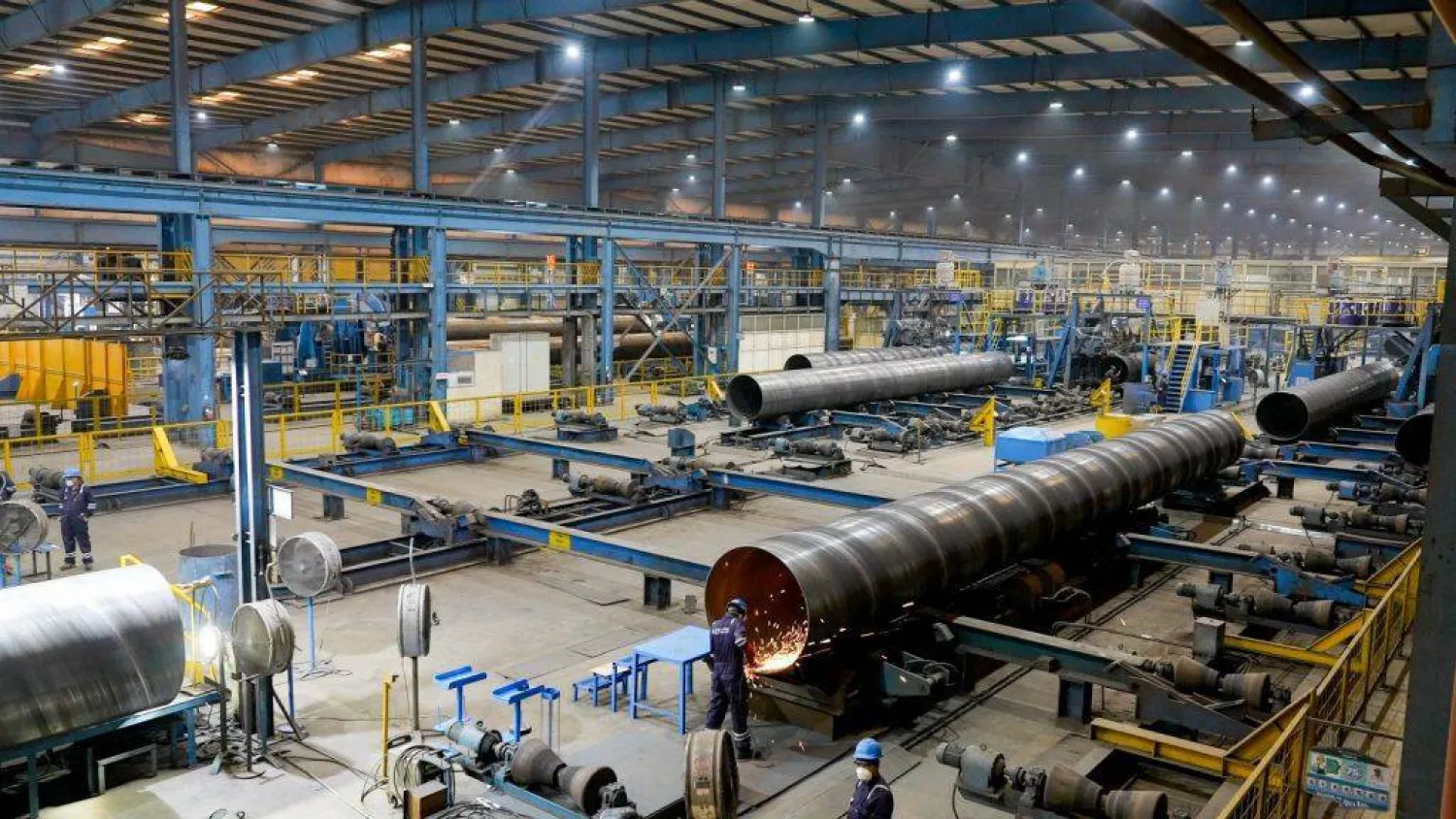
A factory operated by Saudi Arabia’s East Pipes Integrated Company for Industry. (Company photo)
TT

Saudi Industrial Production Falls 23.5% in August

A factory operated by Saudi Arabia’s East Pipes Integrated Company for Industry. (Company photo)

Saudi Arabia’s industrial production index fell 23.5% in August 2026 from a year earlier, weighed down by declines in mining and quarrying and manufacturing activity, data from the General Authority for Statistics showed on Sunday.

On a monthly basis, the index dropped 14% from July, amid declines in both main activities.

The data showed that the oil activities index fell 33.6% year on year, while the non-oil activities index rose 1.2%, reflecting divergent performances between the two sectors during the month.

By economic activity, the mining and quarrying index declined 35.8% year on year and 24% from July. The manufacturing index fell 8.8% annually and 3.2% month on month.

The decline in manufacturing was driven by a 24.1% year-on-year drop in the manufacture of coke and refined petroleum products, and a 3.3% decrease in the manufacture of chemicals and chemical products.

Some industrial activities, however, recorded annual growth. The index for electricity, gas, steam and air conditioning supply rose 9.4%, while the index for water supply, sewerage, waste management and remediation activities increased 7.4%.

On a monthly basis, the non-oil activities index rose 1.4%, while the oil activities index fell 21.5%, according to the authority’s preliminary data.


Nvidia Stops Shipping AI Servers to Four SE Asian Nations

FILE PHOTO: Nvidia logo, computer chips and a 3D-printed representation of a robot hand are seen in this illustration taken August 27, 2025. REUTERS/Dado Ruvic/Illustration/File Photo
TT

Nvidia Stops Shipping AI Servers to Four SE Asian Nations

FILE PHOTO: Nvidia logo, computer chips and a 3D-printed representation of a robot hand are seen in this illustration taken August 27, 2025. REUTERS/Dado Ruvic/Illustration/File Photo

US tech titan Nvidia is not allowing orders of computer servers containing its artificial intelligence chips to be shipped to four Southeast Asian countries, the Financial Times reported Thursday.

AFP said that the article comes after Washington tightened export controls for the sensitive components in the wake of an espionage scandal that has engulfed Nvidia -- forcing out longtime CEO Jensen Huang before his reinstatement on Sunday.

Citing national security concerns, the United States has since 2022 restricted export to tech rival China of Nvidia's industry-leading advanced chips that are used to train and run AI tools.

Washington last week moved to close a loophole in those controls, to crack down on chip smuggling, but also the large grey market of Chinese companies renting computing power from data centers in third countries, often in Southeast Asia.

The Financial Times report said Nvidia had instructed manufacturing partners to stop shipping computer servers to buyers in Malaysia, Singapore, Thailand and Indonesia.

The British newspaper, citing three people with knowledge of the matter, said it was unclear whether the halt was temporary.

It named US giants Dell and Supermicro, who package Nvidia AI chips into servers for data centers, as two affected partners.

Buyers affected include Singapore-based cloud computing company Aolani, which had planned to provide access to the Nvidia hardware to Chinese TikTok owner ByteDance through leasing agreements, the Financial Times said.

An executive at a cloud provider told the newspaper that Washington's new rules had caused "sheer chaos" in the region during a 90-day period in which to apply for a newly required license.

AFP has contacted Nvidia, Dell, Supermicro, Aolani and ByteDance for comment.

The Nvidia scandal erupted following reports of Huang's affair with Alice Huang -- a former executive at Megaspeed, a Singapore-based company under investigation for the alleged transfer of Nvidia chips to China in circumvention of US rules.

Alice Huang, no relation to Jensen, is also reportedly suspected by some US officials of spying for Beijing.

Massive investments from US and Chinese tech giants have driven a data center construction boom in Southeast Asia, especially in the countries surrounding hyper-connected Singapore.

Data center capacity in Southeast Asia is projected to triple from 2025 levels by 2030, driven by a tenfold surge in AI use, according to KPMG.


US Unveils Proposed Tariffs on Major Partners, Including EU and China

New Volkswagen cars on a car tower at the VW plant in Wolfsburg, Germany, 28 April 2016. (EPA)
TT

US Unveils Proposed Tariffs on Major Partners, Including EU and China

New Volkswagen cars on a car tower at the VW plant in Wolfsburg, Germany, 28 April 2016. (EPA)

The United States on Wednesday unveiled proposed tariffs on 14 economies including the European Union and China, after a months-long probe into alleged excess production -- the latest move by US President Donald Trump to remake Washington's trade relationships.

The duties, proposed at up to 20 percent, come over allegations the economies "are promoting production and capacity divorced from the realities of demand and market principles," a senior US official said on condition of anonymity.

The new tariffs face a period of public comment before taking effect, with the official adding that the proposals take existing trade deals into account.

The new levies target some of the largest US trading partners, including China, the European Union, India, Bangladesh, Cambodia, Indonesia, Japan, South Korea, Malaysia, Singapore, Switzerland, Taiwan, Thailand and Vietnam.

The US official said a 20-percent tariff is being proposed for China, the joint-highest for any economy.

Vietnam also faces a proposed 20-percent tariff; Cambodia and Indonesia 18 percent; and India 17 percent, according to the US Trade Representative's office (USTR).

Partners like the EU, Korea and Taiwan, which have signed earlier trade deals, will see tariffs broadly capped at 15 percent.

In a separate announcement, USTR also proposed additional tariffs on goods from Brazil, including aircraft, over alleged inaction on addressing US trade concerns.

Trump's tariffs have targeted Washington's friends and foes alike, and are part of a push in his second term to remake global trade by forcing countries to buy US products or produce their goods in his country.

The latest move offers some relief for partners that earlier signed tariff deals with the Trump administration, but it could still raise temperatures as the US president prepares to host G20 leaders in Miami in December.

"We don't expect this to create tension or rancor" at the G20 summit, the senior US official said. "We actually expect that we may be signing more agreements at the G20 in the wake of these announcements."

- Inflation pressures -

Over-capacity concerns affect a range of sectors, from batteries to cement, chemicals to processed food, the senior US official said.

The duties could add further pressure on US businesses already squeezed by earlier tariffs, with firms now likelier to pass on costs to consumers already frustrated with the high cost of living.

Affordability was a key issue in recent midterm elections, which saw Trump's Republican Party swept out of power in both houses of Congress by Democrats.

US consumer inflation came in at 3.7 percent year-on-year in September, close to a three-year high as prices are pushed up by the effects of Trump's war on Iran, tariffs, and the massive AI investment boom.

US Federal Reserve policymakers, responsible for keeping inflation to a long-term two-percent target, say that most price effects of Trump's previous tariff rollout have passed through the economy -- but any new levies could push prices up further.

The new tariffs are likely to come into effect in January at the earliest, the senior US official said.

They follow the start of a USTR investigation in March on excess manufacturing capacity and production over whether other countries were taking actions deemed "unreasonable or discriminatory," and if they weighed on US commerce.

The probes came days after the US Supreme Court struck down Trump's previous slew of tariffs on the grounds that the president lacked the authority to impose the duties using the law the White House had cited.

- Pushback expected -

Trade lawyer Ryan Majerus told AFP that he expected this probe to be among "the most important" actions for the Trump administration, given its underlying concern that factories with excess capacity start operations abroad and "never get turned off, even if there's no demand."

This potentially leads to an oversupply of goods, depressed prices and a "hollowing out" of US manufacturing, he added.

The US determination is likely to face strong pushback from China and others, with Beijing long rejecting criticism that it relies too much on exports to boost its economy.

While the US Supreme Court struck down Trump's global tariffs in February, his sector-specific duties remain intact.

The new tariffs will not stack on top of those sector-specific tariffs on items like automobiles and steel, the senior US official said.

In July, Trump imposed a separate wave of tariffs on 60 economies, accusing them of insufficient action against forced labor.

For economies facing both the forced labor and excess production tariffs, the levies would not stack, the US official said. Instead, the higher rate of the two would prevail.



Saudi Arabia’s PIF Assigned Inaugural A+ Long-Term Credit Rating from S&P with Stable Outlook

Saudi Arabia’s PIF Assigned Inaugural A+ Long-Term Credit Rating from S&P with Stable Outlook
TT

Saudi Arabia’s PIF Assigned Inaugural A+ Long-Term Credit Rating from S&P with Stable Outlook

Saudi Arabia’s PIF Assigned Inaugural A+ Long-Term Credit Rating from S&P with Stable Outlook

Saudi Arabia's Public Investment Fund (PIF) announced on Wednesday that S&P Global Ratings has assigned it the inaugural A+ long-term foreign and local currency issuer credit ratings, with a stable outlook. PIF’s existing A-1 short-term rating remains unchanged, with PIF’s ratings in line with those of Saudi Arabia.

The A+ rating reflects confidence in PIF’s long-term strategy and its strong financial position. It further adds to PIF’s already strong credit profile, thereby supporting its sustainable funding base and long-term investment strategy.

S&P’s assessment highlighted PIF’s diversified funding profile, moderate leverage position and its focus on value realization under PIF’s 2026-2030 strategy, as well as its critical role in driving Saudi Arabia’s economic transformation.

PIF’s Head of Capital Finance Strategy Ziyad Alfawzan said: “The inaugural A+ long-term rating from S&P marks an important milestone in the continued development of PIF’s credit profile and our long-term funding plan.”

“PIF holds strong long-term credit ratings from S&P, Moody’s and Fitch, reflecting PIF’s diversified and sustainable funding base and the strength of its financial profile and governance. It further reflects confidence in PIF’s long-term strategy, as we advance the 2026-2030 value realization phase,” he added.

The S&P rating adds to PIF’s robust credit profile. Moody’s Ratings confirmed PIF’s aa3 baseline credit assessment and Aa3 long-term issuer rating with a stable outlook remain unchanged following a periodic review, in September.

Fitch Ratings also affirmed PIF’s long-term foreign and local currency issuer default ratings at “A+” with a stable outlook, in October.

PIF is one of the world’s most impactful investors, with a long-term investment strategy to further drive the economic transformation of Saudi Arabia and deliver sustainable financial returns.