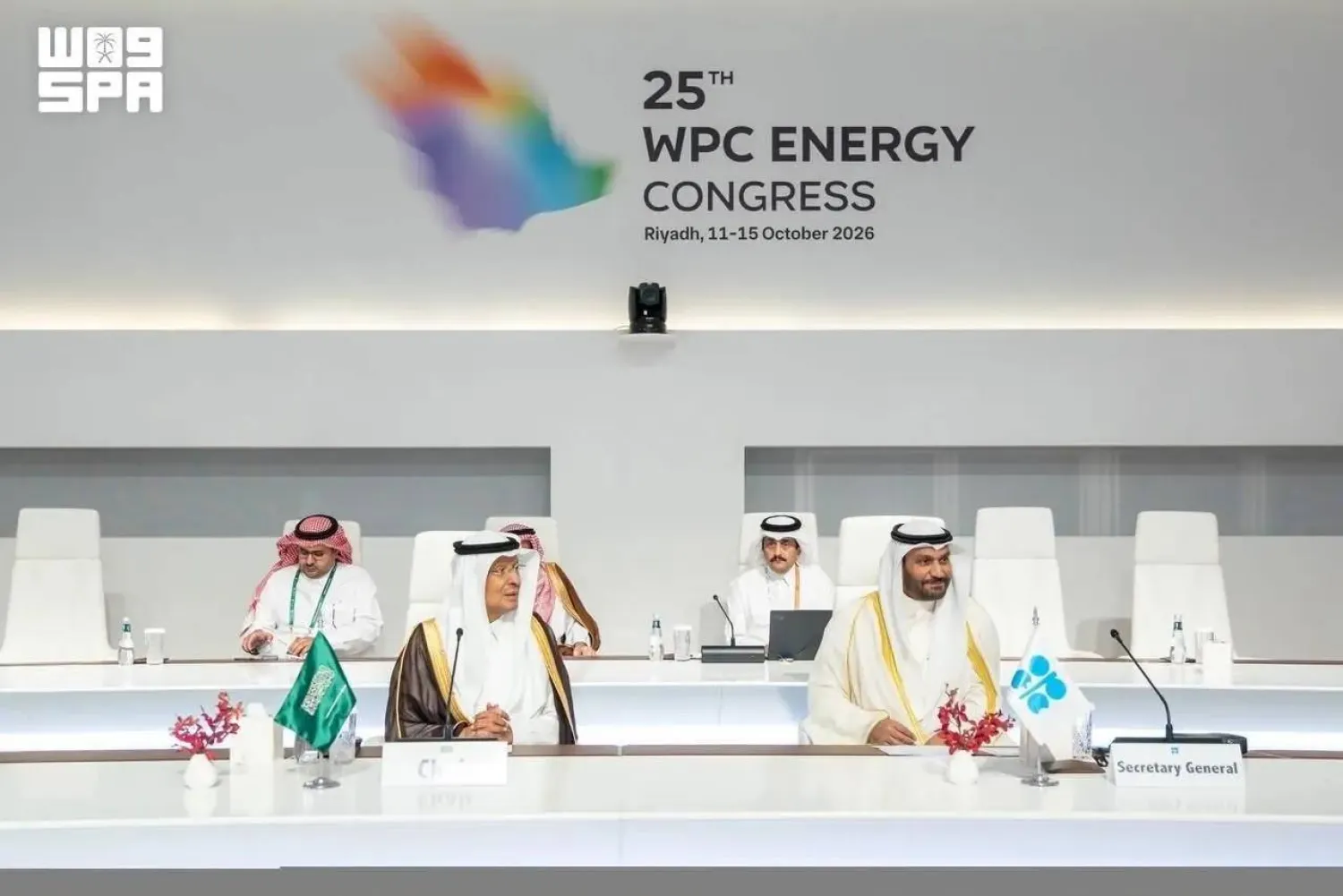
OPEC, Non-OPEC Ministers Stress Critical Importance of Safeguarding Int’l Maritime Routes

Saudi Minister of Energy and Minister of Industry and Mineral Resources Prince Abdulaziz bin Salman bin Abdulaziz (L) at the Riyadh meeting on Monday. (SPA)
TT

OPEC, Non-OPEC Ministers Stress Critical Importance of Safeguarding Int’l Maritime Routes

Saudi Minister of Energy and Minister of Industry and Mineral Resources Prince Abdulaziz bin Salman bin Abdulaziz (L) at the Riyadh meeting on Monday. (SPA)

Ministers of OPEC and non-OPEC Participating Countries in the Declaration of Cooperation (DoC) met on the sidelines of the 17th IEF ministerial meeting and the 25th WPC Energy Congress in Riyadh on Monday.

The ministers reviewed market conditions and agreed to continue consultation with all OPEC+ countries, through already established mechanisms, including the Joint Ministerial Monitoring Committee (JMMC) and the OPEC and Non-OPEC Ministerial Meetings (ONOMM).

They reaffirmed their commitment to the decisions made on June 7, 2026 (41stONOMM) to achieve and sustain a stable oil market.

The ministers stressed the critical importance of safeguarding the international maritime routes to ensure the uninterrupted flow of energy.

They noted that the current interruption of energy flows has elevated the cost of shipping and insurance, which have reached unprecedented levels of more than one third of the commodity value, impeding the timely and efficient movement of crude oil and products, and placing additional inflationary pressures on the global economy.

These exceptionally elevated costs are ultimately transmitted across the oil value chain, increasing and prolonging the cost burden on producing and consuming countries and impacting global economic growth, they remarked.

The ministers will continue monitoring the situation and will engage with governments, industry stakeholders, and international organizations such as the IEF, IEA, and others to improve global shipping conditions.


Fitch: US Chip Curbs Will Slow Asia Data-center Investment

The Chinese and American flags on an electronic circuit board featuring semiconductor chips (Reuters)
TT

Fitch: US Chip Curbs Will Slow Asia Data-center Investment

The Chinese and American flags on an electronic circuit board featuring semiconductor chips (Reuters)

Asia-Pacific data-center investment will slow and become more selective as tighter US chip controls pressure operators reliant on Chinese customers and advanced American semiconductors, Fitch Ratings said on Thursday.

Fitch's statement comes a day after S&P placed Nvidia's rating on downgrade watch over governance concerns and Moody's said CEO Jensen Huang's reinstatement reduced near-term execution uncertainty but governance and regulatory risks persisted.

The new rules, effective November 19, require licenses for covered chip shipments to Malaysia, Singapore, Indonesia and Thailand, and overseas data centers supplying significant computing power to China-based companies.

Fitch ⁠said this could ⁠reshape Asia's AI boom, redirecting capital toward projects with secure chip access and diversified customers. It would also widen the divide between physical data-center owners and highly leveraged computing providers, Reuters quoted it as saying.

Neocloud operators — specialized cloud providers that rent out AI computing power — face the greatest pressure ⁠because they must keep costly graphics processors highly utilized, Fitch said.

Additionally, China-focused operators may have to lower prices, offer less-advanced computing or keep using existing Nvidia chips without access to upgrades, which could hurt sales, profits and their ability to compete, Fitch added.

Also at risk would be nearly completed projects, facing delays if operators cannot secure chips or confirm that customers are eligible to use them, pushing back when the facilities can begin generating revenue.

Projects with ⁠uncertain chip ⁠supplies or customer eligibility will face tighter financing as lenders conduct more checks and delay funding or new loans, Fitch added.

Earlier on Thursday, Reuters exclusively reported that the restrictions could delay flagship models from China's Z.AI and Moonshot AI, with Moonshot expecting development cycles to double to 12 months or longer if overseas computing access is cut off entirely.

The Financial Times reported earlier in the day that Nvidia told manufacturing partners to stop server shipments to the four Southeast Asian countries while assessing compliance with the new controls.


Iraq Raises Oil Exports to 3.6 Million Barrels per Day

A gas flare burns at an oil facility in Shekhan, Nineveh province, Iraq, November 25, 2026. Picture taken with a mobile phone. REUTERS/Stringer
TT

Iraq Raises Oil Exports to 3.6 Million Barrels per Day

A gas flare burns at an oil facility in Shekhan, Nineveh province, Iraq, November 25, 2026. Picture taken with a mobile phone. REUTERS/Stringer

Iraq has raised its oil exports to 3.6 million barrels per day (bpd), up from around 200,000 bpd when the current government took office in May, Oil Minister Basim Mohammed said, attributing the increase to expanded production and export capacity and efforts to overcome challenges in supplying petroleum products.

The minister said Iraq's oil revenue reached $8.8 billion in October, alongside more than $4.5 billion from exports of fuel oil, sulfur and naphtha. He also revealed that Baghdad was in talks with OPEC to raise its production ceiling and was negotiating with US companies to develop oilfields.

In an interview with the Iraqi News Agency (INA), Mohammed said the ministry assumed its responsibilities when the government took office on May 14, facing significant challenges, including a decline in exports to around 200,000 bpd, lower production levels, difficulties securing petroleum products and budget constraints.

He said the ministry and its various departments, operating across Iraq from north to south, had overcome those challenges with government support and the efforts of its management, engineering and technical teams.

As a result, exports rose to 3.6 million bpd, while the ministry secured sufficient petroleum products to meet domestic market needs. He attributed the improvement to increased production and export capacity, which helped generate revenue to support the state treasury.

Mohammed explained that most of Iraq's oil exports pass through the Strait of Hormuz, while additional volumes are shipped through Türkiye's Ceyhan port. Iraq also has a contract to transport oil to Syria by tanker trucks.


Saudi Arabia Strengthens Consumer Protection with Advisory Council, National Strategy

A Ministry of Commerce inspector monitors product prices at a shopping center (Ministry of Commerce)
TT

Saudi Arabia Strengthens Consumer Protection with Advisory Council, National Strategy

A Ministry of Commerce inspector monitors product prices at a shopping center (Ministry of Commerce)

Saudi Arabia's consumer protection framework is entering a new phase of regulatory development with the establishment of an advisory council comprising representatives of consumers, consumer associations and the private sector, alongside plans for a national strategy to unify regulatory efforts and coordinate responsibilities among relevant authorities.

The new law also gives economic operators up to one year to bring their operations into compliance and introduces financial incentives to encourage the reporting of violations.

The measures form part of the Kingdom's new Consumer Protection Law, which aims to strengthen coordination among government agencies and expand consumer participation in discussions concerning legislation and regulations affecting their rights.

The Council of Ministers, chaired by Crown Prince and Prime Minister Mohammed bin Salman, recently approved the law.

Compliance Period

Under the new arrangements, reviewed by Asharq Al-Awsat, the Ministry of Commerce will temporarily assume the duties and responsibilities of the competent consumer protection authority until a study by the Council of Ministers' Bureau of Experts determines which entity should permanently hold that mandate.

Economic operators will be granted a period of no more than one year from the law's effective date to bring their operations into compliance with its provisions.

To strengthen public participation, the law provides for the establishment of a Consumer Advisory Council, whose composition and operating rules will be determined by a decision of the Council of Ministers.

The council will include consumer representatives with relevant expertise and interest, representatives of consumer associations and members of the private sector.

It will provide advice, opinions, proposals and recommendations on consumer protection matters, either at the request of the competent authority or on its own initiative.

National Strategy

Relevant authorities will also be required to seek the council's views on draft laws and regulations related to consumer protection.

The council will organize discussions, facilitate dialogue and promote exchanges of views among consumer representatives, economic operators and experts.

At the institutional level, the Permanent Committee for Consumer Protection, established by a Council of Ministers decision, will be affiliated with the competent authority designated under the new law.

Working with relevant government bodies, the committee will prepare a national strategic plan for consumer protection and submit it for approval through the prescribed legal procedures.

It will also develop operational plans for implementation and oversee their review, evaluation and updating.

The committee's responsibilities include identifying the government entities involved in consumer protection and defining their respective regulatory and supervisory jurisdictions in agreement with those entities.

It will also coordinate their functions, activities and efforts to promote complementary roles and minimize overlapping responsibilities.

In cooperation with relevant authorities, the committee will help formulate general and specialized consumer protection policies and develop the laws, regulations and programs needed to implement them.

Its mandate also includes developing human resources and improving workforce productivity through training, as well as enhancing working procedures and practices across the relevant government agencies.

Policy Development and Regulatory Oversight

The committee will also facilitate information sharing among relevant authorities, within their respective jurisdictions, concerning measures already taken or planned to strengthen consumer protection.

It will work to improve public awareness of the agencies responsible for receiving consumer complaints and make those agencies more accessible.

To encourage the reporting of violations, the arrangements stipulate that rules governing the financial rewards provided for under the law must be approved in agreement with the Ministry of Finance.

These rules must also take into account provisions concerning rewards for whistleblowers, in accordance with the governance framework for incentive payments to individuals who help uncover regulatory violations, as approved by the Council of Ministers.

Together, the arrangements reflect a move toward a more integrated consumer protection system that combines policy development, regulatory oversight and coordinated government responsibilities, while giving consumers and the private sector a greater role in discussions on relevant issues and legislation.