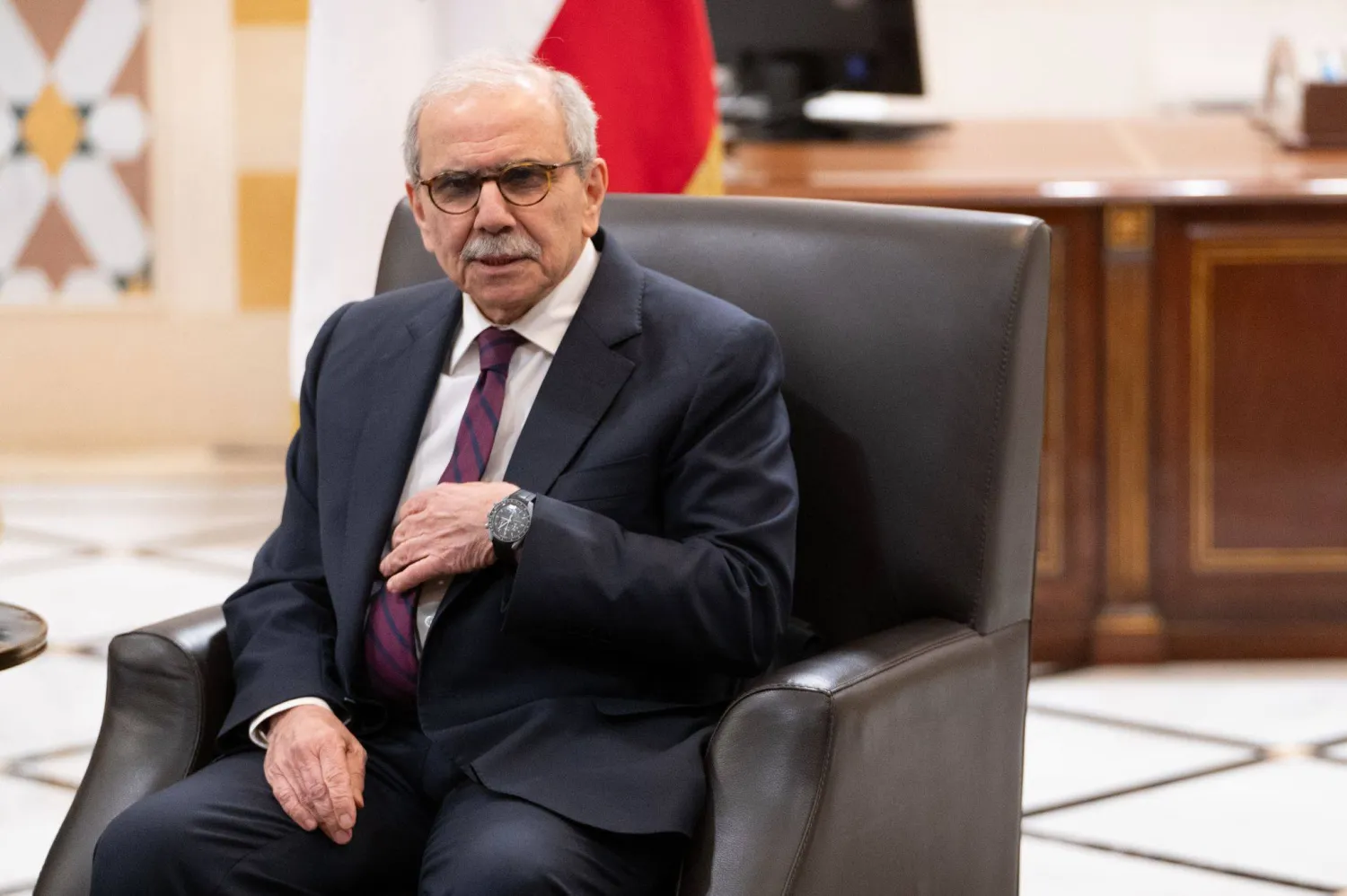
Lebanese Army Seizes More Explosives as PM Vows Firm Response

16 February 2026, Lebanon, Beirut: Lebanese Prime Minister Nawaf Salam is pictured during a meeting at the Prime Minister's office. (dpa)
TT

Lebanese Army Seizes More Explosives as PM Vows Firm Response

16 February 2026, Lebanon, Beirut: Lebanese Prime Minister Nawaf Salam is pictured during a meeting at the Prime Minister's office. (dpa)

Lebanon's army said it seized explosives on Monday, after Prime Minister Nawaf Salam vowed to deal firmly with illegal weapons, days after security forces seized a truck carrying materiel suspected of belonging to Hezbollah.

The army said soldiers in the northeastern Hermel region "seized around 200 kilograms (around 440 pounds) of explosive material packed in bags and ready for smuggling from Syrian territory" into Lebanon, adding that the smugglers fled back into Syria.

A judicial official told AFP that the C4 explosives were being smuggled "on a mule through an illegal crossing in the town of Qasr".

The announcement was the third of its kind this month, and came days after a judicial official told AFP that authorities detained two suspected members of Iran-backed Hezbollah at a security checkpoint in Dahr al-Baidar as they headed to Beirut.

The official said they were transporting half a ton of explosives -- 250 kilograms of TNT and 250 kilograms of C4 -- when they were stopped near a road linking Syria to the Lebanese capital.

Salam on X confirmed that "it has become known that a few days ago a truck was stopped" in Dahr al-Baidar "carrying hundreds of kilograms of explosive materials" including C4.

"We will not be lenient in following up and expanding the investigation in order to identify all those involved in this criminal operation, and those behind them," he said.

"We will deal with weapons outside the legal framework will the required firmness," he added, whether regarding their possession, transportation or use.

Salam also said that he understood "Lebanese worries" over the C4, particularly as it "has been used in a number of political assassinations" in Lebanon's history.

- Detonators -

Earlier this month, Lebanon's army said it had seized "approximately 245 kg of TNT, four explosive devices, eight detonators and electrical wiring for the detonators", which were being "smuggled from Syrian territory into Lebanese territory", adding that the smugglers fled towards Syria.

Lebanon and Syria share a 330-kilometer (205-mile) border known for being porous.

Hezbollah until recently was the most influential political and military force in Lebanon, enjoying key support from Iran and longtime Syrian ruler Bashar al-Assad.

The group has been accused of carrying out assassinations of political figures who opposed Damascus, particularly between 2005 and 2008.

A UN-backed court in 2020 sentenced a fugitive Hezbollah member for the 2005 assassination of former Lebanese Prime Minister Rafik al-Hariri, with the court subsequently sentencing two more Hezbollah members in absentia.

Lebanese authorities last year committed to disarming Hezbollah, after hostilities between Israel and Hezbollah erupted in 2023 and culminated in all-out war the following year, decimating the group's leadership.

The 2024 toppling of Assad also severed the group's key weapons supply line from Iran, and Syria's new authorities regularly say they have seized weapons headed for Lebanon.

However, Hezbollah this year drew Lebanon into the Middle East war with rocket fire at Israel, which responded with airstrikes and a ground invasion.

The cash-strapped Lebanese army faces enormous challenges in carrying out its mission of disarming Hezbollah and deploying in south Lebanon, including under an Israel-Lebanon framework reached in June this year.


Arab Parliament Reaffirms Inalienable Rights of the Palestinian People

Arab Parliament logo
TT

Arab Parliament Reaffirms Inalienable Rights of the Palestinian People

Arab Parliament logo

The Arab Parliament affirmed that the rights of the Palestinian people are inalienable and cannot be erased by the passage of time. Foremost among these rights are self-determination and the establishment of an independent Palestinian state along the June 4, 1967 borders, with East Jerusalem as its capital.

It stressed that these rights must be upheld in accordance with the two-state solution, relevant international resolutions, and the Arab Peace Initiative, in a manner that ensures a just and comprehensive peace.

In a statement issued on Monday to mark the 109th anniversary of the Balfour Declaration, the Arab Parliament described the declaration as a historic crime against the Palestinian people, whose devastating consequences continue to this day.

It noted that these repercussions are reflected in the ongoing crimes committed by the Israeli occupation against Palestinians and its persistent violations across the occupied Palestinian territories, particularly in the Gaza Strip, Jerusalem, and the West Bank. These include killings, forced displacement, starvation, and genocide, all in flagrant violation of international law, norms, and conventions.

The Arab Parliament condemned these continued crimes and violations, calling on the international community to assume its responsibilities and take decisive measures to stop them and hold those responsible accountable.


Lebanon’s EDL Begins Cutting Power to Ministries, Municipalities and Public Institutions over Unpaid Dues

The offices of Electricite du Liban in Beirut on August 17, 2024. (EPA)
TT

Lebanon’s EDL Begins Cutting Power to Ministries, Municipalities and Public Institutions over Unpaid Dues

The offices of Electricite du Liban in Beirut on August 17, 2024. (EPA)

Lebanon’s public power utility, "Electricite du Liban" (EDL), began on Monday implementing measures to disconnect electricity supply to public administrations, public institutions, and municipalities that have failed to settle their financial dues.

This unprecedented move, in terms of its sweeping scope, targets ministries, official bodies, water authorities, and municipalities. It comes amid a severe financial crisis confronting the state utility due to the accumulation of public sector debts.

An initial list obtained by Asharq Al-Awsat revealed the names of institutions and administrations covered by the measures. They include the Council for Development and Reconstruction, Ministry of Public Works and Transport, Directorate General of Urban Planning, Directorate General of Education at the Ministry of Education and Higher Education, the Land Registry Directorates, and the Directorate General of Customs, in addition to subscriptions belonging to the Ministry of Telecommunications across various regions.

An informed source confirmed to Asharq Al-Awsat that "the decision to cut electricity to public institutions and administrations that fail to settle their dues does not aim to punish them or disrupt their work, but rather to enforce respect for the law and establish permanent financial regularity in paying electricity bills, thereby ensuring that EDL secures its rights and the continuity of its operations."

The source explained that "the primary objective is not the power disconnection itself, but rather to push public institutions to assume their financial responsibilities and settle their accumulated obligations on a regular basis, instead of continuing to pile up debts and resorting to temporary fixes whenever the crisis intensifies."

Rafik Hariri International Airport in Beirut successfully avoided a power disconnection after the Civil Aviation Authority reached an understanding with EDL. The agreement stipulates the payment of a portion of the accumulated dues and the rescheduling of the remaining amounts, alongside a commitment to settle incoming bills on a regular basis.

The accumulated dues owed by the Directorate General of Civil Aviation reached around $22.8 million, according to figures circulated regarding public sector debts.

These measures come in light of EDL’s need to collect regular revenues to finance fuel purchases and operate power plants. Its dues from public administrations and institutions reached around a quarter of a billion dollars.

The problem of arrears dates back to years of irregular electricity bill payments and has worsened with the tariff increase and the lack of sufficient credit availability among some administrations. This presents a dual challenge related to settling past debts and ensuring the payment of new consumption.


Lebanese, Syrian Talks in Damascus Tackle Border Security, Refugees

Syrian Foreign Minister Asaad Al-Shaibani and Lebanon's Deputy Prime Minister Tarek Mitri meet in Damascus. (Syrian Foreign Ministry)
TT

Lebanese, Syrian Talks in Damascus Tackle Border Security, Refugees

Syrian Foreign Minister Asaad Al-Shaibani and Lebanon's Deputy Prime Minister Tarek Mitri meet in Damascus. (Syrian Foreign Ministry)

Syrian Foreign Minister Asaad Al-Shaibani received on Monday a high-level Lebanese delegation led by Deputy Prime Minister Tarek Mitri in the Syrian capital, Damascus, for talks on outstanding issues between the neighboring countries.

Informed sources in Damascus told Asharq Al-Awsat that the Syrian side focused heavily on border control and joint security cooperation and coordination, while the Lebanese side focused primarily on the file of Syrian refugees in Lebanon.

A Syrian Foreign Ministry statement said: "The meeting discussed ways to strengthen bilateral relations between the two brotherly nations and develop joint coordination across various fields, primarily security cooperation and border control. This is in addition to expanding the horizons of partnership in the sectors of education, higher education, social affairs, and labor, as well as following up on the work of joint technical committees to serve mutual interests."

The Lebanese delegation's visit to Damascus comes within the context of strengthening bilateral relations, serving as a continuation of previous talks and a follow-up on the work of the joint committees established between the two sides to address shared files.

This follows an agreement reached by both countries last July to establish a joint higher committee to serve as an institutional framework for coordinating the work of the relevant ministries, developing economic, investment, and trade cooperation, and reinforcing security understandings.

According to informed sources in Damascus, the management of the Syrian–Lebanese border, traffic at border crossings, and security coordination to combat smuggling and infiltration topped the agenda of the talks.

The file of Syrian refugees and the status of residents in Lebanon, particularly those who entered covertly, was brought forward. The discussions sought to address the refugee issue from multiple dimensions, including social, security, and legal aspects. The situation of Syrian students in Lebanese schools was also raised.