NKorea's Kim Showcases Missile Capable of Reaching US as Trump Signals Possible Meeting

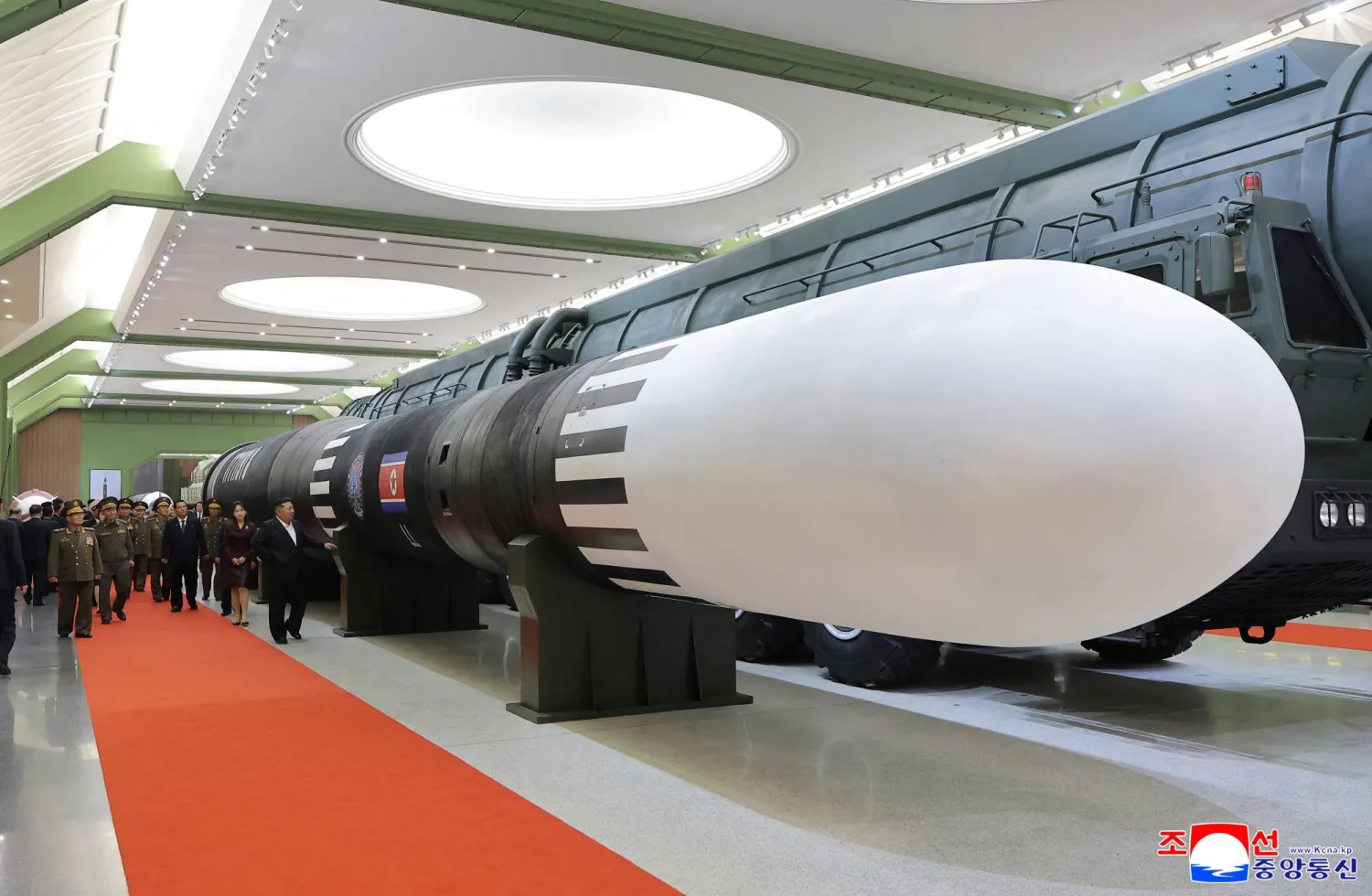
North Korean leader Kim Jong Un and his daughter Kim Ju Ae attend the opening ceremony of the National Defense Revolution Museum of the Second Economic Committee, North Korea, October 11, 2026, in this picture released by North Korea's official Korean Central News Agency. KCNA/via REUTERS    KCNA via REUTERS
North Korean leader Kim Jong Un and his daughter Kim Ju Ae attend the opening ceremony of the National Defense Revolution Museum of the Second Economic Committee, North Korea, October 11, 2026, in this picture released by North Korea's official Korean Central News Agency. KCNA/via REUTERS KCNA via REUTERS
TT

NKorea's Kim Showcases Missile Capable of Reaching US as Trump Signals Possible Meeting

North Korean leader Kim Jong Un and his daughter Kim Ju Ae attend the opening ceremony of the National Defense Revolution Museum of the Second Economic Committee, North Korea, October 11, 2026, in this picture released by North Korea's official Korean Central News Agency. KCNA/via REUTERS    KCNA via REUTERS
North Korean leader Kim Jong Un and his daughter Kim Ju Ae attend the opening ceremony of the National Defense Revolution Museum of the Second Economic Committee, North Korea, October 11, 2026, in this picture released by North Korea's official Korean Central News Agency. KCNA/via REUTERS KCNA via REUTERS

North Korean leader Kim Jong Un visited a defense industry museum displaying an intercontinental ballistic missile capable of reaching the United States, state media KCNA showed on Tuesday.

The report came a day after US President Donald Trump said he might meet Kim during a planned trip to Asia. Trump is expected to attend ⁠the Asia-Pacific Economic ⁠Cooperation summit in China in mid-November.

Kim, accompanied by his daughter known as Ju Ae and wife Ri Sol Ju, attended the opening of the newly opened Defense Revolution Museum on Sunday, KCNA said.

The museum displayed weaponry developed under Kim's leadership ranging from drones to the Hwasong-20 intercontinental ballistic missile (ICBM), KCNA photographs showed.

A display in front of the Hwasong-20 launcher appeared to show a multiple ⁠warhead design and a world map depicting ranges extending beyond the US mainland to the Middle East, Australia and South America, said Shin Jong-woo, Secretary General of the Korea Defense and Security Forum.
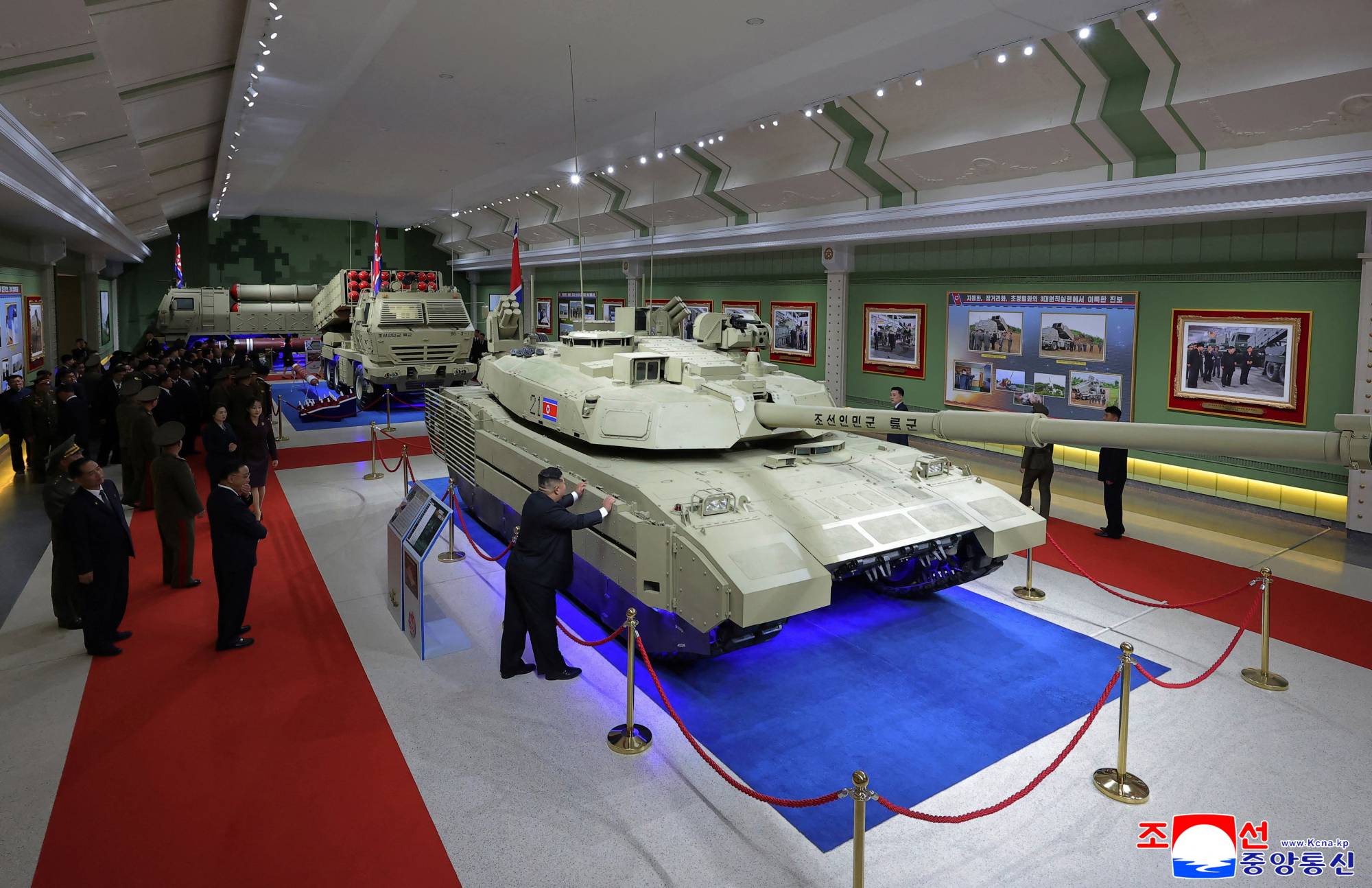
North Korean leader Kim Jong Un, his wife Ri Sol Ju and his daughter Kim Ju Ae attend the opening ceremony of the National Defense Revolution Museum of the Second Economic Committee, North Korea, October 11, 2026, in this picture released by North Korea's official Korean Central News Agency. KCNA/via REUTERS

"The exhibition appears intended to highlight the achievements of Kim's defense science development program," Reuters quoted Shin as saying. "It gave the impression of propaganda aimed at gaining a strategic advantage ahead of potential a North Korea-US summit."

Analysts said the museum also reflected a broader effort by Kim to elevate North Korea's weapons displays into lasting symbols of the regime's military accomplishments.

"By turning what were once temporary weapons exhibitions into a permanent ⁠museum, Kim ⁠is institutionalizing his military achievements and portraying North Korea's nuclear and missile buildup as a completed and enduring legacy," said Lim Eul-chul, a professor at Kyungnam University's Institute for Far Eastern Studies.

Separately, North Korea said it test-fired a tactical ballistic missile on Monday to confirm the successful technical upgrade of an unspecified key component.

KCNA said the upgrade marked an important step in improving the performance of all offensive weapons systems, without providing further details.

South Korea's military said on Monday that North Korea had fired multiple ballistic missiles towards the sea off its east coast. The launch was Pyongyang's fourth in a month, following Seoul's recent test of a hypersonic missile.


Iranians Have Left Doha Talks, Draft Proposal for US Deal Being Circulated, Official Says

An Iranian woman holds Iran's national flag on a street in Tehran on November 1, 2026. (AFP)
TT

Iranians Have Left Doha Talks, Draft Proposal for US Deal Being Circulated, Official Says

An Iranian woman holds Iran's national flag on a street in Tehran on November 1, 2026. (AFP)

Iranian negotiators have left talks with Qatari mediators aimed at ending the war with the United States, and a draft proposal is being circulated with a follow-up meeting possible, an official briefed on the talks said on Monday.

The negotiators departed on Sunday, though not because of difficulties in the negotiations, the official said, without providing further details on the draft proposal.

Iran's foreign ministry spokesperson said the basis of the talks is a seven-step plan ‌Iran drew up ‌in September to reopen the Strait of ‌Hormuz ⁠and end the ⁠US naval blockade on Iran, with Tehran now suggesting that proposal could be implemented on a faster timeline under a deal.

The spokesperson, Esmaeil Baghaei, said deputy Foreign Minister Kazem Gharibabadi had been in Doha to facilitate the exchange of messages with Washington via Qatari intermediaries.

"Our demands have been ⁠articulated very clearly and transparently. These demands are ‌reasonable and logical: no final ‌agreement can be initiated, nor can the Strait of Hormuz be ‌reopened or secured, unless the US naval blockade ‌is brought to an end, Iran's demands are respected, and Iran’s legitimate requirements are addressed,” Baghaei said.

On Saturday, Qatari broadcaster Al Jazeera quoted Iran's Foreign Minister Abbas Araghchi as saying that under ‌a deal the Strait of Hormuz could be opened within a two-day timeline rather than within ⁠the seven ⁠days originally envisaged.

Iran's initial proposal was rejected by US President Donald Trump.

The latest round of diplomacy comes amid concerns that the conflict could escalate again after Tuesday's midterm elections in the United States. Asked about Tehran's view on the midterms, Baghaei said Tehran did not expect elections to "give birth to a new US."

Trump has said the United States would not launch new attacks on Iran before the vote and that talks with Tehran have been productive, though he has not ruled out further military action.


Iran Says Considering Two-day Plan to Reopen Hormuz

Image published by the Iranian government's media website showing Foreign Ministry Spokesperson Esmaeil Baqaei during a press conference
TT

Iran Says Considering Two-day Plan to Reopen Hormuz

Image published by the Iranian government's media website showing Foreign Ministry Spokesperson Esmaeil Baqaei during a press conference

Iran's foreign ministry on Monday said it was considering a two-day plan to reopen the Strait of Hormuz if the US agrees to its conditions, having previously proposed a one-week timeline, AFP said.

"The possibility of implementing this plan in two days is another indication of Iran's good-faith approach. We have stated that, if Iran's demands are met, it would be possible to restore security to the Strait of Hormuz and resume the negotiating process within a short period," said foreign ministry spokesman Esmaeil Baqaei, adding that the "exchange of messages is still ongoing" via mediators.


China's Xi Says Middle East Should Not Become Battleground for Great Power Rivalry

Chinese President Xi Jinping attends a signing ceremony with Oman's Sultan Haitham bin Tariq (not pictured) during the Sultan's state visit to China, at the Great Hall of the People, in Beijing, China, 02 November 2026.  EPA/TINGSHU WANG / POOL
Chinese President Xi Jinping attends a signing ceremony with Oman's Sultan Haitham bin Tariq (not pictured) during the Sultan's state visit to China, at the Great Hall of the People, in Beijing, China, 02 November 2026. EPA/TINGSHU WANG / POOL
TT

China's Xi Says Middle East Should Not Become Battleground for Great Power Rivalry

Chinese President Xi Jinping attends a signing ceremony with Oman's Sultan Haitham bin Tariq (not pictured) during the Sultan's state visit to China, at the Great Hall of the People, in Beijing, China, 02 November 2026.  EPA/TINGSHU WANG / POOL
Chinese President Xi Jinping attends a signing ceremony with Oman's Sultan Haitham bin Tariq (not pictured) during the Sultan's state visit to China, at the Great Hall of the People, in Beijing, China, 02 November 2026. EPA/TINGSHU WANG / POOL

The Middle East and Gulf region should not become a battleground for great-power rivalry and China is willing to work with Arab nations to achieve lasting peace, Chinese President Xi Jinping told Oman's sultan on Monday.

China has traditionally played a low-key diplomatic role in the Middle East, but has stepped up efforts to try to help end tensions amid the US-Israeli war on Iran, which has snarled the Strait of Hormuz and driven up global energy and shipping costs.

Xi told Omani Sultan ‌Haitham bin Tariq ‌al-Said that the world is undergoing profound changes.

"The Middle ‌East ⁠Gulf region should ⁠not become an arena for great-power rivalry and geopolitical conflict. Peace and stability in the region require joint nurturing and protection by all parties," Xi said, according to China's Foreign Ministry.

China has consistently been committed to stopping the war, and hopes to contribute "wisdom and solutions to resolving the region's security dilemmas," he added.

China is willing to strengthen communication and coordination with Arab countries, including the Gulf Cooperation Council states, to work together ⁠toward restoring peace and achieving lasting stability and security, Xi ‌said.

China's Foreign Ministry said later on Monday that ‌Zhai Jun, its special envoy to the Middle East, would visit Iran, Oman and Saudi ‌Arabia this month.

FIRST CHINA TRIP

Haitham arrived in Beijing on Sunday for a ‌two-day visit, the first by an Omani head of state since the countries established ties in 1978.

Haitham told Xi his government had deep appreciation for China's positions on key issues concerning the region, Omani state media reported.

"We believe that development and stability are inextricably linked," he said.

"The ‌prosperity of nations requires an environment defined by security, peace, respect for state sovereignty, and adherence to international law — an ⁠environment where disputes ⁠are resolved through peaceful means."

He also said Oman was open to entering into a preferential bilateral trade and investment agreement with China.

"We are confident that such an agreement would open new avenues for trade and investment, facilitate and enhance commercial and investment exchanges between our two nations," Haitham said.

China is Oman's largest trade partner, with tourism and business links boosted by direct flights between Beijing and Muscat since November last year.

Oman, which exports crude oil and energy products to China, has also been looking to further develop its renewable energy supply chains and digital commerce.

The Omani leader, who was welcomed on the tarmac in Beijing by People's Bank of China Governor Pan Gongsheng, also emphasized cooperation between investment and financial institutions.