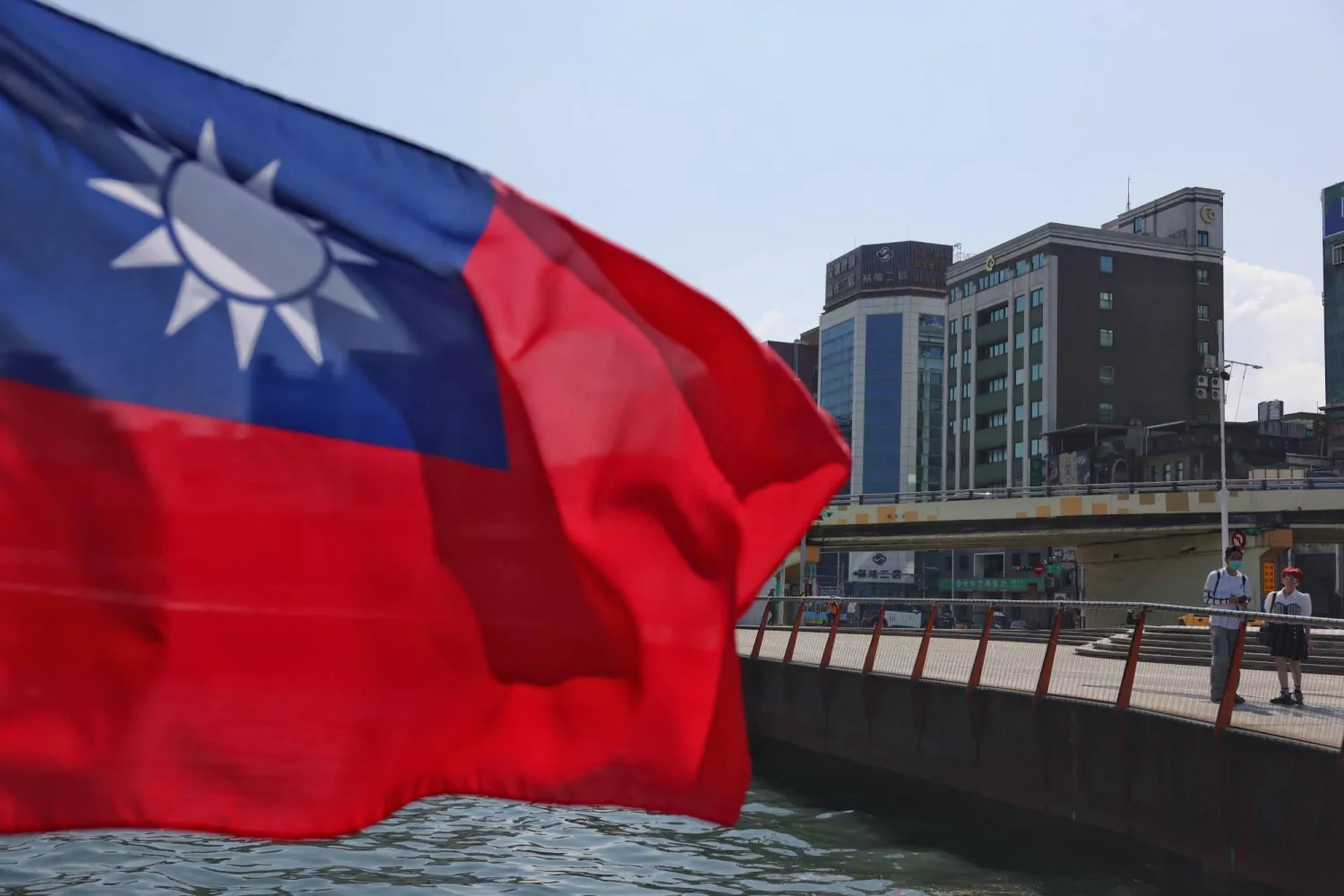
China Sanctions Officials in Paraguay and Belize over Their Countries' Ties with Taiwan

A Taiwanese flag is seen in Keelung on October 12, 2026. (Photo by I-Hwa Cheng / AFP)
TT

China Sanctions Officials in Paraguay and Belize over Their Countries' Ties with Taiwan

A Taiwanese flag is seen in Keelung on October 12, 2026. (Photo by I-Hwa Cheng / AFP)

China sanctioned Paraguay’s communications minister and Belize’s foreign minister on Monday over ties with Taiwan, the island democracy Beijing claims as its own.

The sanctions against Gustavo Villate of Paraguay and Francis Fonseca of Belize serve to safeguard China’s “national sovereignty, security, and development interests, and to oppose separatist acts seeking ‘Taiwan independence,’” the Chinese Foreign Ministry said on its website.

“Certain politicians in Paraguay and Belize have willingly served as pawns of the Taiwan authorities in their attempts to seek Taiwan independence by soliciting external forces,” said Foreign Ministry spokesperson Mao Ning.

She added that the foreign officials had visited Taiwan and received visits by “Taiwan independence separatists,” as well as “spread disinformation about Chinese cyberattacks to smear and attack China, creating a seriously negative international impact.”

Paraguay and Belize are among the last 12 remaining diplomatic allies of Taiwan, an island democracy China sees as its own territory, to be annexed by force if necessary.

In recent years, Beijing has increased its military pressure on the island, sending warplanes and military ships near it almost daily. It has also ramped up a campaign of winning over its diplomatic partners. Countries including Nauru, Honduras and Nicaragua have switched allegiances from Taiwan to Beijing in recent years.

Taipei’s remaining diplomatic allies are mostly smaller countries in Central America, the Caribbean and South Pacific, along with Eswatini in southern Africa and Vatican City.

The sanctions against Villate and Fonseca are mostly symbolic, as officials from countries that have ties with Taiwan do not generally travel to China. The curbs include freezing any assets the officials might have in China; denial of visas and entry into China; prohibiting any Chinese individuals and organizations from cooperating with them.

The governments of Belize and Paraguay did not immediately react to the sanctions.

In July, Paraguay and the US Embassy in its capital, Asunción, said cybersecurity attacks linked to the Chinese government had compromised Paraguay's state systems. China vehemently denied the accusations.

The US State Department condemned China's sanctions on Tuesday.

“The Trump Administration opposes coercion and aggression by China against countries in our hemisphere for exercising their sovereign rights,” department spokesperson Tommy Pigott said.

Taiwanese Premier Cho Jung-tai on Tuesday told reporters that the island democracy is a sovereign country and that China has no right to interfere in its internal affairs or influence its foreign relations.

He said Taiwan would continue working with its allies and other democracies to uphold freedom and democracy, maintain regional peace and security, and resist “any expansion of hegemonic or authoritarian forces.”

China and Taiwan have been governed separately since 1949, when a civil war brought the Communist Party to power in Beijing. Defeated Nationalist Party forces fled to Taiwan. The island has operated with its own government since then.

Taiwan’s Deputy Foreign Minister Chen Ming-chi also criticized China’s moves, noting that Taiwan’s international visibility is growing.

“Are they going to sanction the entire world?” he said.


Iranians Have Left Doha Talks, Draft Proposal for US Deal Being Circulated, Official Says

An Iranian woman holds Iran's national flag on a street in Tehran on November 1, 2026. (AFP)
TT

Iranians Have Left Doha Talks, Draft Proposal for US Deal Being Circulated, Official Says

An Iranian woman holds Iran's national flag on a street in Tehran on November 1, 2026. (AFP)

Iranian negotiators have left talks with Qatari mediators aimed at ending the war with the United States, and a draft proposal is being circulated with a follow-up meeting possible, an official briefed on the talks said on Monday.

The negotiators departed on Sunday, though not because of difficulties in the negotiations, the official said, without providing further details on the draft proposal.

Iran's foreign ministry spokesperson said the basis of the talks is a seven-step plan ‌Iran drew up ‌in September to reopen the Strait of ‌Hormuz ⁠and end the ⁠US naval blockade on Iran, with Tehran now suggesting that proposal could be implemented on a faster timeline under a deal.

The spokesperson, Esmaeil Baghaei, said deputy Foreign Minister Kazem Gharibabadi had been in Doha to facilitate the exchange of messages with Washington via Qatari intermediaries.

"Our demands have been ⁠articulated very clearly and transparently. These demands are ‌reasonable and logical: no final ‌agreement can be initiated, nor can the Strait of Hormuz be ‌reopened or secured, unless the US naval blockade ‌is brought to an end, Iran's demands are respected, and Iran’s legitimate requirements are addressed,” Baghaei said.

On Saturday, Qatari broadcaster Al Jazeera quoted Iran's Foreign Minister Abbas Araghchi as saying that under ‌a deal the Strait of Hormuz could be opened within a two-day timeline rather than within ⁠the seven ⁠days originally envisaged.

Iran's initial proposal was rejected by US President Donald Trump.

The latest round of diplomacy comes amid concerns that the conflict could escalate again after Tuesday's midterm elections in the United States. Asked about Tehran's view on the midterms, Baghaei said Tehran did not expect elections to "give birth to a new US."

Trump has said the United States would not launch new attacks on Iran before the vote and that talks with Tehran have been productive, though he has not ruled out further military action.


Iran Says Considering Two-day Plan to Reopen Hormuz

Image published by the Iranian government's media website showing Foreign Ministry Spokesperson Esmaeil Baqaei during a press conference
TT

Iran Says Considering Two-day Plan to Reopen Hormuz

Image published by the Iranian government's media website showing Foreign Ministry Spokesperson Esmaeil Baqaei during a press conference

Iran's foreign ministry on Monday said it was considering a two-day plan to reopen the Strait of Hormuz if the US agrees to its conditions, having previously proposed a one-week timeline, AFP said.

"The possibility of implementing this plan in two days is another indication of Iran's good-faith approach. We have stated that, if Iran's demands are met, it would be possible to restore security to the Strait of Hormuz and resume the negotiating process within a short period," said foreign ministry spokesman Esmaeil Baqaei, adding that the "exchange of messages is still ongoing" via mediators.


China's Xi Says Middle East Should Not Become Battleground for Great Power Rivalry

Chinese President Xi Jinping attends a signing ceremony with Oman's Sultan Haitham bin Tariq (not pictured) during the Sultan's state visit to China, at the Great Hall of the People, in Beijing, China, 02 November 2026.  EPA/TINGSHU WANG / POOL
Chinese President Xi Jinping attends a signing ceremony with Oman's Sultan Haitham bin Tariq (not pictured) during the Sultan's state visit to China, at the Great Hall of the People, in Beijing, China, 02 November 2026. EPA/TINGSHU WANG / POOL
TT

China's Xi Says Middle East Should Not Become Battleground for Great Power Rivalry

Chinese President Xi Jinping attends a signing ceremony with Oman's Sultan Haitham bin Tariq (not pictured) during the Sultan's state visit to China, at the Great Hall of the People, in Beijing, China, 02 November 2026.  EPA/TINGSHU WANG / POOL
Chinese President Xi Jinping attends a signing ceremony with Oman's Sultan Haitham bin Tariq (not pictured) during the Sultan's state visit to China, at the Great Hall of the People, in Beijing, China, 02 November 2026. EPA/TINGSHU WANG / POOL

The Middle East and Gulf region should not become a battleground for great-power rivalry and China is willing to work with Arab nations to achieve lasting peace, Chinese President Xi Jinping told Oman's sultan on Monday.

China has traditionally played a low-key diplomatic role in the Middle East, but has stepped up efforts to try to help end tensions amid the US-Israeli war on Iran, which has snarled the Strait of Hormuz and driven up global energy and shipping costs.

Xi told Omani Sultan ‌Haitham bin Tariq ‌al-Said that the world is undergoing profound changes.

"The Middle ‌East ⁠Gulf region should ⁠not become an arena for great-power rivalry and geopolitical conflict. Peace and stability in the region require joint nurturing and protection by all parties," Xi said, according to China's Foreign Ministry.

China has consistently been committed to stopping the war, and hopes to contribute "wisdom and solutions to resolving the region's security dilemmas," he added.

China is willing to strengthen communication and coordination with Arab countries, including the Gulf Cooperation Council states, to work together ⁠toward restoring peace and achieving lasting stability and security, Xi ‌said.

China's Foreign Ministry said later on Monday that ‌Zhai Jun, its special envoy to the Middle East, would visit Iran, Oman and Saudi ‌Arabia this month.

FIRST CHINA TRIP

Haitham arrived in Beijing on Sunday for a ‌two-day visit, the first by an Omani head of state since the countries established ties in 1978.

Haitham told Xi his government had deep appreciation for China's positions on key issues concerning the region, Omani state media reported.

"We believe that development and stability are inextricably linked," he said.

"The ‌prosperity of nations requires an environment defined by security, peace, respect for state sovereignty, and adherence to international law — an ⁠environment where disputes ⁠are resolved through peaceful means."

He also said Oman was open to entering into a preferential bilateral trade and investment agreement with China.

"We are confident that such an agreement would open new avenues for trade and investment, facilitate and enhance commercial and investment exchanges between our two nations," Haitham said.

China is Oman's largest trade partner, with tourism and business links boosted by direct flights between Beijing and Muscat since November last year.

Oman, which exports crude oil and energy products to China, has also been looking to further develop its renewable energy supply chains and digital commerce.

The Omani leader, who was welcomed on the tarmac in Beijing by People's Bank of China Governor Pan Gongsheng, also emphasized cooperation between investment and financial institutions.