Damaged and Drained, Indonesia's Peatlands Go Up in Smoke

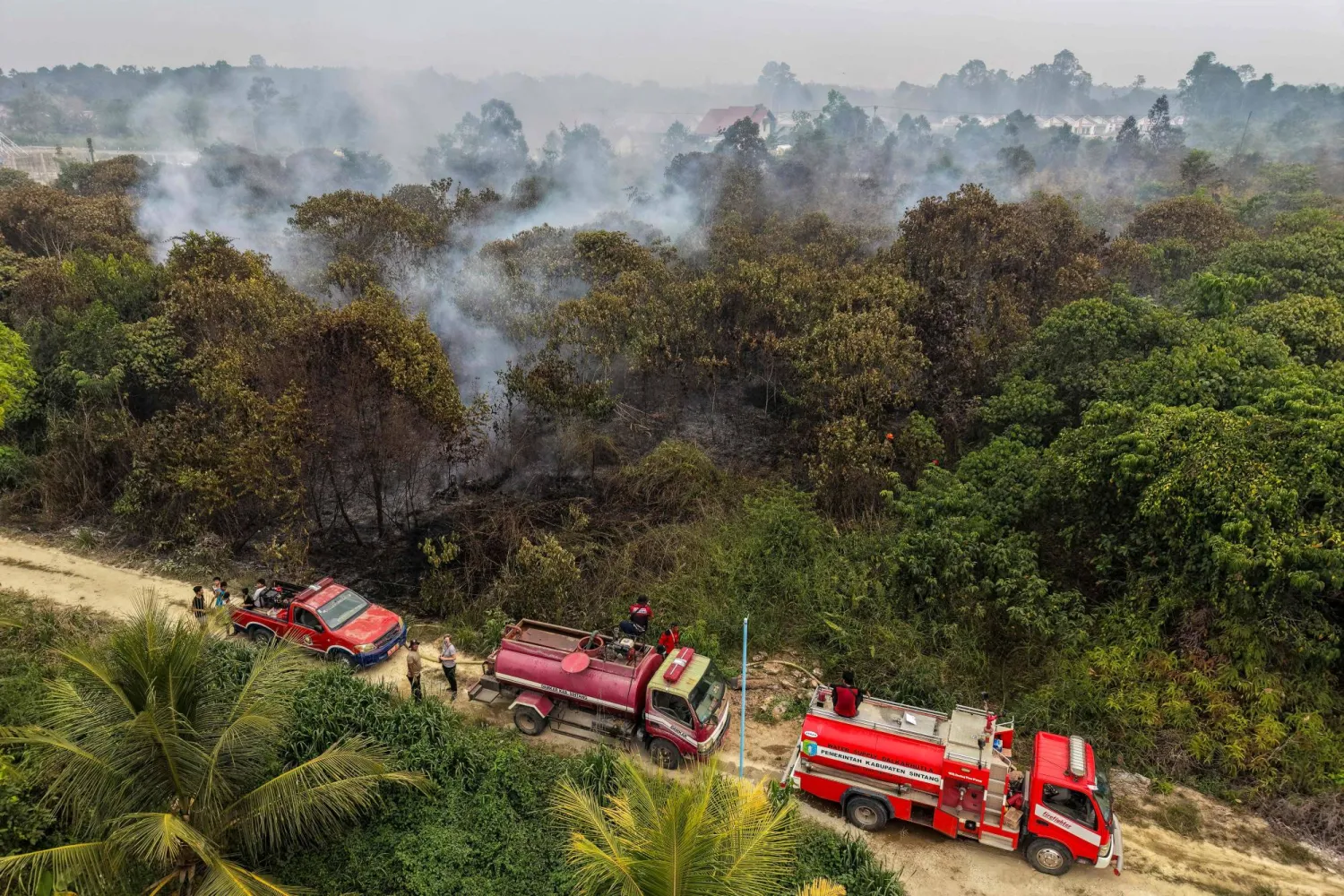
(FILES) This aerial picture shows fire fighters battling peatland fires in Sintang, West Kalimantan on September 5, 2026. (Photo by BAY ISMOYO / AFP)
TT

Damaged and Drained, Indonesia's Peatlands Go Up in Smoke

(FILES) This aerial picture shows fire fighters battling peatland fires in Sintang, West Kalimantan on September 5, 2026. (Photo by BAY ISMOYO / AFP)

For weeks on end, parts of Indonesian Borneo have resembled an Armageddon landscape with masked residents immersed in a putrid, red-brown haze as wildfires devour peatlands near homes and farms.

Burning slowly, mostly under the surface and sometimes for months on end, peatland fires are responsible for much of the dry season haze that this year has tainted air as far afield as Malaysia, Singapore and the Philippines.

- What are peatlands? –

Peatlands are composed of organic material that does not completely decompose in water-logged conditions and has settled over thousands of years into a layered soil-like substance.

Healthy peatlands are home to diverse plants and trees like nutmeg and durian, and animals that can include endangered orangutans, clouded leopards, Sumatran tigers, sun bears and tapirs.

They are porous and absorbent, making them critical for flood containment.

While they cover only about three percent of global land, peatlands store about a third of the world's soil carbon -- double that trapped by forests.

Indonesia has the world's biggest share of tropical peatland, about a third of the global total.

- Why are they burning? –

Of Indonesia's estimated 24.2 million hectares (93,400 square miles) of peatland, 16.4 million hectares have been degraded and are vulnerable to fire, according to the Pantau Gambut NGO.

The culprit is mainly industrial-scale plantations for timber, pulp and paper, rice paddies and palm oil, of which Indonesia is the world's biggest producer by far.

To cultivate peatlands, they are drained with canal networks that in Indonesia span about 285,000 kilometers (177,000 miles), according to Pantau Gambut research -- seven times the circumference of Earth.

The water runs into rivers or the sea, leaving the dried-out peatlands vulnerable to burning, especially in strong El Nino years that can bring severe drought to Indonesia.

Peatland fires are often imperceptible but for the foul smoke they emit and the heat they generate underfoot, AFP reported.

The many layers of thick carbon can keep smoldering in "zombie fires" for weeks, and are hard to put out.

- What are the impacts? -

While less than a third of wildfires in Indonesia are on peatlands, they produce most of the haze, according to Greenpeace research.

This toxic smog contains harmful elements including formaldehyde, hydrogen cyanide and ammonia, as well as PM2.5 particles small enough to penetrate the lungs or bloodstream.

The World Health Organization has linked PM2.5 exposure to increased illness and death.

Indonesia and Malaysia have shut hundreds of schools over haze, and more than 170,000 people in Indonesia required treatment for acute respiratory infections in August and September, according to the health ministry.

Many more fell ill in Malaysia and Singapore.

Peatland fires also ravage the habitats of animals, further imperiling already endangered species such as orangutans and Sumatran rhinos.

- What about greenhouse gases? -

By October 6, Indonesian wildfires had emitted 140.5 megatons of planet-warming carbon, around 13 percent of the global total this year, according to the Copernicus Atmosphere Monitoring Service.

That was the highest figure for Indonesia fire emissions since 2019, another strong El Nino year.

Indonesia emits significant greenhouse gases from its coal-powered electricity grid, and is seeking to reduce its emissions in part by relying on forests, peatlands and other land ecosystems to absorb more than they emit.

- What is being done? -

Activists and experts say concession licenses for extractive activities on peatlands must be revoked, and peatlands should be rewetted and planted with native species.

Canals should be blocked, they say.

Indonesia has a moratorium in place on new permits to clear 66 million hectares of land designated as primary forest and peatland.

In a statement last year, the government said it had rewetted 4.16 million hectares of peatland, built 45,000 canal barriers and replanted various native species.

But there are doubts about some of that work.

"Today, some of the peat hydrological units that have received major restoration efforts... have experienced fires and have some of the highest hotspot counts," Greenpeace forest campaigner Belgis Habiba told AFP.

Last month, the government announced the creation of a new National Peatland and Mangrove Management agency to replace a body whose mandate expired in 2024.

The agency's remit and resources are still being worked out, but there are concerns its name mentions neither restoration nor protection.

"Does managing in this context serve as a pretext for the state to grant new concessions on peatlands?" asked Belgis.

The forestry ministry did not reply to AFP's request for input.


South Korea Education Chief Resigns Amid AI Cheating Scandal

South Korean Prime Minister Han Seongsook addresses the nation, announcing a series of measures to prevent cheating using AI in the nationwide college entrance exam, during a televised briefing at the Government Complex in Seoul, South Korea, Tuesday, Nov. 17, 2026. (Ahn Jung-won/Yonhap via AP)
TT

South Korea Education Chief Resigns Amid AI Cheating Scandal

South Korean Prime Minister Han Seongsook addresses the nation, announcing a series of measures to prevent cheating using AI in the nationwide college entrance exam, during a televised briefing at the Government Complex in Seoul, South Korea, Tuesday, Nov. 17, 2026. (Ahn Jung-won/Yonhap via AP)

South Korea's education minister resigned Sunday over an AI-assisted cheating scandal that erupted ahead of the country's key college entrance exams last week.

The country has been gripped by fears of AI-assisted exam cheating since last Sunday, when the top scorer in a national tax accountant exam confessed to using a miniature camera and smartphone to achieve a near-perfect score, just four days before the crucial college entrance exam known as the Suneung.

The annual nine-hour Suneung is widely seen as a ticket to prestigious universities, well-paid jobs and even better marriage prospects in the highly competitive country.

The confession sent officials scrambling to roll out a slew of preventive measures -- including blocking public Wi-Fi in testing areas and placing stickers over clothing buttons -- but Education Minister Choi Kyo-jin struggled to reassure the public, particularly after remarks he made three days before the exam.

"The exam concluded without any major incidents... However, as the minister in charge, I do not believe I am immune from public criticism that we failed to prepare adequately in advance," Choi wrote on X.

"Now that the exam is over, I take full responsibility and hereby offer my resignation," he added.

President Lee Jae Myung has accepted his resignation, the presidential office said.

Asked during a parliamentary hearing on Monday whether he was confident that authorities could catch would-be cheaters on exam day, the 72-year-old replied: "Due to my age, I am not confident I could."

His response quickly drew public backlash.

Choi did not appear at press conferences in the days leading up to Thursday's exam, where a vice minister instead announced the preventive measures.

Officials said 111 cases of misconduct involving electronic devices were identified during Thursday's exam, nearly half of which were detected through three emergency alerts sent by the government to identify smartphones that test takers had failed to hand over.


Japan-Europe Joint Probe Enters Mercury’s Orbit

This composite image provided by NASA/Johns Hopkins University Applied Physics Laboratory/Carnegie Institution of Washington on Oct. 22, 2013, shows Mercury as it appeared to the Messenger spacecraft following a flyby of the planet. (NASA/Johns Hopkins University Applied Physics Laboratory/Carnegie Institution of Washington via AP, File)
TT

Japan-Europe Joint Probe Enters Mercury’s Orbit

This composite image provided by NASA/Johns Hopkins University Applied Physics Laboratory/Carnegie Institution of Washington on Oct. 22, 2013, shows Mercury as it appeared to the Messenger spacecraft following a flyby of the planet. (NASA/Johns Hopkins University Applied Physics Laboratory/Carnegie Institution of Washington via AP, File)

After an eight-year-long trek through outer space, the Japanese-European joint BepiColombo probe has entered Mercury's orbit, the European Space Agency (ESA) said on Sunday.

On X, the ESA said that BepiColombo "achieved orbital capture" around the smallest and least understood planet in the Solar System after turning on the thrusters for more than half an hour.

The probe was already analyzing the data it had collected, the agency added.

Launched in 2018, the four-ton satellite had already crossed more than 10 billion kilometers and nine other planets en route to the closest planet to our Sun.

Earlier this year, ESA mission chief Santa Martinez told AFP that the mission was set to "offer humanity never-before-seen views of Mercury and open a new chapter in our understanding of the Solar System".

The European and Japanese portions of the probe are set to split from each other and go along their respective orbits on December 9 and 10, according to the mission plan.

The European portion is set to study the planet's surface, skimming just 480 kilometers (300 miles) above Mercury.

The Japanese part, meanwhile, will follow an elliptical orbit that will take it as far as 11,000 kilometers from the planet in a bid to learn more about Mercury's magnetic field.

Swinging between temperatures hitting as low as -180C and as high as 450C, Mercury is frequently bombarded by intense radiation from our Sun.

In 1974, NASA's Mariner 10 probe became the first to fly past the planet.


Scientists Report Strong New Evidence that Specially Bred Mosquitoes Can Fend Off Dengue

FILE - A mosquito feeds on a technician at the Salt Lake City Mosquito Abatement District on July 26, 2023, in Salt Lake City. (AP Photo/Rick Bowmer, File)
TT

Scientists Report Strong New Evidence that Specially Bred Mosquitoes Can Fend Off Dengue

FILE - A mosquito feeds on a technician at the Salt Lake City Mosquito Abatement District on July 26, 2023, in Salt Lake City. (AP Photo/Rick Bowmer, File)

Children who lived in Brazilian neighborhoods buzzing with a special kind of mosquito were far less likely to catch dengue or another worrisome virus, chikungunya, researchers reported Saturday.

The major study of more than 5,700 children in one of the world’s dengue hot spots offers new evidence that breeding mosquitoes unable to transmit these viruses can be a viable strategy rather than solely relying on pesticides and trying to avoid getting bitten.

In neighborhoods populated by these so-called Wolbachia-carrying mosquitoes, researchers found about a 69% reduction in dengue and chikungunya infections in schoolchildren compared to similar neighborhoods — an effect sustained even during Brazil’s severe 2024 dengue outbreak, said Dr. Sri Edupuganti of Emory University, part of the international research team.

According to The Associated Press, the researchers reported the findings at a meeting of the American Society of Tropical Medicine and Hygiene.

“This is really exciting,” said Dr. David Hamer, a global health expert at Boston University who wasn’t involved with the Brazilian study. He predicts that pairing more use of these Wolbachia mosquitoes with existing steps to fight mosquito-borne disease could “knock dengue down to much lower levels” in many places.

The latest research comes as Florida grapples with an unusually large outbreak of the virus, what appears to be the biggest in any US state since at least the 1940s.

Usually in the continental US, dengue is found mostly in people who traveled internationally. But as of Friday, Florida health officials had tallied more than 650 locally acquired cases, about three-quarters of them in Hillsborough County, home to Tampa.

Outside the US, the nonprofit World Mosquito Program has pioneered the Wolbachia strategy.

How it works: Scientists breed mosquitoes to carry a kind of bacteria called Wolbachia. It is harmless to people and common in many insects, although not dengue-carrying Aedes aegypti mosquitoes.

The bacteria dramatically reduce the mosquitoes’ ability to transmit certain viruses. Female mosquitoes spread the bacteria to their offspring, so releasing enough of the specially bred insects — males and females — into an area allows Wolbachia to gradually become established in the local mosquito population.

Field trials and other studies in Indonesia and elsewhere have shown the strategy can significantly lower dengue diagnoses. But because people with mild symptoms may not be diagnosed, the new study in Belo Horizonte, Brazil, went further. Researchers tested blood for signs of dengue, chikungunya or the Zika virus.

The four-year study compared children living in neighborhoods that all got the same pesticide and other mosquito-control interventions, but half were randomly assigned to have Wolbachia mosquitoes released into the area.

There were too few cases of Zika to calculate if the special mosquitoes had any effect on that disease.