Study: Global Deforestation Slowed in 2025 but Surged in Congo Basin

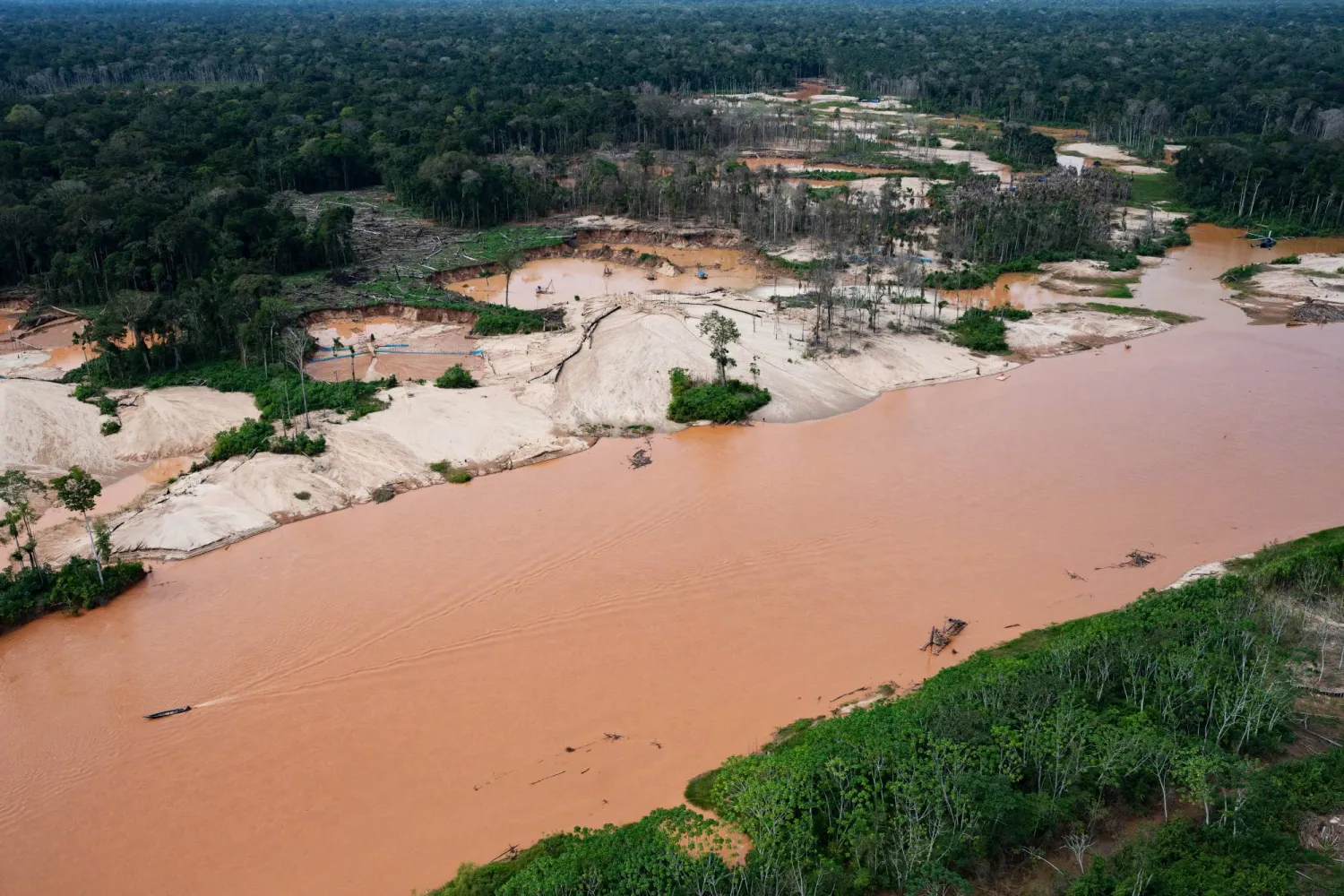
Deforestation from illegal mining borders the Malinowski River in the Tambopata National Reserve in Puerto Maldonado, Peru, Tuesday, Aug. 11, 2026. (AP Photo/Guadalupe Pardo)
TT

Study: Global Deforestation Slowed in 2025 but Surged in Congo Basin

Deforestation from illegal mining borders the Malinowski River in the Tambopata National Reserve in Puerto Maldonado, Peru, Tuesday, Aug. 11, 2026. (AP Photo/Guadalupe Pardo)

Deforestation slowed worldwide last year, but the improvement is unlikely to last as the situation deteriorates in Central Africa and an exceptionally strong El Nino weather pattern intensifies, a new study said on Wednesday.

Seven million hectares of forest -- roughly the size of the Republic of Ireland -- were permanently destroyed in 2025, a 15-percent drop from the previous year, according to the annual Forest Declaration Assessment.

The slowdown, however, is not enough to keep the world from missing a pledge to end deforestation by 2030, according to the report, which was drafted by a coalition of research groups and non-governmental organizations.

The 2025 figure is "encouraging but so far it's the exception, not a new trajectory", Erin Matson, the study's co-author and lead consultant at advisory group Climate Focus, said in a media briefing.

To meet the target, agreed at the United Nations' COP26 climate talks in 2021, deforestation would have to fall by around one million hectares per year.

Clearing forests for agriculture or mining operations remains the leading drivers of deforestation.

Last year's improvement was due in part to progress in Latin America, with a 33-percent drop in what has historically been the world's deforestation "hot spot", according to the study.

The authors pointed particularly to Brazil's deforestation action plan and increased enforcement in the country's Amazon, AFP reported.

Progress in the region, however, "rests heavily on the choices of a small number of governments and remains highly vulnerable" to recent and upcoming elections across the Amazon basin.

Brazil's left-wing leader, Luiz Inacio Lula da Silva -- who has vowed to end illegal deforestation by 2030 -- faces populist right Senator Flavio Bolsonaro in a runoff presidential election on October 25.

Deforestation had surged under the administration of Bolsonaro's father, far-right former president Jair Bolsonaro.
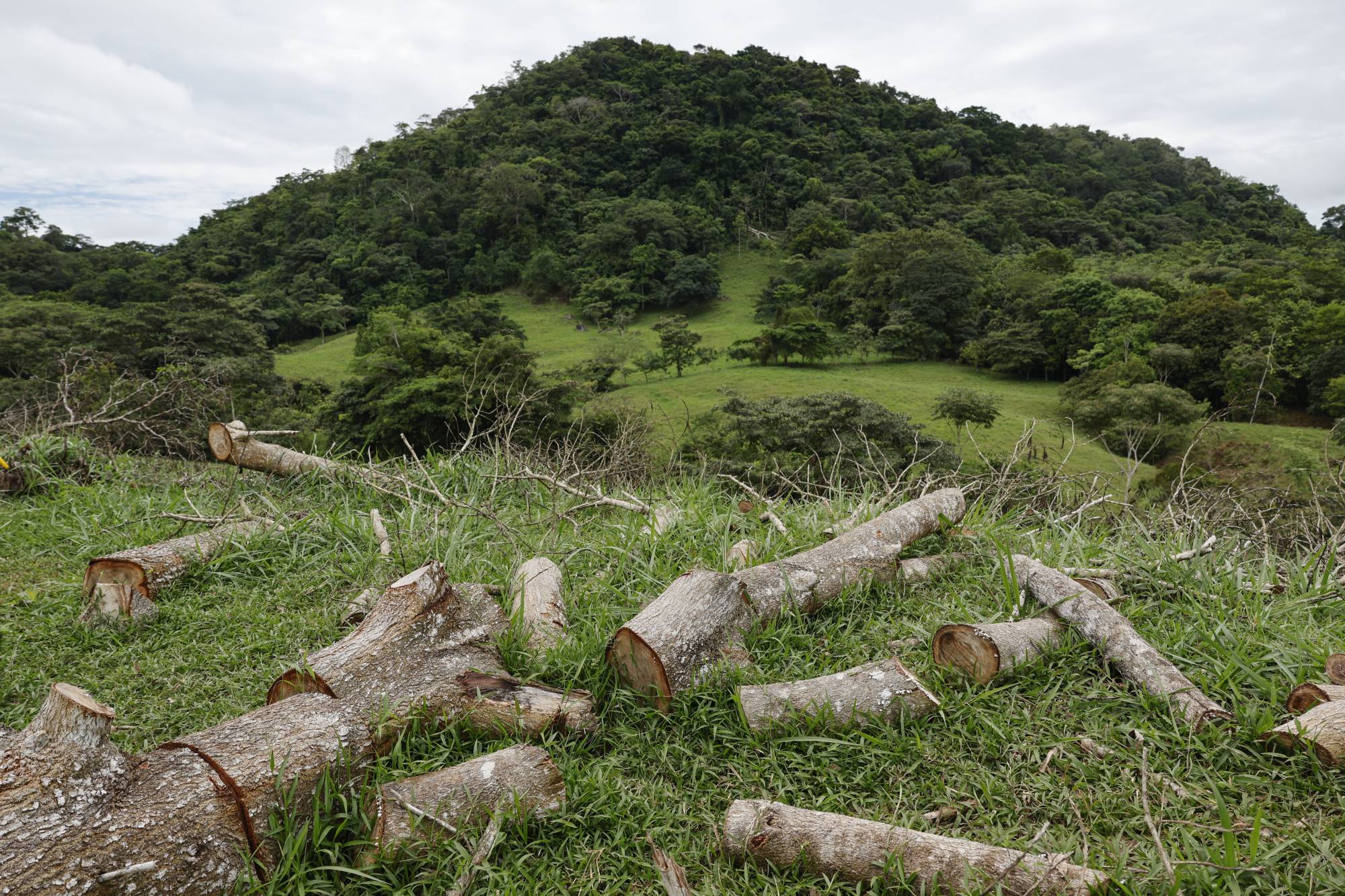
Trunks of a tree in Capira, Panama, 06 October 2026. EPA/Bienvenido Velasco

Progress could also be threatened in Colombia and Peru, where hard-right presidents were recently elected, according to the experts.

Across the Atlantic in Africa, the situation deteriorated in the Congo basin, where rainforest loss reached 2.4 million hectares -- near the same level of deforestation as the Amazon for the first time.

"Losing such a size of forest every year is a disaster," said Sam Nguiffo, a lawyer and founder of the Centre for Environment and Development in Cameroon.

"As humanity, we clearly cannot afford that because it will be totally irreversible," he said.

Logging for timber or felling trees for agriculture or mining appear to prevail in forest management in Central Africa, Nguiffo said.

Deforestation has a "massive impact on the cultural identity and on the livelihood of local and indigenous communities", he said.

"The erosion of the forest, both in size and in number of species, reduces the space available for communities and fuels conflicts," the lawyer added.

El Nino, the warming phase of a natural climate cycle, also threatens progress because its effects include droughts, creating conditions for wildfires.

The current El Nino event, which emerged in June, is expected to peak later this year but is already shaping up to be the strongest ever observed.

El Nino has been associated with strong drought in Indonesia, where tracts of forest and plantations have been burning in biodiverse Borneo and South Sumatra for months.

"If projections of the historically strong 2026-27 El Nino materialize, drought and fire risks will intensify further across tropical forest regions," the deforestation report said.

Matson, of Climate Focus, noted that there was a "huge spike" in tree cover loss during the last "super" El Nino event in 2015-2016.

"We can't fully predict the future but it's unlikely, I would say, that in 2026 we'll see the same kind of reductions (in deforestation) that we saw last year," she said.


Lahore, Delhi Choke as Air Pollution Spikes in Parts of South Asia

Pedestrians walk amid smog at the Kartavya Path near India gate in New Delhi on November 3, 2026. (AFP)
TT

Lahore, Delhi Choke as Air Pollution Spikes in Parts of South Asia

Pedestrians walk amid smog at the Kartavya Path near India gate in New Delhi on November 3, 2026. (AFP)

Air quality deteriorated sharply in parts of northern India and adjoining Pakistan on Tuesday, with the onset of pre-winter smog making Lahore the world's most polluted city and authorities in Delhi imposing curbs to fight the toxic haze over the capital.

Air pollution becomes a severe problem for the region around this time of the year when cold, dense air traps ‌emissions from vehicles, ‌construction sites and crop waste burning, pushing pollution levels ‌to ⁠the highest in ⁠the world and exposing residents to serious respiratory risks.

Early on Tuesday, the air quality index (AQI) in Lahore stood at 447, according to IQAir, a Swiss group that measures air quality levels based on the concentration of toxins. An ⁠AQI reading of up to 50 is considered good ‌with little or no health risk.

Lahore's PM2.5 ‌concentration was 60 times higher than the World Health Organization's annual PM2.5 ‌exposure guideline. PM2.5 refers to particulate matter measuring 2.5 microns or ‌less in diameter that can be carried into the lungs, risking deadly diseases and heart problems.

A significant drop in temperatures and sluggish winds have affected air quality in Lahore, authorities said.

Pakistan's government has intensified action against brick kilns ‌violating environmental regulations and continues to urge farmers not to burn crop residue after harvesting.

The AQI in ⁠Delhi was ⁠lower at 215, as per IQAir. India's Central Pollution Control Board rated the capital city's air quality "very poor" with a higher AQI reading of 332.

The Swiss and Indian readings vary due to the different AQI scales and methodologies used to calculate and classify air pollution levels.

Delhi's graded pollution control measures — including restrictions on polluting vehicles, construction activities, the use of coal and firewood in eateries, and boosting public transport services — took effect on Monday.

With Diwali over the weekend expected to add to the pollution, India's Supreme Court has allowed only low-polluting fireworks to be burst for three hours each on Saturday and Sunday.


South Korea Investigates Online Leak of President's Passport Details

South Korean President Lee Jae Myung delivers a budget speech for 2027 at the National Assembly in Seoul on November 2, 2026. Lee Jin-man / POOL/AFP
TT

South Korea Investigates Online Leak of President's Passport Details

South Korean President Lee Jae Myung delivers a budget speech for 2027 at the National Assembly in Seoul on November 2, 2026. Lee Jin-man / POOL/AFP

South Korea is investigating an online leak of passport details belonging to President Lee Jae Myung and more than 160 other officials, a government minister said on Tuesday.

Local media reported on Monday that a computer file containing personal details, including the passport numbers and dates of birth of the first couple and senior officials accompanying Lee on an overseas trip, had been uploaded to a website in June, AFP said.

The file was reportedly uploaded to VirusTotal, a malware-scanning platform, ahead of Lee's visit to Europe, and remained accessible for nearly five months.

It remains unclear who uploaded it and why.

The foreign ministry has since renewed the passports of all those affected, including Lee, and had the exposed information removed from the website, ministry spokesman Park Doo-soon said at a news briefing on Tuesday.

"The foreign ministry is now working with the National Police Agency and other agencies to determine how the information was leaked," he said.

Park said the ministry was treating the incident as a data leak rather than a hacking attack, and was examining computers and email accounts used to prepare the presidential trip.

The leak was a "serious matter that must not be taken lightly", Presidential Chief of Staff Lim Kwang-hyun told an emergency meeting on the breach, according to Lee's office.

The incident has raised "need for a thorough investigation into how the leak occurred, the extent of the information exposed and whether any actual harm had resulted", he said.


UN Reports Warn of Large-Scale Damage to Earth’s Ice from Climate Change

Melting of glaciers and sea ice, the thawing of permafrost and the accelerating rise in sea levels, will have widespread repercussions, from flooding to water shortages. (AFP)
TT

UN Reports Warn of Large-Scale Damage to Earth’s Ice from Climate Change

Melting of glaciers and sea ice, the thawing of permafrost and the accelerating rise in sea levels, will have widespread repercussions, from flooding to water shortages. (AFP)

Exceeding 1.5C of global warming will have "irreversible" consequences for glaciers, sea ice and the Earth's frozen regions, two UN reports warned on Monday, calling for urgent action.

The landmark 2015 Paris Agreement commits the world to limiting warming to well below 2C and pursuing efforts to hold it at 1.5C to try to avoid the worst effects of climate change.

One of the reports said overshooting the 1.5C target "will bring large-scale and in many cases irreversible impacts" for the cryosphere -- Earth's ice in all its forms.

Melting of glaciers and sea ice, the thawing of permafrost and the accelerating rise in sea levels, will have widespread repercussions, from flooding to water shortages.

Some of the effects of the rise in temperature are already visible, such as the 20-percent loss in glacial mass in Switzerland.

But even if the 1.5C target remains relevant, it is already too high for the cryosphere, as current levels of warming were "already unsafe" for the Arctic, Antarctic, mountain glaciers and polar oceans, the UN warned.

"Although returning to 1.5 C will slow ice loss, a truly 'safe' temperature for Earth's ice is now thought to be closer to 1C or even below over the coming centuries," it added.

Global warming has already reached 1.37C above pre-industrial levels and according to the European Copernicus network, the 1.5C threshold could be exceeded around 2030.

"There are no good outcomes in exceeding 1.5C," said glaciologist James Kirkham, lead author of one of the reports, entitled "Overshoot and the Cryosphere", which was written with 80 scientists.

"To contain the global fallout and damage from ice loss in the world's polar and mountain regions, overshoot needs to be kept to the absolute minimum," he said.

"Every extra fraction of a degree and every year spent in overshoot means more devastating impacts."

- Urgency -

Scientists warn in particular about the risks of crossing certain tipping points and say that, even if temperatures were to return to below the 1.5C threshold, recovery would be very slow.

Reducing warming to under 1.5C and even 1C could see some glaciers partially regenerate, while there could also be benefits for sea ice.

But Matthew England, an oceanographer and climatologist at the University of New South Wales in Australia, said recovery could take "decades to centuries".

The second report -- "State of the Cryosphere 2026. The Cost of Overshoot" -- shows that exceeding 2.8C into the next century would have significant consequences.

Sea levels could rise by up to five centimeters a year by 2150, compared to the current 0.45 centimeters while the thawing of permafrost could release as much carbon dioxide each year as the United States, the world's second-largest polluter.

A worst-case but not-so-improbable scenario is that the world is heading towards warming of 2.6C by 2100 even if countries meet their climate commitments.

"Temporarily exceeding 1.5C does not mean that the goals of the Paris Agreement are irrelevant but instead makes them more urgent," argued Kirkham.

"Returning to 1.5C or below by 2100 remains possible with sufficient political ambition and urgency, specifically by speeding the transition away from fossil fuel use to reach net zero by mid-century," he said.

"Such urgent action can prevent and even reverse some cryosphere loss."

Gunjan Silwal, a Nepali glacier researcher, said decisions made in the next few years "will lock in the scale of the damage", warning that August's mountain and glacier collapse that killed more than 1,400 and left over 5,000 missing, was "only a foretaste".