Isle of Wight Fossil Sheds Light on Enigmatic Meat-eating Dinosaurs

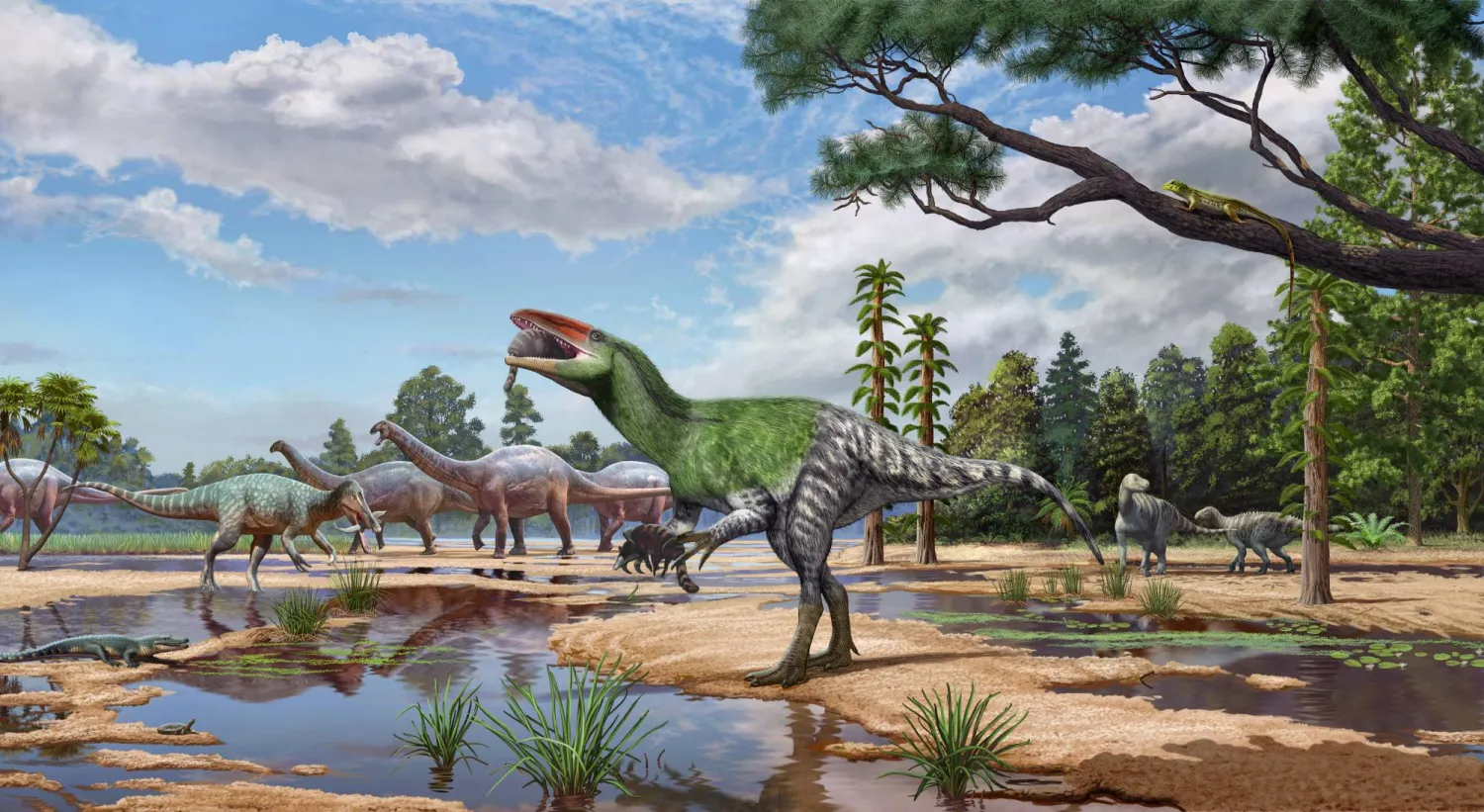
The meat-eating dinosaur Invictibellatrix amberina feeds on a mammal while grasping another in its ecosystem alongside other dinosaurs and other kinds of animals on the Isle of Wight, United Kingdom, in the Cretaceous Period around 120 million years ago, in this illustration released on October 13, 2026. Sergey Krasovskiy and Pedro Salas/Handout via REUTERS
TT

Isle of Wight Fossil Sheds Light on Enigmatic Meat-eating Dinosaurs

The meat-eating dinosaur Invictibellatrix amberina feeds on a mammal while grasping another in its ecosystem alongside other dinosaurs and other kinds of animals on the Isle of Wight, United Kingdom, in the Cretaceous Period around 120 million years ago, in this illustration released on October 13, 2026. Sergey Krasovskiy and Pedro Salas/Handout via REUTERS

The partial skull of a tiger-sized predator that prowled what is now the Isle of Wight off England's southern coast about 120 million years ago is giving scientists a better understanding of an enigmatic group of meat-eating dinosaurs known for running down prey and ripping them apart with massive hand claws.

Researchers said the fossil belongs to a species they have named Invictibellatrix amberina, an early member of the lineage of Cretaceous Period carnivorous dinosaurs called megaraptorans. Invictibellatrix adds to the knowledge of skull anatomy among early megaraptorans and, being the first one known from Europe, helps show how the group spread globally.

Invictibellatrix is one of the smallest megaraptorans. Based on fossils of closely related megaraptorans, the researchers estimated that Invictibellatrix was about 16 feet (5 meters) long, with the weight of a large tiger. Its body may have been covered in filament-like feathers, they said.

Megaraptorans were part of the group called theropods that spans all the meat-eating dinosaurs, Reuters reported.

"Megaraptorans are very unique among theropods because they have relatively small and slender heads but had long and strong arms with massive hand claws as well as very lightly built skeletons," ⁠said Cassius Morrison, ⁠a postdoctoral researcher at the University of Leeds in England and lead author of the study published in the journal Royal Society Open Science.

"These characteristics imply that megaraptorans were agile hunters capable of chasing down prey and using their large arms and claws to catch them and disembowel them using their hand claws," Morrison said.

The largest-known megaraptoran, named Maip, was about 33 feet (10 meters) long, inhabiting Patagonia during the twilight of the dinosaur age, about 50 million years after Invictibellatrix lived.

Littler megaraptorans like Invictibellatrix may have hunted smaller prey like mammals, smaller reptiles and baby dinosaurs. Larger megaraptorans may have targeted bigger plant-eating dinosaurs like duckbilled hadrosaurs and long-necked sauropods, though probably not the biggest ones.

Megaraptorans hunted in the ⁠opposite way from massive predators like Tyrannosaurus rex. Tyrannosaurus employed its large and stoutly built head, enormous teeth and incredible bite strength to kill prey, but had puny arms of little use in hunting.

Invictibellatrix was not the Isle of Wight's top predator, with larger theropods around, alongside various herbivorous dinosaurs, and may have filled a role similar to a hyena today.

There is a debate among dinosaur paleontologists as to where megaraptorans fit on the theropod family tree. Despite differences in how they were built and hunted, one hypothesis is that megaraptorans were closely related to tyrannosaurs, the group that included Tyrannosaurus and others that dominated the landscapes in North America and Asia later in the Cretaceous.

Invictibellatrix means "unconquered female warrior." Morrison noted that after humble beginnings megaraptorans developed into apex predators in South America, Australia and Antarctica, becoming "the ruling queens," while the tyrannosaurs became the "tyrant kings" in North America and Asia.

Scientists are trying to unravel the evolutionary history of megaraptorans. A leading hypothesis has megaraptorans originating in Asia before migrating through Europe into Africa and then on into South America, thriving until ⁠the dinosaurs were doomed by an ⁠asteroid strike 66 million years ago. This hypothesis was lacking fossil evidence because no megaraptorans had been known from Europe until now.

"These findings help to uncover the evolution of one of the most mysterious theropod groups," University College London doctoral student and study co-author Charlie Scherer said.

The Invictibellatrix fossil, a fragmented braincase, was discovered about a century ago and acquired by the Natural History Museum in London in 1924.

"It was left in one of the collection's drawers ever since, and no one noticed it until a couple of years ago," Scherer said.

While Tyrannosaurus may be more imposing than Invictibellatrix, the researchers noted that if a person were somehow transported back in time — like in the recent film "The End of Oak Street" — Invictibellatrix might present more of a danger.

"A smaller theropod like Invictibellatrix would likely have been a much bigger threat to a human than something like T. rex because we would likely be too small for T. rex to see as a worthwhile meal because of how massive it was and the amount of energy it would be required to catch us," Morrison said.

"But we would be the perfect size for something smaller like Invictibellatrix, as we are about a third to a quarter of its weight, making us a good hearty meal and more than just a snack.

Additionally, Invictibellatrix would have the agility and maneuverability to pursue and catch a human."


Hong Kong Logs Hottest October on Record

An evening view of the financial Central district and Victoria Harbour in Hong Kong, China, May 9, 2023. (Reuters)
TT

Hong Kong Logs Hottest October on Record

An evening view of the financial Central district and Victoria Harbour in Hong Kong, China, May 9, 2023. (Reuters)

Hong Kong experienced its hottest October since records began, data from the city's weather service showed on Tuesday.

The Hong Kong Observatory logged a monthly mean temperature of 27.6C -- a 0.2C increase from last year's already record-breaking figure for the same period.

Hong Kong began recording weather observations in 1884, according to the observatory.

This year's exceptionally strong El Nino has driven up temperatures around the world, with global forecasters warning for months that this would likely become the strongest ever observed.

El Nino is the warming phase of a natural climate cycle, and temporarily raises sea temperatures in the tropical Pacific, triggering changes in weather that can increase the risk of drought and flooding, and exacerbate man-made global warming.

Hong Kong observed its highest temperature ever of 36.9C in August as Typhoon Dolphin swept warm air over the city.


Monarch Butterflies Get Tiny Trackers to Help Scientists Follow Their Mysterious Migration

Monarch butterflies rest on their way to Mexico, Sept. 12, 2023, in Cleveland. (AP)
TT

Monarch Butterflies Get Tiny Trackers to Help Scientists Follow Their Mysterious Migration

Monarch butterflies rest on their way to Mexico, Sept. 12, 2023, in Cleveland. (AP)

As a child, Rebeca Quiñonez-Piñón wondered where monarch butterflies stop for a meal and a night's rest on their long migrations across North America. Now she and other scientists are attaching tiny tracking devices to hundreds of butterflies to find those critical stopover locations before they disappear.

Swarms of dazzling orange-and-black monarchs use environmental cues to travel some 3,000 miles (4,800 kilometers) from as far as southern Canada to spend the winter in forests of oyamel fir trees in central Mexico, a protected biosphere reserve that's also a World Heritage site.

For decades, however, scientists have struggled to build a clear picture of the butterflies' routes, how far they fly each day and where they settle at night. Solar-powered radio tags attached to nearly 1,750 monarchs this year are helping provide answers.

As habitat loss, pesticides and climate change pummel monarch populations, the research could help their numbers rebound. Quiñonez-Piñón said the uniquely famous monarch butterfly helps draw attention to the threats facing insects and their vital role in sustaining plant life across the continent.

“Pollinators are crucial to protect and ensure that our ecosystems remain healthy,” she said, “and also to have the sources of food that we require as humans.”

The public can follow the progress of individual butterflies on the free app called Project Monarch Science.

Tracking monarch butterflies in the ‘Texas funnel’ and beyond

Quiñonez-Piñón is the senior scientist at the National Wildlife Federation, a nonprofit that recently joined a tri-national science team to track monarchs. She’s leading a study that mixes real-time migratory tracking with community science to better understand where they stop in Texas.

Only some monarchs migrate. Of the ones that do, a big portion of the butterflies east of the Rocky Mountains fly through a narrow corridor known as the “Texas funnel” every fall and spring, when they head north again to lay their eggs before dying.

But depending on the year, they might favor different parts of the Lone Star State, based on where they can find water, nectar and overnight shelters like trees. It’s a detail that has fascinated scientists, including Quiñonez-Piñón.

Since the tracking started last year, scientists have found the first evidence of a butterfly in Utah, west of the Rockies, joining eastern monarchs in central Mexico. Others migrated down the Eastern Seaboard to Florida, jumped the Gulf of Mexico and are now tracking across Mexico, a connection scientists hadn’t seen before in such numbers.

“There’s just all these unique stories of their paths, connections between the population, that we didn’t know existed or we hypothesized but couldn’t prove,” said Emma Pelton, senior conservation biologist with the Xerces Society for Invertebrate Conservation.

“We’re a year into it, and I think we’re all just thrilled,” she said, especially since older tracking devices proved too big or heavy.

Since their migration started this year, about 175 tagged butterflies have been detected in Mexico.

Only some monarch butterflies get tracking devices

The new $200 tags weigh about as much as a drop of water and were developed by Cellular Tracking Technologies. If the person attaching the tag is properly trained and puts it on correctly, Quiñonez-Piñón said, “the monarch will be completely safe.”

Not all monarchs are good contenders for the tags. To ensure they’re not overburdened, most of the butterflies that get a tag weigh more than 400 milligrams (about as much as a standard pill), said David La Puma, vice president of global market development for Cellular Tracking Technologies and coordinator of the Project Monarch Collaboration, the team the National Wildlife Federation recently joined. Other researchers and community scientists look for longer-winged monarchs to tag.

Many monarchs are caught with nets and kept in cool temperatures to calm them before they're tagged, which requires delicacy and care. The insect is positioned in the middle of a special board, its legs and antennae protected, where adhesive is cotton-swabbed onto its abdomen and the tag. Then the transmitter is gently pressed to its body and the butterfly is eventually released.

Louie Yang, an insect ecologist at the University of California, Davis, said the technology is “pretty remarkable” because “we haven’t previously been able to see what path they take or how quickly they’re moving over different parts of that journey.”

But there are also limitations. The technology doesn't tell us a butterfly's exact location, he said, but rather where there was a receiver that detected it. And just because a butterfly was detected doesn't mean it's still alive.

Yang also said further studies will be needed to understand how and if the tags impact butterfly behavior.

Pesticides and climate change are pervasive threats

Monarchs typically live two to six weeks, but the butterflies that migrate to Mexico can live up to nine months and spend their lives moving south, waiting out the winter and migrating north again before breeding in the spring. The monarch’s feat has made it a symbol for the rights of international migrants.

Since the mid-1990s, the population of eastern monarchs has dropped more than 80%, and in the west by about 95%. Pesticides are a pervasive threat to milkweed, the plant where monarchs lay their eggs and the exclusive food source for its caterpillars.

Human-caused climate change — driven by burning coal, oil and gas — is also a primary threat year-round, said Tierra Curry, senior scientist and endangered species codirector with the Center for Biological Diversity.

“One of the problems now is that it stays too hot too long in the northern areas, and so they don’t get the cues to migrate. And then if the temperature freezes, they’re probably not going to make it to Mexico,” she said. “The later they start, the less the chances that they’re going to get all the way to the forest.”

Prolonged drought can dry up the water and nectar flower sources they need. They get hit by cars and trucks. And out in California, forests where western monarchs fly for the winter are being razed for development.

Late last year, the Trump administration delayed a decision on federal protections for monarchs. Several groups filed a lawsuit, and a court ordered the government to make a final decision by 2030.

However, conservationists are pushing ahead with new ways to protect the dwindling monarch population.

In Texas, nets on some highways are encouraging butterflies to fly higher so they don't get smashed, especially at night when they fly down to roost. Other efforts involve mass plantings of milkweed and pollinator plants in gardens, along roadsides and transportation corridors, Curry said. Several studies show they're boosting local populations.


After Months Lost at Sea on a Small Boat, 5 People Are Rescued in the Island Nation of Kiribati

North and South Tarawa are seen from the air in the central Pacific Island nation of Kiribati, May 23, 2013. Kiribati consists of a chain of 33 atolls and islands that stand just meters above sea level, spread over a huge expanse of otherwise empty ocean. (Reuters)
TT

After Months Lost at Sea on a Small Boat, 5 People Are Rescued in the Island Nation of Kiribati

North and South Tarawa are seen from the air in the central Pacific Island nation of Kiribati, May 23, 2013. Kiribati consists of a chain of 33 atolls and islands that stand just meters above sea level, spread over a huge expanse of otherwise empty ocean. (Reuters)

Five people, including two children, were rescued this week in the South Pacific island nation of Kiribati after three months drifting at sea in a 20-foot skiff, authorities said. Another four remained missing.

Villagers rescued the group Sunday off Fanning Island in Kiribati, the Australian Broadcasting Corp. reported, after they had drifted an estimated 5,400 kilometers (3,355 miles) east from the Federated States of Micronesia.

The US Coast Guard in Guam on Tuesday confirmed that the skiff with nine people aboard had been reported missing after it failed to return to Ruo Island in Micronesia on July 30. A 10-day search covering 85,700 square kilometers (33,000 square miles) followed without any sign of the missing boat or those aboard, it said.

“Incredible and wonderful news these five folks were found and are receiving care,” the US Coast Guard told The Associated Press in an email.

“Our profound condolences to family and friends of those who did not arrive with them,” the email added.

When asked by the AP what happened to the missing four, the US Coast Guard said it was continuing to gather and confirm information and would reply as soon as possible.

A lawmaker in Kiribati, Kaotitaake Rakoroa, told ABC the survivors were being cared for by a pastor on the island.

Nursing officer Paukin Tororo told the ABC on Monday that all five were severely dehydrated and malnourished. All were put on intravenous drips and were showing signs of recovery.

“They can give a smile face, they show the sign they want to eat,” she told the ABC.

The survivors had yet to speak publicly about their ordeal and had requested privacy, the Australian broadcaster reported.

The governor of Micronesia's Chuuk state, Alexander Narruhn, issued a statement Sunday saying he had begun talks with the Kiribati government to bring the survivors home.

“There were nine people aboard the boat that went missing. Thanks be to God for his love and mercy that five of the nine have been found,” Narruhn said through an interpreter.

“We continue to pray for their four companions,” he added. Narruhn did not immediately respond to the AP’s request for comment.

The nine had been making a one-hour crossing between the islands of Murilo and Ruo when they were caught in a storm, the ABC reported.