Ali Kayali, Main Suspect in 2013 Baniyas Massacre, Arrested

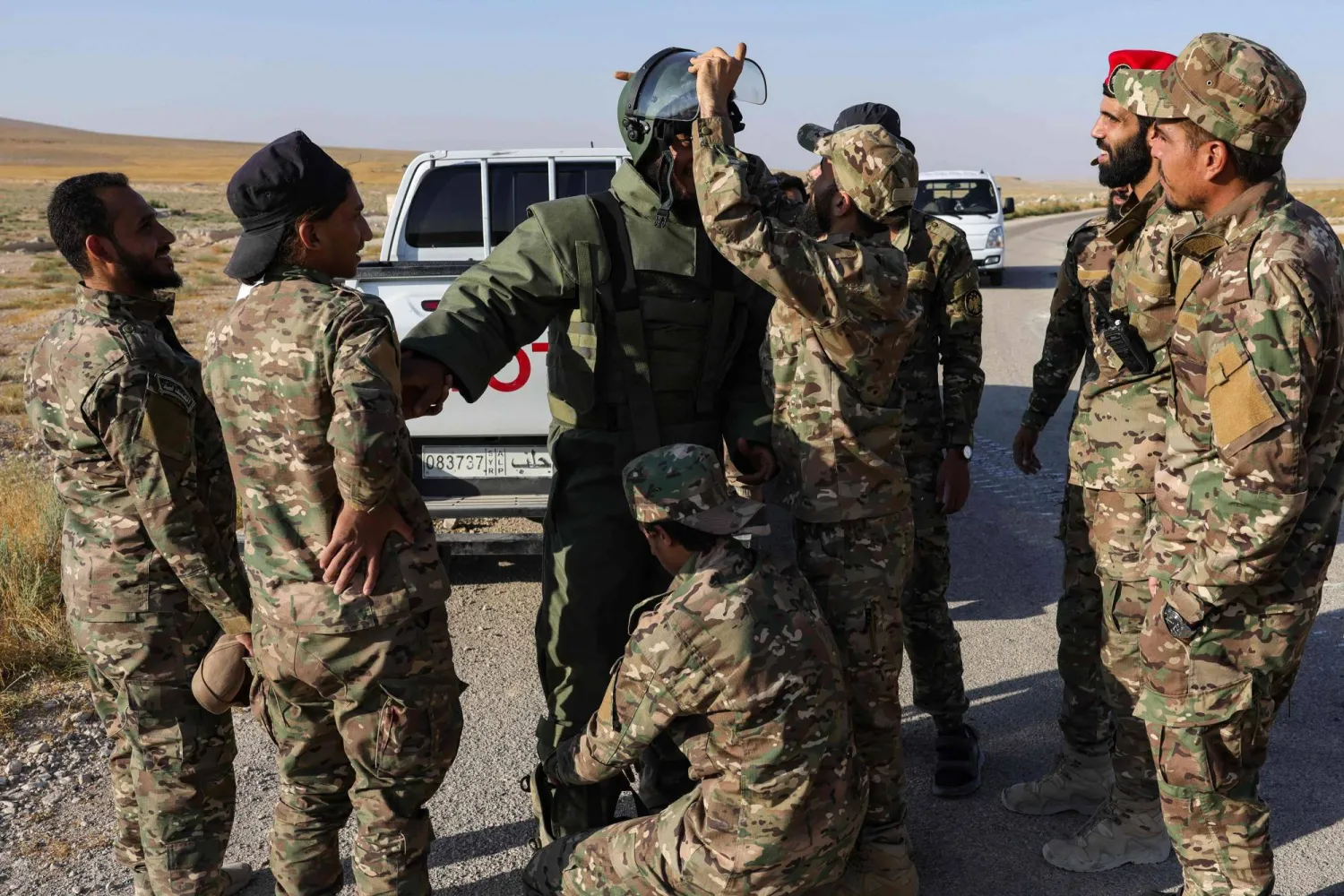
A Syrian army officer puts on his blast suit during a demining operation, by the Syrian Ministry of Defense's military engineering department, to clear land mines in Qarah in the Damascus countryside on August 23, 2026. (Photo by Bakr ALkasem / AFP)
TT

Ali Kayali, Main Suspect in 2013 Baniyas Massacre, Arrested

A Syrian army officer puts on his blast suit during a demining operation, by the Syrian Ministry of Defense's military engineering department, to clear land mines in Qarah in the Damascus countryside on August 23, 2026. (Photo by Bakr ALkasem / AFP)

Syria's General Intelligence Service has arrested Ali Kayali, also known as Mihrac Ural, the main suspect in the 2013 Baniyas massacre, as he attempted to flee across the border, according to the Syrian Arab News Agency (SANA).

The agency did not specify where he was arrested or which country he was attempting to enter. Syrian sources say he had been spotted crossing the border into Lebanon several times.

However, according to Lebanon's MTV television, the Syrian-Turkish national known as Ali Kayali, or Mihrac Ural, and nicknamed the "Butcher of Baniyas" in Syria, was the same person reportedly abducted from his home in Mansourieh, in Lebanon's Metn district, after his wife and son were tied up.

Asharq Al-Awsat could not independently verify the accuracy of the report.

Who Is Mihrac Ural?

Mihrac Ural was born in 1956 in Türkiye's Hatay province, formerly known as the Sanjak of Alexandretta. He joined a far-left extremist party and was imprisoned several times in Türkiye before fleeing to Syria in the early 1980s.

There, he received special privileges, including Syrian citizenship, which was granted to him by then-President Hafez al-Assad.

Ural later adopted the Syrian name Ali Kayali and led an armed group known as the Syrian Resistance, which fought alongside forces loyal to Bashar al-Assad throughout the Syrian war.

The group has been linked to the massacres in al-Bayda and Baniyas and participated alongside Assad's forces in suppressing the Syrian uprising. Ural's name has also been associated with the 2012 Houla massacre and the bombings in Reyhanli, Türkiye.

According to the Syrian Network for Human Rights (SNHR), the al-Bayda massacre claimed the lives of 264 civilians, including 36 children and 28 women. The Ras al-Nabaa massacre killed another 195 civilians, including 56 children and 43 women.

Testimonies and reports documenting the two massacres described bodies scattered across streets, shops and even basements, as well as summary executions carried out with firearms and bladed weapons. Homes and bodies were also reportedly burned.

Militias affiliated with Kayali were also accused of carrying out massacres against Syrians in the countryside of Latakia, Aleppo and Idlib, leaving hundreds dead and wounded.

Human Rights Watch, in a report published in September 2013, documented the execution of at least 248 people, including 167 in al-Bayda and 81 in Baniyas, warning that the actual death toll could be higher.

Based on survivor testimonies and video evidence, the organization concluded that the vast majority of the victims had been killed after fighting had ended and opposition fighters had withdrawn from the two areas.

Following news of Kayali's arrest, chants of "Allahu Akbar" rang out from mosques in al-Bayda, a town near Baniyas in Syria's western Tartus province, on Thursday.

Videos circulating online showed mosques broadcasting the chants, which those sharing the footage said were in celebration of Ural's reported arrest, nearly 13 years after the massacre.

Marking the occasion, Fadel Abdul Ghany, executive director of the Syrian Network for Human Rights, wrote on X on Thursday:

"On May 10, 2013, we published our report documenting the killing of 459 civilians, including 92 children and 71 women. We named Ali Kayali in the report, based on testimonies from residents who identified him as one of the leaders of the massacre."

He described the killings as a massacre with a sectarian character, recalling the painstaking work of documenting the names of children, women and men, families that had lost several members or had been wiped out entirely, and survivors whose testimonies remained unforgettable.

"More than 13 years later, I feel how important it is that this case has finally reached a stage where one of its most prominent suspects can be investigated. Today, I am thinking especially of the victims' families, who have waited all these years," he added.

Ahmad Muwaffaq Zaidan, media adviser to the Syrian presidency, also welcomed the arrest in a post on X.

"We congratulate our people on the arrest by Syrian intelligence, in cooperation with the Interior Ministry, of the criminal Mihrac Ural, known as Ali Kayali, who carried out massacres against our people during the Syrian revolution, including the al-Bayda massacre in Baniyas," he wrote.

He vowed that those responsible for killings would be pursued regardless of how much time had passed, stressing that perpetrators would not escape Syria's security agencies.

Syrian authorities had previously announced on October 4 the arrest of Jamal Trabulsi, whom they identified as Ural's deputy, on suspicion of involvement in the same massacre.

Syrian authorities are pursuing individuals implicated in abuses against civilians during Assad's rule as part of their stated efforts to achieve transitional justice and hold those responsible for crimes accountable.

On December 8, 2024, Syrian rebels entered Damascus and announced the overthrow of Bashar al-Assad's regime, ending the rule he had inherited from his father, Hafez al-Assad.


Houthi Donation Boxes Target Merchants, Shoppers to Fund War Effort

Houthis launch a previous fundraising campaign to support the war effort (Houthi media).
TT

Houthi Donation Boxes Target Merchants, Shoppers to Fund War Effort

Houthis launch a previous fundraising campaign to support the war effort (Houthi media).

The Houthi group has turned markets and commercial establishments in Yemen's Houthi-held capital, Sanaa, into new sources of funding for its military activities, launching a coercive fundraising campaign targeting hundreds of companies, businesses, shops, restaurants and shopping centers, according to local and business sources.

The campaign forces business owners to install donation boxes on their premises and extracts money from merchants and residents under the pretext of supporting the group's "war effort" and the families of its fighters killed, wounded or missing on the front lines, the sources said.

The campaign, launched at the beginning of the week, reflects efforts by the Houthis to expand their sources of compulsory funding and offset military and personnel losses by shifting the financial burden of the continuing war onto businesses and residents, at a time when living conditions are deteriorating and commercial establishments are increasingly struggling to remain operational.

Sources told Asharq Al-Awsat that Houthi members and supervisors had targeted commercial establishments in several districts of Sanaa, forcing owners through threats and intimidation to accept donation boxes while conducting field visits to pressure merchants and customers into contributing money.

The sources said the group had ordered its members to visit shops and businesses daily to collect money deposited in the boxes, then transfer the proceeds to bank accounts belonging to senior Houthi leaders.

They added that the campaign went beyond collecting donations, involving mandatory financial contributions and direct pressure on business owners.

More than 320 donation boxes in two days

In a sign of the campaign's expanding reach, the Houthis distributed more than 320 donation boxes to private-sector establishments across several districts during the first two days, with plans to distribute about 4,000 additional boxes in the coming days to cover the rest of the capital and its outskirts.

The move coincided with complaints from merchants who said Houthi supervisors and armed members had entered their shops carrying donation boxes and forced them at gunpoint to install them without seeking their permission or consent.

Merchants said the group had also ordered business owners and employees to encourage customers to donate, warning that shops whose boxes were opened and found empty would face severe measures.

The threats appeared aimed at turning merchants into collectors of compulsory contributions from ordinary residents.

Ramzi, a pseudonym for a shop owner in a Sanaa neighborhood, said Houthi supervisors had forced him to place a donation box inside his store under the pretext of supporting fighters on the front lines and the families of Houthi members killed or wounded in combat.

He said Houthi members regularly visited his shop to collect the money, leaving him no opportunity to object or refuse to keep the box on his premises.

Ramzi added that repeated threats and constant monitoring by Houthi supervisors sometimes forced him to put his own money into the box to avoid being held responsible when customers failed to donate or facing punitive measures.

An empty donation box, he said, had become sufficient grounds for questioning and intimidation.

On the outskirts of Sanaa, a restaurant owner who requested anonymity complained that the campaign had become another means of extorting money from business owners.

He said Houthi supervisors not only imposed donation boxes but also pressured restaurant owners and employees to make additional payments despite declining sales and rising operating costs.

Saeed, a Sanaa resident, said he believed the Houthis were seeking to turn the city's remaining markets and shops into permanent collection points for extracting money from the public.

He said residents were increasingly overwhelmed by successive donation drives and compulsory levies at a time when many were struggling to provide basic necessities for their families.


Gaza Welcomes US Election Results With Reservations

Palestinians receive food distributed by the World Food Program in Gaza on Wednesday (AP)
TT

Gaza Welcomes US Election Results With Reservations

Palestinians receive food distributed by the World Food Program in Gaza on Wednesday (AP)

Political factions in Gaza watched the US midterm elections as closely as Israel's, but were divided over what the results could mean for Palestinians.

Some welcomed the Republicans' loss of their majorities in both the House of Representatives and Senate under President Donald Trump as a victory for the Palestinian cause. Others were more cautious, arguing that the results would do little to ease the crises gripping the war-battered enclave.

Neither Fatah nor Hamas, nor any other Palestinian faction in Gaza, publicly commented on the US congressional midterm results. But their affiliated media outlets closely tracked the vote, highlighting the success of candidates of Arab and Muslim descent.

Among them was Dr. Adam Hamawy, who won a House seat representing New Jersey after having worked in Gaza during the Israeli war that followed the Oct. 7, 2023, attacks.

Munther al-Hayek, Fatah's spokesman in Gaza, told Asharq Al-Awsat that the war had featured prominently in the midterm campaigns and that the current US administration's stance on the Palestinian territories had cost Republicans votes.

"The current US administration's negative positions toward the situation in the Palestinian territories influenced voters, contributing to the Republicans' clear defeat," Hayek said.

"Everyone who supported Palestine and stood by its people, particularly Gaza, whose plight featured in most campaign speeches by its supporters, achieved clearly positive results," he added.

Hamas leaders, including spokesman Hazem Qassem, took a more guarded approach, declining to comment officially.

In October 2025, Hamas accepted a Trump-proposed plan to end the Gaza war. Israel, however, has yet to withdraw from the positions it occupies in the enclave as required under the agreement and continues to carry out targeted killings of Hamas members.

A senior Hamas official based in Turkey, speaking to Asharq Al-Awsat on condition of anonymity, played down expectations of any meaningful shift.

"The election results will change nothing fundamental for Palestinians, particularly Gaza residents, but could offer some hope of curbing the overwhelming US support for Israel's attacks on the enclave," the official said.

He also cautioned against overlooking the Democrats' role in the war.

"We must remember that the Democratic Party, represented by former President Joe Biden's administration, was the first to support the ongoing war and was unable to impose any solutions on Benjamin Netanyahu's government, unlike Trump, who later managed to do so despite his unwavering support for Israel," he said.

For many ordinary Palestinians in Gaza, the distinction between Republicans and Democrats is narrow, according to Gaza-based writer and political analyst Mustafa Ibrahim.

"Most Palestinians outside the political factions, particularly in Gaza, believe both parties support Israeli policies, with only minor differences on certain issues," Ibrahim told Asharq Al-Awsat.

He said it was too early to gauge the elections' impact on Gaza, noting that newly elected lawmakers would not be sworn in or take office for another two months.

In the meantime, Ibrahim said, Trump could press Israel to accelerate measures sought by the Board of Peace in Gaza, including the entry of the national committee tasked with administering the enclave.

But he saw little prospect of major progress, citing Israel's political deadlock following its own elections.

Ibrahim also doubted that Democratic lawmakers could exert significant influence, drive rapid change, or deliver major breakthroughs in US policy toward the Palestinian cause.


Yemeni Govt Forces Regain Initiative Against Houthis

A Yemeni government military vehicle storms a Houthi position in Al-Jawf. (Military Media)
TT

Yemeni Govt Forces Regain Initiative Against Houthis

A Yemeni government military vehicle storms a Houthi position in Al-Jawf. (Military Media)

Yemeni government forces seized strategic positions in the Lahj and Al-Jawf provinces on Wednesday, beating back Houthi attacks and infiltration attempts as fighting intensified across several fronts and the group fired ballistic missiles to support its embattled fighters.

Clashes continued along the Bab al-Mandeb front, where government troops pressed an offensive to dislodge Houthi fighters from their last remaining pockets around the strategic strait.

Field sources said government troops, backed by the Giants Brigades, Nation's Shield forces and the National Resistance, recaptured positions in Al-Maqatirah district in northern Lahj and thwarted Houthi advances toward Tur al-Baha and Al-Mudaribah.

Fighting spread to areas bordering the two districts, while government forces pressed ahead with offensive operations in the eastern Al-Jawf province.

In Taiz, government forces held their defensive positions despite a continuing Houthi siege, with clashes persisting on the city's southern and eastern fronts. The Houthis suffered casualties and equipment losses, particularly around the city.

In the latest advance, the Southern Giants Brigades and Nation's Shield forces said they had seized the strategic Jabal al-Sabaa Roqud position in Al-Maqatirah, driving out Houthi fighters and snipers after clashes.

The position overlooks Wadi Maabaq and commands sections of the vital Aden-Al-Turbah road through Tur al-Baha, giving government forces greater control over supply routes and troop movements while reducing the threat of Houthi sniper fire, according to military assessments.

The advance coincided with airstrikes on Houthi positions on Jabal Araf.

Local resistance fighters, backed by government fighters, also foiled a Houthi infiltration attempt deeper into Tur al-Baha.

On the Al-Maqatirah front, fierce clashes continued near the boundary with Al-Mudaribah, where National Resistance forces and local fighters repelled Houthi attempts to seize several positions, field sources said.

Southeast of Taiz city, fighting erupted along the Kahlan and Dabbah front after Houthi fighters tried to infiltrate residential neighborhoods.

Army troops and local resistance fighters ambushed the attackers, killing and wounding several of them, according to the 35th Armored Brigade's media office.

The National Resistance's military media office also reported heavy Houthi casualties and destroyed military vehicles after government forces repelled the attacks.

Government forces push forward in Al-Jawf

In the Al-Jawf province, government troops expanded their offensive east of Al-Hazm, capturing military positions in Al-Duhaida, Mulayfiyah and surrounding areas after fighting broke out before dawn.

Clashes continued as troops pushed toward the Al-Duhaiza mountains.

Field sources said government forces were clearing recaptured positions of landmines, explosive devices and fortifications left behind by retreating Houthi fighters.

The clearance operations slowed their advance despite continued ground assaults and air support.

The Yemeni Armed Forces' media center said warplanes and drones struck Houthi fortifications, troop concentrations and weapons depots, destroying several military vehicles.

Houthis fire ballistic missiles at military positions

The Houthis stepped up ballistic missile attacks in Lahj and Al-Dhale provinces in an effort to support fighters along the front lines.

Field sources said the group fired two ballistic missiles toward the Al-Maqatirah front and Tur al-Baha.

The sources said the Houthis had installed launch platforms on high ground in the district, using them as forward positions to target government troop concentrations and supply routes.

The attack came as fighting continued across Al-Dhale, where the Houthis have sought a breakthrough by striking military camps and troop concentrations after failing to advance along the front lines.

Meanwhile, government forces pressed operations along the Bab al-Mandeb front, seeking to clear remaining Houthi pockets from scattered positions around the strait.

1,208 strikes

Yemen's armed forces said they carried out 1,208 strikes against Houthi positions and movements on Tuesday under Operation Dawn of Yemen, targeting troop concentrations, reinforcements, fortifications, firing positions and military vehicles.

The operations involved warplanes, drones, field artillery and rocket launchers.

Armed Forces spokesman Colonel Majed al-Nuzaili said the strikes had neutralized about 370 Houthi commanders and fighters and destroyed or disabled roughly 120 military vehicles and pieces of equipment across multiple fronts.

Al-Nuzaili said army troops and local resistance fighters had captured positions along several fronts in Taiz and repelled Houthi attempts to retake them, while airstrikes hit the group's troop concentrations and equipment.

He said strikes were continuing in Marib, Al-Jawf and the southern and western sectors as government forces sought to weaken Houthi combat capabilities and reclaim positions still under the group's control.