Meta Releases Open-Weight Muse Spark Model for Coding, Agentic Tasks

The logo of Meta is seen at the entrance of the company's temporary stand ahead of the World Economic Forum (WEF) in Davos, Switzerland January 18, 2025. (Reuters)
TT

Meta Releases Open-Weight Muse Spark Model for Coding, Agentic Tasks

The logo of Meta is seen at the entrance of the company's temporary stand ahead of the World Economic Forum (WEF) in Davos, Switzerland January 18, 2025. (Reuters)

Meta ‌Platforms on Thursday released an open-weight version of its Muse Spark artificial intelligence model for coding and AI agents, expanding developers' ability to download and adapt the technology.

Open-weight models make trained parameters available for developers to modify, unlike proprietary models ‌that remain under ‌their creators' control. ‌They ⁠can offer businesses ⁠a lower-cost alternative to closed systems.

Meta said Muse Spark has 816 billion total parameters, with 42 billion active at a time, and ⁠can handle a context window ‌of up ‌to 1 million tokens.

The ‌model can run locally on ‌two Apple M5 Ultra Mac Studio computers and is also available through some API providers.

CEO ‌Mark Zuckerberg has argued that advanced AI should ⁠not be ⁠concentrated among a small number of companies.

While open-weight models can give companies greater control over their data, they can require significant computing resources and technical expertise to operate at scale.

In August, Meta released Muse Glimmer, a smaller open-weight model.


Defense, AI, High Tech: A Delicate Balance Between Armies and Industry

Activists from the Campaign to Stop Killer Robots, a coalition of non-governmental organizations opposing lethal autonomous weapons or so-called "killer robots", stage a protest at Brandenburg Gate in Berlin, Germany, March, 21, 2019. (Reuters)
TT

Defense, AI, High Tech: A Delicate Balance Between Armies and Industry

Activists from the Campaign to Stop Killer Robots, a coalition of non-governmental organizations opposing lethal autonomous weapons or so-called "killer robots", stage a protest at Brandenburg Gate in Berlin, Germany, March, 21, 2019. (Reuters)

The rapid integration of high tech and artificial intelligence into the armed forces presents a tricky dilemma: entrusting part of their future to private companies while risking their sovereignty.

On one side are digital and mission-critical technology specialists driven by market forces and controlled by private capital demanding profits, independent from any political control.

On the other are military leaders who answer only to political authority and are obsessed with strategy, hierarchy and the sacrosanct nature of defense secrecy.

Between them is the race to connect the battlefield, from troop coordination to real-time terrain analysis, generating terabits of data which can decide a war's outcome and the fate of many lives.

Beyond the even more complex issue of so-called killer robots, one example sums up the defense challenge: the civilian Starlink satellite network and its military counterpart, Starshield, which Ukraine desperately needs.

Since Russia's invasion in 2022, Kyiv has faced restrictions on access to Starshield, owned by Elon Musk's SpaceX, leaving a Sword of Damocles hanging over Ukraine's armed forces.

Musk has shifted his stance on Ukraine many times, insisting any disruption was the responsibility of Washington, not SpaceX.

- 'A fine line' -

The issue loomed over NATO Edge this week, a three-day conference on critical technologies and digital warfare where military chiefs, government officials and defense experts from NATO's 32 member states and Ukraine gathered in Izmir, Türkiye.

"This is a difficult issue, one many ministries of defense are grappling with," analyst Tom Barton with intelligence firm Janes told AFP.

For companies "to deliver the so-called 'networked battlefield', some access ideally needs to be given" to confidential data, he explained.

"From space to land-based sensors and military communications, defense establishments are experimenting with standalone exercises and varying levels of trust and access."

But militaries -- without safeguards -- cannot entrust their fate to developers, who are often focused primarily on civilian needs.

"There is a lot of push or advocacy for military and government to have a closer relationship with industry," a US company representative told AFP on condition of anonymity.

"But there's a fine line. You turn on the news and you see Elon Musk doing shit in Ukraine like slowing down the internet," he fumed.

With boundaries constantly shifting, military leaders have little choice but to compromise.

"You don't need to be 100 percent sovereign, but sovereign enough," he explained.

- Trust -

For Major General Rainer Beeck, one of NATO's top cyberspace commanders, it is "a hard nut to crack".

"You have to make choices about which classification you make, for which data... The problem is the trust," he said.

Admiral Pierre Vandier, NATO's Supreme Allied Commander Transformation (SACT), likewise insisted that "trust ... is the most important thing".

"Trust in architecture, in data sharing, in AI agents, in decision-making tools," he said.

"We need to close the fighter-factory gap. Ukraine did it."

Nearly five years of war have given Kyiv more experience than anyone else in NATO.

The dynamics also vary according to the size of national defense budgets.

For large powers, "data collection is not the problem... If war would start, we would get (it). The problem then is it's too late to organize," Beeck said, calling for a more proactive approach.

Smaller governments need "to build up their capacity", said Mitch Free, vice president of international government at Vantor, which provides satellite imagery for defense and intelligence agencies.

Many may only own a handful of satellites and must weigh their intelligence value against the cost of building and operating them.

"This is where commercial... helps fill the gap," he said.

Ultimately, the real debate is about the best way to use AI.

"The bottleneck is often not technology, but permission: classification boundaries, national rules and trust decisions," said Jean-Charles Ellermann-Kingombe, NATO's cyber and digital transformation chief.

The alliance must make "AI adoption possible at scale", with these capabilities "secure, interoperable and deployable within NATO's infrastructure... by personnel who understand their value and their limitations", he added.


Nvidia Faces US Accounting Probe amid Deepening Turmoil

FILE PHOTO: A silhouette of Jensen Huang, NVIDIA logo and decreasing stock graph are seen in this vertical illustration created on November 12, 2026. REUTERS/Dado Ruvic/Illustration/File Photo
TT

Nvidia Faces US Accounting Probe amid Deepening Turmoil

FILE PHOTO: A silhouette of Jensen Huang, NVIDIA logo and decreasing stock graph are seen in this vertical illustration created on November 12, 2026. REUTERS/Dado Ruvic/Illustration/File Photo

US securities regulators are investigating the accounting practices of Nvidia, according to US media, adding to the turmoil engulfing the artificial intelligence chip giant following the resignation of its chief executive.

The Securities and Exchange Commission (SEC) inquiry is in its early stages, The New York Times reported Saturday, citing people briefed on the confidential investigation.

The Wall Street Journal reported on the investigation earlier this week, although it was unable to establish its precise focus. The probe could end without any charges being brought against the company.

Questions about Nvidia's financial disclosures have intensified amid scrutiny of its dealings with Megaspeed, a Singapore-based company investigated by American authorities over suspected shipments of restricted AI chips to China.

Nvidia last year changed how it reported sales by geographical location, switching from customers' billing addresses to the countries where they are headquartered, US media reported.

The change removed Singapore from its geographical breakdown, despite the company's significant business there.

It remains unclear whether the SEC investigation is connected to those accounting changes or to the scandal surrounding former chief executive Jensen Huang.

Huang resigned earlier this month following revelations of extramarital affairs, including with Alice Huang, a former Megaspeed executive suspected by US intelligence of working for Beijing.

China has denied the espionage allegations, while Megaspeed has maintained that it operates lawfully.

Nvidia's board has appointed former chief financial officer Colette Kress as interim CEO and launched an investigation into the circumstances surrounding Huang's departure.

The upheaval has shaken investor confidence in one of the world's most valuable companies, whose advanced semiconductors have been central to the global AI boom.

Nvidia shares plunged 14 percent on Friday, bringing their losses for the week to more than 20 percent.

US President Donald Trump nevertheless called Friday for Huang to be reinstated.

"I think that I would love to see Jensen be given a second chance," Trump told reporters.

But Nvidia Chairman Harvey Jones has ruled out his return, saying board directors unanimously accepted his resignation.


Trump, Xi Did Not Discuss Nvidia’s Huang, Says Bessent

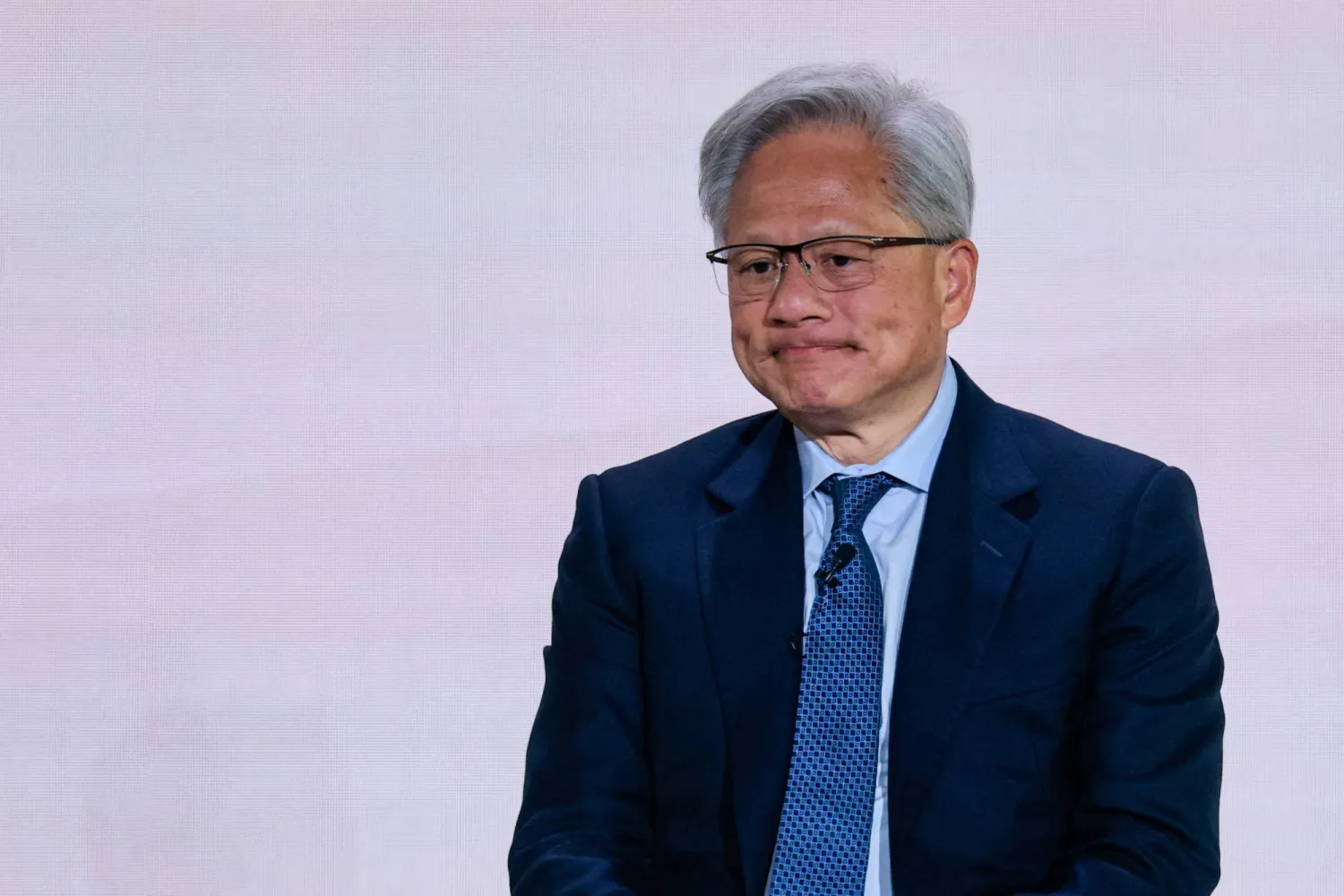
 Nvidia CEO Jensen Huang looks on during National Design Studio's launch event for America.gov, a new AI-powered government website, at the Mellon Auditorium in Washington, DC, US, September 29, 2026. (Reuters)
Nvidia CEO Jensen Huang looks on during National Design Studio's launch event for America.gov, a new AI-powered government website, at the Mellon Auditorium in Washington, DC, US, September 29, 2026. (Reuters)
TT

Trump, Xi Did Not Discuss Nvidia’s Huang, Says Bessent

 Nvidia CEO Jensen Huang looks on during National Design Studio's launch event for America.gov, a new AI-powered government website, at the Mellon Auditorium in Washington, DC, US, September 29, 2026. (Reuters)
Nvidia CEO Jensen Huang looks on during National Design Studio's launch event for America.gov, a new AI-powered government website, at the Mellon Auditorium in Washington, DC, US, September 29, 2026. (Reuters)

US President Donald Trump did not discuss former Nvidia CEO Jensen Huang with Chinese President Xi Jinping during their meeting this week, Treasury Secretary Scott Bessent said on Friday.

Huang resigned as chief of the chip giant at the center of the artificial intelligence revolution after revelations of extramarital affairs, including one with an alleged Chinese spy who may have funneled restricted chips to that country.

Responding to a question, Bessent told US broadcaster CNBC that Huang had not come up in Trump's talks with Xi, held earlier this week in Shenzhen.

Speaking about the Trump administration's support for the domestic AI sector, Bessent stressed that the United States "must stay ahead" of China in that realm.

"Our best protection against the foreign SI and exploits by foreign actors is for our labs to maintain their substantial lead, and in effect, they are our shield against SI," he said, using the administration's term for AI technology.

"There's no turning back on this. What we have to do is make sure that our labs maintain their leads through their continued innovation, through their access to the best chips, and through smart policy."

Bessent said Trump and Xi had agreed on certain guardrails on the use of AI in the military domain.

"President Trump and President Xi agreed that humans should always be involved in any military decisions that SI makes, and the SI should not be allowed to be autonomous for major military actions," he said.

On the threat of AI-enabled cyberattacks, Bessent again stressed that the best defense his country had was to allow its AI companies "to continue at the frontier and to provide us with the best defense against these other models."