


Tiny Fiji Village Restores Dying Fishery with Coral Planting

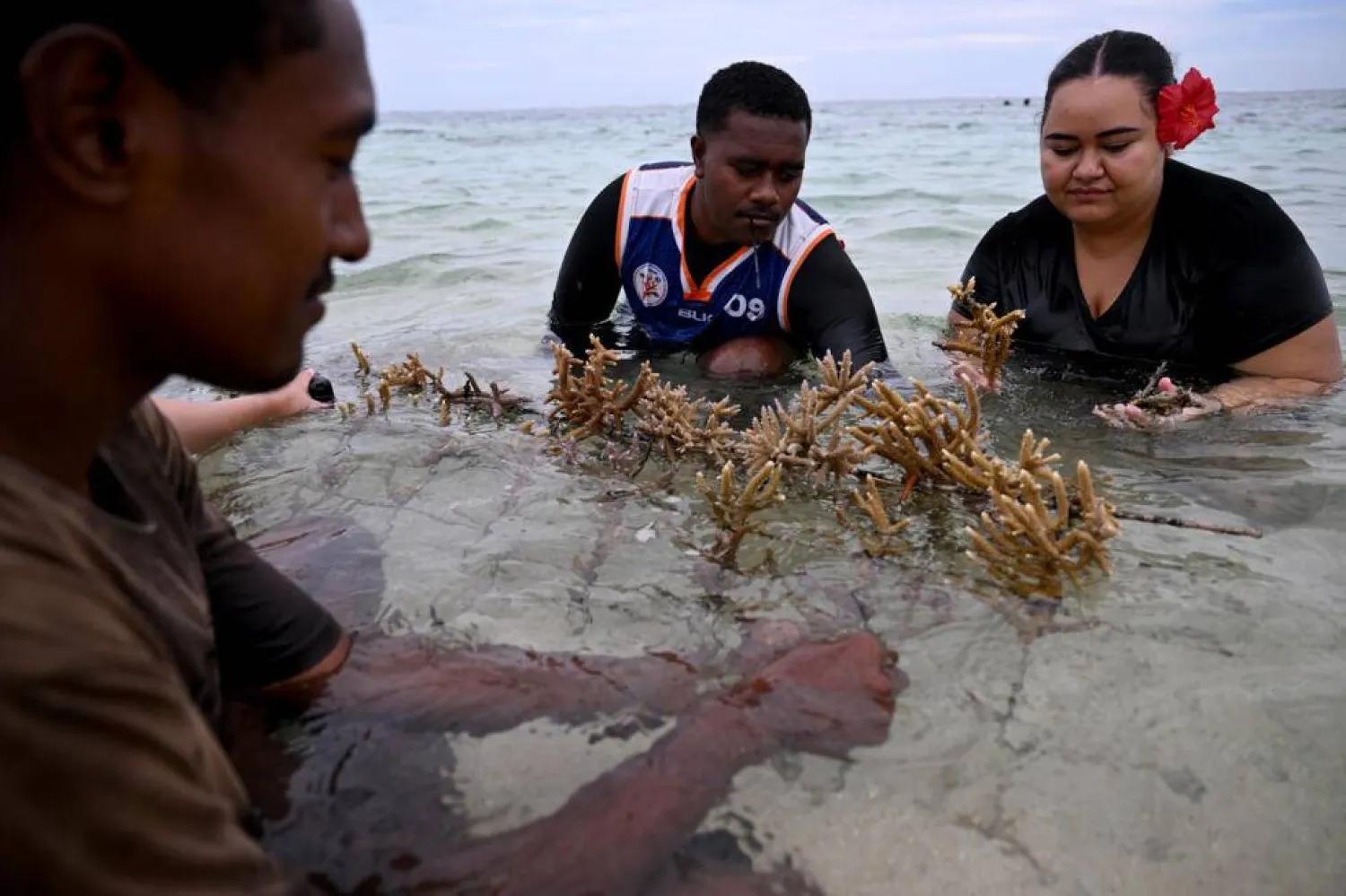
Villagers and environment advocates plant coral in the sea within the Naidiri Marine Biodiversity Park. Saeed KHAN / AFP
TT

Tiny Fiji Village Restores Dying Fishery with Coral Planting

Villagers and environment advocates plant coral in the sea within the Naidiri Marine Biodiversity Park. Saeed KHAN / AFP

It had been decades since sharks last patrolled the reef off the coast of Fiji's Naidiri Village, but they returned this year following a community-led effort to protect the fishery and plant thousands of corals.

Manoa Duwai convinced his village in 2009 to create a protected area within their customary fishing grounds on Fiji's Coral Coast after concerns over the small number and size of fish he was catching.

At the time, he was lucky to catch a fish as big as his palm.

"Man, imagine 10, 15, 20 years to come, what we going to have," Duwai said after a fishing trip one night yielded only tiny, juvenile fish.

"What type of species are we going to have left in our customary fishing ground? We have to do something," he said.

Duwai approached village elders with a proposal to protect part of their fishing grounds, originally a 30-by-40-metre area within the reef.

It didn't take long for the plan to bear fruit, with larger fish finding a home in the protected area and then spreading into the neighboring waters.

In time, the village increased the size of the protected area to 280 by 240 meters. It is now flanked by a similar-sized area they call "the fridge", which they temporarily closed as a way to build up fish stocks.

Duwai's vision for a plentiful marine habitat that would sustain his village of 147 people has now received global praise, with academics and charities seeking his insights.

- Youth ownership -

Joseva Kunagado, 21, leads the youth of Naidiri Village in preserving the health of their protected area.

The village formed a youth group in 2011 to manage what they call the "tabu area", and the group leads the effort to plant corals and encourage a healthy ecosystem.

In 2023 alone, the group planted 18,000 corals and 10,000 mangroves.

"When we started this we were small kids," Kunagado told AFP.

"We used to take some barrels, cut it in half, tie the rope on it, and we pull it. We have to walk for maybe 20 minutes to get corals, come back and plant.

"From that to today, we can say that we are very happy on the work that we have done because we've seen big changes."

The protected area Kunagado and his friends have cultivated is bursting with corals and is now home to hundreds of heat-resistant "super corals" that may protect the village from the impacts of rising sea temperatures.

Sharks have started returning to the area.

Far from being scared, Duwai said he shed a tear when they came back this year.

"When things started to come back, different types of fish species, invertebrates, all back, I'm like the most happiest person in the whole village," Duwai said.

Kunagado said he'd seen sharks the morning of AFP's visit. He smiled with pride at the state of the fishery.

"We didn't see this coming, like having tourists coming, having researchers, students from universities coming. So we're proud of the work."

- Super corals -

Researchers are interested in not only how Naidiri Village has protected their marine ecosystem, but also specific corals showing extraordinary heat resistance.

Duwai said water temperatures reached up to 39C during a heatwave earlier this year, and there was widespread bleaching of the thousands of planted corals.

At those temperatures, most of the coral should have died, but Duwai said 20 percent survived and are considered "super corals".

"The only corals we have here now are the ones who survived this 38, 39 degrees."

Duwai said Naidiri is now transplanting their heat-resistant corals to deeper, cooler waters close to the capital Suva to further protect from future heatwaves.



Hoor Al Qasimi Becomes 1st Arab Woman to Lead Venice Biennale Art Show

Emirati curator Hoor Al Qasimi (Venice Biennale)
TT

Hoor Al Qasimi Becomes 1st Arab Woman to Lead Venice Biennale Art Show

Emirati curator Hoor Al Qasimi (Venice Biennale)

Emirati curator Hoor Al Qasimi has been named as the first Arab and the seventh woman to lead the Venice Biennale contemporary art exhibition, scheduled for 2028.

Al Qasimi leads the Sharjah Art Foundation, which she founded in 2009 to promote contemporary art and foster cultural exchange in the emirate, and has run the Sharjah Biennial since 2003. She curated the UAE’s pavilion at Venice in 2015.

The influential contemporary art magazine ArtReview ranked her No. 1 on its 2024 Power 100 list of the contemporary art world’s most influential figures, highlighting her support for artists beyond the Western mainstream.

The curator’s role is to present an organizing theme for the 62nd International Art Exhibition and choose artists for the main curated show, which runs alongside national pavilions that often take cues from the curator’s vision.

“The International Art Exhibition of La Biennale di Venezia has been an important platform for many of us around the world,’’ said Al Qasimi, who visited her first Venice Biennale in 2005.

“For me, La Biennale continues to be a critical space to engage with the work of influential artists and curators,” she added on Thursday.

Biennale President Pietrangelo Buttafuoco, who recommended Al Qasimi’s appointment, said her work combines “a profound attentiveness to deep-rooted memory and its legacies, an open perspective on the intricate complexities of the present, and a rare ability to listen to places and their people.”

The 61st Biennale contemporary art show curated by the late Koyo Kouoh closed on Sunday.


‘American Doctor’ Documentary Puts Spotlight on Gaza Health Workers

Doctors Feroze Sidhwa and Thaer Ahmad and filmmaker Poh Si Teng of the documentary film ‘American Doctor’ pose for a portrait in London, Britain, November 20, 2026. REUTERS/Kevin Coombs
TT

‘American Doctor’ Documentary Puts Spotlight on Gaza Health Workers

Doctors Feroze Sidhwa and Thaer Ahmad and filmmaker Poh Si Teng of the documentary film ‘American Doctor’ pose for a portrait in London, Britain, November 20, 2026. REUTERS/Kevin Coombs

Filmmaker Poh Si Teng went “all chips in” to reveal the harsh realities of Gaza’s hospitals in her feature debut “American Doctor.”

A former New York Times journalist and Al Jazeera documentary commissioner, Malaysian American Teng left her role at a major studio, used up her savings and fundraised to direct her first feature-length documentary.

The film follows three US doctors, Jewish American orthopedic surgeon Dr. Mark Perlmutter, Zoroastrian trauma surgeon Dr. Feroze Sidhwa and Palestinian American emergency physician Dr. Thaer Ahmad, who volunteer to provide care for Palestinians in Gaza.

Shot by local filmmakers and medics on the ground, it takes viewers inside the overwhelmed operating rooms and hospitals hit by Israeli strikes, depicting the extreme conditions, shortages and difficult decisions the trio and their Palestinian colleagues face.

“A lot of my well-meaning friends told me, ‘if you make this film, know that you’re sabotaging your own commercial film career’,” Teng told Reuters.

“And I thought to myself, ‘look, as a taxpayer, I’m paying for what is happening in Palestine, so if I’m going to be sabotaging my career, then, okay, all ⁠chips in, let’s go. Maybe this is the last feature, so be it’.”

Teng’s team agreed early on to make the film – shot between Christmas 2024 and Christmas 2025 – at record speed to release it before the US midterm elections.

Looking for an entry point that would resonate with audiences and allow her to examine America’s role in the Gaza war, Teng reasoned that “everybody’s got a doctor and has been to OR and ER at some point in their lives.”

“The title was always meant to be like a decoy. It was always meant to be a Trojan horse, especially in the United States, where people were so afraid to talk about Palestine and Gaza. I was, like, ‘let’s give it the most non-controversial title’,” she said.

“People came to watch ‘American Doctor’, quite a substantial chunk of the audience didn’t know what it was, and then when they watched it, they were exposed to what’s happening in Palestine.”

From Khan Younis to Washington

The film shows Sidhwa and Perlmutter working in the surgery department of Nasser Hospital in ⁠Khan Younis, which serves half of Gaza’s 2 million people, and follows Ahmad’s efforts to gain permission to re-enter Gaza.

They also engage in advocacy work, talking to journalists, addressing conventions and travelling to Washington, DC, to meet politicians.

Trying to convince lawmakers to support medical humanitarian aid was not a role they had been eager to take on, said Ahmad, but they felt it was necessary.

“They are casting votes that directly lead to bombs being dropped on our colleagues in Palestine, so it’s essential that they understand how deeply involved they are and that ⁠they need to be held accountable,” he said.

Israel’s campaign in Gaza has strained the decades-long bipartisan support for the country in the US.

Israel’s military has struck the Nasser Hospital complex at least seven times since the start of the Gaza war, according to hospital officials.

Surgeon Rezik Abushira, who is featured in “American Doctor,” was killed in an Israeli airstrike on Nasser Hospital two weeks ⁠ago.

Israel’s military said it targeted a senior Hamas commander and accused the militants of using the hospital complex to plan attacks, which the group denied.

Hospitals are protected sites under international law. Both attacking hospitals and their use for military purposes are typically considered breaches of the law.

Israel’s assault on Gaza has killed more than 74,000 ⁠Palestinians since 2023, caused a hunger crisis, internally displaced Gaza’s entire population and led to assessments of genocide from scholars and United Nations inquiries.

Israel has said its actions were in self-defense after Hamas-led militants killed 1,200 people and took more than 250 hostages in an attack on Israel in October 2023.

The Academy announced earlier this week that “American Doctor,” currently showing in cinemas in Britain and Ireland, was eligible for Oscar consideration.


Tourists Enjoy Brilliant Autumn Colors in Kyoto

Tourists dressed in kimonos pose for photos near autumn leaves next to the Nanzen-ji Buddhist temple in Kyoto on November 25, 2026. (Photo by Andrew CABALLERO-REYNOLDS / AFP)
TT

Tourists Enjoy Brilliant Autumn Colors in Kyoto

Tourists dressed in kimonos pose for photos near autumn leaves next to the Nanzen-ji Buddhist temple in Kyoto on November 25, 2026. (Photo by Andrew CABALLERO-REYNOLDS / AFP)

Visitors from Japan and overseas marveled at the brilliant reds and yellows of Kyoto's autumn foliage season, as it transformed the city's temples, gardens and mountains with a blaze of color.

The ancient Japanese capital is known for its cherry blossoms in spring, but autumn is another peak tourism season, particularly for local visitors keen to enjoy the centuries-old tradition of viewing vibrant fall foliage.

"The autumn leaves themselves are beautiful," Rie Segawa, 34-year-old visitor from Osaka, told AFP, adding that the colors make her "feel calm".

"Seeing them turn red makes me happy to see the seasons changing," she said.

Anthony Piglioni from France said he'd heard so much about the famous cherry blossom season but "the colors are just as beautiful as in the spring".

"It's incredible... the colors, the landscapes... very zen, very relaxing," the 37-year-old told AFP.

Kyoto has a long-standing tradition of appreciating autumn foliage.

During the Heian period between the late eighth century and the late 12th century, when the city was Japan's capital, looking at autumn leaves was an important seasonal pastime among the aristocracy, much like cherry blossom viewing in spring.

The aristocracy would visit the mountains and compose poems celebrating the beauty of the autumn colors.

Over time, trees such as Japanese maples were planted in aristocratic residences, temples and gardens across Kyoto.

Scientists say climate change is delaying famed autumn foliage season in Japan, pushing back the peak display of red and yellow leaves, although this year was within the normal range for Kyoto.