

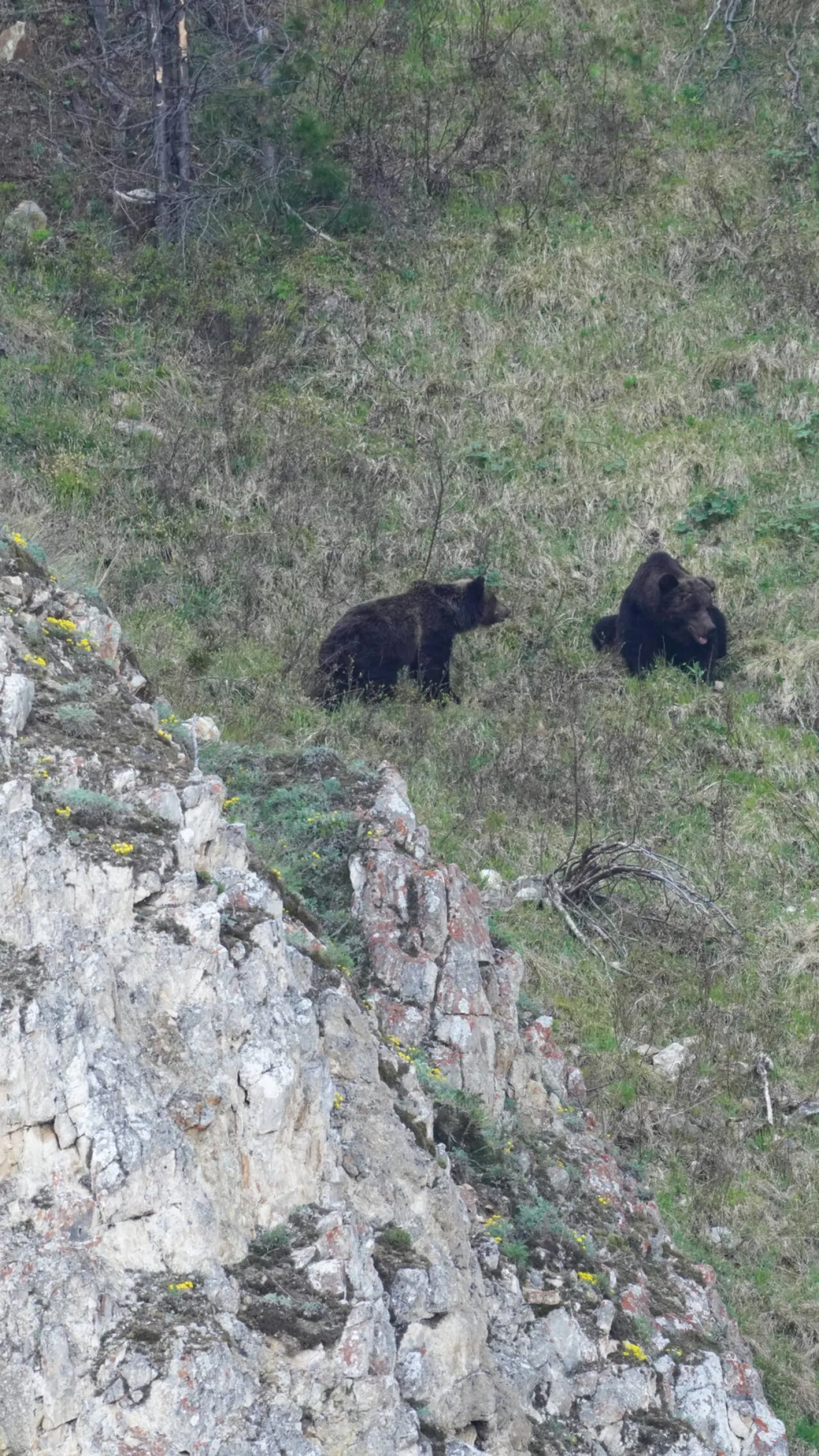

'We've Never Had This': Bear Sightings Spook Russia

Russia's brown bear population has more than doubled since 1990, according to one estimate. Handout / National Park "Zapovednoye Pribaikalye"/AFP
TT

'We've Never Had This': Bear Sightings Spook Russia

Russia's brown bear population has more than doubled since 1990, according to one estimate. Handout / National Park "Zapovednoye Pribaikalye"/AFP

Seeing what looked like a brown blob in a tree while driving through Siberia's Irkutsk region, 36-year-old Daria Tyurneva pulled over, curious to get a better look.

She was not expecting to find a bear cub, perched on a branch, several feet up.

"We stopped, without turning off the engine or taking off the gear, because we knew the mother could be somewhere nearby," Tyurneva told AFP, showing a phone video she recorded of the bear.

Her sighting was one of several to spook Russians in recent weeks, as the country grapples with a spate of deadly bear attacks.

Russia is home to the world's largest population of brown bears. Experts say interactions with bears are becoming more common, as habitat loss and climate change force the animals to find food where humans live.

Their numbers have more than doubled since 1990, from around 130,000 to almost 308,000 in 2026, according to an estimate from Russia's natural resources ministry.

While the number of bear attacks across Russia has remained constant at around 20 to 30 a year, according to the ministry, a series of recent maulings has caused alarm.

At least 26 people have been killed in bear attacks this year, seven of which were in Siberia's vast Krasnodar region, according to Russian state media.

In September, a bear was reported to have killed a 66-year-old woman after dragging her from her window, while a week later, a 39-year-old logger was killed guarding machinery in a forest.

A Siberian town reported last month that it was "under siege" from the furry animals.

- 'I started fighting it' -

Bears flee in the vast majority of encounters with humans, according to the Russian government.

The number of deadly attacks this year has not yet reached the record of around 80 deaths, last seen in 1996, according to the state-owned TASS news agency.

This year has seen abnormally large bear sightings, said Mikhail Strelkov, a ranger in the Lake Baikal national park.

"We've never had this," he told AFP of the recent incursions of bears into urban areas.

"There is no pine nut in the forest, the main food source that the bear eats and uses to fatten before hibernation," he added.

He showed AFP videos his team had recorded of bears frolicking at the edge of Lake Baikal, one of which scampered away upon hearing their boat approach.

Vladimir Odulo, an angler from Russia's far east, told the Komsomolskaya Pravda newspaper in October how a female bear rushed at him on the banks of a river.

"Believe it or not, I didn't even have time to get scared. I started fighting it off with my fishing rod," he said.

He said he escaped after a fight that left him with injuries across his body.

- 'Not afraid of bears' -

Authorities have introduced curfews in some municipalities and formed bands of hunters but some environmental activists say the government may be overestimating the bear population.

So far, in 2026, officials have culled more than "3,400 dangerous bears", TASS reported earlier in October.

Alla, a Russian tourist whom AFP met at the entrance to a hiking trail near Lake Baikal, said she turned back after seeing a sign warning of bears.

"Maybe I will come again to see. Maybe in summer, maybe in winter, when they're hibernating," she said.

Other tourists were unfazed.

"I'm not afraid of bears," said 39-year-old Chinese tourist Nick, who also only gave one name.

Brown bears eat a mixed diet that can include up to 90 percent fruit and vegetation.

Russia's emergencies ministry says the best way to avoid bear encounters is to make loud noises and that in the rare event a bear starts to attack, "to give up".

"It's common for a bear to stop attacking when it feels the threat has been eliminated. Remain motionless for as long as possible," it said.

"If you move and the bear sees or hears you, it may return and resume the attack. In rare cases, an attacking bear may mistake a person for food."



France Faces Sole Fish Crisis as Channel Stocks Collapse

The hopper dredger ship Omvac Doce sails next to the entrance of the "chatiere", a new channel in the port of Le Havre, northwestern France, on November 26, 2026. (AFP)
TT

France Faces Sole Fish Crisis as Channel Stocks Collapse

The hopper dredger ship Omvac Doce sails next to the entrance of the "chatiere", a new channel in the port of Le Havre, northwestern France, on November 26, 2026. (AFP)

Huguette Germain's seafood restaurant is close to the Normandy D-Day beaches and a short walk to a monument to lost sailors, but Germain and the region's fisherman are increasingly worried about a new battle: disappearing sole.

Sole meunière, the emblematic flat fish cooked in lashings of butter, is a staple delicacy of any French fish restaurant worth its salt. But stocks in the eastern Channel separating France and Britain have mysteriously collapsed, sending shock waves through dining rooms and trawler fleets.

"It's become very difficult to find, and there's a good chance we'll have to take it off the menu next year," said Germain, who runs La Trinquette in the fishing village of Grandcamp-Maisy.

Sole meunière has been a staple at her establishment since the 1980s. "But there is no longer enough to be found in Normandy, so we're bringing it in from Brittany" -- at increasingly prohibitive prices.

"Even mackerel is becoming hard to come by," Germain added. "Moving forward, we'll inevitably have to cut back on these types of fish."

With the 2027 quotas on sole fishing slashed in a bid to save stocks, many French fishermen in the region fear they will be put out of business.

The International Council for the Exploration of the Sea (ICES) -- a senior scientific authority -- has recommended a catch limit of 163 tons in the eastern Channel, stretching from the Belgian border to the Gulf of Saint-Malo. This is 87 percent down on 2025.

"It's heartbreaking," said Dimitri Rogoff, president of the Normandy Fisheries Committee. "Sole is what has put food on my table for 30 years. I never thought I'd see this in my lifetime."

He called the crisis "a complete failure in resource management."

- Over-fished -

"It is going to be a catastrophe," predicted Quentin Yonnet, 45, who has a trawler in Port-en-Bessin.

"In the spring, the boats will be left tied up at the dock, and some will end up for sale. It's as simple as that."

Yonnet said some 150 boats in the Seine Bay on the Normandy coast depend on the sole that is shared with trawlers from Britain and Belgium.

Channel sole has long been over-fished. In the early 2000s, the trawlers caught up to 5,000 tons a year in the eastern Channel.

Since 2015 "we have seen a continuous reduction in fishing, yet the stock is not recovering," said Raphaël Girardin, a fisheries scientist at France's main sea institute IFREMER. The sole that survive are also getting smaller and the reasons are mainly unknown.

"We haven't identified a specific culprit," said Girardin, though he did pinpoint some "environmental factors."

In winter, sole spawn hundreds of thousands of eggs offshore. After hatching, the larvae drift for two months. As young sole, they spend the first two years in coastal mudflats that serve as nurseries. Even minor environmental changes can have a radical impact.

Over the past two centuries, Seine Bay has lost a third of the intertidal mudflats that were a vital habitat for juvenile sole. Much has been dredged away so bigger vessels can enter the key river Seine.

Olivier Le Pape, a researcher in fisheries ecology at L'Institut Agro, said that if the bay was in the same conditions as the 19th century there would already be 20 percent more fish.

But Le Pape, who has studied a similar phenomenon in the Bay of Biscay down the coast, said the decline appears to begin as early as the larvae stage though he cannot say why.

Plankton may be changing or there may be problems with the timing of the larvae hatching and the plankton blooms. Le Pape said that could be more fallout from global warming.


Tiny Bee Hotels Open a Hidden World of City Pollinators in South Africa

University of the Witwatersrand researcher Chevonne Reynolds points out a bee hotel room, a small hole drilled into untreated pine attached to a tree trunk, in Johannesburg, South Africa, on Sept. 16, 2026. (AP)
TT

Tiny Bee Hotels Open a Hidden World of City Pollinators in South Africa

University of the Witwatersrand researcher Chevonne Reynolds points out a bee hotel room, a small hole drilled into untreated pine attached to a tree trunk, in Johannesburg, South Africa, on Sept. 16, 2026. (AP)

Just before checkout on a warm spring morning in South Africa, a solitary bee peeks outside one of the world’s smallest hotels and then retreats to her room: a small hole drilled into untreated pine.

Monitoring this tiny, black guest is Celia Haupt of Johannesburg, a banking analyst-cum-bee hotelier who owns one of the 510 bee hotels distributed to volunteers across her city and Cape Town.

As they report on the bees, these citizen scientists are themselves being monitored as part of UrbanBEE, a project exploring how cities shape solitary bee diversity and how engaging with overlooked pollinators can reconnect city dwellers with nature.

Haupt, for one, has spent months watching her bee hotel. She thinks of its guests as “little homebodies” who love their cozy holes but are happy to meet the neighbors now and then.

“They pop their heads out, and I feel like they’re chatting to me,” Haupt told The Associated Press. “For a solitary bee, they’re not so anti-social. Maybe these are the extroverted introverts.”

The hive-dwelling managed western honeybee is among the world’s best-studied insects, but most of the more than 20,000 bee species known worldwide are solitary, making them harder to locate and monitor.

South Africa alone has roughly 1,300 bee species, most of them solitary, and they also help pollinate wild plants and crops as they stock their nests with pollen and nectar for their young, burrowing underground or filling cavities in wood or hollow stems.

UrbanBEE grew out of a pandemic-era project involving 347 Johannesburg residents, led by University of the Witwatersrand researcher Chevonne Reynolds. The expanded project, funded by the European Union-backed Biodiversa+ partnership, includes parallel studies in Budapest, Hungary; Turin, Italy; and Vienna, Austria. The volunteers began submitting weekly photographs in October 2025.

Comparing hotels across African and European cities could show how climate, vegetation, development and socioeconomic conditions affect bee diversity and how collecting data changes how people value urban nature. Researchers also hope a standardized approach can be adapted for other cities as the world gets warmer.

For many participants, learning about biodiversity started with recognizing creatures they hadn’t realized were bees.

“Now I know that not every flying insect is a fly,” Johannesburg citizen scientist Guinivere Pedro said.

Sage Naidoo pointed out a tiny guest using its rear end to guard her room in a hotel hanging from a tree on the Wits campus.

“If you look at this, you might think that it’s an ant with wings, but it’s actually a solitary bee,” said Naidoo, a PhD candidate helping to coordinate the South African campaign. He identified her as an Allodapula, a species that can remain with their young in small social nests. “In my opinion, they’re the cutest type of bee that we have.”

Other species close their nests with mud, plant fibers, leaves, colorful flower petals or a thin, cellophane-like membrane. Behind the seals, young bees develop on stores of pollen and nectar left by their mothers.

“If a leaf cutter enters your hotel, you’ll typically see this bright pop of green,” Naidoo said.

Haupt’s hotel had plenty of rooms but no guests for about two months as a friendly competition intensified. Weekly occupancy maps became informal scoreboards as participants compared arrivals and noted whose hotel was filling fastest.

“Everyone wants to be doing better than their neighbor,” Naidoo said. “It was like, ’My bee hotel has 20 bees, whereas yours has five.'”

The effort brought Haupt and her daughter closer and rekindled a connection with a former schoolmate she had known only from a distance 40 years earlier as they commiserated over their vacancies and, eventually, celebrated arrivals.

“Here we were bonding over a lack of occupancy in the bee hotel, then joy over the bee hotel, and a little bit of rivalry,” Haupt said.

Haupt finally welcomed her first guest after moving her hotel to catch the morning sun. She named the bee “Yoncé,” naturally.

When Pedro joined UrbanBEE, she announced on LinkedIn that she had finally become a property owner: “Finally, I have a hotel of my own,” she said. “It’s just a very small one.”

After a few weeks without guests, Pedro moved her hotel to a sheltered spot, where bees appeared seemingly overnight.

Preliminary results show people changing their gardening practices to attract more pollinators as they've been drawn into the hotels' miniature dramas. Naidoo said researchers also found hotels being occupied earlier in Johannesburg than in cooler and windier Cape Town.

A year later, Pedro's hotel is nearly full. She has planted more flowers, left parts of her garden undisturbed and even taken birding courses.

“The bees revealed to me how much life there is in the garden,” she said. “Once you notice the first small thing, the next small thing presents itself.”


Hoor Al Qasimi Becomes 1st Arab Woman to Lead Venice Biennale Art Show

Emirati curator Hoor Al Qasimi (Venice Biennale)
TT

Hoor Al Qasimi Becomes 1st Arab Woman to Lead Venice Biennale Art Show

Emirati curator Hoor Al Qasimi (Venice Biennale)

Emirati curator Hoor Al Qasimi has been named as the first Arab and the seventh woman to lead the Venice Biennale contemporary art exhibition, scheduled for 2028.

Al Qasimi leads the Sharjah Art Foundation, which she founded in 2009 to promote contemporary art and foster cultural exchange in the emirate, and has run the Sharjah Biennial since 2003. She curated the UAE’s pavilion at Venice in 2015.

The influential contemporary art magazine ArtReview ranked her No. 1 on its 2024 Power 100 list of the contemporary art world’s most influential figures, highlighting her support for artists beyond the Western mainstream.

The curator’s role is to present an organizing theme for the 62nd International Art Exhibition and choose artists for the main curated show, which runs alongside national pavilions that often take cues from the curator’s vision.

“The International Art Exhibition of La Biennale di Venezia has been an important platform for many of us around the world,’’ said Al Qasimi, who visited her first Venice Biennale in 2005.

“For me, La Biennale continues to be a critical space to engage with the work of influential artists and curators,” she added on Thursday.

Biennale President Pietrangelo Buttafuoco, who recommended Al Qasimi’s appointment, said her work combines “a profound attentiveness to deep-rooted memory and its legacies, an open perspective on the intricate complexities of the present, and a rare ability to listen to places and their people.”

The 61st Biennale contemporary art show curated by the late Koyo Kouoh closed on Sunday.