



Japan to Launch Historic Round-trip Mission to Mars Moon

(FILES) A vehicle assembly building is seen at the Tanegashima Space Center in Minamitane, Kagoshima prefecture on August 13, 2026. (Photo by Yuichi YAMAZAKI / AFP)
TT

Japan to Launch Historic Round-trip Mission to Mars Moon

(FILES) A vehicle assembly building is seen at the Tanegashima Space Center in Minamitane, Kagoshima prefecture on August 13, 2026. (Photo by Yuichi YAMAZAKI / AFP)

Japanese scientists are readying a mission to Mars's moons to retrieve samples that could help unlock the origins of the Solar System and life on Earth, in what aims to be the first round trip to the Martian region.

The unmanned Martian Moons eXploration (MMX) probe, a collaboration with US and European space agencies as well as numerous universities and tech companies, could also help lay the groundwork for eventual human exploration.

The flagship H3 rocket carrying the MMX is set to blast off from the Tanegashima Space Center Tuesday at 4:41 am (1941 GMT Monday), according to the Japan Aerospace Exploration Agency (JAXA).

The spacecraft will arrive near Mars one year later, where it will orbit its moon Phobos for up to three years before landing and collecting at least 10 grams (0.35 ounces) of material from the surface.

A rover dubbed IDEFIX -- the French name for the comic hero Asterix's dog -- will first conduct surface observations aimed at ensuring a safe landing.

"The sampling (from) Phobos is of course the world's first, but it means... this is the first round trip to the Martian system," MMX's project manager Yasuhiro Kawakatsu told AFP.

JAXA said the mission will also explore the possibility of using Phobos as a "natural space station" by establishing the requirements for a round trip to Mars -- something "essential for crewed Mars exploration".

It will also observe the Red Planet's moon Deimos, although it will not land on it, before returning to Earth.

JAXA hopes the mission will reveal how Mars and its two moons formed, a key piece of knowledge in working out how the Solar System was born.

One theory for the origin of the Martian moons -- the "giant impact" hypothesis -- is that they formed after a celestial body collided with Mars.

The "capture" hypothesis, meanwhile, postulates that the moons are asteroids captured by Mars's gravity.

Determining which is right will help reveal "how a habitable environment for life might have arisen on the terrestrial planets", JAXA said, referring to the four rocky worlds closest to the Sun -- Mercury, Venus, Earth and Mars.

"MMX will shed light on the transport mechanisms that delivered water, volatiles, and organic compounds from the outer Solar System to the inner rocky planet region -- processes that may have played a key role in making these worlds habitable," said Patrick Michel, a French astrophysicist working on IDEFIX.

"If Phobos and Deimos are indeed remnants of these early delivery systems, they may hold clues to the origins of life itself, or, to be more correct, to the transport of the materials that were key to the emergence of life on rocky planets," he told AFP.

MMX is a collaboration with France's National Centre for Space Studies (CNES), the German Aerospace Center (DLR), NASA, the European Space Agency (ESA), and about 20 universities and tech companies.

The development of the spacecraft's landing legs was particularly difficult, as gravity on Phobos is extremely weak, JAXA scientists say.

Japan's unmanned Smart Lander for Investigating Moon (SLIM) -- the "Moon Sniper" -- tipped over after touching down on Earth's Moon in 2024, but still transmitted data and survived several two-week lunar nights.

Japan also has experience in bringing back samples from space, including JAXA's unmanned Hayabusa-2, which returned 5.4 grams of rock and dust collected from an asteroid several hundred million kilometers from Earth in 2020.

One of the differences between JAXA's past asteroid probes and the MMX mission is that this time "we have to travel very close to Mars and return", which means escaping the planet's heavy gravity, Kawakatsu told reporters.

Phobos orbits about 6,000 kilometers above the Martian surface.

"Going deep into what we call the 'gravity well' is difficult," Kawakatsu said.

US and Chinese space agencies have been racing to be the first to return rock samples from Mars's surface back to Earth.

NASA's Perseverance rover, which has been roaming the Red Planet since 2021, has already collected samples.

The mission, however, was effectively cancelled by the administration of President Donald Trump following a vote by the US Congress in January.

China, meanwhile, has announced its Tianwen-3 spacecraft is scheduled for launch around 2028 and hopes to return Mars samples to Earth as early as 2031 -- potentially before the MMX's return.

JAXA scientists say sand and rocks from Phobos may offer a wider variety of samples than those on the planet itself, especially if it was formed by a collision between a celestial body and Mars.



Fisherman, 71, Killed by 12-foot Alligator Alongside Florida Lake

FILE - An alligator peers from the water's surface at the Circle B Bar Reserve, Tuesday, Oct. 21, 2025, in Polk County, Fla. (AP Photo/Chris O'Meara, File)
TT

Fisherman, 71, Killed by 12-foot Alligator Alongside Florida Lake

FILE - An alligator peers from the water's surface at the Circle B Bar Reserve, Tuesday, Oct. 21, 2025, in Polk County, Fla. (AP Photo/Chris O'Meara, File)

A 71-year-old man fishing on the shore of a Florida pond was attacked and killed on Friday by a nearly 12-foot alligator, the second fatal such attack reported this year.

Steven Hamilton of Winter Garden was standing on the shoreline of Lake Apopka at Dr. Bradford Memorial Park, 15 miles (24 kilometers) northwest of Orlando, when the reptile struck around 5 p.m., the Winter Garden Police Department said.

The presence of other active alligators in the water complicated any chance of rescuing Hamilton, whose body was recovered around two hours later, Winter Garden Fire Chief Jose Gainza told FOX35.

Hamilton's death marked the second deadly alligator attack in Florida this year.

After a 31-year-old Oviedo woman, Brittany Clark, was killed by a 13-foot alligator near her home in June, Republican US Rep. Greg Steube introduced a resolution calling for the Comptroller General and US Department of the Interior to study the impacts of the American alligator's listing as “threatened due to similarity of appearance” on Florida's ability to remove nuisance alligators from residential and commercial waterways.

He said the species has been fully recovered since 1987, but it remains protected to prevent trafficking and the hunting of the similar-looking American crocodile.

Using Florida state data, the two 2026 deaths bring the total number of individuals killed by alligators since 1948 to 34. Among them was a 61-year-old woman tipped out of her canoe by an alligator in 2025 and an 85-year-old widow who was dragged out of her backyard by an alligator while walking her dog in 2023.

According to The Associated Press, Police Capt. Michael Mason said authorities were not alerted in advance Friday that an alligator was near the shoreline of the lake, possibly because the lake “has tons of alligators in it.”

He said police have launched a joint investigation with the Florida Fish & Wildlife Conservation Commission, whose trappers captured and killed the animal.

“Always be aware of your surroundings. Always be safe,” he said. “Wildlife: Respect it. Keep your distance. It looks like it's docile, it looks like your Florida emblem, but it can be dangerous.”


Exotic Species Appear Off California Thanks to an Unusually Strong El Niño

Dana Wharf Sport Fishing and Whale Watching co-owner Donna Kalez poses in front of her family's 55-year-old business on the waters of Dana Point, California, US, October 9, 2026. REUTERS/Mike Blake
TT

Exotic Species Appear Off California Thanks to an Unusually Strong El Niño

Dana Wharf Sport Fishing and Whale Watching co-owner Donna Kalez poses in front of her family's 55-year-old business on the waters of Dana Point, California, US, October 9, 2026. REUTERS/Mike Blake

The longfin bigeye fish was spotted in California for the first time last month, and the first sea turtles of any kind nested on California beaches. Meanwhile, a venomous yellow-bellied sea snake swam ashore as whale sharks and hammerheads cruised just off the coast.

Exotic species have been visiting California's shores since an unusually strong El Niño weather phenomenon arrived this year. Occurring naturally every few years, El Niño brings warm ocean water farther north, and tropical species with it, providing California with a stunning visual display that has become ever more evident with the advent of drone and video technology.

"There's kind of a buzz. Fishermen are loving it for sure. I'm as interested as anybody else. It's strange times," said Nate Jaros, vice president of animal care at the Aquarium of the Pacific in Long Beach.

Other visitors include flying fish and manta rays.

California had already experienced an unusual marine heat wave just before its arrival. This year's phenomenon coincided with a string of hurricanes ⁠in the eastern ⁠Pacific, fueling sea level rise and large waves that have destroyed homes and denuded some Southern California beaches of sand. Preparing for more effects to come this winter, California has declared a state of emergency.

But it has provided a bounty for businesses like Dana Wharf Sportfishing & Whale Watching. Co-owner Donna Kalez said anglers have pulled in 5,000 yellowfin tuna this year, compared to 2 a year ago. They are also landing wahoo and dorado, also known as mahi-mahi, a green fish with a blunt head giving it the profile of a bulldozer.

"Dorado is very exciting because they're very acrobatic, so they jump out of the water. We ⁠catch them off kelp paddies, and it's a thrill," Reuters quoted Kalez as saying.

Experts expect conditions to mostly return to normal after El Niño, a natural phenomenon predating human-caused climate change, passes next year. The greatest short-term harm may be to kelp, which thrives in colder waters and provides habitat for multiple species, experts say.

"It’s good for some sharks and probably bad for others," said Chris Lowe, director of the Shark Lab at California State University, Long Beach. "For animals that can't move, that's a bigger problem, right? Most sharks that are highly mobile. They can simply move."

The yellow-bellied sea snake may have venomous fangs but cannot swim like a large shark.

When an apparently sick one swam ashore in Orange County in September, a beachgoer used a palm frond to lift it off the sand and drop it in the sea. Jaros said that based on cellphone video he had little doubt it was the yellow-bellied sea snake, Hydrophis platurus.

There have only been six or ⁠seven confirmed sightings in California, said ⁠William Ludt, associate curator of ichthyology at the Natural History Museum of Los Angeles County. The last confirmed sighting came during the El Niño of 2015-2016, he said.

Exotic sharks such as the whale shark — a gentle giant and the largest fish on Earth — and the more menacing-looking hammerheads venture into California waters during El Niño. Both have been spotted recently. Lowe said a white shark nursery reappeared for the first time since 2011 in Santa Monica Bay, where juveniles frolic without bothering humans.

Ludt said the aptly named longfin bigeye fish species was recorded for the first time in California this year when an angler caught one on the Venice Fishing Pier in Los Angeles.

When two olive ridley sea turtle nests were found on a pair of Orange County beaches in September, they marked the first-ever recorded nest for any sea turtle species on the US West Coast, according to the US National Oceanic and Atmospheric Administration. The first was discovered by a beachgoer in Seal Beach on September 16, the second by lifeguards in neighboring Huntington Beach three days later, officials said.

And other new species may yet arrive.

"We still aren't fully through it," Ludt said. "It's still very much ongoing."


'We've Never Had This': Bear Sightings Spook Russia

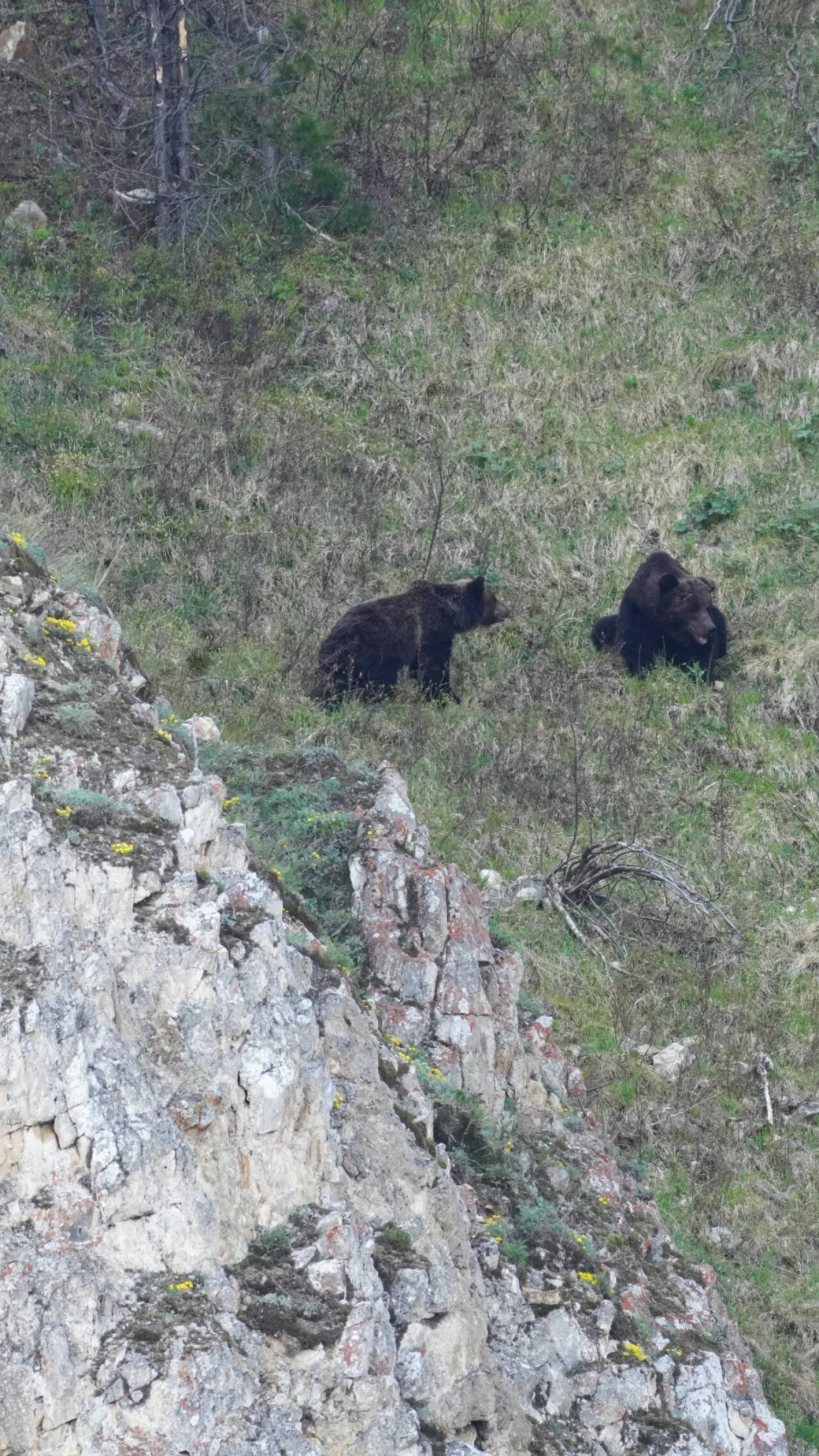
Russia's brown bear population has more than doubled since 1990, according to one estimate. Handout / National Park "Zapovednoye Pribaikalye"/AFP
TT

'We've Never Had This': Bear Sightings Spook Russia

Russia's brown bear population has more than doubled since 1990, according to one estimate. Handout / National Park "Zapovednoye Pribaikalye"/AFP

Seeing what looked like a brown blob in a tree while driving through Siberia's Irkutsk region, 36-year-old Daria Tyurneva pulled over, curious to get a better look.

She was not expecting to find a bear cub, perched on a branch, several feet up.

"We stopped, without turning off the engine or taking off the gear, because we knew the mother could be somewhere nearby," Tyurneva told AFP, showing a phone video she recorded of the bear.

Her sighting was one of several to spook Russians in recent weeks, as the country grapples with a spate of deadly bear attacks.

Russia is home to the world's largest population of brown bears. Experts say interactions with bears are becoming more common, as habitat loss and climate change force the animals to find food where humans live.

Their numbers have more than doubled since 1990, from around 130,000 to almost 308,000 in 2026, according to an estimate from Russia's natural resources ministry.

While the number of bear attacks across Russia has remained constant at around 20 to 30 a year, according to the ministry, a series of recent maulings has caused alarm.

At least 26 people have been killed in bear attacks this year, seven of which were in Siberia's vast Krasnodar region, according to Russian state media.

In September, a bear was reported to have killed a 66-year-old woman after dragging her from her window, while a week later, a 39-year-old logger was killed guarding machinery in a forest.

A Siberian town reported last month that it was "under siege" from the furry animals.

- 'I started fighting it' -

Bears flee in the vast majority of encounters with humans, according to the Russian government.

The number of deadly attacks this year has not yet reached the record of around 80 deaths, last seen in 1996, according to the state-owned TASS news agency.

This year has seen abnormally large bear sightings, said Mikhail Strelkov, a ranger in the Lake Baikal national park.

"We've never had this," he told AFP of the recent incursions of bears into urban areas.

"There is no pine nut in the forest, the main food source that the bear eats and uses to fatten before hibernation," he added.

He showed AFP videos his team had recorded of bears frolicking at the edge of Lake Baikal, one of which scampered away upon hearing their boat approach.

Vladimir Odulo, an angler from Russia's far east, told the Komsomolskaya Pravda newspaper in October how a female bear rushed at him on the banks of a river.

"Believe it or not, I didn't even have time to get scared. I started fighting it off with my fishing rod," he said.

He said he escaped after a fight that left him with injuries across his body.

- 'Not afraid of bears' -

Authorities have introduced curfews in some municipalities and formed bands of hunters but some environmental activists say the government may be overestimating the bear population.

So far, in 2026, officials have culled more than "3,400 dangerous bears", TASS reported earlier in October.

Alla, a Russian tourist whom AFP met at the entrance to a hiking trail near Lake Baikal, said she turned back after seeing a sign warning of bears.

"Maybe I will come again to see. Maybe in summer, maybe in winter, when they're hibernating," she said.

Other tourists were unfazed.

"I'm not afraid of bears," said 39-year-old Chinese tourist Nick, who also only gave one name.

Brown bears eat a mixed diet that can include up to 90 percent fruit and vegetation.

Russia's emergencies ministry says the best way to avoid bear encounters is to make loud noises and that in the rare event a bear starts to attack, "to give up".

"It's common for a bear to stop attacking when it feels the threat has been eliminated. Remain motionless for as long as possible," it said.

"If you move and the bear sees or hears you, it may return and resume the attack. In rare cases, an attacking bear may mistake a person for food."