


Coalition Thwarts Houthi Attempt to Smuggle Weapons at Sea as Taiz Withstands Militant Assaults

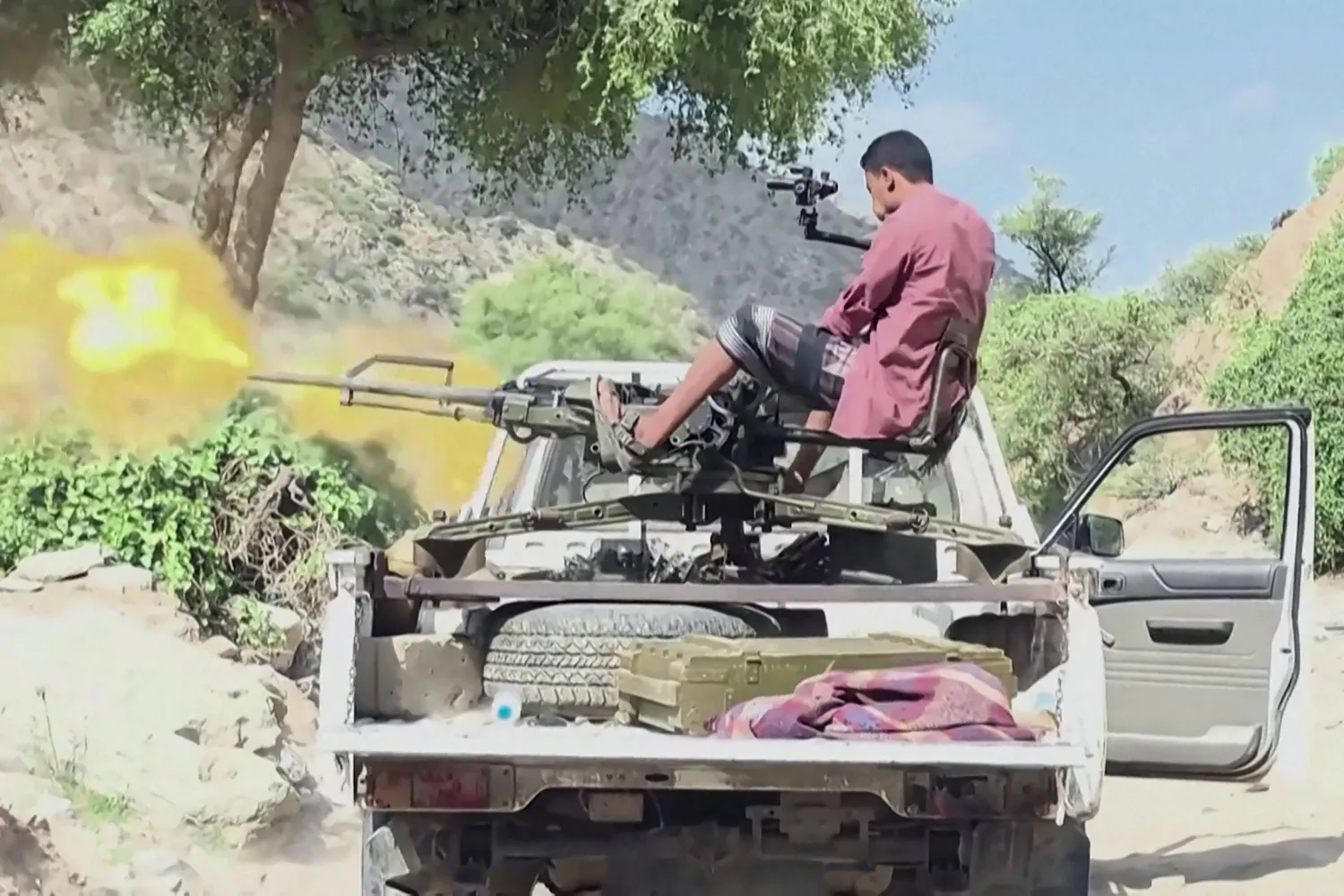
This frame grab taken on October 9, 2026, from AFPTV video footage shows a member of the Yemeni government forces firing a machine gun mounted on a pick-up truck during clashes with Houthi fighters in Hayfan district, south of Taiz, on October 8, 2026. (AFPTV /AFP)
TT

Coalition Thwarts Houthi Attempt to Smuggle Weapons at Sea as Taiz Withstands Militant Assaults

This frame grab taken on October 9, 2026, from AFPTV video footage shows a member of the Yemeni government forces firing a machine gun mounted on a pick-up truck during clashes with Houthi fighters in Hayfan district, south of Taiz, on October 8, 2026. (AFPTV /AFP)

The Coalition to Support Legitimacy in Yemen thwarted an attempt by the terrorist Houthi group to smuggle weapons at sea to Yemen’s Hodeidah governorate in a development that highlights efforts to cut off the militants’ military supply lines.

On the ground, clashes continued along fronts in Taiz as Operation Dawn of Yemen expands.

In a video on the X platform about the smuggling operation, Coalition spokesperson Major General Turki al-Malki said: "We strike them on land... we sink them in the sea."

On Saturday, Operation Dawn of Yemen entered its 13th day amid ongoing Houthi attacks on the fronts in the southwestern city of Taiz. Government forces and the Popular Resistance repelled the attacks in fierce battles, with the Houthis incurring heavy losses, according to Yemeni military statements.

The Yemeni Armed Forces announced that it carried out 1,417 precise and direct operations, using warplanes, drones and field artillery, targeting militia gatherings, reinforcements, fortified positions, firing sources, armored vehicles, combat equipment, and drone launch sites.

Yemeni Armed Forces spokesman Majed al-Nuzaili said the operations have disrupted Houthi movement, preventing them from deploying their reserves to the fronts or achieving any tactical objective on the ground.

The operations killed and injured around 800 militants, and destroyed or damaged more than 190 armored, transport and supply vehicles, as well as fortifications and firing positions, he added.

The Armed Forces on the eastern front managed to clear hostile positions and expand their scope of control, securing a new tactical field position, he went on to say.

In Taiz, al-Nuzaili said the Armed Forces and the Popular Resistance thwarted continuous waves of attacks, while warplanes targeted the militia's positions and reinforcements with concentrated strikes, inflicting heavy losses among their ranks.

The Armed Forces confirmed that their operations are strictly confined to legitimate military targets and are executed in accordance with international humanitarian law and its customary rules.

They renewed their call to citizens in areas under the control of the militias to protect their children from recruitment campaigns and from being dragged into losing battles in defense of a project that does not represent the Yemeni people and does not serve their homeland.

In another development, al-Nuzaili said that government forces and the Popular Resistance detained a number of Houthi field commanders.

According to government forces' statements, the Houthi militia continues to send reinforcements to the frontlines to compensate for its losses.

The steadfastness of government forces is preventing the Houthis from achieving their field goals, despite the continuous military pressure, they added.

The developments are not limited to Taiz. The Armed Forces announced that they made new progress in Marib, taking control of strategic positions. Meanwhile, operations on the southern and western fronts aim to deplete the group's capabilities and weaken its movements.

According to al-Nuzaili, military engineering units continue to remove mines and explosive devices planted by the Houthis, as well as securing the recaptured areas and opening roads for the armed forces.



Egypt's Sisi Says His Rule Will End in 2030, Dismisses Reports He Is Grooming Relative for Presidency

Egyptian President Abdel Fattah al-Sisi. (Egyptian Presidency)
TT

Egypt's Sisi Says His Rule Will End in 2030, Dismisses Reports He Is Grooming Relative for Presidency

Egyptian President Abdel Fattah al-Sisi. (Egyptian Presidency)

Egyptian President Abdel Fattah al-Sisi stressed that his presidency will end in 2030, calling the date a "settled matter," ruling out constitutional amendments and dismissing speculation that he is grooming a relative to succeed him.

Political and strategic affairs experts told Asharq Al-Awsat that Sisi's remarks marked a major shift and a historic precedent, potentially putting to rest speculation over constitutional changes that could distract from Egypt's development priorities.

Sisi came to power in 2014 after winning the presidential election and secured re-election in 2018 and 2023. Constitutional amendments passed in 2019 extended presidential terms from four to six years and allowed him to seek a third term, which expires in 2030.

No constitutional changes

Speaking at a graduation ceremony for Egyptian Military Academy cadets on Saturday, Sisi insisted that the constitution would remain untouched.

He said his presidency would definitively end in 2030 and that the matter was not open to debate, stressing that Egypt had an abundance of qualified citizens capable of leading the country.

Sisi also rejected speculation that he was preparing a family member or relative to succeed him, saying the Egyptian Military Academy had a role in training future leaders.

He stressed the need to safeguard the state against individuals unable to shoulder the responsibilities of leadership.

With 43 months remaining until 2030, he suggested dedicating 30 months to preparing prospective leaders.

He called for the speaker of parliament, prominent intellectuals and politicians, and the ministers of higher education and justice to develop a comprehensive framework that would pave the way for legislation governing the election of qualified candidates.

The program, he suggested, could train groups of 200, 300 or 500 participants in the workings of the state and the requirements for safeguarding it, broadening the choices available to Egyptian voters.

Sisi urged action on the proposal, emphasizing the responsibility to protect Egypt and its future and keep its flag flying high.

His remarks follow speculation on social media that the constitution could be amended in 2027 to allow him to seek another presidential term.

A historic precedent

Major General Mohamed el-Ghabari, a strategic affairs expert and former director of Egypt's National Defense College, said Sisi's declaration signaled a commitment to the constitutional transfer of power.

Speaking to Asharq Al-Awsat, he said Sisi wanted history to remember him for helping establish that principle, becoming the first Egyptian president in decades to clearly set an end date for his rule.

The remarks conveyed Sisi's belief that he had assumed office with a sense of duty and intended to hand over power with the same responsibility, while pressing ahead with development plans despite economic challenges and regional turmoil threatening stability and growth, he added.

Ghabari said Sisi was also making clear that the choice of Egypt's next leader rests with its people, warning that speculation about constitutional amendments or extending his presidency served no national interest and risked diverting attention from development and strategic planning.

He stressed that building credible political alternatives would require effective parties and institutions capable of nurturing leaders with clear platforms and the ability to present their visions to voters.

Mohamed Ezz al-Arab, head of the Arab and Regional Studies Unit at the Al-Ahram Center for Political and Strategic Studies, said Sisi appeared determined to make 2030 the endpoint of his rule.

Speaking to Asharq Al-Awsat, he said: "What's striking is not just his announcement that his presidential term will end in 2030, but his call for the speaker of parliament to work with the justice minister and political, party and academic figures on selecting and preparing centers of excellence and future leaders."

"That would represent a major shift if things proceed as intended," he added.

Ezz al-Arab said Sisi's remarks reinforced the principle that Egypt is a state of institutions, where power cannot be inherited by his sons or any other family member.


Thousands Protest in Tunisia Demanding Return of Democracy, Freedoms

A scene from the mass demonstrations that swept through the streets of Tunisia's capital (EPA)
TT

Thousands Protest in Tunisia Demanding Return of Democracy, Freedoms

A scene from the mass demonstrations that swept through the streets of Tunisia's capital (EPA)

Thousands poured into the streets of Tunisia’s capital on Saturday in a mass protest demanding the restoration of democracy and freedoms, reflecting growing anger over President Kais Saied's policies amid accusations that he has failed miserably to tackle the worsening economic crisis.

The protest, led by the powerful Tunisian General Labor Union (UGTT) and influential organizations including the Human Rights League, the Bar Association and the Journalists' Union, was the largest of its kind in several years. It marked a significant challenge to Saied after years of divisions that had weakened his opponents' ability to mobilize supporters.

In a rare show of unity, opposition parties from across the political spectrum, including groups that had been at odds for years, joined lawyers, doctors, journalists, unemployed people and civil society organizations in the protest.

Demonstrators gathered in Mohamed Ali Square, the headquarters of the UGTT, before marching through Tunis toward Habib Bourguiba Avenue, a focal point of the demonstrations that sparked the Arab Spring 15 years ago.

Hundreds of police officers were deployed across the capital's streets and neighborhoods, many of which were closed off. The protest was held under the slogan "Tunisia First... The People Above All Else," with demonstrators waving Tunisian flags.

"Tunisia's crisis today is fundamentally the result of one person monopolizing all powers," UGTT Secretary-General Slah Eddine Salmi told the crowds.

According to Reuters, protesters chanted demands for freedoms, judicial independence, an end to the prosecution of political opponents and an end to infringements on trade union rights.

They also carried banners and chanted slogans expressing growing frustration over widespread unemployment, poor public services and what they described as false promises.

"There is no democracy without freedoms,There is no dignity in poverty," and "No to criminalizing civil and political activity," read some of the slogans.

The demonstrators also chanted in unison: "O failed regime... Departure is the only solution."

"Enough is enough! The country is collapsing. We suffer from power and water cuts, and one crisis after another," said Yassine Gharseli, a protester from Sfax, about 250 km south of Tunis.

"I came from Sfax to stand up for my freedom and I'm not about to give up, even if I become the last voice in the country."

Boubaker Ben Thabet, head of Tunisia's National Bar Association, said civil society groups were "uniting today to defend citizens' right to live in dignity and work freely, as guaranteed by international conventions and the constitution."

Protesters also chanted angrily: "No fear, no terror... The streets belong to the people," and "Freedoms! The police state is over."

They revived one of the most prominent slogans of Tunisia's revolution, which later echoed across countries in the region: "The people want the fall of the regime."

Demonstrators also chanted slogans condemning the Interior Ministry and the government's performance, describing it as a "government of failure" and demanding its departure.

The protest comes amid a worsening economic crisis and a sharp deterioration in public services, including repeated water and electricity outages and shortages of medicines and some basic goods.

The march also coincides with mounting demonstrations by unemployed people demanding jobs and faster implementation of a law passed a year ago allowing the employment of people who have been out of work for more than a decade.

Meanwhile, opposition groups are demanding the release of dozens of political figures opposed to Saied's rule who have been imprisoned for more than three years.

Local and international human rights organizations accuse Saied of intensifying a crackdown on civil society groups and imprisoning journalists and opposition leaders, saying he has turned the country into an open-air prison.

Saied, however, rejects accusations of authoritarianism and repression, saying he is not a dictator and remains determined to purge the country of those he describes as traitors, corrupt figures and conspirators.

He also accuses his opponents of manufacturing economic crises to fuel social unrest and destabilize the country from within.

In 2021, Saied consolidated control over most state powers, later dissolving the elected parliament, beginning to rule by decree, disbanding the judicial council and dismissing dozens of judges in moves his critics described as a coup.


Senior Hamas Official Reveals Gaza Political Chief Wounded in Israeli Strike

Hamas official Ali al-Amoudi. (Hamas-affiliated Palestinian Information Center)
TT

Senior Hamas Official Reveals Gaza Political Chief Wounded in Israeli Strike

Hamas official Ali al-Amoudi. (Hamas-affiliated Palestinian Information Center)

A senior Hamas official has confirmed that Ali al-Amoudi, the acting head of the group's political bureau in Gaza, was wounded in an Israeli strike on a residential apartment in western Gaza City on Oct. 3 that killed five Palestinians.

Speaking to Asharq Al-Awsat late Friday on condition of anonymity, the official said al-Amoudi suffered moderate injuries, including fractures to his limbs, in the attack on the apartment in Gaza City's port district.

Al-Amoudi was inside the apartment when it was hit but survived because he was in a section away from the main impact, the official said. He declined to provide further details, saying only that al-Amoudi was in good health and receiving treatment at a secure location.

The disclosure marks the first acknowledgment by a Hamas official that al-Amoudi was inside the apartment during the strike, contradicting accounts from several sources who told Asharq Al-Awsat in recent days that he had left the building before the attack. Those sources had also confirmed his survival.

Narrow escape

Three Hamas sources had told Asharq Al-Awsat days earlier that an urgent intelligence warning reached al-Amoudi about three hours before the strike, prompting him to leave the apartment.

The report did not explicitly warn of an imminent operation targeting him personally, but the sources said he took it seriously and moved to a secure location.

In separate but consistent accounts, the sources said the warning followed suspicious Israeli drone activity detected by two operatives from the air unit of the Izz el-Deen al-Qassam Brigades, Hamas' armed wing.

On Oct. 2, the operatives spotted two Israeli intelligence drones repeatedly circling the building and the surrounding port district in western Gaza City.

The aircraft were of a type known to Palestinian security agencies for their sophisticated surveillance capabilities, the sources said. According to the sources, the drones carried advanced intelligence-gathering systems, including artificial intelligence technology designed to help identify targets with precision.

After tracking the aircraft for hours, the two operatives suspected an assassination operation against a senior figure in the area was being prepared. They alerted higher-ranking security officials, setting off a chain of warnings that eventually reached those responsible for protecting senior Hamas figures, including al-Amoudi.

The sources said al-Amoudi's sole security aide, who knew his whereabouts, immediately went to warn him. Believing he could be the target, al-Amoudi decided to leave the apartment without delay.

Roughly an hour or more later, the apartment was struck with guided missiles and one or two explosive-laden drones, according to the sources.

The senior Hamas official who confirmed al-Amoudi's injuries would neither confirm nor deny those earlier accounts.

He said Hamas commanders at various levels routinely receive intelligence reports from field operatives monitoring Israeli drone movements over Gaza. Such activity, he said, can signal possible assassination attempts or other operations in areas under surveillance.

Asharq Al-Awsat sought clarification from its earlier sources after learning that al-Amoudi had been wounded and had remained inside the apartment until the strike. Two did not respond. A third said his information had come from an internal report but offered no further explanation.

Hamas may have concealed details of al-Amoudi's injuries even from its own leaders and figures in other Palestinian factions as part of an intelligence campaign aimed at portraying Israeli strikes as failures and keeping Israeli security agencies uncertain.

Some Israeli media reports have indicated that Israeli authorities are investigating why the operation failed.

Key figure in Hamas' inner circle

Al-Amoudi has emerged as a central figure in Hamas' leadership, known within the movement for his security background and strategic thinking.

His rise through the ranks has accelerated in recent years, with a series of senior responsibilities entrusted to him since his release from Israeli imprisonment.

He was a close associate of former Hamas leader Yahya al-Sinwar, a relationship forged during their years together in Israeli prisons and maintained after their release.

Al-Amoudi was freed in 2011 in the prisoner exchange deal involving Israeli soldier Gilad Shalit.

A member of Hamas' political bureau, al-Amoudi headed the group's media department before the war.

In December 2025, he became the acting head of its political bureau in Gaza after he and several other close associates of Sinwar were tasked with running the movement in the territory. Most of those appointed were based in Khan Younis in southern Gaza.

The arrangement, however, faced opposition from some Hamas leaders, who rejected the appointments and endorsements as an attempt to bypass the movement's internal rules.

In the days and weeks before the assassination attempt, al-Amoudi had also contested an internal election to lead Hamas in Gaza against Nizar Awadallah.

The vote failed to produce a decisive winner, leading to a runoff that was subsequently suspended following a challenge to the process.

Al-Amoudi remains an influential figure in Hamas, both inside Gaza and beyond, with a significant role in shaping the movement's decisions.