
In Shadow of War, Israelis to Decide if Hard-Right Turn Is Permanent

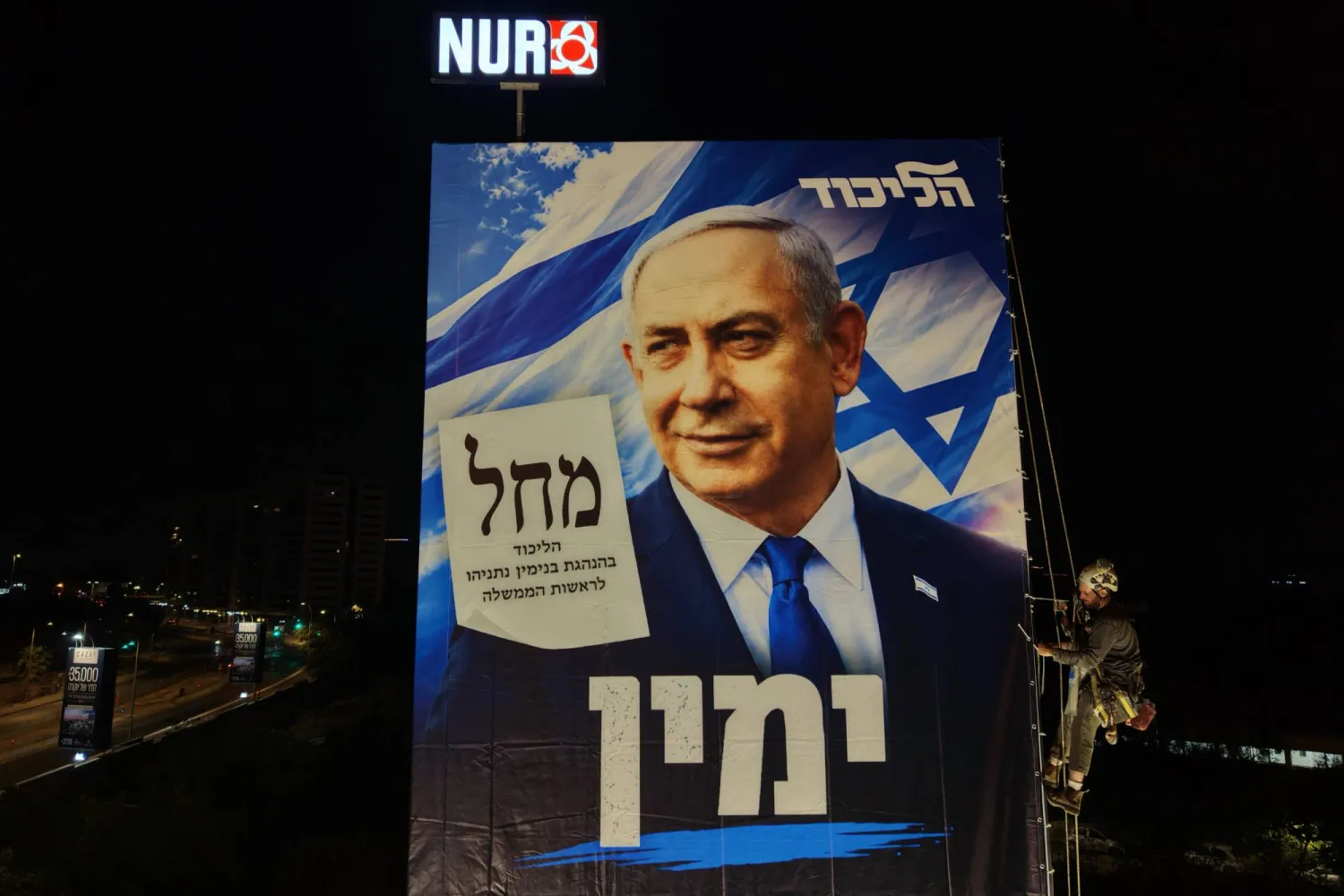
Rappelling workers install an election billboard featuring an image of Israeli Prime Minister Benjamin Netanyahu, and reading in Hebrew "It's either the Right or Palestine," in Ramat Gan near Tel Aviv, Israel, 18 October 2026. (EPA)
TT

In Shadow of War, Israelis to Decide if Hard-Right Turn Is Permanent

Rappelling workers install an election billboard featuring an image of Israeli Prime Minister Benjamin Netanyahu, and reading in Hebrew "It's either the Right or Palestine," in Ramat Gan near Tel Aviv, Israel, 18 October 2026. (EPA)

Three years after suffering their deadliest single attack, Israelis will deliver their verdict on veteran Prime Minister Benjamin Netanyahu in an October 27 election that could decide if the country moves definitively into hard-right nationalism.

The trauma of October 7, 2023 remains raw across Israel. Faded stickers bearing the smiles of young people killed by Hamas cover station walls and lampposts, and at bustling restaurants, no one bats an eye as patrons dine with their assault rifles, now liberally allowed.

Netanyahu, Israel's longest-serving prime minister who polls show is in a tight race, is seeking a new mandate after leading a multi-front regional war in response to October 7, with Israel reducing Gaza to rubble, occupying part of Lebanon and, with US help, bombarding Iran.

The relentless Gaza campaign has brought pariah status to Israel in many once-friendly Western countries, and Netanyahu himself faces an arrest warrant from the International Criminal Court.

Even if the public broadly has supported the war's aims, the effects at home have been much more divisive, including emboldening Netanyahu's far-right allies bent on reshaping Israel into a religious-nationalist Jewish state.

"I really think that these elections are about the future of the state in a literal sense," said Gideon Rahat, a political scientist at the Hebrew University of Jerusalem and the Israel Democracy Institute.

Netanyahu's government has ramped up settlements in the occupied West Bank where settlers armed with the blessing of far-right National Security Minister Itamar Ben-Gvir have been attacking Palestinians on their lands with only occasional pushback from authorities.

"The state without a monopoly on the use of force is a failed state," Rahat said.

Netanyahu, who turns 77 on October 21, has served as prime minister on and off for more than 19 years.

The wily political operator returned to power in December 2022 bringing in once-shunned ultra-nationalists and quickly tried to rein in the judiciary, which is examining corruption charges that could land him in jail.

The proposed reforms brought out some of the largest protests in Israel's history in the months before the Hamas attack.

"Everyone in the country has a strong opinion about Netanyahu. People either hate him or adore him," said Alon Yakter, a political scientist at Tel Aviv University.

"When you want to see who people vote for, the first question you have to ask is their emotional feelings about Netanyahu."

- Anti-Netanyahu in style, not stance -

Seeking to unseat Netanyahu is an informal bloc of parties united mostly around their distaste for him.

Netanyahu's most formidable rival, according to polls, is former military chief Gadi Eisenkot, who is in many ways his antithesis -- a political novice who wants to unite centrists rather than rally a base, and a phlegmatic speaker with halting English and none of the American-raised Netanyahu's flair for blistering, headline-grabbing speeches.

Eisenkot, as well as other opposition leaders, have zeroed in on why Netanyahu failed to prevent October 7.

Netanyahu has been rocked by reports he ignored warnings. He vehemently denies the charges, blaming security chiefs who he said failed to wake him up that morning.

Netanyahu "may have his perfect English, but even with perfect English he got us October 7", Eisenkot, in Hebrew, told a security conference at Reichman University.

Eisenkot's son died in the Gaza war -- offering an unspoken contrast to Netanyahu's son Yair, a globe-trotting social media provocateur.

The working-class son of Moroccan Jewish immigrants, Eisenkot would be the first prime minister of Middle Eastern ancestry, a watershed in a country politically dominated since its founding by an elite of European descent.

Opposition leaders have not criticized Netanyahu's decision to wage war, likely a losing stance in a country where a recent survey found that only 21 percent of the population identifies as anywhere left of center.

Eisenkot, as military chief during the 2006 Lebanon war, promoted the Israeli doctrine of using massive force even against civilian infrastructure when in areas used by militants, such as Hezbollah.

The opposition has instead heavily focused on social issues including Netanyahu's tight alliance with ultra-Orthodox Jews, a fast-growing segment of the population due to high birth rates that has promoted religious priorities, such as keeping public transit closed on Saturdays.

Netanyahu, while personally secular, has allowed religious students to remain exempt from military service, a source of particular resentment when stretched reservists have served multiple tours.

Opposition figure Naftali Bennett, prime minister in a short-lived 2021-22 government, has vowed to end all exemptions to military service and said that social divisions were putting Israel on a "slow-motion suicide mission".

- Hardline appeal -

While the opposition attacks Netanyahu over October 7, for some Israelis, the aftermath of the attack shows the government has brought stability.

While Israelis have died in Iranian and Hezbollah retaliatory attacks, fire has stopped from Gaza, even as Israel keeps striking the territory and Hamas remains.

Israel's economy has boomed since October 7, with construction sites dotting the major cities and the stock market soaring, led by the technology and defense sectors.

Neriah Yarchi, 19, a barber from Bat Yam near Tel Aviv, came of political age after October 7. He said he would vote for far-right Finance Minister Bezalel Smotrich, who wants the "voluntary" removal of Gaza's two million Palestinians.

"If Gaza had been ours, they wouldn't have had a place to infiltrate from and there wouldn't have been a massacre," Yarchi said.

Netanyahu has sought to seize on his international notoriety, with his Likud party putting up posters of leaders including New York Mayor Zohran Mamdani, an outspoken critic of Israeli policies, that read, "They want Netanyahu to lose. Don't let them win."

Netanyahu has also vowed loudly never to align with parties representing Arab Israelis, who make up around one-fifth of the population and who some expect to turn out in higher numbers after the intense anti-Arab stances of some of Netanyahu's ministers.

Arab lawmakers broke precedent to be kingmakers in the 2021-2022 government.

If the new election's results are as close as expected, it could take weeks or months to form a government. Eisenkot has said he would not ally with Arab parties or Netanyahu, but some critics do not believe he would refuse.

Uriel Reichman, a former lawmaker who founded the university bearing his name, told the conference addressed by Eisenkot that a Netanyahu triumph could permanently entrench Israel's right-wing turn.

He drew a parallel to countries where an elected populist packs the government with loyalists and transforms once-independent institutions.

"Experience shows that once such a system is put in place, it would be extremely difficult to dismantle it," he said.


Weapon Technology in The Hands of Terrorist Groups

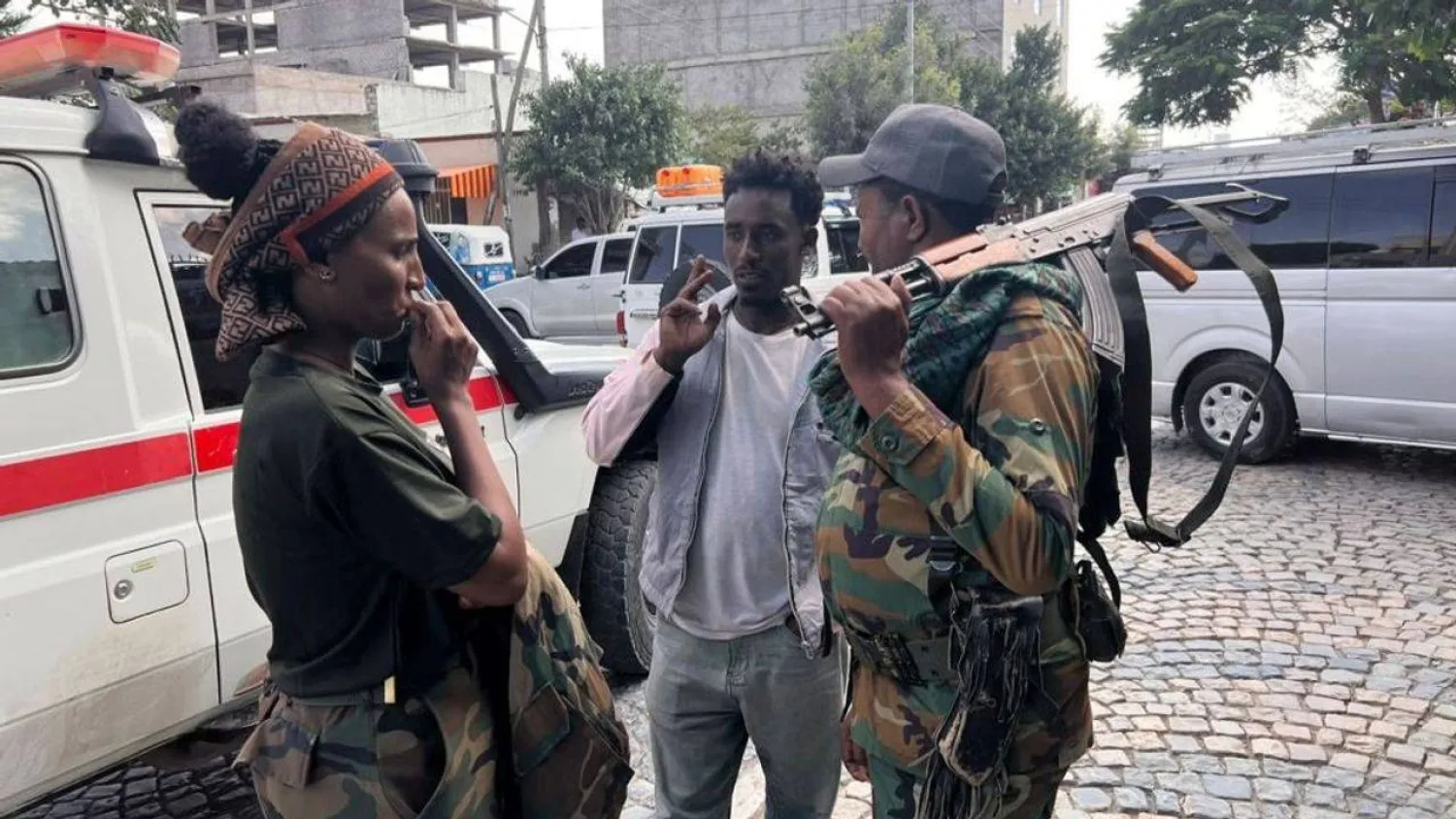
Weapons on the streets of cities in Ethiopia’s Tigray region. (AP) 
TT

Weapon Technology in The Hands of Terrorist Groups

Weapons on the streets of cities in Ethiopia’s Tigray region. (AP) 

By: Mohammed Al-Rayes

From the battlefield to the digital realm, terrorist and rebel groups across Africa are reshaping the security landscape, harnessing advanced technologies to expand their capabilities and transform warfare in ways scarcely imaginable a decade ago.

Military and strategic experts interviewed by Asharq Al-Awsat warned that the growing technological capabilities of rebel, separatist and extremist groups in Ethiopia, Somalia, Mali, Burkina Faso, Mozambique, Sudan and Libya pose mounting security threats that could push governments to strengthen their defense and offensive capabilities through modern technology and artificial intelligence.

The threat is unlikely to recede as armed groups continue to acquire advanced technologies, particularly low-cost drones.

On November 24, customs authorities in Burkina Faso announced the seizure of drones, military equipment and satellite communications devices worth more than 80 million CFA francs (122,000 euros) before they could be illegally brought into the country.

Customs Director General Yves Kafando said some of the confiscated drones were dual-use devices designed for civilian applications but could be repurposed in ways that threaten national security.

Drone warfare has become increasingly prevalent in Sudan and Ethiopia, while rebel groups in Mali, including the Azawad Liberation Front (FLA) and the Group for the Support of Islam and Muslims (JNIM), have made territorial gains against regular forces since 2023.

The technology has also featured in confrontations between Libya’s rival authorities in Benghazi and Tripoli and in attacks by rebels operating in North and South Kivu in eastern Democratic Republic of Congo (DRC).

An evolving threat

Drones, however, represent only one dimension of the growing technological threat.

Somalia’s representative to the UN Security Council, Ambassador Abukar Dahir Osman, known as Abukar Baale, warned in September that the terrorist threat was constantly evolving, with extremist groups increasingly exploiting modern technology, communications software and artificial intelligence.

Digital tools have also transformed how armed groups conduct surveillance, disseminate propaganda and disinformation, recruit fighters, communicate and secure funding.

Egyptian military and strategic expert Brigadier General Samir Ragheb told Asharq Al-Awsat that the danger lay not merely in armed groups acquiring sophisticated weapons but also in the imbalance in costs and the resulting attrition imposed on regular armies.

He attributed territorial gains by armed groups in Mali and Burkina Faso partly to their exploitation of technology and domestic instability, arguing that some national armies had become largely symbolic or were preoccupied with governing and military coups.

The challenge is compounded by porous borders, difficulties policing cyberspace, widespread weapons proliferation and the limited resources of several African militaries.

Ragheb also pointed to support and financing networks linked to the region’s natural resources and competing regional and international interests, including Russia’s presence in Africa and its indirect confrontation with Western and Ukrainian actors.

An open arms market

Major General Amin Ismail Majzoub, a Sudanese military and strategic expert specializing in crisis management and negotiations, attributed these developments to the emergence of an increasingly unregulated global arms market.

Illicit arms trading and the widespread availability of technical knowledge, he explained, have enabled terrorist organizations, particularly in Africa, and transnational organized crime networks to acquire weapons using illicit funds.

In several countries ravaged by insurgencies and wars, weapons and advanced technologies have fallen into the hands of terrorist groups, allowing them to develop combat capabilities and train personnel to operate them.

Mujahed Al-Sumaidaie, an expert at the European Center for Counterterrorism and Intelligence Studies, said technological advances had fundamentally altered the nature of confrontations between regular armies and terrorist organizations in Africa.

Affordable equipment, advances in satellite communications and navigation, and the proliferation of dual-use technologies have strengthened armed groups’ capabilities, imposing mounting security and military costs on the countries confronting them.

These developments, Al-Sumaidaie argued, are redefining asymmetric warfare, with numerical superiority and conventional military arsenals no longer sufficient to secure territorial control or military victory.

Weak government control over vast conflict zones, inadequate border security, expanding smuggling and organized crime networks, and political instability have all contributed to the spread of such technology.

The problem is exacerbated by inadequate legislation and oversight of dual-use equipment, poor coordination between security and intelligence agencies, corruption and the limited ability of some governments to trace terrorist financing.

Countering the threat

African governments are stepping up efforts to confront the growing challenge.

Ethiopian Prime Minister Abiy Ahmed told parliament on November 25 that his country had strengthened its defense forces through modern technology and was already seeing tangible results.

Majzoub argued that long-established African armies, dating back to their countries’ independence in the 1960s and 1970s, possessed the technical expertise, training infrastructure and skilled personnel needed to handle advanced technologies.

Fourth-generation warfare, he explained, has required greater technological proficiency and postgraduate education for military personnel.

Countries including South Africa, Nigeria, Egypt, Ethiopia and, to some extent, Sudan have made advances in domestic manufacturing, drone technology and counter-drone capabilities.

Security and military cooperation across the continent also encompasses joint training programs and coordination among military chiefs through the African Union, the Intergovernmental Authority on Development (IGAD) and regional military groupings in East, West and Central Africa.

These bodies facilitate exchanges of information and expertise to counter terrorist organizations and their evolving capabilities.

Majzoub also highlighted the role of the Committee of Intelligence and Security Services of Africa (CISSA), a continental intelligence body that holds annual meetings under a rotating presidency.

The organization has considerable experience in intelligence sharing, data analysis and efforts to contain conflicts. Regional and bilateral security alliances have further strengthened cooperation against terrorist threats.

Challenges requiring a comprehensive approach

Despite these advances, Al-Sumaidaie cautioned against treating African armies as a homogeneous military establishment, given the considerable disparities in their capabilities.

While Egypt, Algeria, Morocco and South Africa possess relatively advanced military, technological and intelligence capabilities compared with neighboring countries, many Sahel states face severe financial, technical and intelligence constraints.

They also lag in developing early warning, surveillance, electronic warfare and air defense systems, while their military personnel lack adequate training in modern warfare.

“The fundamental challenge facing some African armies is the transition from conventional military doctrine to a more flexible one capable of absorbing technological advances,” Al-Sumaidaie said.

He advocated establishing joint regional mechanisms for intelligence sharing, coordinating border surveillance, pursuing smuggling and financing networks, and adopting common legislation regulating sensitive technologies.

Ragheb stressed that confronting the threat required an integrated approach, beginning with improving the efficiency and training of regular armies.

Such a strategy must extend beyond military considerations to encompass ideological, cultural and development dimensions, alongside international efforts to halt foreign interference that fuels conflicts and supplies armed groups with technology, and to support the restoration of national institutions.

Majzoub identified another obstacle: Africa’s transformation into an arms market.

He accused arms dealers, manufacturers and suppliers of perpetuating instability across the continent, arguing that their commercial interests undermined prospects for peace.

As insurgencies and internal wars subside in one place, they erupt elsewhere, sustaining arms sales, maintenance services and the presence of military experts in new conflict zones, he said.

It is as though Africa were destined to see technology become a curse that transcends borders, he added.

From Somalia to the Sahel: Terrorism’s digital reach

Technological threats across Africa have grown at an unprecedented pace over the past decade as terrorist and rebel groups increasingly challenge regular armies.

From the Sahel and West Africa to the Lake Chad Basin and the Horn of Africa, several extremist, separatist and insurgent movements have emerged as prominent actors in this technological race.

Group for the Support of Islam and Muslims (JNIM)

Established in March 2017, the Al-Qaeda affiliate operates across the Sahel, particularly in Mali, Burkina Faso and Niger, with activities extending into neighboring countries such as Benin.

It has emerged as one of the most active armed groups using drone technology in the region, with attacks increasing significantly since 2023, particularly in Mali.

Boko Haram and ISIS West Africa Province (ISWAP)

Boko Haram and its splinter faction, ISWAP, operate across the Lake Chad Basin, encompassing Chad, Cameroon, Niger and Nigeria.

A 2025 report by a nongovernmental peace research center documented their growing reliance on technology for surveillance, propaganda and recruitment, followed by its increasing incorporation into combat operations.

That trend accelerated in late 2024 and early 2025 and continued into 2026.

Al-Shabaab in Somalia

Founded in 2004, Al-Shabaab pledged allegiance to Al-Qaeda in 2012 and has waged an insurgency against Somali authorities in a country plagued by weak central government since the overthrow of President Mohamed Siad Barre in 1991.

The group has increasingly incorporated drones into its activities and reportedly received military training from Iran-backed Houthi militants in 2026.

March 23 Movement (M23) in the Democratic Republic of Congo

The movement, reportedly renamed the Front for the Refoundation of the Nation in October, has seized vast stretches of mineral-rich eastern DRC since resuming its insurgency in 2021.

The rebels, who seek to overthrow the Congolese government, reportedly named former President Joseph Kabila as their leader.

A drone attack claimed by the movement against the airport in the strategic northeastern city of Kisangani in February 2026 highlighted its growing technological capabilities.


Iran’s Flogging of Singer Was Warning from Anxious Hardliners, Insiders Say

 Iranians shop at a street market in Tehran, Iran, 23 November 2026, as the country faces an economic crisis amid ongoing US-Iran tensions. (EPA)
Iranians shop at a street market in Tehran, Iran, 23 November 2026, as the country faces an economic crisis amid ongoing US-Iran tensions. (EPA)
TT

Iran’s Flogging of Singer Was Warning from Anxious Hardliners, Insiders Say

 Iranians shop at a street market in Tehran, Iran, 23 November 2026, as the country faces an economic crisis amid ongoing US-Iran tensions. (EPA)
Iranians shop at a street market in Tehran, Iran, 23 November 2026, as the country faces an economic crisis amid ongoing US-Iran tensions. (EPA)

Iran's flogging of a female singer this week for offending public decency was a display of force by an embattled clerical elite straining to uphold public obedience it once took for granted, Iranian insiders say.

Parastoo Ahmadi, 29, and four members of her production team received 74 lashes each on Monday for a livestreamed performance in a caravanserai near the city of Qom in which she had bare shoulders, no headscarf and male musicians, defying Iran's theocratic legal code.

Her punishment - which shocked many Iranians following years of looser enforcement of dress laws - came two years after footage of the concert first appeared online, underscoring the political nature of the decision to flog her, the sources said.

"I think the authorities are sending a message of fear through the flogging," said Saba Robatjazy, a London-based Iranian singer who performs under the stage name Emma and has known Ahmadi since they sang together as children.

AUTHORITIES ARE WARY OF HARD WARTIME WINTER, ANALYST SAYS

The timing, nine months into a war that has ravaged Iran's economy and nearly a year after nationwide protests, showed the heightened levels of concern in a ruling system determined to suppress any defiance of its rule, the sources said.

According to the sources - three officials and two other establishment insiders - the sentence was ‌a warning to potential dissidents ‌and a sop to hardline supporters of the system whose loyalty is critical to upholding its rule.

However, while ‌the decision ⁠was backed by ⁠hardliners within the hierarchy, more moderate officials did not support the move, fearing it would inflame public opinion and prove divisive at a difficult time, one of the people said.

The sources spoke to Reuters on condition of anonymity.

The Iranian government says its judiciary is independent and such punishments have nothing to do with politics.

Two of the officials said the approaching anniversary of last winter's protests had heightened concerns that mounting economic grievances worsened by the war could again spill over into anti-government protests that it was a priority to avert.

"They know it's going to be a hard winter. This war might go on for many more months to come, and they do worry about public protests and they sometimes take decisions like this one just to flex muscle," said Alex Vatanka of the Middle East Institute think tank.

Three of the sources also described what they called growing anger among hardliners over lax ⁠enforcement of dress codes which since the 1979 revolution have required women to cover their hair and wear a long, ‌loose coat over their clothes.

Those rules have been routinely ignored across Iran since mass protests in 2022 following ‌the death in custody of a woman who had been detained for breaking them - marking a rare success for a national protest movement in the country.

PUNISHMENT AIMED TO SEND MESSAGE ‌WHILE AVOIDING BACKLASH

However, while President Masoud Pezeshkian has cautioned authorities against pushing back on social and cultural issues through force, hardline politicians have demanded action against what ‌they see as subversive moral backsliding.

Since the US and Israel attacked Iran on February 28, hardliners have encouraged their supporters to flood Iran's streets in defense of the ruling system with rallies and other events aimed at maintaining a public display of unity and denying space to internal dissent.

Supporters of the hardline faction in Iran, those most fervently anti-Western and inflexible in enforcing the revolution's writ, remain an influential force, regularly winning more than a tenth of votes in national elections.

The role they have played has made it more important to placate them over issues such ‌as public morality, the sources have said, and there have been indications a crackdown may come.

Gholamali Haddadadel, a conservative politician and father-in-law of Supreme Leader Mojtaba Khamenei, said on September 9 that wartime conditions were preventing authorities from enforcing dress ⁠codes as emphatically as they would like.

However, ⁠by punishing Ahmadi and her team, the establishment may be seeking a way to reassure hardliners without risking the public backlash that a nationwide crackdown on women could provoke, said the two insiders.

While the punishment of Ahmadi may temporarily satisfy hardliners and intimidate opponents, the authorities must contend with an uncomfortable truth: the demands of their most hardline supporters are increasingly at odds with the changing aspirations of many Iranians.

"I do think that although we cannot see the light right now and how things will go moving forward, but we have always had and we always have faith that better days will come," Ahmadi's London-based childhood friend Robatjazy said.

Although she has not been in touch with Ahmadi for months with communications into Iran more difficult since the start of the year, she believes the singer and her team were aware of the risk they were taking by livestreaming their performance, she said.

There was no word on their condition or location following the flogging, which she said had not stamped out defiance.

"I think that the punishment that they gave Parastoo and her band members is only bringing up more anger from people," she said.

For hardliners, not punishing such open defiance of compulsory veiling would mean more than relinquishing control over women’s appearance. It would amount to acknowledging that decades of resistance had forced the regime to compromise on one of its founding ideological principles, one of the officials said.

Skylar Thompson, deputy director at Human Rights Activists News Agency, a US-based group, said the punishment was part of a broader push for control.

"The regime has made a clear and concerted effort to continue to police the way women express themselves in public and the way that they move about their daily lives," she said.


Israeli Veteran Soldiers Protect Palestinians from Settler Attacks

An Israeli soldier stands on the rear step of an army vehicle as troops block Palestinians from reaching the Hamsa area to protest settler attacks, property destruction and land confiscation, on the outskirts of the West Bank city of Dura, Friday, Nov. 27, 2026. (AP)
TT

Israeli Veteran Soldiers Protect Palestinians from Settler Attacks

An Israeli soldier stands on the rear step of an army vehicle as troops block Palestinians from reaching the Hamsa area to protest settler attacks, property destruction and land confiscation, on the outskirts of the West Bank city of Dura, Friday, Nov. 27, 2026. (AP)

The four Israeli soldiers stepped out of their car in the occupied West Bank, their faces masked, their uniforms unmarked and automatic weapons strapped across their shoulders.

They had entered a Palestinian olive grove but, little did they expect, the person there planning to tell them to leave could have once been issuing them orders.

A retired Israeli general, Eyal Ben Reuven, had come that day to the Palestinian town of As Sawiyah, on a mission to prevent some of the rampant violence against Palestinians by extremist Israeli settlers.

For the 72-year-old, joined by fellow battle-hardened veterans of the Israeli military, the violence is a stain on the institution in which they once served.

"I've fought in a number of wars. And unfortunately, I have reached the point where I have seen an evolution," said the former military man with piercing eyes, who spent much of his career driving tanks.

The army is failing to act, he said, even when the violence has reached a level "I never could have imagined".

Unrest has soared in the West Bank since the unprecedented October 7, 2023 attack by Hamas on Israel, which responded with a massive military campaign in the Gaza Strip.

More than 1,100 Palestinians have been killed by the army or settlers in the West Bank since then. More than 50 Israelis have died in the same time in the territory, which Israel captured in 1967.

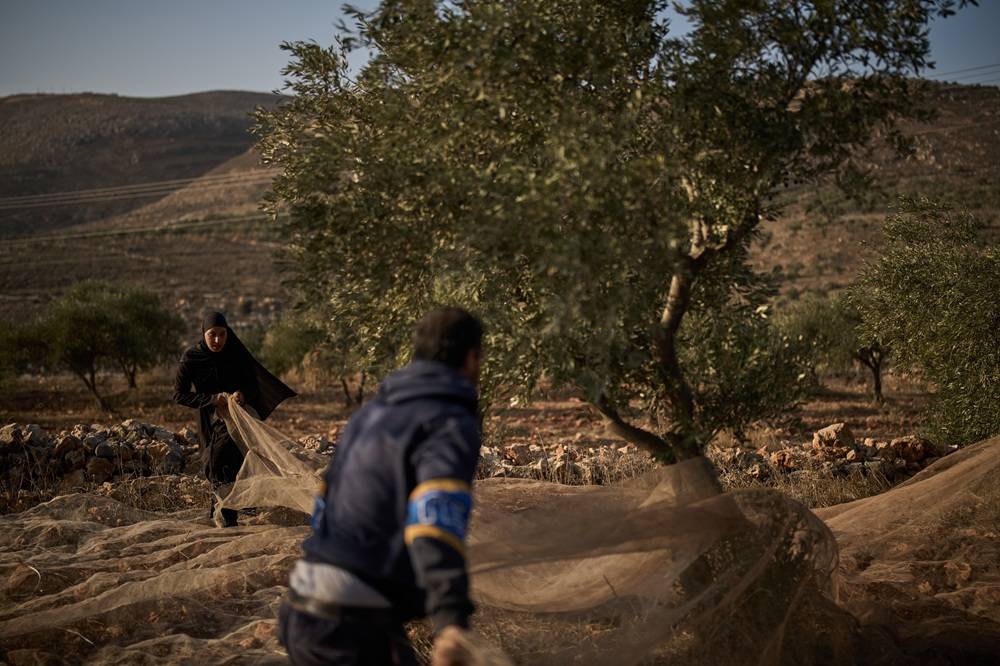
The olive harvest has become a flashpoint, with settlers attacking or stealing from Palestinian farmers on a nearly daily basis.

With the other former soldiers, Ben Reuven has set up a protective presence, a tactic more common among leftist activists who put themselves in the way in a bid to stop attacks against Palestinians.

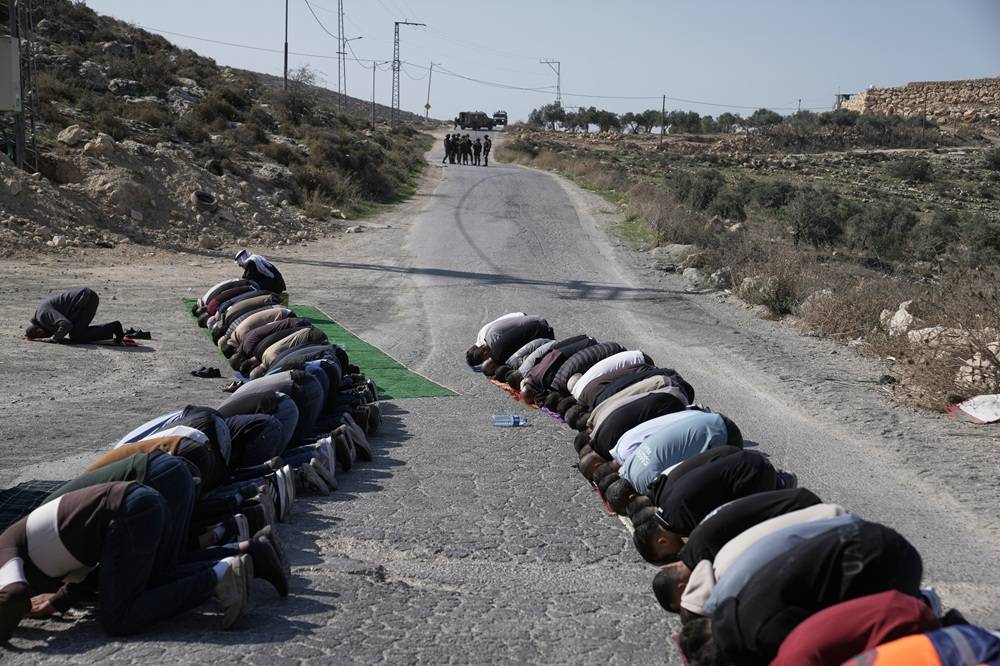
Palestinians pray on a road blocked by Israeli soldiers as they try to reach the Hamsa area to protest settler attacks, property destruction and land confiscation, on the outskirts of the West Bank city of Dura, Friday, Nov. 27, 2026. (AP)

- Army intervenes in harvest -

Clad in comfortable hiking attire and carrying walking sticks, it is difficult to imagine that some of the greying volunteers fought in intense combat.

Like good soldiers, they review instructions upon going out -- they are there to assist the olive harvest, not to confront the settlers, and they will obey the army's instructions.

A Palestinian human rights activist, Arafat Abu Ras, led the military men to a small olive grove. An old Palestinian woman was waiting to guide them and the soldiers, more accustomed to the battlefield than to farming, used sticks and small rakes to start knocking the olives off the trees, volunteering to do the work on the Palestinians' behalf.

Almost immediately a military vehicle arrived. Under the humming of a drone, one of the serving soldiers shoved aside an AFP team to prevent filming, while another checked Abu Ras's identity papers and ordered everyone to leave.

Abu Ras said that the olive farmers had coordinated with the army, which insists that Palestinians receive approval for their harvests in the occupied West Bank, arguing that it is for safety reasons.

"They say, 'yes, yes', and then the next day they come and force us to leave," Abu Ras said.

After the serving soldiers arrived, a second vehicle came, this time with Israeli settlers. An official from a neighboring settlement also ordered the olive pickers out, with troops saying it was a "closed military zone".

The Israeli veterans, in line with their guidance, complied. They instead moved elsewhere with the farmers, hoping to prevent attacks on them.

"Our army is a joke," fumed Yoel Feldschuh, a 77-year-old former air force brigadier general.

"Is it its role to shut an olive grove? What does the military have to do with that?"

Feldschuh made headlines when he was handcuffed and taken away by police in a similar action a month earlier.

Changing the behavior of the military, he said, "will take a generation".

Salsabil, 16, left, and a Palestinian man spread a net under an olive tree to collect olives during the harvest with the support of Israeli activists in the West Bank village of Majdal Bani Fadil, Friday, Nov. 27, 2026. (AP)

- Rampant violence -

COGAT, the Israeli body responsible for civil affairs in the Palestinian territories, maintains that "security forces are deployed to ensure a safe olive harvest".

But since September, the harvest has been marked by nearly 500 attacks, some of them fatal, according to the Israeli human rights organization Yesh Din.

Amram Mitzna, an 81-year-old retired general, attributes the army's inaction to the young ages of the soldiers, who have grown up under now-caretaker Prime Minister Benjamin Netanyahu, Israel's longest-serving leader.

"They consider every Arab an enemy who must be treated as such," said Mitzna, who has also served as mayor of Haifa, Israel's third largest city.

Netanyahu has allied himself with the far-right and championed a rapid growth of West Bank settlements, which are considered illegal under international law.

Netanyahu is fighting for political survival after losing ground in elections. Gadi Eisenkot, a former general seeking to succeed him, supports many of Netanyahu's security policies but accuses him of yielding to "Jewish terrorism" in the West Bank and vowed to crack down on extremist settlers.

In As Sawiyah, the former soldiers eventually finished harvesting the olives in a nearby area alongside a school, putting them in bags to be taken by Palestinian villagers.

While no one was injured, Ben Reuven remained deeply disturbed by how the young soldier acted during the altercation.

"When I saw him arrive, masked, shouting, kicking sacks of olives, I was ashamed."