


What Does Egypt’s Pledge to Support Saudi Arabia Mean for Regional Security and Yemen’s Future?

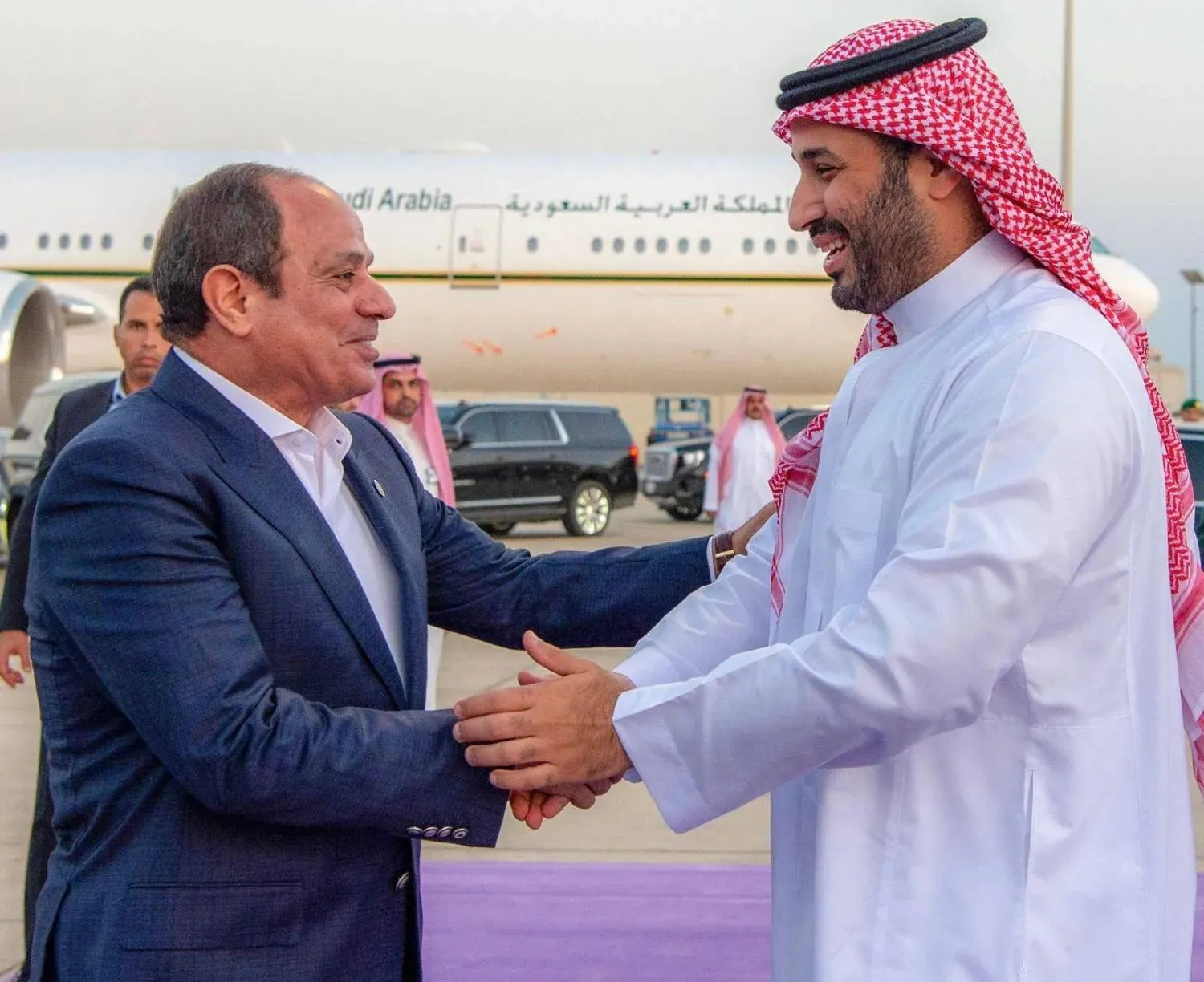
Egyptian President Abdel Fattah El-Sisi meets Saudi Crown Prince Mohammed bin Salman in NEOM during his visit to Saudi Arabia in August 2025 (SPA)
TT

What Does Egypt’s Pledge to Support Saudi Arabia Mean for Regional Security and Yemen’s Future?

Egyptian President Abdel Fattah El-Sisi meets Saudi Crown Prince Mohammed bin Salman in NEOM during his visit to Saudi Arabia in August 2025 (SPA)

Egyptian President Abdel Fattah el-Sisi's announcement on Saturday that his country would take any measures necessary to protect and defend its Saudi brothers, "in accordance with the directives of King Salman bin Abdulaziz and Crown Prince Mohammed bin Salman," has gained considerable momentum within the framework of the two countries' historic relations, with potentially significant implications for geopolitical developments in the region.

Cairo began taking concrete steps on Sunday, when the National Defense Council, chaired by El-Sisi, decided to "provide all necessary and possible forms of support to Saudi Arabia to defend its security and stability, safeguard its resources, territorial integrity and Islamic holy sites."

The decision was based on "the historic relations and strong bonds between the peoples of the two brotherly countries, which represent the heart of the Arab nation, and the conviction that Saudi national security is inseparable from Egyptian and Arab national security."

Both countries possess substantial and advanced military capabilities across various defense sectors.

Analysts speaking to Asharq Al-Awsat said military cooperation, coordination and solidarity would complement the growing political cooperation between Riyadh and Cairo, particularly amid frequent high-level exchanges, including the Saudi crown prince's visit to Egypt last month.

Political analyst Muneef Al-Harbi placed Egypt's position within a broader context extending beyond current military developments.

He said relations between Riyadh and Cairo have a distinctive historical character, with both countries serving as central pillars of Arab national security and maintaining a long record of mutual support during regional crises.

Al-Harbi told Asharq Al-Awsat that the relationship rests on "deep political history," recalling the so-called "Arab triangle" of Riyadh, Cairo and Damascus in the 1950s, before a Saudi-Egyptian partnership emerged that was capable of responding to the region's changing circumstances and threats.

A History of Mutual Support

Al-Harbi cited Saudi Arabia's support for Egypt in 2013 and Cairo's participation in the 1990 war to liberate Kuwait, despite Egypt's membership at the time in the Arab Cooperation Council.

He recalled that former Egyptian President Hosni Mubarak sided with those calling for Kuwait's liberation.

Summing up the relationship, Al-Harbi said, "The strength of each country reinforces the strength of the other."

He added that Egypt's position on Gulf security also aligns with existing regional cooperation initiatives, including the quadrilateral framework bringing together Saudi Arabia, Egypt, Pakistan and Türkiye, as well as their participation in the multinational defensive maritime coalition recently established by Saudi Arabia.

Al-Harbi highlighted Yemen's particular importance in this context, noting that Egypt has incurred losses estimated at $11 billion as a result of the closure or disruption of shipping through the Bab el-Mandeb Strait.

Shared Security and Interconnected Interests

International affairs specialist Ahmed Al-Ibrahim said Egypt's support for Saudi Arabia "goes beyond political solidarity and reflects Cairo's recognition of the direct connection between the security of the Kingdom and the Gulf and Egypt's own national security."

Al-Ibrahim told Asharq Al-Awsat that granting President El-Sisi the requested authorization would "complete the legal framework necessary for any potential Egyptian military action beyond its borders, should Saudi Arabia request it."

He explained that such authorization would give Cairo the legal basis to consider its options as developments unfold, without necessarily implying that a decision to take military action had been made.

He added that the move also sends a political message that Egypt does not view threats to Saudi Arabia as separate from broader regional security concerns.

The Red Sea, he said, is a particularly important area of shared strategic interests, given Egypt's dependence on the security of the Bab el-Mandeb Strait and uninterrupted shipping toward the Suez Canal, as well as the waterway's direct importance to Saudi Arabia.

Military Cooperation Across Multiple Fronts

From a military perspective, former Saudi military officer and strategic analyst Abdullatif Al-Mulhim said any additional Saudi-Egyptian military cooperation, should developments require it, could take several forms.

These include intelligence sharing, early warning systems, air defense, naval coordination and logistical support, all of which could strengthen the ability to counter Houthi attacks and protect shipping routes.

Speaking to Asharq Al-Awsat, Al-Mulhim highlighted the scale of the two countries' military capabilities.

Citing the 2026 Global Firepower rankings, he said both countries' armed forces rank highly, with their combined air fleets exceeding 2,000 aircraft, including more than 500 fighter jets.

Al-Mulhim added that expanding coordination between Riyadh and Cairo could help strengthen deterrence, protect coastlines and shipping lanes, and reduce threats to security in the Red Sea and the Bab el-Mandeb Strait.



Gulf Support to Saudi Arabia’s Right to Defend Itself, Condemnation of Houthi Attacks

The GCC foreign ministers during their meeting in Bahrain. (GCC)
TT

Gulf Support to Saudi Arabia’s Right to Defend Itself, Condemnation of Houthi Attacks

The GCC foreign ministers during their meeting in Bahrain. (GCC)

Gulf foreign ministers discussed in Bahrain on Sunday regional developments, specifically Houthi attacks on Saudi territory. The officials meeting at the 168th GCC Ministerial Council condemned the assaults and supported the Kingdom's right to defend itself.

In addition to developments in Yemen, they discussed the escalation in the region and threats to freedom of navigation in the Arabian Gulf and Red Sea.

The Gulf meeting was followed by the ninth joint ministerial meeting for the Gulf-Russian Strategic Dialogue, aimed at strengthening relations between both sides and expanding the horizons of partnership in various fields.

Secretary-General of the Gulf Cooperation Council (GCC) Jasem Albudaiwi said the talks between the Gulf ministers and Russian Foreign Minister Sergei Lavrov will address ways to develop Gulf-Russian cooperation and exchange views on issues of common interest.

Solidarity with Saudi Arabia

Addressing the Ministerial Council meeting, Bahrain’s FM Dr. Abdullatif bin Rashid Al Zayani underlined Gulf solidarity with Saudi Arabia and their support for its right to self-defense.

“We stand as one with the Kingdom of Saudi Arabia and support its inherent right to self-defense in accordance with Article 51 of the United Nations Charter,” he said.

The security of "Saudi Arabia is an integral part of the security of the member states of the GCC" and "the security of the GCC states is a fundamental pillar of regional and international security,” he declared.

He condemned the terrorist Houthi attacks on Saudi Arabia and “their deliberate targeting of civilians and civilian objects and airports” that has left deaths and injuries.

He noted the attack on King Khalid International Airport that left 14 civilians dead and over 300 people wounded.

The attacks are a flagrant violation of international law and Chicago convention on international civilian aviation, he said, while reiterating Bahrain’s firm stance in support of Saudi Arabia in confronting these assaults.

For his part, Albudaiwi stressed that the heinous assaults committed by the terrorist militia “confront us with deliberate criminal conduct that disregards the sanctity of human life, the safety of civilian facilities, and the consequences of escalation on regional security and stability.”

He reiterated the GCC's “categorical condemnation of these blatant assaults, rejecting the continued targeting of airports, civilian facilities, and energy infrastructure, as well as terrorizing residents and endangering travelers and workers.”

He affirmed that this militia’s “persistence in repeating its crimes necessitates impactful international action to halt its attacks, hold those responsible accountable, and prevent its threats to security and stability.”

"The repeated Iranian attacks to which GCC member states have been subjected cannot be overlooked, as they represent a flagrant violation of their sovereignty and territorial integrity, and a direct threat to their security and stability,” he added.

“This is in addition to the dangerous and ongoing Iranian practices targeting the security and safety of maritime navigation in the Strait of Hormuz, and its attempts to exploit this vital international waterway as a tool for pressure and intimidation, exposing international trade and global energy supplies to grave risks,” Albudaiwi stated.

While reiterating the categorical condemnation of these unacceptable attacks and practices, he asserted the necessity of Iran’s adherence to the principles of international law and the United Nations (UN) Charter, the full implementation of UN Security Council Resolution 2817, and ensuring freedom of navigation and safe passage through the Strait of Hormuz without restrictions or threats.


Saudi, Russian FMs Discuss Yemen Escalation at Manama Meeting

Saudi Minister of Foreign Affairs Prince Faisal bin Farhan bin Abdullah and his Russian counterpart Sergei Lavrov meet in Manama on Sunday. (SPA)
TT

Saudi, Russian FMs Discuss Yemen Escalation at Manama Meeting

Saudi Minister of Foreign Affairs Prince Faisal bin Farhan bin Abdullah and his Russian counterpart Sergei Lavrov meet in Manama on Sunday. (SPA)

Saudi Minister of Foreign Affairs Prince Faisal bin Farhan bin Abdullah met with his Russian counterpart Sergei Lavrov in Manama on Sunday on the sidelines of the GCC-Russia ministerial meeting.

They reviewed bilateral relations and discussed regional developments, notably the escalation in Yemen, ongoing threats to navigation in the Strait of Hormuz and Bab al-Mandeb, and efforts to maintain regional security and stability.


What Does Egypt’s Pledge to Support Saudi Arabia Mean for Regional Security and Yemen’s Future?

Egyptian President Abdel Fattah El-Sisi meets Saudi Crown Prince Mohammed bin Salman in NEOM during his visit to Saudi Arabia in August 2025 (SPA)
TT

What Does Egypt’s Pledge to Support Saudi Arabia Mean for Regional Security and Yemen’s Future?

Egyptian President Abdel Fattah El-Sisi meets Saudi Crown Prince Mohammed bin Salman in NEOM during his visit to Saudi Arabia in August 2025 (SPA)

Egyptian President Abdel Fattah el-Sisi's announcement on Saturday that his country would take any measures necessary to protect and defend its Saudi brothers, "in accordance with the directives of King Salman bin Abdulaziz and Crown Prince Mohammed bin Salman," has gained considerable momentum within the framework of the two countries' historic relations, with potentially significant implications for geopolitical developments in the region.

Cairo began taking concrete steps on Sunday, when the National Defense Council, chaired by El-Sisi, decided to "provide all necessary and possible forms of support to Saudi Arabia to defend its security and stability, safeguard its resources, territorial integrity and Islamic holy sites."

The decision was based on "the historic relations and strong bonds between the peoples of the two brotherly countries, which represent the heart of the Arab nation, and the conviction that Saudi national security is inseparable from Egyptian and Arab national security."

Both countries possess substantial and advanced military capabilities across various defense sectors.

Analysts speaking to Asharq Al-Awsat said military cooperation, coordination and solidarity would complement the growing political cooperation between Riyadh and Cairo, particularly amid frequent high-level exchanges, including the Saudi crown prince's visit to Egypt last month.

Political analyst Muneef Al-Harbi placed Egypt's position within a broader context extending beyond current military developments.

He said relations between Riyadh and Cairo have a distinctive historical character, with both countries serving as central pillars of Arab national security and maintaining a long record of mutual support during regional crises.

Al-Harbi told Asharq Al-Awsat that the relationship rests on "deep political history," recalling the so-called "Arab triangle" of Riyadh, Cairo and Damascus in the 1950s, before a Saudi-Egyptian partnership emerged that was capable of responding to the region's changing circumstances and threats.

A History of Mutual Support

Al-Harbi cited Saudi Arabia's support for Egypt in 2013 and Cairo's participation in the 1990 war to liberate Kuwait, despite Egypt's membership at the time in the Arab Cooperation Council.

He recalled that former Egyptian President Hosni Mubarak sided with those calling for Kuwait's liberation.

Summing up the relationship, Al-Harbi said, "The strength of each country reinforces the strength of the other."

He added that Egypt's position on Gulf security also aligns with existing regional cooperation initiatives, including the quadrilateral framework bringing together Saudi Arabia, Egypt, Pakistan and Türkiye, as well as their participation in the multinational defensive maritime coalition recently established by Saudi Arabia.

Al-Harbi highlighted Yemen's particular importance in this context, noting that Egypt has incurred losses estimated at $11 billion as a result of the closure or disruption of shipping through the Bab el-Mandeb Strait.

Shared Security and Interconnected Interests

International affairs specialist Ahmed Al-Ibrahim said Egypt's support for Saudi Arabia "goes beyond political solidarity and reflects Cairo's recognition of the direct connection between the security of the Kingdom and the Gulf and Egypt's own national security."

Al-Ibrahim told Asharq Al-Awsat that granting President El-Sisi the requested authorization would "complete the legal framework necessary for any potential Egyptian military action beyond its borders, should Saudi Arabia request it."

He explained that such authorization would give Cairo the legal basis to consider its options as developments unfold, without necessarily implying that a decision to take military action had been made.

He added that the move also sends a political message that Egypt does not view threats to Saudi Arabia as separate from broader regional security concerns.

The Red Sea, he said, is a particularly important area of shared strategic interests, given Egypt's dependence on the security of the Bab el-Mandeb Strait and uninterrupted shipping toward the Suez Canal, as well as the waterway's direct importance to Saudi Arabia.

Military Cooperation Across Multiple Fronts

From a military perspective, former Saudi military officer and strategic analyst Abdullatif Al-Mulhim said any additional Saudi-Egyptian military cooperation, should developments require it, could take several forms.

These include intelligence sharing, early warning systems, air defense, naval coordination and logistical support, all of which could strengthen the ability to counter Houthi attacks and protect shipping routes.

Speaking to Asharq Al-Awsat, Al-Mulhim highlighted the scale of the two countries' military capabilities.

Citing the 2026 Global Firepower rankings, he said both countries' armed forces rank highly, with their combined air fleets exceeding 2,000 aircraft, including more than 500 fighter jets.

Al-Mulhim added that expanding coordination between Riyadh and Cairo could help strengthen deterrence, protect coastlines and shipping lanes, and reduce threats to security in the Red Sea and the Bab el-Mandeb Strait.