

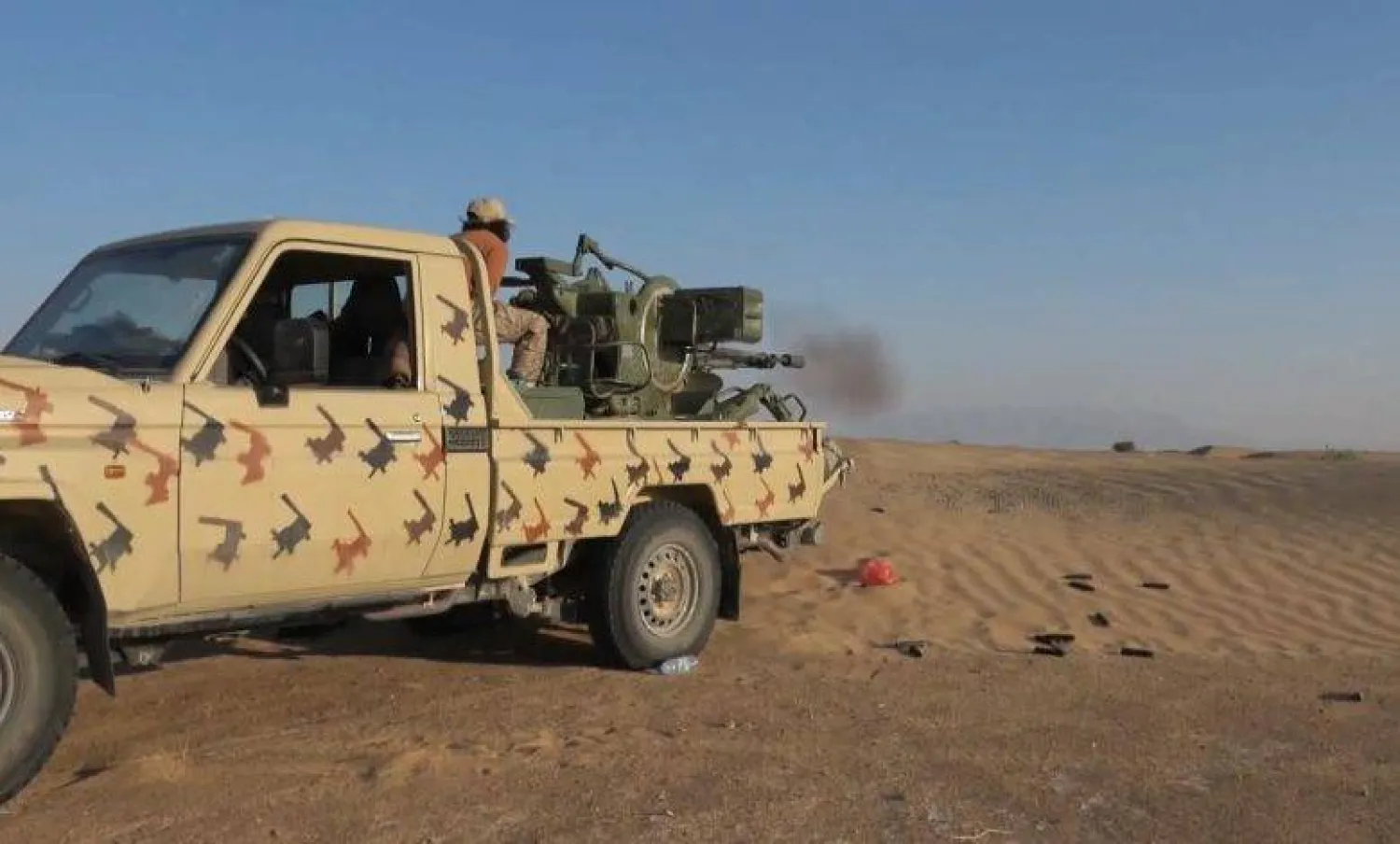

Yemen Forces Keep Up Efforts to Eliminate Remaining Houthis from Bab al-Mandeb

The military sources said 100 Houthi members were killed and 190 wounded during fighting on Saturday. (Military media)
TT

Yemen Forces Keep Up Efforts to Eliminate Remaining Houthis from Bab al-Mandeb

The military sources said 100 Houthi members were killed and 190 wounded during fighting on Saturday. (Military media)

Yemeni government forces continue to confront attacks by the Iran-backed Houthi group, aiming to deplete its capabilities on the Taiz fronts.

Meanwhile, offensive operations kicked off on Sunday, pressing to clear the group's remaining forces in Bab al-Mandeb, while airstrikes and ground clashes extended to Lahj, Marib, and Al-Jawf as Operation Dawn of Yemen entered its 14th day.

In Taiz, government forces, supported by the Popular Resistance, thwarted attacks by the group in the vicinity of the city, including the western and southern fronts, inflicting human and material losses upon them, according to Yemeni military statements.

The group destroyed a bridge in the Haigat al-Abd area on the road connecting Taiz, Lahj, and Aden, a move that increases movement and supply difficulties in a governorate that has suffered from a siege for years.

On the Bab al-Mandeb front, government forces continued their operations to clear Houthi pockets fortified behind hills, trenches, and minefields.

Field sources said that the group lost dozens of members, while thwarting attacks on the Al-Waziyah toward the Kahbub mountains.

Military media reported that government forces thwarted a broad attack launched by the group west of the city of Taiz, following hours of clashes, forcing them to retreat. They were also able to repel another attack on the Al-Shaqab front, located at the southern entrance to the city.

The military sources said 100 Houthi members were killed and 190 wounded during fighting on Saturday.

Warplanes launched airstrikes targeting Houthi positions and gatherings in the vicinity of Jabal Han west of the city, and areas to the south and on the northwestern front, according to the same sources.

Bab al-Mandeb

Meanwhile, as part of Operation Dawn of Yemen, the Yemeni Armed Forces announced the execution of 1,417 precise and direct targeting operations during the past 24 hours using warplanes, drones, artillery, and rocket launchers against Houthi gatherings, reinforcements, fortified positions, vehicles, and firing sources.

Official spokesperson for the Armed Forces Majed al-Nuzaili said the operations have helped disrupt the group's movements and prevent them from deploying their reserves to the fronts or achieving tactical objectives.

He noted that around 800 militants were killed and wounded, and more than 190 armored vehicles, combat trucks, and transport and supply vehicles were destroyed or damaged.

Army units on the eastern front successfully cleared hostile positions, expanded their control, and seized a new tactical field position, while forces in Taiz continued to confront ongoing attacks alongside airstrikes targeting group positions and reinforcements.

On the Bab al-Mandeb front, government forces are focusing on completing the clearing of positions where the group is still fortified behind small hills, trenches, and minefields, amid ongoing clashes in Al-Waziyah toward the Kahbub mountains.

The nature of the area, including its rugged terrain and mined locations, poses challenges to the advancement and clearing operations.

This front has strategic importance due to its proximity to the Bab al-Mandeb Strait, one of the vital corridors for international navigation, making the securing of surrounding positions and routes an essential part of efforts to consolidate military gains and prevent the group from reclaiming its positions.



US Officials Visit Palestinian Village After Settler Attacks on Diplomats

 US Assistant Secretary of State for Democracy, Human Rights and Labor Riley Barnes visits the Christian Palestinian village of Taybeh near Ramallah, a day after Israeli militant settlers attacked a French mayor and European diplomats during olive harvest, in the Israeli-occupied West Bank, October 18, 2026. (Reuters)
US Assistant Secretary of State for Democracy, Human Rights and Labor Riley Barnes visits the Christian Palestinian village of Taybeh near Ramallah, a day after Israeli militant settlers attacked a French mayor and European diplomats during olive harvest, in the Israeli-occupied West Bank, October 18, 2026. (Reuters)
TT

US Officials Visit Palestinian Village After Settler Attacks on Diplomats

 US Assistant Secretary of State for Democracy, Human Rights and Labor Riley Barnes visits the Christian Palestinian village of Taybeh near Ramallah, a day after Israeli militant settlers attacked a French mayor and European diplomats during olive harvest, in the Israeli-occupied West Bank, October 18, 2026. (Reuters)
US Assistant Secretary of State for Democracy, Human Rights and Labor Riley Barnes visits the Christian Palestinian village of Taybeh near Ramallah, a day after Israeli militant settlers attacked a French mayor and European diplomats during olive harvest, in the Israeli-occupied West Bank, October 18, 2026. (Reuters)

US diplomats visited a Christian Palestinian town in the Israeli-occupied West Bank on Sunday following attacks by militant Israeli settlers on European diplomats and an American photojournalist in the previous two days.

Riley Barnes, assistant secretary of state for democracy, human rights and labor, Brian Burch, US ambassador to the Holy See, and a number of other diplomats visited the Latin Convent church and were expected to meet with members of the Christian community in Taybeh.

Belgian, French and Polish diplomats, along with a French mayor and Palestinian civilians, had been attacked near Taybeh on Saturday by masked Israeli settlers.

The previous day, ‌Washington Post photojournalist ‌Heidi Levine was taken to hospital after being assaulted ‌while covering ⁠a Palestinian olive ⁠harvest near another West Bank village.

The diplomats' visit coincided with US President Donald Trump endorsing his ally, Prime Minister Benjamin Netanyahu, for Israel's parliamentary election on October 27.

NETANYAHU CIRCUMSPECT ON SETTLER VIOLENCE

Trump has this year expressed his opposition to settlement expansion, but his administration has put little pressure on Netanyahu's right-wing, pro-settler government to change its policy.

UN bodies and most countries deem the settlements ⁠illegal under international law, but Israel rejects this, viewing ‌the territory as disputed rather than occupied.

While ‌Foreign Minister Gideon Saar and the Israeli military both blamed "Israeli rioters" for the ‌attack on the diplomats, Netanyahu, whose coalition is projected to lose ‌its governing majority, has been more circumspect.

He has said the diplomats entered a "sensitive area with a history of confrontations without prior coordination with the Israeli army", and that the facts of the attack on Levine are "unclear".

France urged Israeli authorities to arrest Saturday's attackers ‌and to end criminal violence in the West Bank, but by Sunday there was no announcement from Israeli ⁠authorities of ⁠any arrests in either of the two latest incidents.

The West Bank is home to some 500,000 settlers and at least 3 million Palestinians.

Settler attacks on the Palestinians are surging, with at least 170 since September 27, according to Yesh Din, an Israeli human rights group. Journalists, activists and foreign observers have also been targeted.

Yet prosecutions of Israeli settlers are rare.

On Sunday, Reuters saw a group of at least 10 settlers, masked and dressed in black, hurling rocks at Palestinians and activists harvesting olives near the Palestinian West Bank town of Salfit, prompting the farmers to flee.

Israeli border police were in the area and shot tear gas towards the hills.


Yemen Forces Keep Up Efforts to Eliminate Remaining Houthis from Bab al-Mandeb

The military sources said 100 Houthi members were killed and 190 wounded during fighting on Saturday. (Military media)
TT

Yemen Forces Keep Up Efforts to Eliminate Remaining Houthis from Bab al-Mandeb

The military sources said 100 Houthi members were killed and 190 wounded during fighting on Saturday. (Military media)

Yemeni government forces continue to confront attacks by the Iran-backed Houthi group, aiming to deplete its capabilities on the Taiz fronts.

Meanwhile, offensive operations kicked off on Sunday, pressing to clear the group's remaining forces in Bab al-Mandeb, while airstrikes and ground clashes extended to Lahj, Marib, and Al-Jawf as Operation Dawn of Yemen entered its 14th day.

In Taiz, government forces, supported by the Popular Resistance, thwarted attacks by the group in the vicinity of the city, including the western and southern fronts, inflicting human and material losses upon them, according to Yemeni military statements.

The group destroyed a bridge in the Haigat al-Abd area on the road connecting Taiz, Lahj, and Aden, a move that increases movement and supply difficulties in a governorate that has suffered from a siege for years.

On the Bab al-Mandeb front, government forces continued their operations to clear Houthi pockets fortified behind hills, trenches, and minefields.

Field sources said that the group lost dozens of members, while thwarting attacks on the Al-Waziyah toward the Kahbub mountains.

Military media reported that government forces thwarted a broad attack launched by the group west of the city of Taiz, following hours of clashes, forcing them to retreat. They were also able to repel another attack on the Al-Shaqab front, located at the southern entrance to the city.

The military sources said 100 Houthi members were killed and 190 wounded during fighting on Saturday.

Warplanes launched airstrikes targeting Houthi positions and gatherings in the vicinity of Jabal Han west of the city, and areas to the south and on the northwestern front, according to the same sources.

Bab al-Mandeb

Meanwhile, as part of Operation Dawn of Yemen, the Yemeni Armed Forces announced the execution of 1,417 precise and direct targeting operations during the past 24 hours using warplanes, drones, artillery, and rocket launchers against Houthi gatherings, reinforcements, fortified positions, vehicles, and firing sources.

Official spokesperson for the Armed Forces Majed al-Nuzaili said the operations have helped disrupt the group's movements and prevent them from deploying their reserves to the fronts or achieving tactical objectives.

He noted that around 800 militants were killed and wounded, and more than 190 armored vehicles, combat trucks, and transport and supply vehicles were destroyed or damaged.

Army units on the eastern front successfully cleared hostile positions, expanded their control, and seized a new tactical field position, while forces in Taiz continued to confront ongoing attacks alongside airstrikes targeting group positions and reinforcements.

On the Bab al-Mandeb front, government forces are focusing on completing the clearing of positions where the group is still fortified behind small hills, trenches, and minefields, amid ongoing clashes in Al-Waziyah toward the Kahbub mountains.

The nature of the area, including its rugged terrain and mined locations, poses challenges to the advancement and clearing operations.

This front has strategic importance due to its proximity to the Bab al-Mandeb Strait, one of the vital corridors for international navigation, making the securing of surrounding positions and routes an essential part of efforts to consolidate military gains and prevent the group from reclaiming its positions.


Israeli Fire Isolates Lebanese Villages Beyond 'Yellow Line'

An Israeli army vehicle operates in East Zawtar, as seen from West Zawtar, southern Lebanon, October 1, 2026. REUTERS/Mohamed Azakir
TT

Israeli Fire Isolates Lebanese Villages Beyond 'Yellow Line'

An Israeli army vehicle operates in East Zawtar, as seen from West Zawtar, southern Lebanon, October 1, 2026. REUTERS/Mohamed Azakir

Residents of border villages in southern Lebanon face growing risks as Israeli forces continue firing at village entrances and surrounding roads, raising fears that entire communities could become effectively isolated without their access routes being formally closed or Israeli troops being stationed inside them.

The repercussions extend beyond daily travel, affecting residents' ability to reach their farmland and medical facilities amid continued Israeli military movements and aerial surveillance.

Lebanese President Joseph Aoun discussed the issue with US Secretary of State Marco Rubio during a telephone call on Thursday evening.

Last week, Israeli forces prevented residents of Kfar Shouba from reaching their fields on Thursday. Two days earlier, Israeli gunfire had swept the Marjayoun-Ebel El Saqi road, coinciding with shelling on the outskirts of Haris and Baraachit and gunfire directed toward the entrances of Mansouri.

Controlling Access Through Firepower to Prevent Residents' Return

Retired Brig. Gen. Dr. Hisham Jaber told Asharq Al-Awsat that Israel had learned from its previous military experiences and was therefore seeking a different approach.

"Israel does not want to occupy the southern villages beyond the Yellow Line and station its forces inside them this time. Instead, it seeks to occupy strategic positions overlooking those villages, allowing it to control surrounding areas from a distance while avoiding the risks its troops would face if they entered the villages," he said.

Jaber explained that Israel's current tactics rely on controlling main and secondary roads connecting the villages through firepower deployed from Israeli military positions, alongside continuous aerial surveillance using drones.

"Israeli drones constantly monitor movements, and whenever they detect activity on a road, the types of vehicles involved are examined," he said.

"Some vehicles may be targeted simply because they arouse suspicion. Motorcycles, for example, are frequently targeted, while other vehicles, such as vans, may also be at risk depending on their movements and Israeli suspicions."

Jaber warned that roads connecting border villages would become dangerous even without a direct Israeli military occupation.

Indeed, several roads have become so dangerous and isolated that they are effectively impassable, despite not being under direct occupation.

These include the Nabatieh-Marjayoun road through Khardali, where vehicles can no longer pass, as well as roads around Nabatieh al-Fawqa, Kfar Tebnit and the outskirts of Kfar Rumman.

The restrictions stem from artillery shelling, intense sweeping gunfire, and strikes carried out by artillery and drones.

On October 2, a delegation from the Deir Mimas municipality met President Joseph Aoun and requested guarantees that roads leading to the village would remain open, essential services would be maintained, and farmers would be able to reach their land for the olive harvest.

Artillery Shelling to Deter Residents from Returning

Assessing the continued Israeli shelling of southern villages, Jaber said such attacks do not necessarily signal a new military escalation each time they occur.

"Israel already maintains a continuous level of attacks and repeatedly uses artillery to strike specific areas and villages," he said.

He explained that intermittent artillery shelling of villages, including Kfar Rumman, serves a political and security objective: preventing residents from returning to their homes, stopping communities from reestablishing themselves and deterring any activity Israel might perceive as a threat to its forces.

"Israel does not need to conduct large-scale ground operations to achieve this objective. It can keep villages under pressure through occasional artillery shelling, discouraging residents from returning and making normal life difficult," he said.

Retired Brig. Gen. Said Kazah, meanwhile, told Asharq Al-Awsat that roads linking southern Lebanon's border villages, as well as areas under Israeli occupation or facing Israeli military positions, remain unsafe because of continued military movements and gunfire.

He warned that it was impossible to know the intentions of Israeli forces or the nature of the operations they might undertake.

"The danger is not limited to the roads. It also extends to residents who continue to remain in their border villages," he said.

Border Roads and Villages Remain Unsafe

Kazah explained that the presence of a foreign army occupying territory leaves roads and surrounding areas under constant threat.

"When a foreign army occupies territory, all roads and areas within or facing the occupied zone remain vulnerable because we cannot know the intentions of the occupying forces or the operations they may be planning," he said.

"As a result, the presence of civilians in southern villages remains fraught with danger."

He added that wars invariably involve collateral damage resulting from gunfire, a possibility taken into account when military operations are planned.

This, he said, helps explain the risks faced by civilians living in or near areas where military operations are taking place.

"Border roads are not entirely safe. All border areas under Israeli occupation, and even those facing them, remain exposed to danger, whether from direct military operations or bullets that may reach them during exchanges of fire," Kazah said.

"This makes both civilian movement and residence in these areas subject to constant risks."

Fears that villages could become isolated are grounded in previous incidents.

In March, Israeli shelling disrupted traffic along the Khardali road and the Marjayoun-Hasbaya route before both were reopened.

On June 4, the Lebanese Army announced the reopening of the Marjayoun-Dibbin-Ebel El Saqi road after removing Israeli earth barriers.

At the time, however, the army warned civilians against approaching the area until troop deployments were completed and checks for unexploded ordnance had been carried out.